What Is Sales Enablement? The Definition Most Teams Get Backwards
Most definitions of sales enablement list the inputs: content, training, tools. That is the 1.0 definition, and it measures the wrong thing. Sales enablement is whether reps do the right behavior, deal by deal, an output.
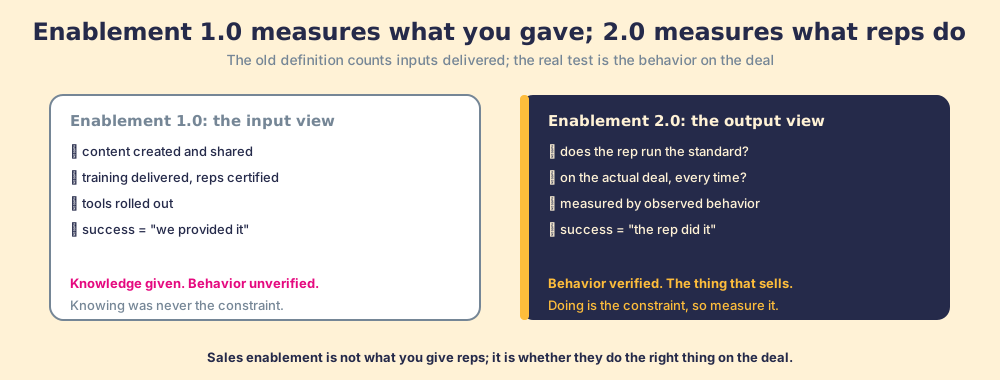
Sales enablement is the practice of getting reps to consistently perform the behaviors that win deals, measured as an output (does the rep do the standard) rather than an input (what content and training was provided), because knowing was never the constraint, doing is.
Ask ten sales leaders what sales enablement is and most will answer with a list of things they provide: content, training, playbooks, tools, a portal. That answer is the entire problem. It defines enablement by its inputs, what gets delivered to reps, and measures success by whether those inputs were produced and distributed. But producing content and delivering training tells you nothing about whether a single rep does anything differently on a real deal. The input definition lets a team feel enabled while changing no behavior at all, which is how organizations spend enormous sums on enablement and watch performance stay flat. Sales enablement defined as inputs is a budget line. Defined as an output, it is the thing that moves the number.
Sales enablement is the practice of getting reps to consistently perform the behaviors that win deals, measured as an output (does the rep do the standard) rather than an input (what content and training was provided), because knowing was never the constraint, doing is. Define it by the behavior, and enablement finally points at the right target.
It helps to picture two warehouses. In the first, a manager walks you down the aisles and shows you the shelves: decks here, battle cards there, a fresh certification module, an onboarding track, a content portal with a search bar. The shelves are full, and the manager is proud, and you leave impressed. In the second warehouse there are no shelves to admire. There is a loading dock, and a clipboard, and a single question written at the top: did the truck leave with the right thing inside it, and did it arrive? The first warehouse measures what it holds. The second measures what it moved. Most sales enablement definition language describes the first warehouse. The number is decided in the second.
Where did the input definition of sales enablement come from?
It is worth knowing the history, because the input view was not stupid; it was correct for its moment and has simply outlived it. The term “sales enablement” entered common use in the mid-2000s, and the founding problem was real: reps genuinely could not find the right material. Marketing produced decks the field never used, the latest pricing sheet lived in someone’s inbox, and a rep walking into a meeting often had the wrong, stale version of everything. So the first generation of the discipline, and the first generation of platforms, organized around findability and delivery. Forrester’s widely cited definition still carries that DNA, framing enablement as a strategic process that equips client-facing roles with the content, training, and coaching they need. Notice the verb: equip. It describes what you hand the rep. It says nothing about what the rep then does.
That was the right frame in 2008, when the content really was missing. It is the wrong frame now, because the missing content got found. Every meaningful sales enablement meaning that survives into 2026 has to reckon with a world where the constraint moved, and most of the popular definitions have not. They still describe the act of equipping, and they still let a team declare victory at the loading dock, before the truck has gone anywhere.
Why is the input definition of sales enablement wrong?
Because it measures what you gave reps, not what reps do, and only the second one matters. The traditional, input-based view, call it Enablement 1.0, counts content created, training delivered, tools rolled out, and declares success when those inputs exist. But every one of those is an input to behavior, not behavior itself. A rep can receive the content, complete the training, and have the tool, and still skip the discovery, mis-qualify the deal, and forget the play. The inputs were delivered; the behavior never changed; and the input definition cannot even see the failure, because it stopped measuring at delivery.
You might object that this is unfair, that good enablement teams already know inputs are not the point and care about outcomes. Granted, the best ones do. But look at what the function actually reports on at the quarterly business review, and the input view reasserts itself every time: assets shipped, courses completed, certification rates, portal logins, content “influenced” pipeline. Those are the numbers that survive contact with a budget meeting, because they are easy to count and they always go up. The behavior numbers, the ones that say whether reps run the standard, are harder to gather and sometimes embarrassing, so they fall off the slide. The definition you measure by is the definition you hold in practice, whatever the strategy deck says.
This matters more in 2026 than it ever has, because knowing is now effectively solved. Each rep has the playbook, the training library, and an AI assistant that can explain any methodology on demand. If knowledge were the constraint on sales performance, performance would be soaring. It is not. CSO Insights, the research group now inside Korn Ferry, spent years tracking quota attainment and watched it slide even as enablement budgets and content volume climbed, with the share of reps making quota falling well below 60 percent across their studies (Korn Ferry). More inputs, flatter results. That is the signature of a constraint that has moved, exactly the knowing-doing gap that Stanford’s Jeffrey Pfeffer and Robert Sutton found at the root of organizational underperformance (Pfeffer and Sutton, The Knowing-Doing Gap). Their core finding, drawn from years of studying why companies fail to act on what they already know, was blunt: “Knowing what to do is not enough.” An enablement function that keeps measuring inputs is solving a problem the world already solved, while the real problem, getting reps to do what they already know, goes unaddressed.
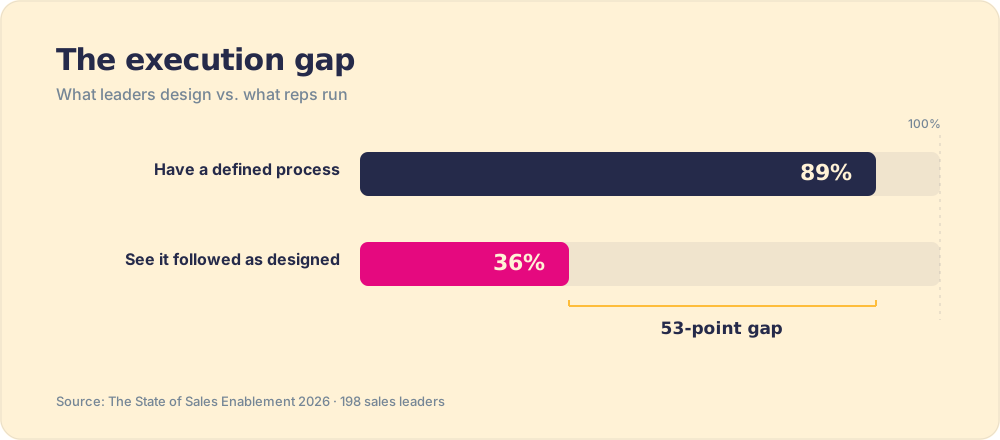
Our own field research puts a number on how wide that gap runs. Across 198 sales leaders, 89 percent said they have a defined sales process and only 36 percent said their reps actually follow it (The State of Sales Enablement). That 53-point gap is not a knowledge gap. Every one of those teams knows what good looks like; they wrote it down. The failure is entirely on the doing side, which is precisely the side the input definition cannot see.
What does sales enablement include?
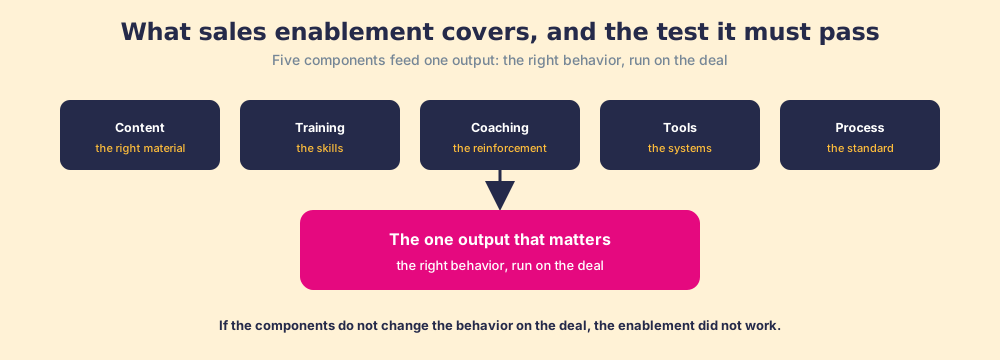
The familiar components, content, training, coaching, tools, and process, but pointed at a single output rather than treated as ends in themselves. Each component matters, and each is a means. Content gives reps the right material; training builds the skills; coaching reinforces them; tools provide the systems; process defines the standard. But the components are not the definition of enablement, because you can have all five in abundance and still fail. The test of whether they worked is one question: did the right behavior get run on real deals? If the content, training, and tools did not change what the rep does, the enablement did not happen, however much was delivered.
This is the shift that separates effective enablement from expensive enablement. The components are necessary, and the output is the point, which connects directly to how you evaluate sales enablement software: not by what it delivers to reps, but by whether it changes what reps do.
- The components are means, not ends. Content, training, coaching, tools, and process all exist to produce behavior, not to be counted as accomplishments.
- The output is the test. The right behavior, run on real deals. If the components do not produce it, they did not work.
- Measure the behavior, not the delivery. Enablement is verified by what reps do, not by what was provided to them.
There is a temptation, when the input view starts to feel thin, to fix it by renaming the function. The industry did exactly this, rebranding “sales enablement” as “revenue enablement” to signal a wider remit across the whole revenue team. The instinct is right, the boundaries of the old job were too narrow, but a rename is not a redefinition. If revenue enablement still counts content shipped and courses completed, it has changed the scope of the input view without changing the view, and it will produce the same flat results across a larger surface. We take apart that distinction in revenue enablement. The fix was never a bigger title. It was a different unit of measure.
How should you define sales enablement for your team?
When you define sales enablement for your own team, define it as the practice of producing consistent winning behavior, and measure it as an output. The practical consequence of the right definition is that your enablement function changes what it tracks: from content produced and training completed, to whether reps run the standard on a real deal. That means naming the behaviors that win, equipping them in the flow of work, and measuring whether they happen, which is the loop in sales process adoption. Defined this way, enablement stops being a content factory and becomes a behavior-change function, responsible not for what reps were given but for what they do. That is a harder mandate, and it is the only one that correlates with results, because the inputs were never the thing buyers responded to. The behavior was.
The mechanism behind why this works is the same one Pfeffer and Sutton named. Knowledge converts into behavior only under specific conditions: when the standard is present at the moment of action, when it is low-friction to follow, and when someone can see whether it happened. Strip those conditions away, hand a rep a binder, and the knowing-doing gap opens by default, not by laziness. The reason an output definition matters is that it forces a function to build those conditions instead of building more binders. You cannot manage to an output you do not measure, and you cannot measure behavior you only delivered content about.
What we recommend
Define sales enablement by its output, not its inputs, because the input definition is exactly why so much enablement spend produces so little. Content created, training delivered, and tools rolled out measure what you gave reps, and giving reps knowledge was never the constraint, since in 2026 every rep already has more knowledge than they use. The constraint is doing: whether the rep runs the right behavior on the actual work. So treat the components, content, training, coaching, tools, process, as means to that one end, and measure enablement by the behavior reps perform, not the inputs they received. The reason this reframing matters is that it points your entire enablement function at the thing that moves the number, the behavior on real deals, instead of the thing that merely fills a portal. Sales enablement is not what you provide. It is whether the rep does the right thing when it counts.
From here: the gap it must close in the knowing-doing gap, the tooling judged by behavior in sales enablement software, the adherence loop in sales process adoption, and the management discipline in sales performance management.
Frequently asked questions
What is sales enablement?+
What does sales enablement include?+
What is the difference between sales enablement and sales training?+
Why is sales enablement an output, not an input?+
Your process, running itself.