Customer Enablement: The Academy Is the Easy Half
Customer enablement programs ship an academy and a knowledge base, then wonder why adoption stalls. The unsolved job is behavior inside the tool at the moment of work, and that is what decides the renewal.
Customer enablement is the work of making a customer's people able to get the value they bought, through onboarding, education, and guidance, and it succeeds only when their behavior changes inside the product at the moment of work.
The implementation wraps on a good note. The pipeline stages are rebuilt, the fields make sense, the client’s team sat through two training sessions and got logins to the academy, and the knowledge base link is pinned in their Slack. The go-live call ends with thanks all round. A month later, the client’s sales manager opens the CRM to run a forecast and finds half the deals still living in the spreadsheet the new system was built to replace. The team refused nothing. They reached for the old switch.
That scene is what customer enablement is for, and it is where the category’s standard answer runs out. The pages that rank for customer enablement, Gainsight, Zendesk, Skilljar, Highspot, describe a program of tools, training, and resources: an academy, a knowledge base, a certification, a community. All of it is useful. None of it is in the room when the rep decides where to log the deal. Knowledge is solved. Behavior at the moment of work is the unsolved half, and it is the half that decides whether the customer renews.
What is customer enablement?
Customer enablement is the work of making a customer’s people able to get the value they bought. The word that matters there is people. In B2B the customer is rarely one user clicking through a tour; it is a team, with a manager, a process, and habits that predate your product by years.
The field’s definitions are close to right, and one of them is better than the rest. Zendesk says customer enablement “provides buyers with the tools, training, and resources they need to successfully use your products or services” (Zendesk). Gainsight goes further: it is “the coordinated effort that helps customers build the skills, confidence, and habits to get lasting value from your product” (Gainsight). We agree with Gainsight, and we want to lean hard on its last noun. A skill can be taught in a classroom. A habit cannot. Habits form where the work happens, repeated at the moment of doing, and that single fact reorganizes everything else about how a program should be built.
So when someone asks what is customer enablement, the short answer is capability, and the longer answer is capability that shows up as changed behavior inside the tool. A customer who passed the certification and still works in the spreadsheet has been educated. They have not been enabled.
How is customer enablement different from customer success, onboarding, and education?
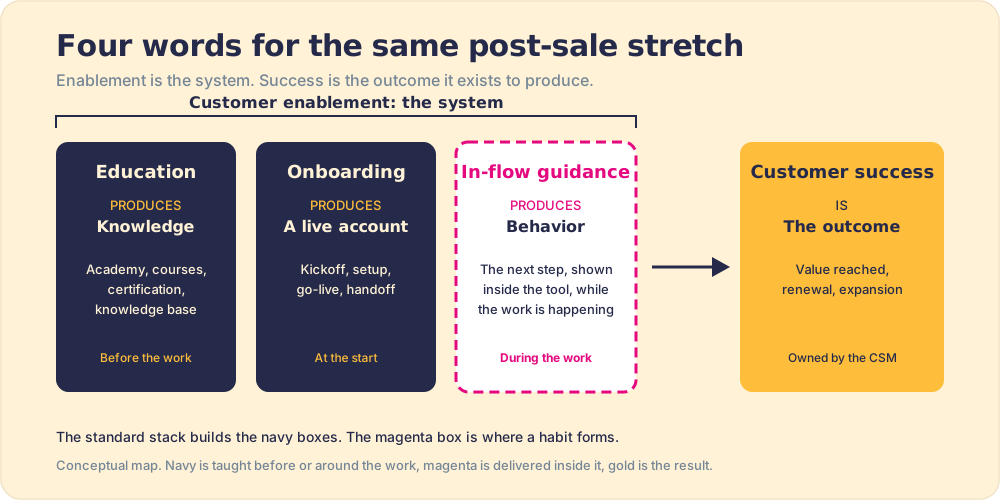
Four words describe the same post-sale stretch. Sort them by what each one produces and the confusion clears.
- Customer education. The academy, courses, certifications, and knowledge base. It produces knowledge, and it happens before the work or beside it in another tab.
- Customer onboarding. The kickoff, setup, go-live, and handoff that bring an account live. It produces a configured, launched account, and it happens at the start.
- In-flow guidance. The next step, shown inside the tool while the work is happening. It produces behavior, and it is the piece the standard definitions mention least.
- Customer success. The outcome: value reached, renewal, expansion. Usually owned by a customer success manager, and fed by the three above. Expansion runs on timing: cross-sell emails sent when a usage or support signal fires put the offer in front of the customer while the need is live.
Gainsight draws the same line between the last two: enablement is the system, success is the outcome (Gainsight). The sharpening we add is inside the system. Education and onboarding hand the customer knowledge and a working account. Only guidance delivered in the flow of work produces the habit, and a program without it is a system missing its last gear.
Why do customer enablement programs stall after the academy launches?
Because the academy teaches at one moment and the customer works at another, and memory does not survive the gap. Hermann Ebbinghaus measured this in the 1880s, and a 2015 replication of his forgetting curve found that relearning material one day later saved only 32% of the original effort, and 4% after a month (Murre and Dros, PLOS ONE, 2015). A customer who watched the onboarding webinar in week one meets the real decision in week five, with a buyer waiting and three tabs open. By then the webinar is a faint outline.
Take a new driver. You can hand them the owner’s manual, and it is a good manual, with a clear page on merging onto the highway. It sits in the glovebox. When the merge comes, with a truck in the right lane and the ramp running out, the glovebox stays shut. Now put a driving instructor in the passenger seat who says one sentence, “check the mirror, then merge,” at the second it matters. Same knowledge. Different timing. The second driver learns to merge; the first one learns to be nervous on ramps.
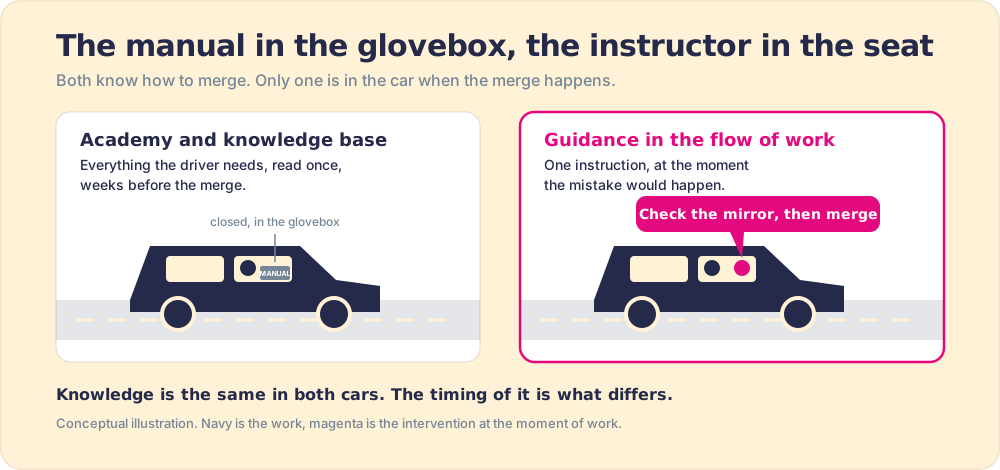
Instructors do not ride along forever, and the goal of guidance is a driver who no longer needs it. Delivering it at the merge serves that goal: repetition in the moment is how the habit forms, so the guidance works itself out of a job. The usual fallback is a human instructor on a video call, and it does not scale. A RevOps manager at an e-commerce services agency told us on a call, “I want them to get that assistance without having to hop on a three-hour long call with me telling them, ‘Move your pointer a little bit more to the right, a little bit more. You see that button? A little bit more.’ That’s how my conversations have been.”
The evidence for the cost of the glovebox model is plain. Pendo’s analysis of product usage found that 80% of features in the average software product are rarely or never used, which it estimated as up to $29.5 billion of development spend by public cloud companies (Pendo, 2019 Feature Adoption Report). Knowing a feature exists and reaching for it at the right moment are different acts, and the gap between them is where the money went. And the damage reaches beyond software: in Wyzowl’s early-2020 survey of 216 people, 55% said they had returned a product because they did not fully understand how to use it (Wyzowl).
Our own research points the same way from the seller’s side of the table. In the State of Sales Enablement, a survey of 198 sales leaders, teams whose process lived inside the CRM workflow hit quota at 49%, while teams whose process lived in a doc, wiki, LMS, or recorded video hit it at 15%. Those respondents lead sales teams, and the variable carries over to a customer’s team: where the process lives when the work happens. An academy is an LMS with a friendlier name.
What does a customer enablement program contain?
A complete customer enablement program has six layers, and the first four are familiar. Skilljar, now part of Gainsight after its acquisition in April 2025 (Gainsight), maps eleven tool categories across the space, from video hosting to certification to feedback (Skilljar). Collapse them by job and you get this.
- An onboarding plan and kickoff. The phases, owners, and exit criteria that take an account from signed to live. We cover how to design one backward from first value in the client onboarding process.
- An academy and certification. Structured courses that build baseline skill, with a credential for the people who finish.
- A knowledge base and self-serve help. Articles and answers the customer can search. In 2026, AI makes this layer nearly free to produce and instant to query.
- Community, webinars, and office hours. Peer learning and live help for the questions the articles miss.
- Guidance in the flow of work. The customer’s process, shown inside the tool at the step where it applies, so the right action is the easy one while the work is in motion.
- Measurement. Time to value, adoption measured as behavior, and expansion, covered below.
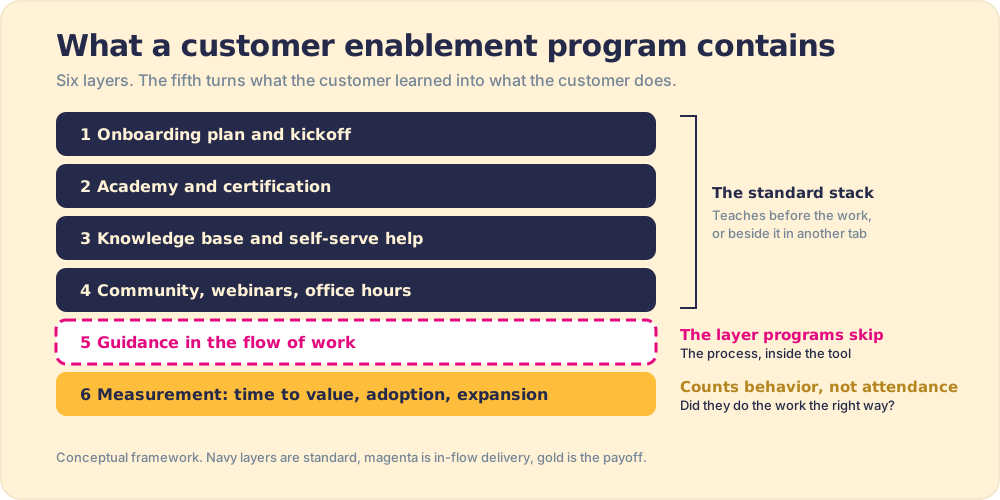
The standard definitions list the fifth layer last or leave it out. That is backward, because it is the layer that turns the other four into a changed workday.
How do you build a customer enablement strategy?
Start from the moment of value and work backward. A customer enablement strategy that starts from content ends with a library. One that starts from behavior ends with a customer who does the work differently. Gartner’s research on what it calls value enhancement gives a useful spine: service interactions that anticipate customer needs, help customers reach their goals, and educate them on better uses of what they bought. In that research, 82% of customers who rated interactions high on value enhancement stayed, 85% bought more, and 97% recommended the supplier (Brent Adamson, Gartner, via destinationCRM, 2020). Anticipating a need is a timing act. You cannot do it from a course catalog.
The strategy, in five parts:
- A definition of first value. The specific result the customer bought, stated so both sides could verify it, such as “the team runs its weekly forecast from the CRM.”
- The handful of moments that decide it. The four or five places in the work where a customer either does the new thing or falls back to the old one. Logging a deal, advancing a stage, handing off to delivery.
- Guidance placed at those moments. One instruction, inside the tool, at the step where it applies: the instructor in the seat.
- One owner per account. A named person accountable for the customer reaching first value, with authority to fix the system when the customer stalls.
- A measurement loop. Behavior on real work, checked early enough to act. You can only expect what you inspect.
The list blames no one. When a customer’s team keeps using the spreadsheet, the easy diagnosis is that the people are the problem. They are not. The spreadsheet is closer, faster, and familiar, and the new process lives somewhere they have to remember to go. It is a design failure, and it is fixable by design, which we trace in detail in user adoption.
What changes when the customer is a client your firm brings live?
For a services firm or implementation partner, customer enablement has a twist: the product is often someone else’s software, configured by you, run by a client team you do not manage. A HubSpot partner rebuilds a client’s pipeline, the work is excellent, and then the consultants roll off, leaving the client’s team with a system shaped around habits they have not formed yet. At RevPartners, the HubSpot partner I started before Supered, we built our pitch around that moment:
From the field
Our frame was, your CRM is a product, and you need to treat it like that. If you do your CRM as a project, you’re choosing to fail. So we’re going to come in and ensure that it’s a product. We’re gonna optimize for adoption and usage. Your reps must use your CRM when you leave.
This is client onboarding, and it is a different animal from user onboarding. User onboarding activates one person inside a product, the welcome tour and the first click, the job Appcues and Userpilot are built for. Client onboarding is a team bringing a whole organization live on a new process, where the first 90 days decide the renewal. We draw that line in client onboarding, and it matters here because a product tour cannot teach a sales team a new stage definition. It can point at a button. It cannot tell a rep what “qualified” means at this company, at the moment they are deciding whether a deal is.
An electrician rewires a house, moves the switch a foot to the left, and walks the family through it on the last day. A month later, in the dark, a hand reaches for the old spot on the wall. What fixes it is a small cue on the new switch, where the hand arrives.
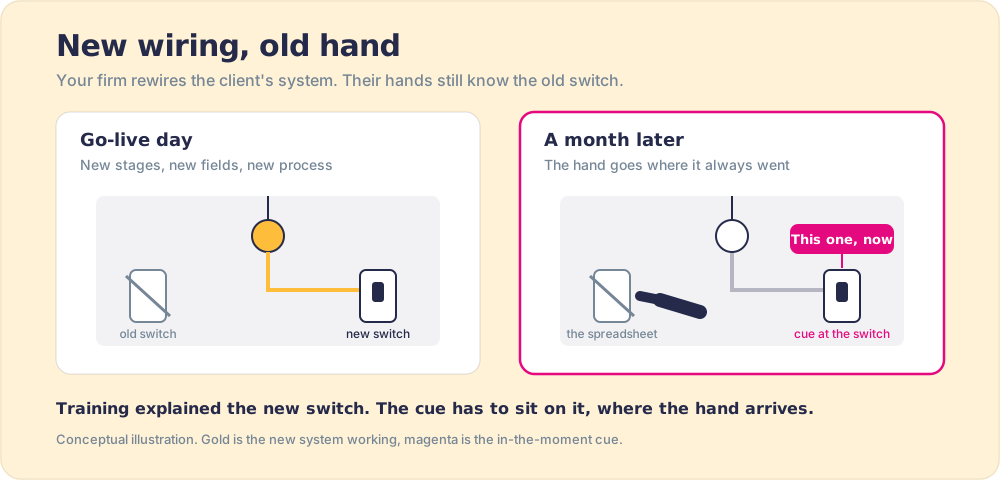
Onboarding teams feel this as a chasing problem. In Rocketlane’s survey of about 290 onboarding and implementation practitioners, 74.7% named ensuring customer accountability as one of their most challenging tasks, and 76% spent more than two hours a week on follow-ups and reminders (Rocketlane, 2023). Those follow-ups are the electrician phoning every evening to ask which switch they used, and they stop the day the project closes. The durable version installs the process inside the client’s CRM, where the client’s people work, and measures whether they ran it. That is also why a client onboarding plan stored in a project tool is only the easy half, a case we make in client onboarding software.
How do you measure customer enablement?
Measure a chain, in order, because each link comes before the next. Attendance is easy to count: courses completed, articles viewed, logins. It tells you content was consumed, and nothing about whether anything changed.
- Time to value. Days from signature to the first result the customer bought. It is already the standard: 50.3% of companies in Rocketlane’s 2023 survey used time to value as a key KPI for onboarding teams, and 78% said they needed to shorten it (Rocketlane).
- Adoption as behavior. The work done the right way, in the tool, on real accounts. Logins count the people who opened the door; behavior counts the ones who did the job. With 80% of features rarely or never used (Pendo), usage alone flatters. We lay out this ladder, access to usage to proficiency to behavior, in digital adoption.
- Renewal and expansion. The outcome the system exists for. Gartner’s value enhancement data (82% stayed, 85% bought more) ties capability to revenue, and Frederick Reichheld’s work at Bain found that raising retention by 5% lifts profits by 25% to 95% (HBR).
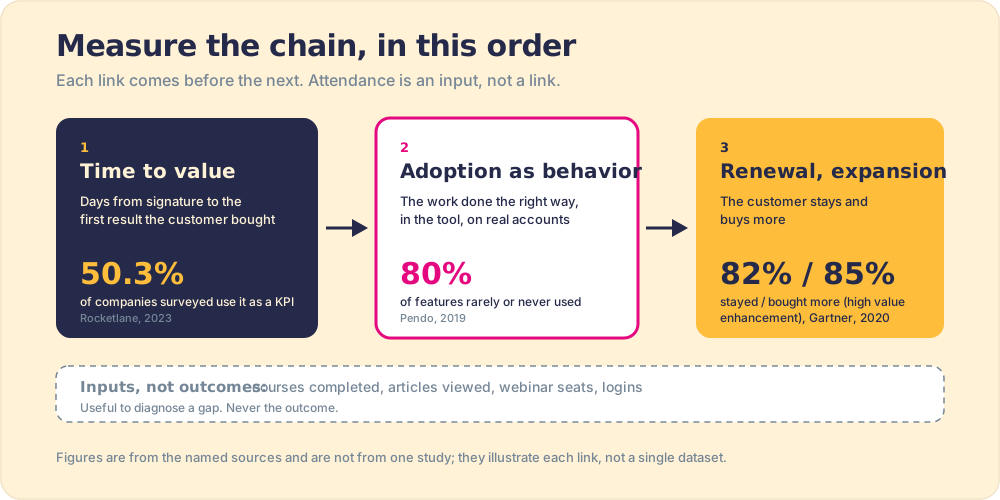
The middle link is the one to instrument first. Time to value tells you when a customer arrived, and renewal tells you, months late, whether they stayed. Behavior on real work tells you, while there is still time to act, which of the two is coming.
What we recommend
Put the customer’s process inside the tool at the moment of work, measure whether their team ran it, and keep the academy lean underneath. Habits form at the moment of doing, the medium of delivery drove the largest effect in our own data (49% against 15%), and value enhancement pays off because it anticipates the need instead of documenting it. Skipping this step has a visible price: 76% of the onboarding practitioners Rocketlane surveyed spend more than two hours a week on follow-ups and reminders, and that chasing stops the day the project closes.
More content is still the right call when a customer does not know what the product can do, which in 2026 is the rarer case, because any customer can ask an AI assistant how a feature works. More CSMs and consultants help during a launch, as long as you plan for the day they roll off.
For teams whose customers or clients work in HubSpot or Salesforce, Supered is one way to do that. It is the Behavior Layer: it surfaces the process, guidance and action plans, inside the CRM at the step where it applies, and measures whether it was followed, account by account. Our partners use it to install a client’s new process in the client’s own CRM, so the enablement stays after the consultants roll off. The digital adoption platform guide covers how that category compares with product-tour tools.
Customer enablement is the post-sale mirror of work that starts before the contract. If you want the other half, how to help a buying team finish the jobs of buying before they sign, read buyer enablement next.
Frequently asked questions
What is customer enablement?+
What is the difference between customer enablement and customer success?+
What does a customer enablement program include?+
How do you measure customer enablement?+
Is customer enablement the same as customer education?+
Who owns customer enablement?+
Your process, running itself.