Sales Enablement KPIs: Stop Measuring Attendance, Measure Adherence
Most sales enablement KPIs measure attendance: training completion, content usage, satisfaction scores.
They tell you nothing about whether the rep hits quota next quarter. Here is the small set that actually predicts.
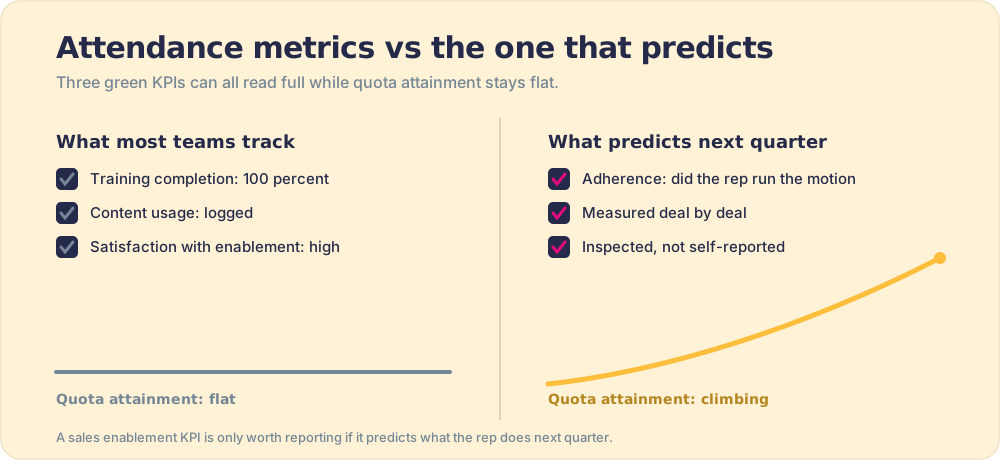
Sales enablement KPIs are the metrics a revenue team uses to judge whether its enablement is working, and the ones that predict next quarter measure rep behavior, whether the playbook motion is actually run, not attendance at training.
Open almost any sales enablement dashboard and you will find it glowing green. Training completion sits at ninety-eight percent. Content usage is logged and trending up. The last enablement survey came back happy. Every number on the board says the program is working. Then the quarter closes soft, the forecast was a story, and nobody on the dashboard can explain why, because not one of those numbers was ever about whether a rep would hit quota.
That is the hidden failure of most sales enablement KPIs, and it is worth naming plainly. The metrics teams report measure attendance: who showed up to training, who opened the deck, who liked the program. They are lagging input metrics. They tell you a thing happened in the past and nothing about what a rep will do on their next deal. The one metric that predicts the future is adherence, whether the rep is actually running the motion the playbook defines, deal by deal. Measure behavior, not attendance. So sales enablement KPIs are the metrics a revenue team uses to judge whether its enablement is working, and the ones that predict next quarter measure rep behavior, whether the playbook motion is actually run, not attendance at training. The rest of this post is about telling the two apart.
What are sales enablement KPIs, and why do most of them mislead?
Strip away the jargon and a sales enablement KPI is just a number you watch to decide whether your enablement is doing its job. The job is to change what reps do so they win more. So the honest test of any enablement metric is simple: does it tell you whether reps are doing the thing differently, and better, than they did before?
By that test, the standard dashboard mostly fails. The familiar sales enablement metrics fall into three buckets, and all three measure something other than behavior:
- Completion metrics. Training completion rate, certifications passed, modules finished. These prove a rep was in the room and clicked through to the end. They are a register of attendance, not of competence, and a rep can pass every certification and freeze on the first real objection.
- Usage metrics. Content views, asset downloads, time in the enablement tool. These tell you a file was opened. They cannot tell you the opened file changed how the rep ran the call, or whether the deal moved an inch because of it.
- Satisfaction metrics. The enablement net promoter score, the post-training survey, the CSAT on the program. These measure how reps feel about enablement. A rep can adore a workshop, rate it a ten, and sell exactly the way they did before lunch.
None of these is useless. They are hygiene checks, and a program with zero completion or zero usage has a real problem. The trouble is treating them as the scoreboard. They are easy to collect, they look like progress, and they answer a question nobody is actually asking. Knowing better was never the same as doing better, which is the whole premise of the knowing-doing gap: the distance between what a rep has been taught and what they actually do under pressure. An attendance metric lives entirely on the knowing side of that gap and reports nothing from the doing side, where the deals are won.
There is a deeper reason this matters now. Knowledge is solved. Any rep can find the doc, and an AI can summarize the battlecard in seconds. What a rep does with three tabs open on a slipping deal is the unsolved problem, and a KPI that counts how many docs got opened is measuring the part that was never hard. Measure the easy half, and you learn nothing about the hard one.
What is the difference between leading and lagging sales enablement metrics?
This is the distinction that reorders the whole dashboard, so it is worth drawing in kitchen words. A lagging metric reports something that already happened and cannot be changed. A leading metric points at something still in motion that you can still influence.
Training completion is lagging. By the time it reads ninety-eight percent, the training is over, the quarter it was meant to help is underway, and the number cannot be moved. It is a photograph of the past. Process adherence on the deals in your pipeline right now is leading. It tells you what reps are doing this week, while there is still time to coach a drift before it costs a deal. One is a rear-view mirror. The other is the windshield.
The reason this is not a pedantic distinction is that the two kinds of metric drive opposite management behavior. Run a team off lagging metrics and you spend the quarter reporting that things happened. Run it off leading metrics and you spend the quarter changing what happens. Andy Grove, who built the operating discipline at Intel and wrote High Output Management, made the same point about manufacturing decades ago: you inspect the work in progress, not just the finished units, because by the time a defect reaches the loading dock it is too late and too expensive to fix. A leading enablement metric is the in-process inspection. A lagging one is the defect report you read after the truck has left.
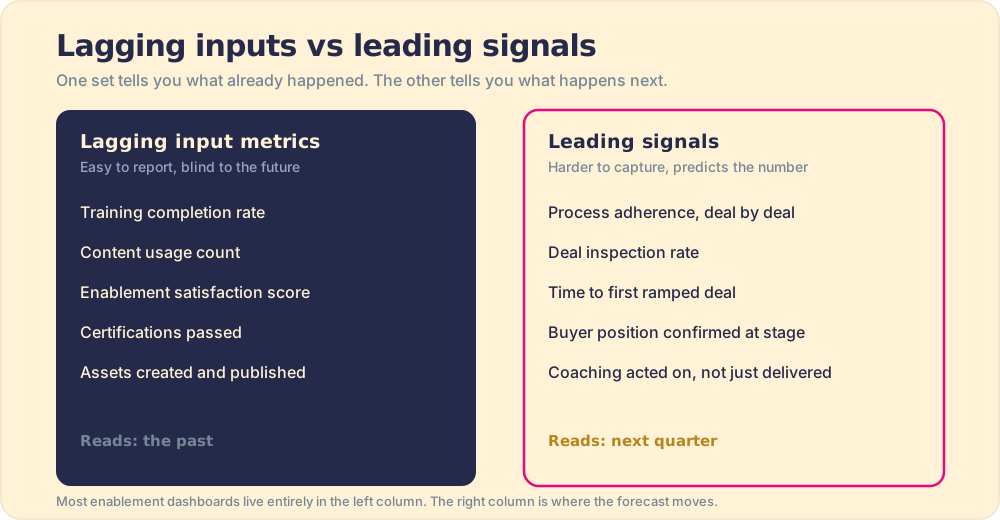
The lagging metrics are also the easy ones to collect, which is exactly why they dominate the dashboard. A learning management system hands you completion rates for free. Measuring whether a rep ran discovery on a real deal takes work. So teams report what is cheap to count and hope it stands in for what is hard to count. It does not. The gap between the two is the sales execution gap, the distance between the process a team designed and the process its reps actually run, and no amount of completion data will ever show you the size of it.
Why does adherence predict the number when attendance does not?
Because adherence is the only one of these metrics that sits on the doing side of the gap. It does not ask whether the rep was taught the motion or felt good about it. It asks whether the motion happened on a deal where money was on the line.
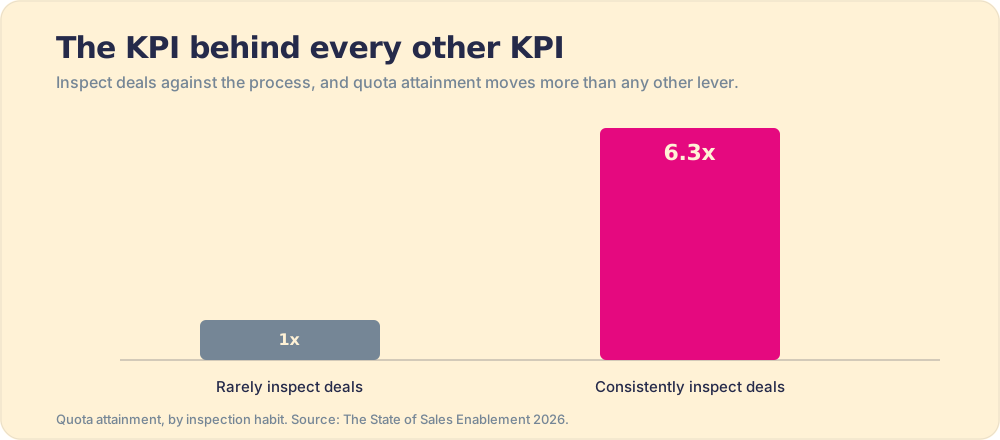
The evidence here is not soft. In the State of Sales Enablement 2026, the variable that separated teams hitting quota from teams missing it was not how much training they delivered or how much content they produced. It was inspection. Teams that consistently inspect deals against a defined process hit quota at 6.3 times the rate of teams that rarely do, the single largest effect in the study. Inspection is how adherence becomes a number you can act on, and it is the lever that moves more than any other.
The mechanism behind that number is delivery, not knowledge. The same report found that teams whose guidance reaches reps in the flow of the work hit quota at 49 percent, against 15 percent for teams whose guidance sits in docs, wikis, and an LMS. Same content. Different moment of delivery. More than triple the result. That gap is invisible to every attendance metric, because completion and usage say nothing about whether the guidance arrived when the rep needed it. They only say it existed somewhere.
Teams whose guidance is embedded in the flow of work hit quota at 49 percent. Teams whose guidance lives in docs, wikis, and an LMS hit quota at 15 percent. The same content, in a different moment, more than triples its associated outcome.
The outside research lands in the same place. CSO Insights, the research arm now inside Korn Ferry, found that teams running structured, data-backed coaching post win rates roughly 28 percent higher than teams without it (cited via the Sales Enablement Collective). Notice what carries the lift: not that a coaching tool was owned, but that coaching happened, reliably, against real deals. The Sales Enablement Collective also reports that getting coaching right correlates with roughly 16.7 percent faster revenue growth. The pattern repeats across the sales enablement data we compiled. The behavior is the cause. The attendance metric only ever sees the setup.
And the cost of the attendance frame is concrete. The Sales Enablement Collective’s 2025 Impact of Enablement report found that 79.7 percent of enablement leaders say their reps leave at least 40 percent of a tool’s features untouched (SEC). A usage metric will happily report that the tool is “adopted” because someone logged in. It will never tell you that four-fifths of teams are paying for capability the people it was bought for never touch. That is what an attendance metric hides, deal after deal.
Is tracking rep activity a vanity metric?
No, and this is where a popular take gets it wrong, so it is worth taking on directly. You will read, often from smart people, that activity metrics are vanity, that counting calls and emails and demos measures motion while ignoring movement, that a busy rep is a rep hiding from results. Grant the case its full force first, because there is a real failure underneath it: a deal that advances only because a rep logged forty calls, with no sign the buyer moved, is a deal lying to your forecast. That failure is real.
But the conclusion drawn from it is wrong. Capturing what a rep did is good and necessary. It is how you verify the process is being followed at all, and the activity itself shapes the buyer’s experience: the follow-up that came on time, the next step that was actually scheduled. Calling activity tracking vanity throws out the one record that tells you whether the motion is happening. The mistake is never that you tracked the activity. The mistake is letting a deal advance on the activity alone.
Think of a captain’s log. A log that records only how hard the crew rowed, how many strokes, how many hours at the oar, and never once which way the ship moved, is a useless log for a captain who needs to reach harbor. But the answer is not to stop recording the rowing. The rowing is real, and a crew that never rowed will never arrive. The answer is to record the rowing and the ship’s position, the activity and the buyer’s real sentiment, so the log tells you both that the crew worked and that the work moved you toward the destination.
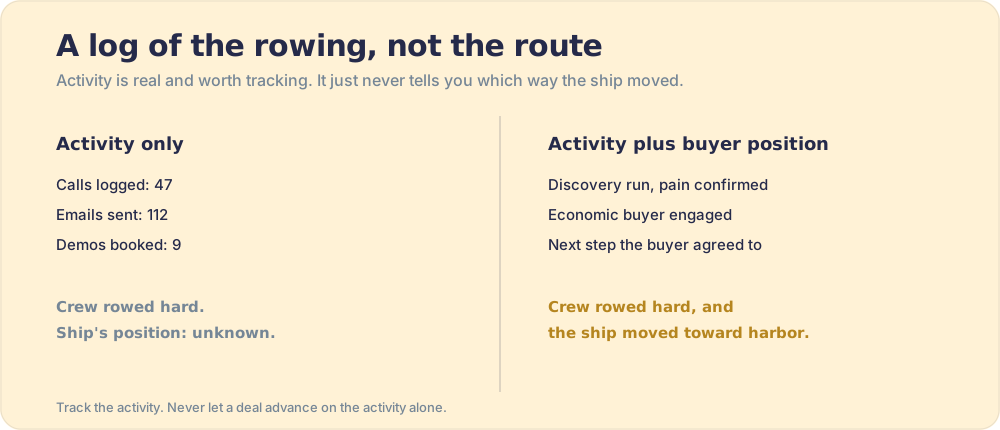
So the right model for activity in your KPIs is not “ignore it” and not “advance on it.” It is “capture it, and pair it with the buyer’s position before you trust the stage.” The pipeline should reflect the buyer’s reality, not just the seller’s checklist. That is the discipline behind real CRM adoption: the activity gets logged because it is useful, and the stage only moves when the buyer truly did.
How do you measure sales enablement effectiveness without drowning in metrics?
You pick a short list that predicts, and you let the rest be hygiene. The temptation with enablement metrics is to track everything, because everything is measurable and a fuller dashboard feels more rigorous. It is the opposite. A dashboard of forty lagging numbers is harder to act on than four leading ones, because no single number is allowed to be the thing that matters. So the discipline of how to measure sales enablement is mostly a discipline of subtraction.
The short list of sales enablement KPIs to track sits below, each chosen because it predicts behavior rather than reports attendance:
- Process adherence, deal by deal. The share of active deals running the motion the playbook defines: the required discovery, the stage exit criteria, the qualification you decided matters. This is the keystone leading metric, and it is the one most dashboards do not have.
- Deal inspection rate. What fraction of deals get inspected against the process, rather than self-reported as on track. This is the 6.3x lever made into a number you can manage, because inspection is what makes adherence real instead of assumed.
- Time to first ramped deal. For new hires, how long until they run the process on a real deal without prompting, at a rate near your tenured team. It predicts ramp far better than training-completion does, because it measures behavior arriving, not knowledge delivered.
- Coaching acted on, not just delivered. Whether the coaching signal changed what the rep did the following week, traced on real deals. Coaching delivered is an attendance metric. Coaching acted on is a behavior one.
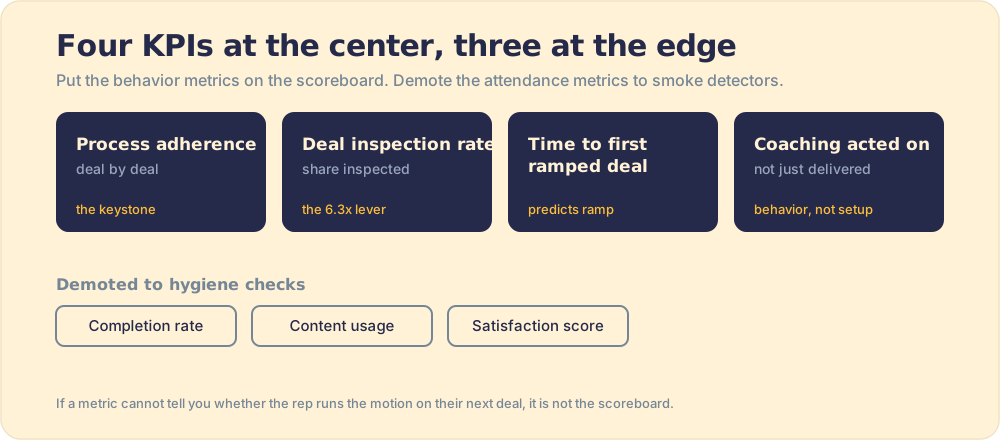
Keep completion, usage, and satisfaction. Demote them. They are the smoke detectors, worth a glance, never the scoreboard. The rule of thumb that sorts any metric: if it cannot tell you whether the rep will run the motion on their next deal, it does not belong at the center of the dashboard.
There is a reason this set is harder to build, and it is the same reason it is worth building. Attendance metrics come free from your LMS. Adherence metrics require you to inspect the work, and manual inspection is tedious, which is exactly why it gets skipped and why so many dashboards default to the easy numbers. The win is not more discipline from managers. It is lifting the inspection burden off them, so adherence gets measured automatically and the manager’s time goes to coaching the motion rather than chasing field updates. This is the work of the Behavior Layer: the process and the next right action reach the rep in the flow of the work, the instant the question arises, and whether they followed it is captured deal by deal, without a manager auditing it by hand.
What we recommend
Two ways to run your sales enablement KPIs sit underneath everything above, and the choice between them decides whether the dashboard earns its place. You can measure attendance: completion, usage, satisfaction, the numbers that come free and read green and tell you nothing about next quarter. Or you can measure behavior: adherence, inspection, time to first ramped deal, coaching acted on, the numbers that take work to build and actually predict the forecast.
We recommend the second, without hedging, and the evidence is why. The State of Sales Enablement 2026 says inspecting the process drives a 6.3x difference in quota attainment, and that guidance in the flow of the work more than triples the share of reps hitting quota, 49 percent against 15. CSO Insights says real coaching lifts win rates 28 percent. The Sales Enablement Collective says four-fifths of teams pay for tool capability their reps never touch, the exact waste a usage metric is built to hide. Every one of those findings points at behavior, and not one of them shows up on an attendance dashboard.
So keep the completion rate as a smoke detector, and stop treating it as the fire. The fire is whether the rep runs the motion in the moment of the work, and the only KPIs worth putting at the center are the ones that can see it. If you want the fuller picture of why a well-documented process still goes unrun, start with the sales execution gap; if you want to know where your program sits on the curve from documentation to measured behavior, read the sales enablement maturity model; and if you want the strategy that wires these metrics into how the whole program runs, start with sales enablement strategy.
Frequently asked questions
What are sales enablement KPIs?+
What is the difference between leading and lagging sales enablement metrics?+
How do you measure sales enablement effectiveness?+
Is tracking sales rep activity a vanity metric?+
What sales enablement KPIs should I track in 2026?+
Your process, running itself.