GTM Enablement: Readiness That Outlives Launch Day
GTM enablement is usually defined by scope, every customer-facing team, which makes it a second name for revenue enablement. The sharper definition is the trigger: a change in the motion. Here is how to run launch readiness so it still holds six weeks later.
GTM enablement is the work of getting every customer-facing team (sales, customer success, marketing, partners, and RevOps) ready to run a change in the go-to-market motion, like a product launch, a pricing change, or a new segment, and keeping them running it after launch day.
Judge GTM enablement at week six, not on launch day. Build the new motion into the CRM and the tools each function already uses, then inspect it at day 7, day 30, and day 45. The kickoff and the deck still happen, but they support the change rather than carry it. When I walk a team through a rollout, this is the part I push on:
From the field
As changes happen, you can announce those changes, ensure that people see them where they’re working, in the flow of work, and not just rely on an email.
A launch, a new price, a new segment, a new partner channel: each is a change that has to land across sales, customer success, marketing, partners, and RevOps at once. The field mostly defines GTM enablement by scope, “all your customer-facing teams,” which makes it hard to tell apart from revenue enablement. The sharper definition is the trigger. GTM enablement exists because the motion changed, and it passes or fails about six weeks after launch day.
What is GTM enablement?
GTM enablement is the work of getting every customer-facing team ready to run a change in the go-to-market motion, and keeping them running it after launch day. Go to market enablement starts when something in the motion moves: a product ships, a price book changes, a new segment opens, a partner program launches. It ends when the new motion is the default behavior and you can see it in the CRM. The enablement session is somewhere in the middle.
The biggest vendors in the category deserve their due. Highspot’s guide argues that “sales enablement has essentially evolved into go-to-market (GTM) enablement,” a performance lever rather than a support function (Highspot). Mindtickle defines it as “the strategy that aligns and equips all of your customer-facing teams to execute your go-to-market motion effectively” (Mindtickle). Both are right about the width. Neither says what makes the work start, and a definition without a trigger turns into a department with a longer name.
The trigger matters because change is now the normal state. Gartner surveyed 234 sales leaders in 2024 and found their organizations had run an average of four transformations in the past two years, and only 11% managed to drive commercial success while doing it (Gartner, December 2024). Two changes a year, and nine teams in ten lose ground on each one. GTM enablement is built for that rate of change.
How is GTM enablement different from sales enablement and revenue enablement?
The three terms nest. Sales enablement is organized around the sales team. Revenue enablement is organized around the whole revenue motion, marketing through customer success, as a standing system with the handoffs in scope. GTM enablement borrows that width for one purpose: getting every function onto the new motion on the same morning, and keeping it there. (The parent discipline is in what is enablement.) Revenue enablement keeps the machine running. GTM enablement changes the machine while it runs.
| Sales enablement | Revenue enablement | GTM enablement | |
|---|---|---|---|
| Organized around | The sales team | The whole revenue motion | A change to the motion |
| Cadence | Always on | Always on | Launch-driven, with a tail |
| Who it touches | Reps and managers | Marketing, sales, CS | Every team the change touches, partners included |
| Failure mode | Content reps never open | A rebrand of sales enablement | A great launch day, then drift back |
| Success test | Reps run the process | Handoffs stop leaking | The new motion is still running at day 45 |
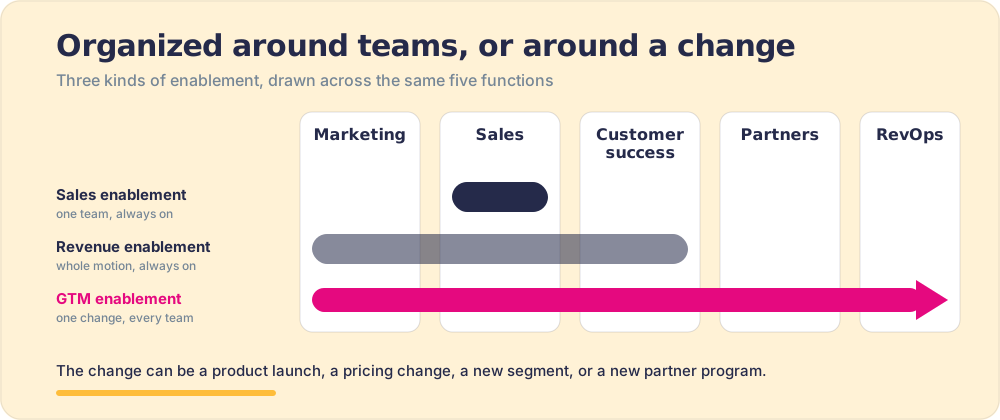
Which functions does GTM enablement span?
Any function that touches the buyer or the record. A useful test: if the change is invisible to a team, the buyer will find the gap before you do.
- Sales. New discovery questions, qualification rules, and plays, written as sales plays that fire as CRM triggers.
- Customer success. Renewals, expansions, and the promises made during onboarding. A new price that sales quotes and CS never hears about gets undone at the first renewal.
- Marketing. Pages, campaigns, and lead routing. Old pages outlive launches.
- Partners. Resellers and solutions partners quote, bundle, and implement, from furthest outside your internal channels.
- RevOps. Products, price books, fields, stages, and approval rules. If the CRM still offers the old price, the old price is what gets sold.
Pricing changes show the stakes most plainly. McKinsey’s pricing research found that a 1% price rise, with volumes held, would lift operating profit by about 8%, and that at one lighting company the average pocket price, after discounts and giveaways, was about half the list price (McKinsey, The power of pricing). A pricing change is decided in a boardroom and won or lost in hundreds of small discount decisions across five functions.
What does launch readiness mean for launches, pricing changes, and new segments?
Launch readiness is the state in which every team the change touches can run the new motion on a real buyer, without asking anyone. The three common triggers stress different parts of the system.
- A product launch. The risk is no plays: reps know the product exists but not which deals it belongs in. Gartner’s survey of 205 product managers found 45% of launches slip by at least a month, and only 11% of organizations said all their products hit their launch targets (Gartner, 2019).
- A pricing or packaging change. The risk is muscle memory: old bundles, old discount habits.
- A new segment. The risk is the wrong playbook, a mid-market motion carried into enterprise.
We would run this checklist for any of the three.
- The change, in one sentence. What moves, for whom, starting when.
- The expected behavior, per function. What a rep, a CS manager, a partner, and a marketer each do differently on day one, written as actions on a record.
- The system changes, live before launch. Products, price books, fields, stages, plays, and approval rules in the CRM before the first call, not after.
- A readiness check on output. A rep builds a real quote on the new price, or runs the new discovery on a practice record. Attendance is not readiness.
- A named owner in each function. One person per team who answers for whether that team runs the new motion.
- The inspection calendar. The metrics you will read at day 7, day 30, and day 45, and who reads them.
- The retirement plan. The old price book, deck, page, and play switched off on a date. Two roads running side by side is how head-on collisions happen.
Why does readiness decay after launch day?
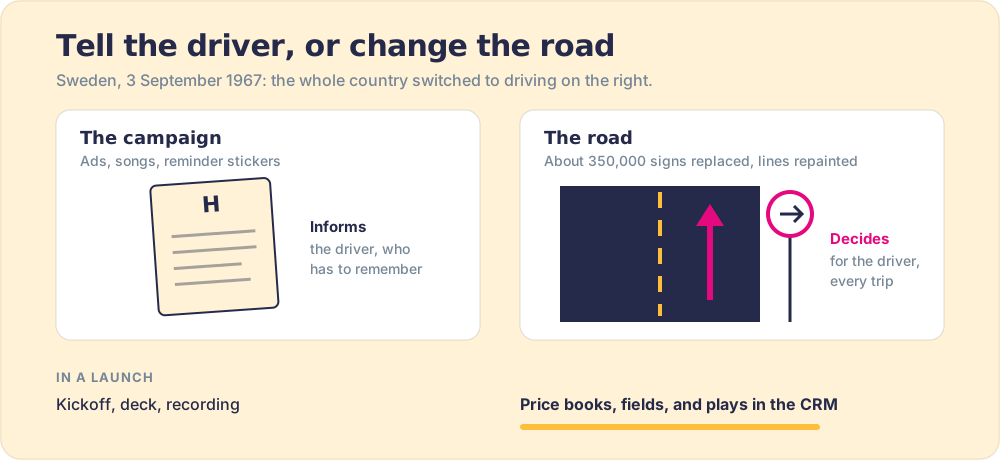
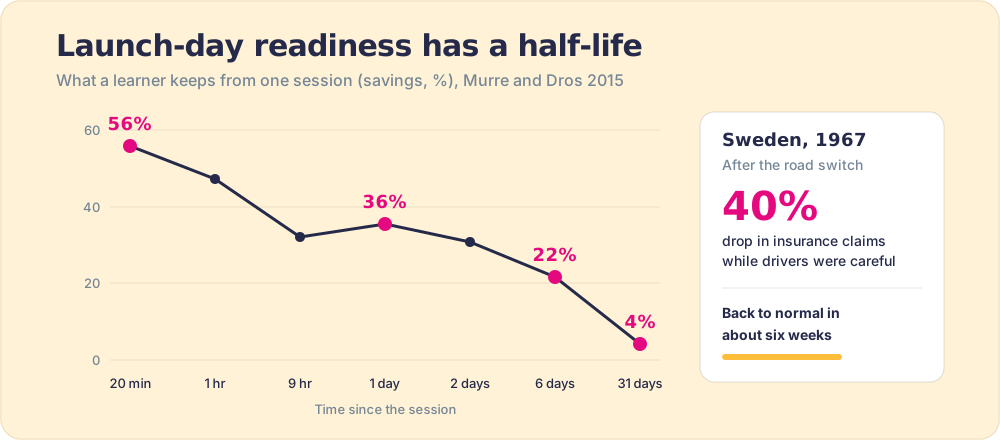
Sweden ran the biggest version of this experiment. On 3 September 1967, the country switched from driving on the left to driving on the right. A four-year public campaign had prepared drivers with ads, songs, and reminder stickers, and crews had also replaced about 350,000 signs and painted new lines under black tape, ready to be uncovered that morning (Wikipedia, Dagen H). After the switch, motor insurance claims fell by 40%, because drivers were careful, and they returned to normal within six weeks. By 1969 accident rates matched the old levels (Wikipedia, Dagen H). The heightened attention of the big day wore off in about six weeks. What stayed was the paint on the road.
Launches follow the same arc. In a 2015 replication of Ebbinghaus’s forgetting-curve experiments, the savings from a first learning session fell to about 36% after a day, 22% after six days, and 4% after 31 days (Murre and Dros, PLOS ONE). A launch deck delivered on Monday is mostly gone by the month’s first renewal call. The reps did nothing wrong. The change was stored in their heads, and I have watched that happen on my own teams:
From the field
I would often create a list of expectations. I would have people do them, and they’d forget them after two weeks.
Our own research points at the same fix. In the State of Sales Enablement 2026, 89% of 198 sales leaders said they have a defined process and 36% see it followed, a 53-point gap. Teams whose process lives in the CRM workflow hit quota at 49%; teams whose process lives in a doc, wiki, or LMS hit 15%. A launch is a new process with a deadline on it, so it inherits that gap on day one.
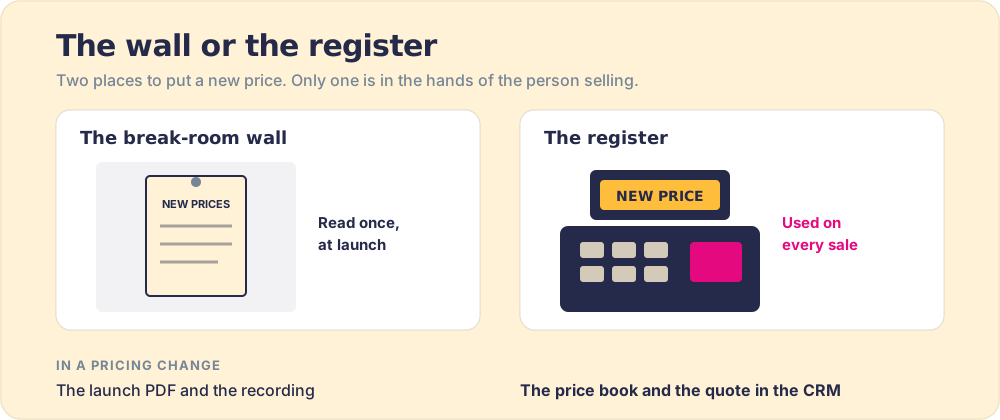
Think of a shop that raises its prices. The manager can pin the new price list to the break-room wall, or change the price in the register. Staff will read the wall once. They will use the register all day. When a pricing change reaches the rep inside the quote they are building, it holds. When it lives in a PDF from the launch call, the old price comes back one discount at a time.
How do GTM engineers relate to GTM enablement?
They build the register. Clay, which coined the role in 2023, defines it in one line: “GTM engineers build revenue engines using AI and automation” (Clay). In a launch, the GTM engineer wires the new product into routing and builds the signals that flag accounts ready for it.
The two roles split cleanly. The GTM engineer builds the system the new motion runs on. GTM enablement decides what behavior that system should produce in each function, and inspects whether it happens. As we argue in the GTM engineer, someone has to own whether the running happened. In a launch, that is GTM enablement.
How do you measure GTM enablement?
Measure the change itself. Completion rates tell you the deck was delivered, and the deck is the part that decays.
- Coverage. How many eligible deals, accounts, or renewals the new motion should touch. Every other number needs it as the denominator.
- First use. How fast each rep, CS manager, and partner runs the new motion on a real opportunity.
- Adherence. Whether it was run as designed: the new discovery questions logged, discounts inside the new guardrails, the new play completed.
- Outcome. Attach rate, win rate, or price realization on the new motion, compared against deals that did not run it.
- The day-45 read. The same four numbers again, after launch-day attention has worn off.
Inspection is the part that makes the rest mean anything. In the State of Sales Enablement, the most-inspected teams hit quota at 6.3 times the rate of the least-inspected. Without an inspection calendar, you judge a launch by anecdote.
How should you structure a GTM enablement team?
Small, and wired into the teams it serves. A GTM enablement team works best as a hub with spokes: a lead who owns launch readiness, next to product marketing (the message) and RevOps (the system), with a named owner in each function.
- Under 50 customer-facing people. One person, often the sales enablement lead, runs the checklist with PMM and RevOps.
- 50 to a few hundred. A small hub reporting to the CRO or the head of revenue operations, with function owners in CS, partners, and marketing.
- Larger organizations. A launch council that meets before each change, with the enablement hub holding the calendar and the day-45 read.
Keep the load on the field light. In the same 2024 study, Gartner found that 70% of sellers feel overwhelmed by the technologies their jobs require, and that organizations practicing what it calls radical role simplification were 4.5 times more likely to be top performers (Gartner, December 2024). A launch that adds a new portal, a new login, and a new tab is adding surface area to people who are already carrying too much.
Judge it by week six
Define GTM enablement by the change it serves and grade it on the day-45 read, not on kickoff attendance. Skipping that step has a known price: Gartner found only 11% of sales organizations drive commercial success while running a transformation, and most run two a year. Knowledge from a launch session falls to 4% within a month, while teams whose process lives in the workflow hit quota at 49% against 15% for doc-and-wiki teams. Sweden kept its drivers on the right by repainting the road, not by rerunning the ads.
The Behavior Layer does that job. Supered puts the new motion in front of the rep, the CS manager, and the partner in the flow of their work, inside HubSpot, Salesforce, and the tools they already use, and measures whether it is being run, deal by deal, long after the launch deck is forgotten.
Next, write the plays your launch needs with sales plays.
Frequently asked questions
What is GTM enablement?+
What is the difference between GTM enablement and revenue enablement?+
What is the difference between GTM enablement and sales enablement?+
What does a GTM enablement team do?+
What should a launch readiness checklist include?+
How do you measure GTM enablement?+
Your process, running itself.