Video in Sales: Ademola Adelakun's Three Numbers for Content That Closes
Ademola Adelakun, founder of A2 Media, opened the first Numbers Known with a card trick and three numbers: 78% of buyers watching your content first, 40% less time to close with video, and three themes to repeat until they stick.
Video in sales is the use of recorded video, from FAQ answers and product walkthroughs to long-form shows, to answer buyers' questions and build trust before and during a deal, so the buyer arrives at the first sales conversation already informed.
When Ademola Adelakun forgets to introduce himself on a call, people “avoid my name like the plague” until the end, when they finally ask how to say it. “I always forget that my name is super Nigerian,” he said. Ademola founded A2 Media, which makes the case for video in sales and builds it for clients, and he was Rob Jones’s guest for the pilot of Numbers Known, a show Rob started with, in his words, “no idea where it’s going to go.”
It went to a card trick. Ademola asked Rob to name a card. Rob said the four of hearts, changed his mind to the four of diamonds, and Ademola fanned the deck to show one card face down. It was the four of diamonds. “We did not prep for this,” Rob said. Then they got to the three numbers Ademola runs his business on, 78, 40 and three. All three are about video in sales.
What does it mean that 78% of buyers watch your content first?
Ademola’s first number is his estimate that about 78% of buyers watch your content before they ever reach your sales team. He did not cite a study on the show, so treat the figure as his. He explained where it comes from.
“They know that your product pages and your landing pages make your product look the best it possibly can,” he said. So buyers go to Reddit, to reviews and to “videos that you’ve put out, they want to see what your vibe is.” He calls it a move from a lack of information to the trust economy. When a buyer finally books a call, they say, “Hey, I already know what you guys do. I just have a couple questions.”
6sense surveyed more than 4,000 buyers for its 2025 Buyer Experience Report and found that 94% of buying groups had a preferred vendor before first contact, and that the vendor they preferred going in still won 80% of deals (6sense). Whatever those buyers watched and read, they did it before a rep was on the phone.
Ademola’s test for that content is a reaction. “The idea is to make people go when they watch your content, say, ‘That’s me.’ Or, ‘How did they know that I needed that?’” If you can name a problem the buyer had not put into words yet, “they will see you as a teacher.” Our guide to buyer enablement covers the same idea from the buyer’s side, where helping them decide shortens the call.
How does video in sales cut time to close?
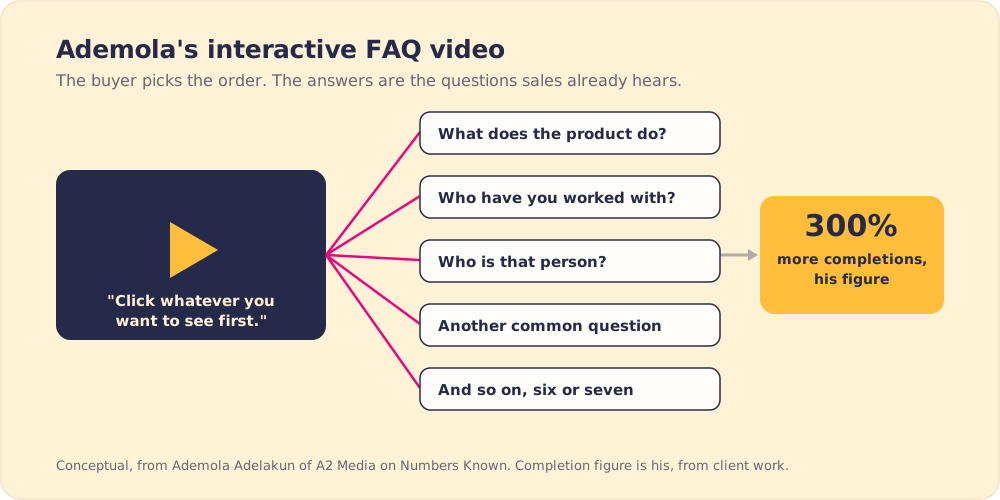
Ademola’s second number is 40. He says video in the funnel can cut time to close by about 40%. The format he uses for clients is an interactive, choose-your-own-adventure video built from the questions buyers already ask sales.
“Let’s say you have frequently asked questions that people typically come to your sales team for, and you make six or seven videos about those frequently asked questions,” he said. The buyer sees one video that says, “Hey, this is an interactive video. Click whatever you want to see first.” They might pick what the product does, then who the company has worked with. “If they get to choose the journey,” he said, completion rates go up, and viewers “complete it up to 300% more of the time.”
Rob added a picture of his own. If you want to teach a kid to hit a baseball, you do not hand over a PDF with schematics. You show a video of the swing, before and after.
In Wyzowl’s 2026 survey, 63% of people said they would most like to learn about a product by watching a short video, against 12% for a text article, and 85% said a video had convinced them to buy (Wyzowl). Ademola’s FAQ videos take the questions reps answer every week and answer them once, before the buyer books a call. Our guide to sales enablement content covers how to decide which questions deserve that treatment.
Why does long-form video build trust faster?
Ademola told a story he heard on a podcast about an event in a stadium. A-list celebrities walked out and got a round of applause that was “kind of weak.” Short-form creators got a little more. Long-form creators and podcasters came out and “people went crazy.” Then the live streamers appeared and “people lost their minds.”
“That signals that people are invested in the people that they watch,” he said. “The more time you spend with people, which is why, you know, I feel like people should be betting on long form content this year, the more trust you build with them.” He asked Rob whose restaurant tip you would take: “a friend that you’ve had for 10 years or someone that you met on the street randomly.”
Researchers named this in 1956. Donald Horton and Richard Wohl called it para-social interaction, the one-sided relationship an audience forms with a performer, and described it as “intimacy at a distance” (Psychiatry, 1956). Ademola’s stadium crowd fits their description: the performers people had spent the most hours with got the biggest welcome.
Is the future of sales marketing?
Rob used the pilot to test a theory he still brings up. Because buyers do most of their research before they engage, he argued, every function moves one step up. Sales becomes marketing, through content and access. Marketing becomes customer service and voice of the customer, because buyers trust specific reviews. Customer success becomes sales, the way a sales engineer at a SaaS company solves the technical problem while the account executive will “go on mute for 25 minutes.”
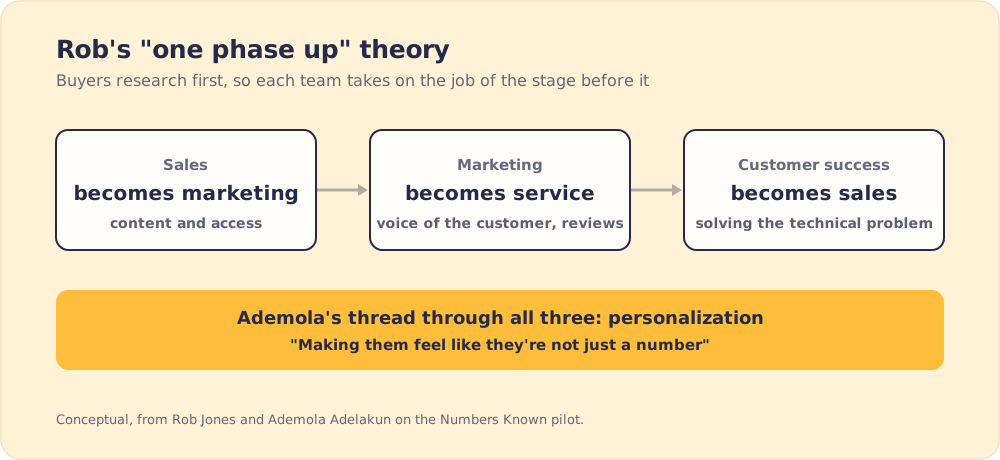
“You’re gonna hate me for this, but I literally have no notes,” Ademola said. He did add one thing. The common thread is “personalization and actually knowing who the hell you’re talking to and making them feel like they’re not just a number.” He also warned the teams racing to publish AI-generated content. “This might be the year where AI slop is just like at its ultimate at its peak and then next year people will be like, we can’t stand that anymore. We just want to feel seen.”
For a sales leader, Rob’s theory means a rep’s content and a rep’s calls answer to the same buyer, often weeks apart. Our guide to sales and marketing alignment covers who owns which part of that, and a digital sales room is one place to keep a buyer’s videos once the deal is live.
What three themes should your sales videos repeat?
Ademola’s last number is three, the number of core themes a brand should have. “A lot of brands don’t know how to go to market in a consistent way and they don’t realize that people have to hear things at least seven times before it sticks,” he said.
He had to pull his own up on screen, “because I never remember what they are”:
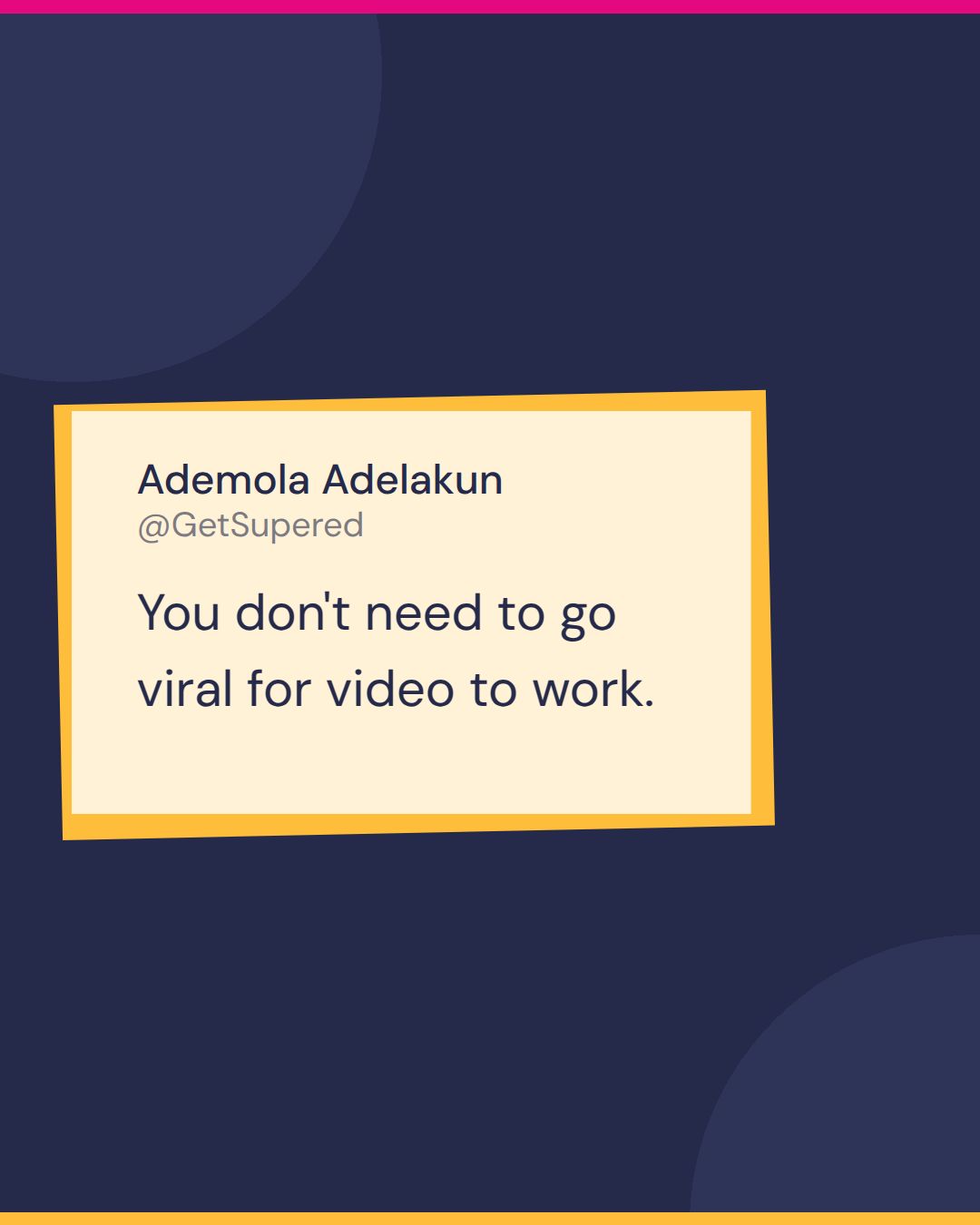
- No need to go viral. “You don’t need to go viral for video to work.”
- No need for a big team. “You don’t need a big team to scale great content.”
- Video as the lead engine. Video done right is the most effective way to drive leads, which he called “a hill that I’d like to die on.”
Before he writes a LinkedIn post or a newsletter, he checks it against the three. “Give it 3 months, 6 months, if I continue to make content that surrounds that, then that is the type of people I’ll bring in.” Those people arrive already agreeing with how A2 Media thinks, “and they become so much easier to work with.”
How to start using video in sales, Ademola’s way
Ademola’s order, from the episode:
- The questions sales already answers. List the six or seven questions buyers bring to every first call.
- One interactive video. Record a short answer to each and let the buyer choose the order.
- Long-form content on a steady rhythm. Time spent builds the trust, so plan a series of episodes.
- Three themes, repeated. Check each post and video against them for three to six months.
Where should a sales team start with video?
A sales team can run Ademola’s advice without waiting on marketing. Start with the FAQ video, because it uses questions your reps already answer and it pays off in shorter first calls. Then pick a long-form format a rep or leader can sustain, and hold it to three themes the whole team agrees on.
That leaves the step after the video. Once a buyer shows up saying “I already know what you guys do,” the rep needs the team’s next move in front of them during the call, and Supered delivers that guidance inside the tools reps already use. As Ademola said about the viewers who stay, “the right people come in if you if you hit on those core themes all the time.”
Frequently asked questions
How do you use video in sales?+
Does video shorten the sales cycle?+
What is interactive video in sales?+
Is long-form or short-form video better for building trust?+
How many content themes should a brand have?+
Your process, running itself.
Turn the playbook into rep behavior.
More from Numbers Known

Active Listening in Sales, Taught by a Comedian: Chris Bogue's Improv Rules for Sellers
Chris Bogue
Pipeline Coverage: Diana Marcela Gonzalez's Quarter Math and the Month-Two Check
Diana Marcela Gonzalez