Active Listening in Sales, Taught by a Comedian: Chris Bogue's Improv Rules for Sellers
Chris Bogue writes jokes for a living and trained in the Chicago improv tradition. On Numbers Known he told Rob Jones how the rules of improv, give gifts and never play the main character, make sellers better listeners.
Active listening in sales is giving the buyer your full attention, responding to what they said rather than to your next line, and asking follow-up questions that show you heard them.
Rob Jones did not have a coin, so he flipped the lens cap off his camera. The side that said Sony was heads. Chris Bogue called heads, the cap came up tails, and Chris had to go first.
Chris writes jokes for companies, coaches people on LinkedIn, and worked with Rob at RevPartners. “Companies pay me to write jokes,” he said, and he cannot take a day off from it “because it’s my job to be funny.” Rob had him on Numbers Known, where each guest brings three numbers and Rob brings three to test them with. Most of what Chris said came back to active listening in sales: hand the buyer something real, then pay attention to what they do with it.
Why does Chris Bogue say comedy comes in threes?
Chris’s first number was three. “If anybody at home wants to know how to tell a joke,” he said, “just set up three things. Normal thing, normal thing, weird thing. That’s a joke.” Later in the episode he broke the three parts down. The first establishes an idea, the second heightens it, and on the third “you subvert the idea.”
Rob hears it as a shape more than a list, a setup, a turn and a resolution, and Chris agreed that any structure boils down to beginning, middle and end. He rarely sees LinkedIn writers talk about it, which strikes him as odd “because all my comedy mentors talked about it all the time.”
What does Second City have to do with selling?
Rob answered with his own number, 60614, the Chicago zip code of Second City. Its alumni include Tina Fey and Bill Murray. Rob asked why improv matters so much in Chris’s work now.
“The world has made everybody into an improviser,” Chris said. Anyone with a brand has to keep putting content out, and “two days from now it’s not going to be relevant anymore.” Second City, he said, teaches “how do you walk into a room with nothing” and put up a full show that people care about.
A sales call puts a rep in the same spot. The buyer brings up something the rep did not plan for, and the next line has to come from what the buyer said.
In two experiments published in 2020 in Thinking Skills and Creativity, Peter Felsman, Sanuri Gunawardena and Colleen Seifert found that 20 minutes of improv exercises raised people’s tolerance for uncertainty and their divergent thinking, compared with control groups (Felsman, Gunawardena and Seifert).
What does “give gifts” mean on a sales call?
Rob asked for improv rules a seller could use, and Chris gave the one he leans on most. “One improv rule that I think works splendidly in B2B is give gifts.”
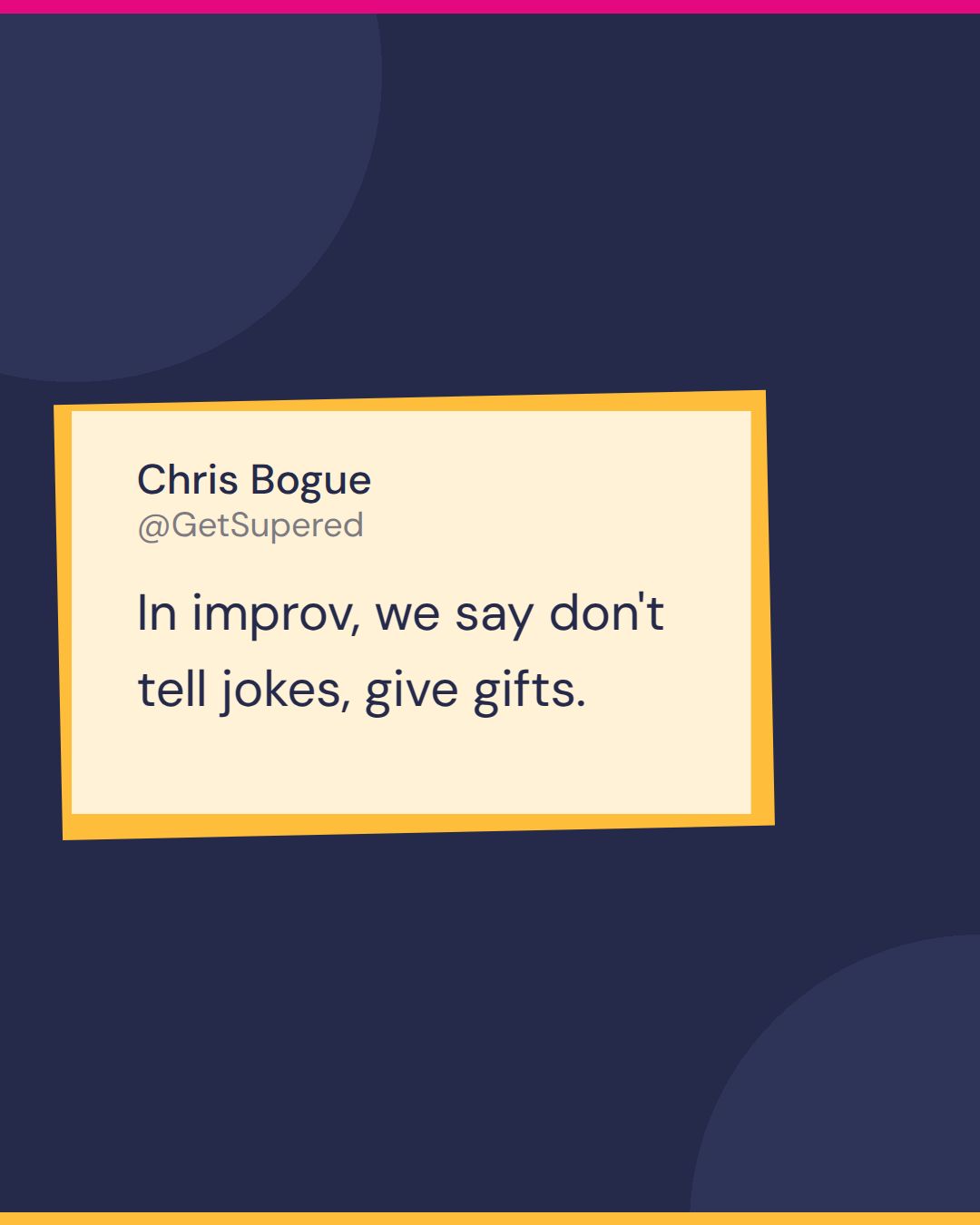
In Chris’s telling, a gift can be anything about you. “Everything about you is a gift,” he said. “In improv, we say don’t tell jokes, give gifts. You’re not sitting there trying to think of how to make something funny. You’re trying to think of like what can I give to this other person that would be interesting, that would be real, that would give them something to play with.”
He pointed at the wall behind him. “I’ve got a saxophone and a clarinet and a synthesizer up against the corner.” They are in the frame on purpose, and “oftentimes it’s the jumping off point for somebody I’m on a call with.” He made the link to sales himself: “If you’re a sales rep, you do not want to be talking for most of the call.”
Gong tracks this as the talk-to-listen ratio. In its 2025 analysis of 326,000 sales calls of at least 10 minutes, reps talked 57% of the time on deals they won and 62% on deals they lost (Gong). Chris uses the saxophone to get the other person talking first.
What is active listening in sales, in Chris Bogue’s terms?
Chris’s second number was two. “Assume as a B2B storyteller, you’re never going to be number one. You’re just not.” The buyer is number one, and so is your boss. “In improv, you are secondary to the scene,” he said, and “the most compelling character is usually the guy who walks on stage and has one line and then walks off.” A Chicago kid, he always felt more like Scottie Pippen than Michael Jordan.
He likes the supporting role. “When you don’t have to be the main character, it’s actually very freeing.” Rob offered a line he has heard and agrees with: you might not be an FDR, but you can be an Eleanor. “It’s called two words, buyer’s journey. It’s about them.”
Chris took it straight to listening. “Listening is a skill that most people aren’t good at. So, especially in sales or in marketing, if you can make someone feel heard, that’s really all they need half the time because again, they’re doing it for their reasons, not yours.”
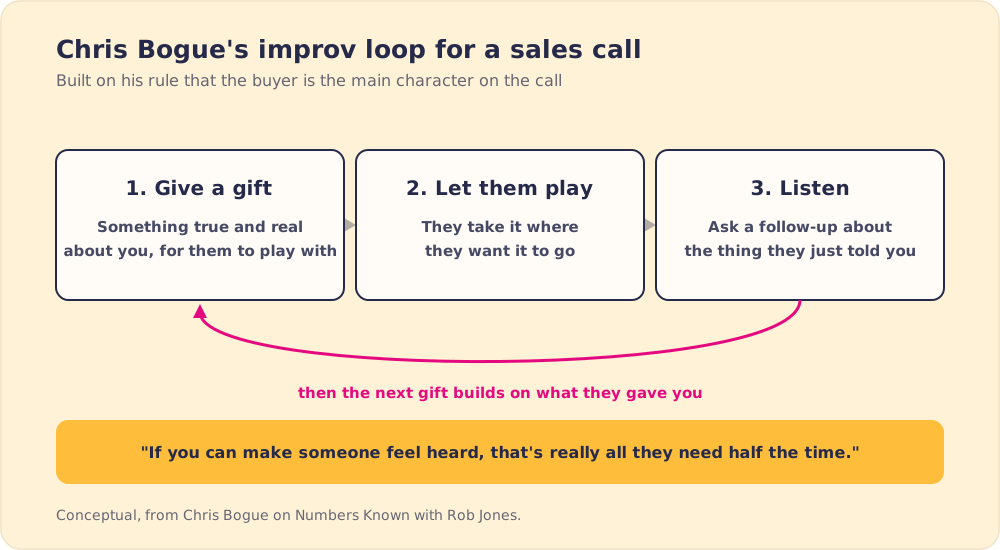
Harvard researchers Karen Huang, Michael Yeomans, Alison Wood Brooks, Julia Minson and Francesca Gino tested the “feel heard” part in 2017. In 15-minute chats, people told to ask more questions were liked more by their partners. Follow-up questions, the ones that ask someone to say more about what they just said, carried the effect, because they made the asker seem to understand and care (Huang et al.).
How do you practice active listening in sales?
Chris’s rules give a rep five things to try on the next call.
- A gift early in the call. Share something true and specific about yourself or what you have seen, so the buyer has something to react to besides your pitch.
- The supporting role. The buyer is the main character, and the rep’s job is to make their scene work. Their reasons drive the deal, “not yours.”
- No script for their answer. “I try not to assume I know what the other person’s going to say,” Chris said. “When we just assume we know what’s going to come out of the other person’s mouth, that’s when we get into trouble. That’s when we fall into cliches. That’s when we stop listening.”
- A follow-up on the thing they said. The Harvard follow-up finding is the reason. Our list of discovery call questions is a fair bank to start from, as long as the second question comes out of the buyer’s first answer.
- Less talk time. Gong’s won deals ran at 57% seller talk time. A rep who sits above 60% has an easy first thing to coach, and our guide to sales coaching techniques covers how to run that conversation.
What did 14,089 LinkedIn followers teach Chris?
Rob’s second number for Chris was 14,089, his LinkedIn follower count about 30 minutes before they hit record. Chris spent years in comedy with a writing partner. “LinkedIn taught me to rely on myself,” he said.
His posts work when he writes them for one person. “Whenever I have hit it out of the park, it’s because I’m thinking about like what would one other person react to if they were in the room?” He has gotten into trouble when a client handed him a joke that ChatGPT had clearly written, “going for the most generic thing.”
Rob asked for his rules for posting, and Chris gave two. “Decide how often you want to put stuff out,” he said. “If you want to make two posts a month, I think that’s fine. But you got to actually do it, you know?” The second was “play to the audience that’s there,” in part because LinkedIn’s connection suggestions are bad. “If LinkedIn had it LinkedIn’s way, I would only connect with people that went to my college that haven’t logged on to LinkedIn in the past 10 years.”
Why does Chris always send the fourth follow-up?
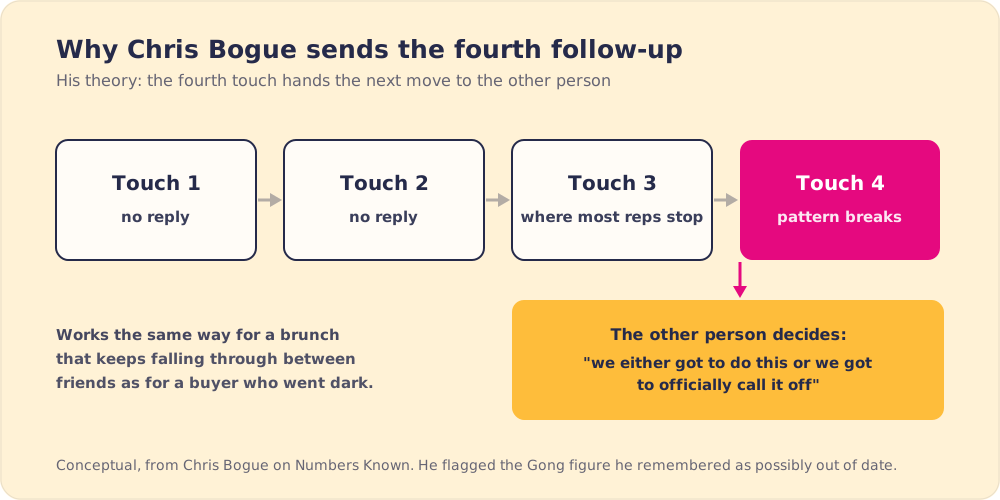
Chris’s third number was four. He remembers a Gong study from years back saying reps tend to give up after the third follow-up, and he was careful about it: “I don’t know if this is true anymore.” His reason for the fourth touch is his own theory. “Once you go for that fourth time, the other person realizes, oh, I am the one who has to break the pattern otherwise this is just going to keep going.”
He sees the same thing with friends. You and a friend keep meaning to get brunch, and it falls through three times. That is usually where people give up. On the fourth try, the friend thinks, “we either got to do this or we got to officially call it off.”
Belkins tracked 7.5 million emails sent in 2025. Follow-ups drew 58.6% of all replies, and steps three through five of a sequence booked 53.5% of the meetings that email produced (Belkins). A fourth touch still has to give the buyer something new to answer. Our guides to the sales follow-up email and sales cadence cover what to put in each step.
Rob’s last number was 12, the count of notes in Western music. Chris likes that those notes are the same “no matter where you are,” so people with no shared language can still play together. When Rob asked for the non-musical version, Chris went back to the buyer. Find out what is going on in that person’s world, he said, “where do they see themselves in the story, and then you meet them there for just a moment.”
What Chris Bogue’s improv rules teach sellers
- Three parts. Establish, heighten, subvert, the way a joke and a short story both work.
- Gifts over jokes. Something true and specific about you gives the buyer something to build on.
- The supporting role. The buyer is the main character, and “they’re doing it for their reasons, not yours.”
- Listening as the skill. Gong’s won deals had reps talking 57% of the time, and follow-up questions made people better liked in the Harvard study.
- A cadence you keep. Two posts a month is fine if you do it, and a fourth follow-up asks the other person to decide.
What should a sales leader do with Chris’s rules?
Improv for sales teams can start with a class, and the Felsman study found effects after 20 minutes. The faster move is to coach the call itself. Pick one recorded call per rep this week and grade two things Chris would grade: did the rep give the buyer something true to react to, and did their next question come from the buyer’s last answer? Then check talk time against Gong’s 57%.
A manager can only coach what they can see on real calls. Supered keeps your call guidance in front of reps inside HubSpot or Salesforce while they work, and shows managers who is following it, so the coaching conversation starts from what happened on the call.
Chris told Rob he would love to come back, and Rob said he has a music episode in mind.
Frequently asked questions
What is active listening in sales?+
How much should a sales rep talk on a call?+
How does improv help salespeople?+
Do follow-up questions make buyers like you more?+
How many times should you follow up with a prospect?+
Your process, running itself.
Turn the playbook into rep behavior.
More from Numbers Known

Pipeline Coverage: Diana Marcela Gonzalez's Quarter Math and the Month-Two Check
Diana Marcela Gonzalez
Quit Your Job to Start a Business? Crispy Barnett Wishes He Had Gone Sooner
Crispy Barnett