Buyer Enablement: Stop Enabling the Seller, Enable the Buyer
Most enablement points inward, at making the seller better.
Buyer enablement, Gartner's term, flips the job: help the buyer finish the buying tasks they are stuck on. Here is what that actually takes.
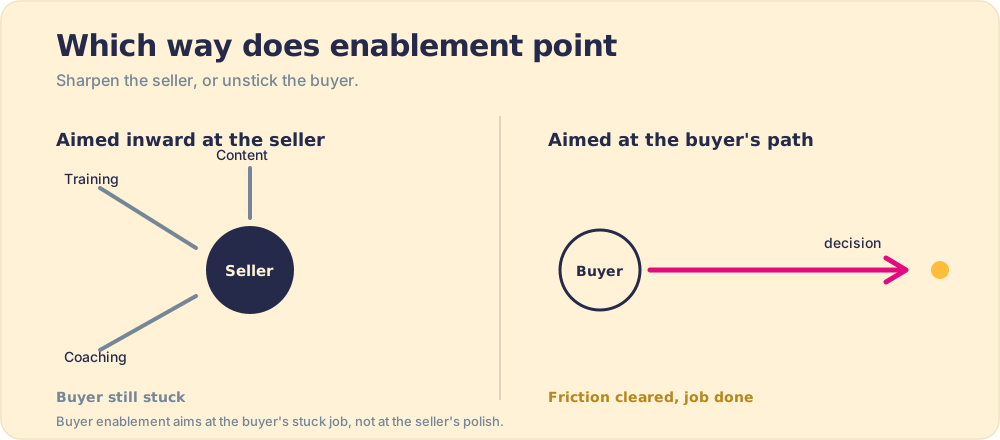
Buyer enablement is the practice of giving B2B buyers the information and tools they need to complete the jobs of buying, the term Gartner coined for help aimed at the buyer's path rather than at making the seller perform.
Sit in on a deal that died and you will usually find the same autopsy. The rep did everything the playbook asked. The demo was clean, the follow-up prompt, the proposal sharp. And the deal still went nowhere, because three weeks after the demo the champion sat in a room with a CFO and a head of IT and could not answer a question about integration, and had no document that answered it for them, and the momentum drained out of the thing. The seller was enabled to the teeth. The buyer was on their own.
That gap sits outside the view of most enablement programs. Almost everything we file under enablement points inward, at the seller: train the rep, build the content, coach the motion, sharpen the pitch. Buyer enablement, the term Gartner coined, turns the camera around. The job is not to make the seller better. It is to help the buyer finish the jobs of buying they are stuck on, because in a B2B purchase the person doing the hardest work is not your rep. It is a buyer trying to wrangle a committee toward a decision they have never made before. A consistent, well-run seller motion is felt by the buyer, and that felt experience is what closes deals in a market where buyers find buying genuinely hard. Buyer enablement is not more content hurled at the buyer. It is friction removed from the buyer’s path.
So let us define it plainly. Buyer enablement is the practice of giving B2B buyers the information and tools they need to complete the jobs of buying, the term Gartner coined for help aimed at the buyer’s path rather than at making the seller perform. Hold that definition next to where a typical enablement budget goes, training and content for the seller, and the mismatch is plain.
What is buyer enablement, exactly?
Strip the jargon and buyer enablement is help pointed the other way. Sales enablement asks, “what does the rep need to sell well?” Buyer enablement asks, “what does the buyer need to buy well?” Those are not the same question, and treating them as one is how a fully enabled sales team still loses deals to no-decision.
People search for buyer enablement Gartner because the idea came out of CEB, the research firm Gartner acquired in 2017, and reached a wide audience in “The New Sales Imperative,” a March 2017 Harvard Business Review article by Nicholas Toman, Brent Adamson, and Cristina Gomez (HBR). Its core claim is uncomfortable for a sales leader. The hard part of a modern B2B sale is not the selling. It is the buying. A purchase that looks like a single decision is really a sequence of tasks a buying group has to complete, and Gartner names six of them: problem identification (“we need to do something”), solution exploration (“what is out there”), requirements building (“what exactly do we need this to do”), supplier selection, validation (“are we sure”), and consensus creation (“can we get everyone on board”) (Gartner). Buyers do not march through these in order. They loop, revisit, stall, and double back, each job a place a deal can stall out and die.
In plain terms, to enable a buyer is to take one of those jobs, the one where this particular deal is stuck, and make it easier to finish. Not to describe your product more vividly. To do the buyer’s work alongside them. A requirements checklist that saves the champion from building one from scratch. A value calculator that gives the CFO a number to react to. A one-page comparison the champion can forward without rewriting it. The category most teams call buyer enablement content is exactly this: tools that complete a job, not brochures that admire the product.
Why does buyer enablement matter now?
Because two things became true at once, and together they leave the old model stranded. Buying got harder, and the rep lost the room.
Take the difficulty first. Gartner finds that 77% of B2B buyers describe their most recent purchase as complex or difficult (Gartner). Not a niggle, a genuine ordeal: more stakeholders, more options, more ways to be wrong, more internal politics to work through. A buying group now runs to six, ten, sometimes more people, each with a different fear and a different definition of a good outcome. The buyer is not lazy or slow. They are doing a hard thing they do rarely, surrounded by colleagues who disagree.
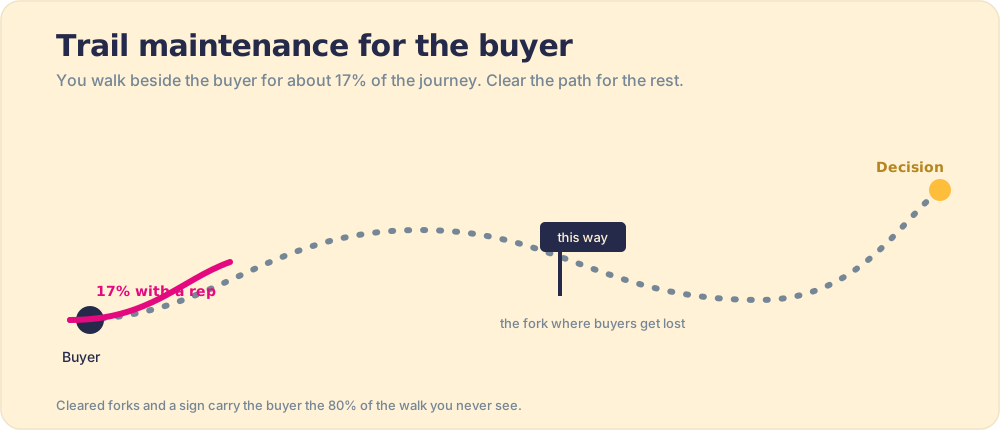
Now take the access. The reflex when a deal is hard is to put more rep in front of it. The trouble is the buyer will not let you. Gartner’s research shows B2B buyers spend only about 17% of the entire buying journey meeting with any supplier’s reps, and that sliver is split across every vendor they are weighing, so a single supplier’s sales team gets perhaps 5% to 6% of the buyer’s time (Gartner). The rest, more than 80% of the journey, happens in rooms you are not in: independent research, internal debate, a Slack thread between the champion and the skeptic that you never see.
Put those two facts beside each other and the conclusion is hard to dodge. Buying is harder than ever, and you are in the room for a sliver of it. You cannot out-talk that problem. The deals that close are the ones where the buyer’s path was made easier in the 80% of the journey you never see, and that is precisely the work buyer enablement names.
Forrester measured how far behind sellers are on this. In its B2B Sales Survey, 63% of sales leaders said digital, self-directed buying behavior would significantly affect their organization within two years, yet only 37% had made digitizing the buyer’s journey a priority (Forrester). Nearly two thirds of sales leaders saw the buyer going self-service. Barely a third were building for it, and buyer enablement is the work that closes that gap.
There is a homely picture for this. Think of a hiking trail maintained by a ranger who is almost never on the path. The ranger cannot walk beside every hiker. What the ranger can do is clear the deadfall, mark the forks, and post a sign at the spot where everyone gets lost, so a stranger walking alone still makes it to the summit. Buyer enablement is trail maintenance for the buyer. You will not be there for most of the walk. Your job is to make the walk passable when you are not.
What is buyer enablement content, really?
Many teams hear “enable the buyer” and reach for the wrong tool. They print more. A glossier deck, a longer case study, another gated PDF. That instinct treats the buyer’s problem as a shortage of information, and in 2026 the buyer has no shortage of information. Knowledge is solved; any buyer can find your spec sheet, and a model can summarize your category in seconds. What the buyer lacks is not facts. It is a way through a hard, unfamiliar task. Pile on more content and you have handed a lost hiker a thicker guidebook, when what they needed was a sign at the fork.
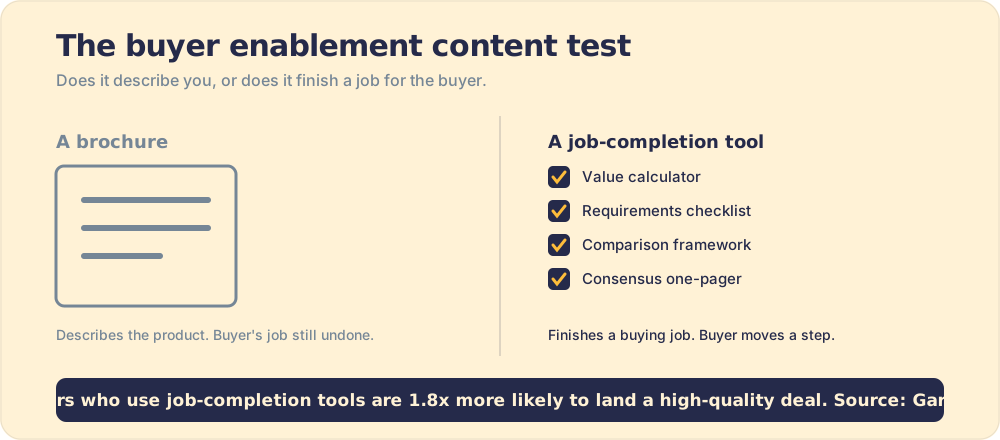
So buyer enablement content is built to a different test. Not “does this describe us well” but “does this finish a job for the buyer.” Gartner calls these job-completion tools, and the examples are concrete and unglamorous on purpose:
- A value calculator. Turns your pitch into a number the buyer’s CFO can argue with. It does the quantification the champion would otherwise stall on for a week.
- A requirements checklist. Hands the buyer the list of questions they did not know to ask, so requirements building, one of the six jobs, gets done in an afternoon instead of three meetings.
- A comparison framework. Lets the buyer evaluate options on the criteria that actually matter, including criteria where you do not win, which is what makes them trust the ones where you do.
- A consensus-building one-pager. Something the champion can forward to a skeptical stakeholder without rewriting it, so consensus creation, the job where most deals die, gets a tool instead of a prayer.
Each of these moves the buyer one step closer to a confident decision, and it works whether or not a rep is in the room. The room test separates buyer enablement content from a brochure. A brochure makes the buyer admire you. A job-completion tool makes the buyer’s job easier. Only one of those survives the 80% of the journey you are not present for.
Gartner’s data adds a twist that matters for the rest of this post. Buyers are 1.8 times more likely to complete a high-quality deal when they use supplier-provided digital tools in partnership with a sales rep, rather than independently (Gartner). The same research finds 75% of B2B buyers say they prefer a rep-free experience, and that self-service purchases are more likely to end in regret. The buyer wants the tool. The deal goes better when a rep hands it over at the right moment.
What are the best buyer enablement tools?
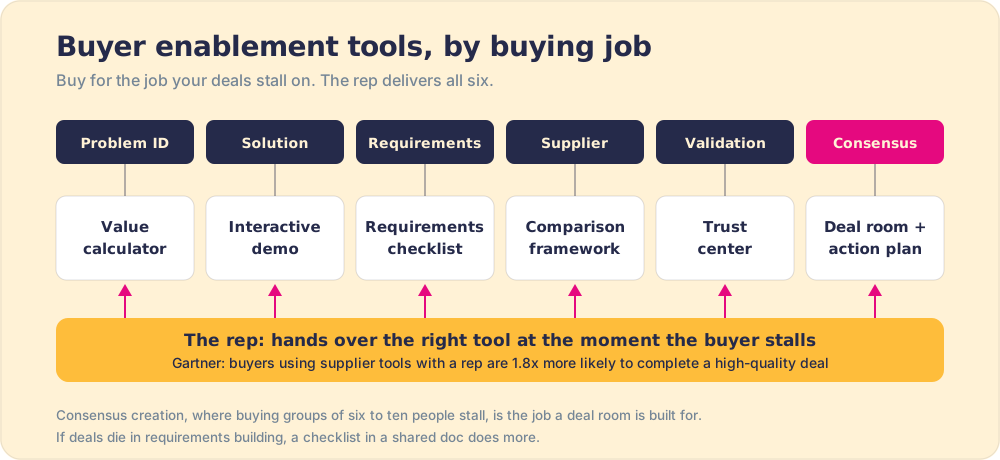
The best buyer enablement tools are the ones matched to the buying job your deals stall on, delivered by a rep at the moment of the stall. Sort the category by Gartner’s six jobs and it stops looking like a crowded vendor map and starts looking like a shopping list with one or two lines that matter for your deals.
| Buying job | What finishes it | Tool type | Examples (status, Oct 2026) |
|---|---|---|---|
| Problem identification | A number the buyer can take to a budget owner | Value or ROI calculator | Built in a spreadsheet or a calculator builder; no category leader |
| Solution exploration | A look at the product without a sales call | Interactive or automated demo | Storylane, Navattic; Consensus (bought Peel and Saleo, June 2026) |
| Requirements building | The questions the buyer did not know to ask | Requirements checklist, RFP template | A shared doc is enough; many teams over-buy here |
| Supplier selection | Criteria that include where you lose | Comparison framework, fair comparison page | Your own site and review sites such as G2 |
| Validation | Security and reference answers before they are asked | Trust center, reference program | SafeBase (owned by Drata since February 2025), Vanta Trust Center |
| Consensus creation | One shared plan for six to ten stakeholders | Digital sales room, mutual action plan | Dock, Aligned, GetAccept; Seismic (merged with Highspot, August 2026) |
Two judgments sit behind the table. The first is that the expensive end of the category, a digital sales room platform, earns its price only on the job it was built for: consensus creation, the job where Gartner’s buying groups of six to ten people stall. If your deals die in requirements building instead, a checklist in a shared doc does more than a deal room. The second is that every tool on the list fails in the same way, by sitting unused while the buyer struggles. The SOSE 2026 data on shelfware applies to buyer-facing tools as much as seller-facing ones: 48% of sales leaders said tools become shelfware because they are not embedded in the workflow (State of Sales Enablement 2026). A deal room the rep forgets to open is a brochure with a login.
What are examples of buyer enablement?
Five buyer enablement examples, each tied to the job it finishes and the moment a rep hands it over:
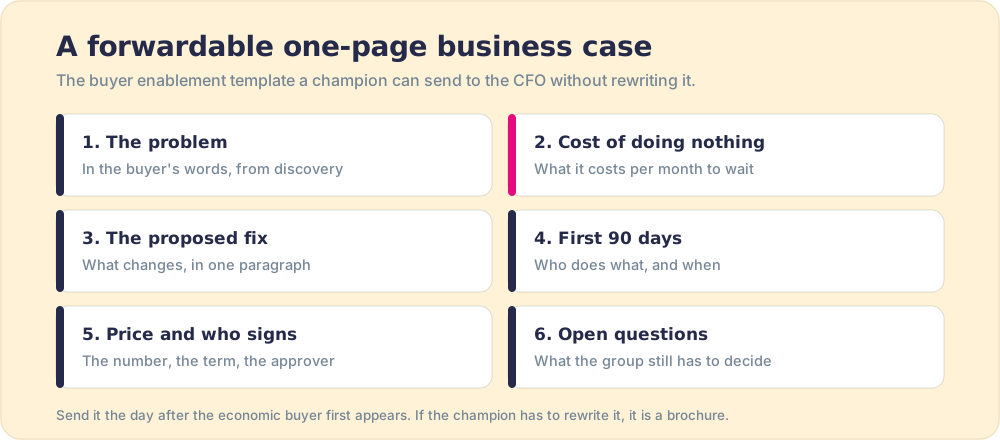
- The forwardable business case. A one-page summary of the problem, the cost of doing nothing, the proposed fix, and the price, written in the buyer’s language so the champion can forward it to the CFO unedited. Handed over the day after the first meeting with an economic buyer.
- The post-discovery requirements checklist. Twelve to fifteen questions the buyer’s team should answer before evaluating anyone, including questions your product answers poorly. Sent within a day of discovery, while the buyer is still forming the list.
- The pre-answered security packet. The security questionnaire, SOC 2 report, and data-handling summary in a trust center, shared before IT asks. It removes the most common late-stage stall in a software deal.
- The mutual action plan. Every step to signature, with an owner and a date on both sides, shared in a mutual action plan or a deal room. Built together in the meeting where the buyer says “we need to take this to the team.”
- The self-guided demo link. A clickable product tour for the stakeholder who missed the demo and will not sit through another one. Sent to the champion to forward, so the skeptic can look on their own time.
None of these is new. What separates a team that runs them from a team that has them is whether the rep remembers to send the business case on every deal or only on the deals a strong rep runs. The template for the first example, the one that does the most work in consensus creation, fits on a page.
How does buyer enablement connect to the seller’s motion?
The seller connection makes buyer enablement workable instead of aspirational, and it follows straight from Gartner’s 1.8x finding. You cannot enable the buyer through a glossy library alone, because the buyer mostly meets your company through a person: the rep, in those few interactions you do get. If the rep delivers the right tool at the right moment on one deal and forgets it on the next, the buyer experience is a coin flip, and an inconsistent experience reads to a nervous buying committee as an unreliable vendor.
So buyer enablement has a prerequisite hiding inside it: a consistent seller motion. The same value calculator, surfaced at the same point in every deal. The same consensus one-pager, handed to every champion before the stakeholder meeting, not just the ones a sharp rep remembers. Consistency here is not a virtue for the manager’s dashboard. It is felt by the buyer. A buying group that gets a clear, well-sequenced, helpful experience from one vendor and a scattered one from another does not need a spreadsheet to tell them which company will be easier to work with after the contract is signed.
A poorly run process is therefore a buyer problem as well as an internal one. When a rep skips the step that would have unstuck the buyer, the cost lands on the buyer’s side of the table as a stall, a re-do, a meeting that should not have been needed. And when reps do not run the motion consistently, that is almost never a discipline failure. It is a system failure: the right tool was not in front of the rep at the moment the buyer needed it, so it did not get delivered. Fix the system, and the buyer feels the difference.
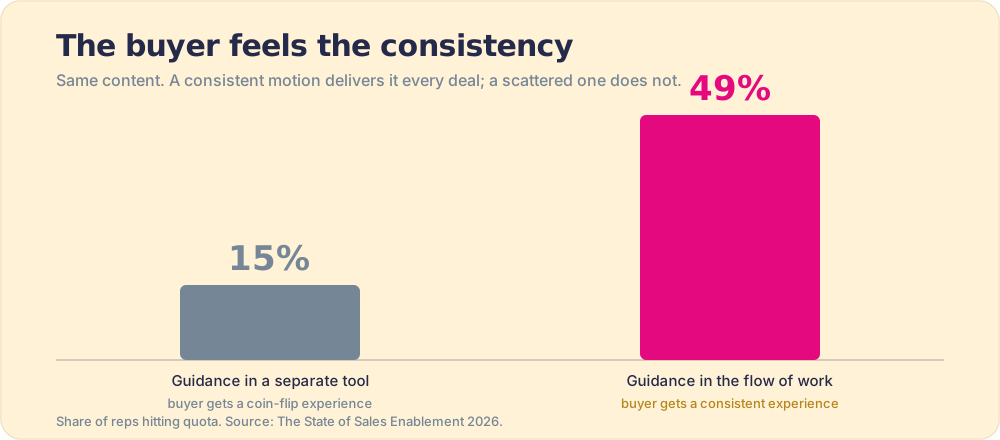
Teams whose guidance is embedded in the flow of work hit quota at 49 percent. Teams whose guidance lives in docs, wikis, and a separate tool hit quota at 15 percent. Same content. The moment of delivery is the lever.
That contrast, from the State of Sales Enablement 2026, is usually cited as a seller finding. It is just as much a buyer finding. The teams whose guidance reaches the rep in the flow of the work hit quota at 49% against 15% for teams whose guidance sits in a separate tool, and the reason it more than triples the outcome is that the rep delivers the right next step, every deal, which means the buyer gets the help, every deal. The 49% teams are not better at selling. They are better at producing a consistent buyer experience, because the motion that produces it is consistent. The seller’s process and the buyer’s experience are the same coin seen from two sides.
What does good buyer enablement look like in practice?
Start from the buyer’s jobs, not your funnel. A typical sales team maps a sales process: stages, fields, the order in which the rep does things. Buyer enablement asks you to map the other side, the jobs the buying group has to finish, and to find where they stall. The two maps look similar and are not. Your funnel records what the seller did. The buyer’s jobs record where the buyer actually is, and a deal can sit in the right stage on your side while the buyer is stuck cold on consensus creation. Tracking the rep’s activity is necessary and good, it is how you know the motion ran, but a stage should also reflect the buyer’s real position rather than the mere fact that a box got checked. Buyer enablement is the discipline of advancing that real position.
So the practice runs in a recognizable loop:
- Map the jobs. List the tasks a buying group must complete to buy from you, problem to consensus, the way Gartner frames them. It is the buyer’s process, and sales teams rarely write it down.
- Find the stall. For your deals, name the job where buyers most often freeze. It is usually requirements building or consensus creation, the two hardest committee tasks.
- Build the tool for that job. One job-completion tool aimed at the stall, the calculator or checklist or one-pager that does the buyer’s work for them at exactly that step.
- Make every rep deliver it the same way. Wire the tool into the seller’s motion so it reaches the buyer at the right moment on every deal, not just the ones a strong rep runs well.
- Measure the buyer’s movement, not just your activity. Watch whether buyers actually clear the stall after you ship the tool. If the job still stalls, the tool is wrong, not the buyer.
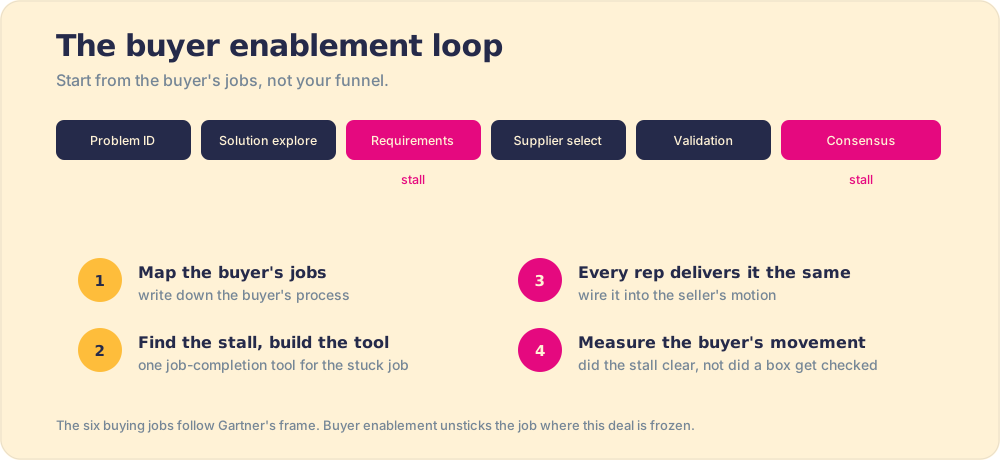
That last step is where buyer enablement stops being a content project and becomes a measured process. Plenty of teams will build a value calculator, ship it, and never check whether the buying jobs downstream actually move. The point of the tool was the buyer’s progress, so the buyer’s progress is the metric. If you cannot see whether the experience improved, you have not enabled the buyer. You have just made more buyer enablement content.
There is a related discipline worth borrowing here: the mutual action plan, a shared, written sequence of the steps both sides will take to a decision, is buyer enablement in its purest form. It makes the buyer’s jobs explicit, assigns them, and gives a nervous committee a path they can see. It is the trail map, drawn together and handed to the hiker.
What we recommend
Lay out the real options and the choice is cleaner than the topic’s fog suggests. You can keep pointing enablement inward, sharpening the rep and printing more content, and accept that you are optimizing a person who is in the room for a sixth of the journey. Or you can point it at the buyer: map the jobs, find the stall, build the tool that finishes the job, and deliver it through a seller motion consistent enough that every buyer gets the same clear path.
Point it at the buyer. The evidence, not principle, settles it. Gartner’s 77% says the buyer is the one drowning, not the seller. Gartner’s 17% says you cannot rescue them by adding rep time you will never get. Gartner’s 1.8x says the tool that finishes a buying job, handed over by a rep, is what moves a deal to a confident close. And our own data says a process delivered consistently in the flow of the work more than triples quota outcomes, because consistency is what the buyer feels. Those four point one way. The lever is not a better pitch. It is a buyer who finds buying from you easier than buying from anyone else.
So when you next plan an enablement quarter, ask the awkward question first: is this work aimed at our seller or at our buyer’s stall? If it cannot name the buying job it unsticks, it is seller polish wearing a buyer’s name. If you want the broader frame for how enablement is shifting from content to behavior, start with what sales enablement is and the move toward revenue enablement; if you want the buyer-facing room where these tools now live, read up on the digital sales room; if you want to see how the buyer’s experience has to survive the handoff after the deal closes, the sales-to-customer-success handoff is where most of that experience breaks; and if you want the system that makes the whole motion consistent enough to be felt, start with the sales enablement software guide and the data behind it in The State of Sales Enablement.
Frequently asked questions
What is buyer enablement?+
How is buyer enablement different from sales enablement?+
What is buyer enablement content?+
Why does buyer enablement matter now?+
What are the best buyer enablement tools?+
What are examples of buyer enablement?+
How do you do buyer enablement well?+
Your process, running itself.