Digital Sales Room: A Branded Content Link Is Not a Deal Room
A digital sales room gets sold as a prettier place to share content with buyers. Its real job is to help six to ten buyers coordinate and reach consensus, which is the actual bottleneck in a complex B2B deal.
A digital sales room is a shared online space for a deal, and its value is in coordinating the buying group around a mutual action plan rather than displaying content, because the bottleneck in a complex B2B deal is the group reaching consensus, not the buyer finding a deck.
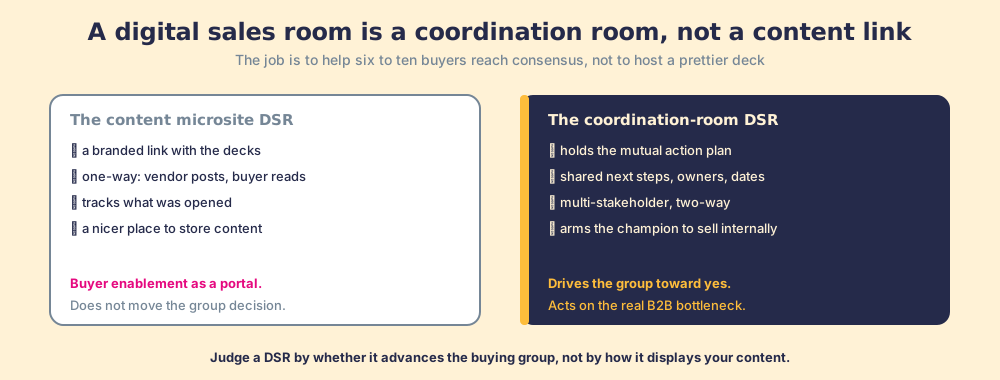
The digital sales room is usually pitched as buyer-side enablement: instead of emailing the buyer a dozen attachments, give them one branded link with all the collateral, neatly organized, with analytics on what they opened. It is a real improvement over a messy email thread, and it solves a small problem. The buyer’s difficulty in a complex deal was never finding your content. It was getting six to ten stakeholders, each with different priorities and a veto, to agree with each other. A digital sales room that perfects content display has perfected the wrong thing, the same mistake content-portal enablement makes on the seller side. The version that matters is not a nicer place to store decks. It is a room where the buying group coordinates toward a decision.
So what is a digital sales room, stripped of the marketing? A digital sales room is a shared online space for a deal, and its value is in coordinating the buying group around a mutual action plan rather than displaying content, because the bottleneck in a complex B2B deal is the group reaching consensus, not the buyer finding a deck. Build it for coordination, and it works on the thing that decides the deal.
Why is a content-microsite DSR not enough?
Because content access was never the constraint in a complex deal, the buying group’s internal agreement was. As we traced in the B2B sales process, a typical complex purchase involves six to ten decision-makers who must reach consensus (Gartner, on the B2B buying journey), and the most common loss is to “no decision,” the group that wants to buy and cannot get itself aligned. A content-microsite DSR does nothing for that. It is one-way: the vendor posts material, the buyer reads it, the tool reports what was opened. That improves the buyer’s access to your decks and leaves the buying group’s coordination problem entirely untouched, which means it optimizes a non-constraint while the real bottleneck, consensus, sits unaddressed.
How big is that bottleneck? Bigger than price and bigger than the competition. In The Jolt Effect, Matthew Dixon and Ted McKenna analyzed more than 2.5 million recorded sales conversations and found that between 40 and 60 percent of forecasted deals are lost not to a rival but to “no decision,” the buying group that wanted to move and could not bring itself to (Dixon & McKenna, The Jolt Effect). The cause is rarely a missing data sheet. It is a group of people, each carrying some private fear of choosing wrong, who never reach the shared confidence a purchase requires. A tidier content portal does not lower anyone’s fear of being the one who picked the tool that failed. It makes the fear easier to read about and no easier to resolve.
This is the buyer-side version of the same trap that catches seller-side enablement, where a content portal improves findability and changes no behavior. A DSR built as a content microsite is buyer enablement as a portal, a tidier filing cabinet for the buyer, and a filing cabinet does not move a group toward yes. The decision happens in the stakeholders’ internal conversations, and a DSR that only displays content is not present for any of them.
Why does the rep’s absence make the digital sales room matter?
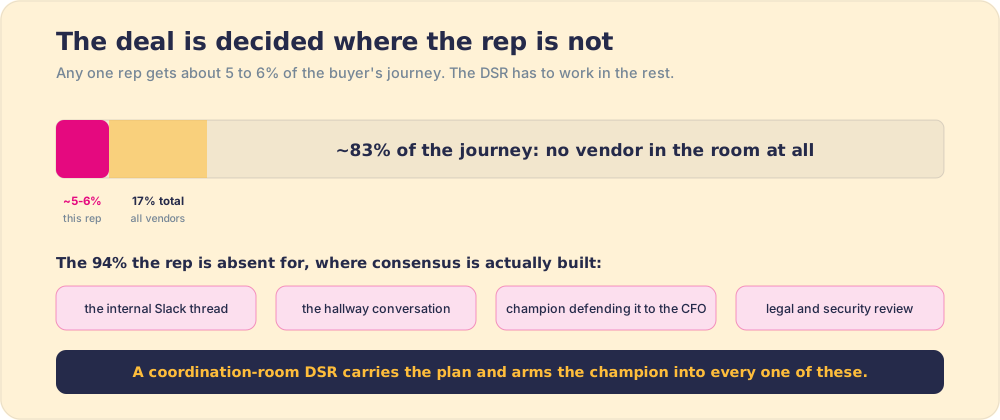
Here is the fact that reframes the whole tool. The seller is barely in the room for the decision. Gartner’s buying-journey research found that B2B buyers spend only about 17 percent of their total purchase time meeting with all potential suppliers combined, and when that sliver is divided across the vendors in the running, any single sales rep gets roughly 5 to 6 percent of the buyer’s attention across the entire journey (Gartner, B2B buying journey). The other 94 percent happens in rooms the rep will never enter: the internal Slack thread, the hallway conversation, the meeting where the champion has to defend the choice to a skeptical CFO without you there to help.
That is the real job of a digital sales room, and it is the opposite of displaying content. The rep cannot be present for the decision, so the DSR has to carry the deal’s standard into the rooms the rep cannot reach. It is the difference between a salesperson and the thing the salesperson leaves behind. A microsite leaves behind a brochure. A coordination room leaves behind a working plan, a shared view of what happens next, and a champion equipped to advance the deal in the 94 percent of the time the rep is absent. One of those acts on where the deal is decided.
What should a digital sales room do for the deal?
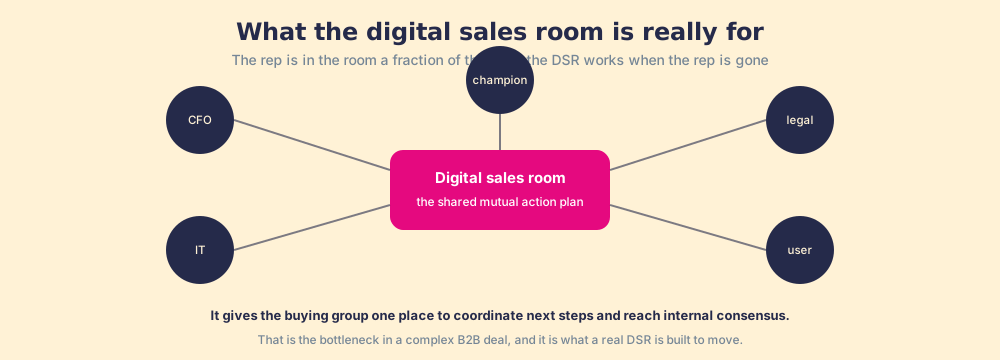
Coordinate the buying group around a shared plan, especially when the rep is not in the room. The defining fact of a complex deal is that the seller is absent for most of the decision, which happens in internal conversations the rep never attends. So the DSR’s real job is to work when the rep is gone: hold the mutual action plan so the agreed next steps, with owners and dates, are visible to everyone; keep all stakeholders aligned on where the deal stands; and arm the champion to advance the deal internally on the rep’s behalf. That is coordination, not display, and it acts precisely where the deal is won or lost, which is the logic behind a strong mutual action plan.
The distinction between the two kinds of DSR is concrete and worth checking before you buy. When you evaluate digital sales room software, the demo will show you the content experience, because that is the part that demos well; the coordination capabilities are harder to see and matter more. The best digital sales room examples are not the prettiest microsites but the deals where every stakeholder knew the next step and the champion never had to wait on the rep to move things forward.
- The microsite is one-way and content-first. Vendor posts, buyer reads, tool tracks opens. It improves access, not the decision.
- The coordination room is two-way and plan-first. Mutual action plan, shared next steps, aligned stakeholders, an equipped champion. It moves the group.
- The test is the buying group. Does the DSR advance the stakeholders toward consensus, or does it merely present your material more attractively?
How should you choose and use a digital sales room?
Pick the coordination room over the microsite, and run it around the mutual action plan. If your deals are simple and single-threaded, a content link is fine, because there is no group to coordinate. But complex B2B deals are decided by a buying group, and there the DSR should be chosen and used for coordination: build it around a mutual action plan with clear next steps, owners, and dates; keep every stakeholder seeing the same current state; and equip your champion to drive the deal internally when you are not present. Evaluate a DSR by whether it advances the buying group toward consensus, not by how elegantly it shows your content, and use it as the shared workspace for the decision rather than as a brochure. The deal is won in the room you are not in, and a real digital sales room is how you stay useful there.
What we recommend
Choose and use a digital sales room for coordination, not content, because content access was never the thing holding a complex deal back. The bottleneck is the buying group reaching internal consensus, and a DSR that is only a branded link to your decks does nothing for it, however much nicer it looks than an email thread. The version that matters is a coordination room: it holds the mutual action plan, keeps six to ten stakeholders aligned on the next steps, and arms your champion to advance the deal when you are not in the room, which is most of the time. So judge every DSR by whether it moves the buying group toward a decision, build it around a mutual action plan rather than a content library, and treat it as the shared workspace where the deal gets decided. A prettier place to read your collateral is a small upgrade. A room where the buying group coordinates toward yes is the deal.
From here: the buying-group dynamics in the B2B sales process, the plan at its center in mutual action plan, the content-portal trap it mirrors in sales enablement platform, and the adherence underneath in sales process adoption.
Frequently asked questions
What is a digital sales room?+
What should a digital sales room do?+
Is a digital sales room only a content portal for buyers?+
Why does a digital sales room help in complex deals?+
Your process, running itself.