Pipeline Coverage: Diana Marcela Gonzalez's Quarter Math and the Month-Two Check
Diana Marcela Gonzalez carries a $350K quarterly number for RevPartners' Allbound service line. She plans 3x to 4x pipeline coverage, checks it at the start of month two, and fills the gaps with allbound.
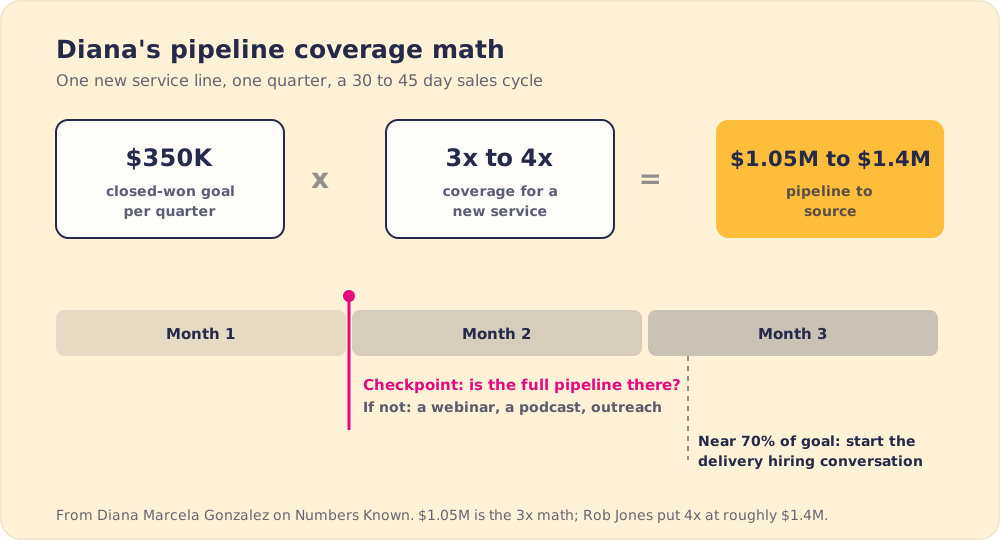
Pipeline coverage is the ratio of open pipeline to the revenue target it has to produce, so a $350K quarterly goal planned at 3x coverage needs about $1.05M of live deals.
Diana Marcela Gonzalez has a number in her head “pretty much every single day.” It is $350K, the average quarterly closed-won goal for the Allbound service line she leads as go-to-market director at RevPartners, the HubSpot partner I co-founded. “I obsess over it every single day,” she said. She works from Colombia, has worked remotely for more than a decade, and still takes three real vacations a year.
Rob Jones worked beside her at RevPartners and calls her his mentor from “a lifetime ago.” His show Numbers Known starts from the idea that top performers know their numbers, so he asked what it takes to hit hers. Her answer on pipeline coverage came with a ratio and a date on the calendar.
How much pipeline coverage does a new service need?
Rob went straight at the math and asked how much pipeline $350K takes.
“Usually uh with a new service, you have really low conversion rate,” Diana said. “So, you need to generate a lot of deals to be able to get to your revenue numbers. So, right now, we are averaging like 3x or 4x in pipeline generation to be able to get to that 350.”
Rob put the top of that range at roughly $1.4 million in pipeline. Then he pushed on the ratio itself, asking whether she would need $5 million, or whether $800K would do for a service that converted at 70%. Diana’s own reason for 3x to 4x was the low conversion rate of a new service, and Rob’s hypotheticals ran the same logic the other way: a proven service that closes most of its deals can carry less pipeline.
Ebsta and Pavilion saw the same pull across the market. Their 2024 benchmarks, built on 4.2 million opportunities from 530 companies, found pipeline generation up 23% while win rates fell 18% against 2022, and revenue still declined (Ebsta and Pavilion, 2024 B2B Sales Benchmarks). Sales teams, in Ebsta’s words, sought comfort in more pipeline coverage.
For your own number, start from the win rate of the product in question. Diana’s new service line has its own ratio, separate from the company average. Then measure your real sales cycle, because the length of it decides when the check has to happen.
Why does Diana check pipeline coverage at the start of month two?
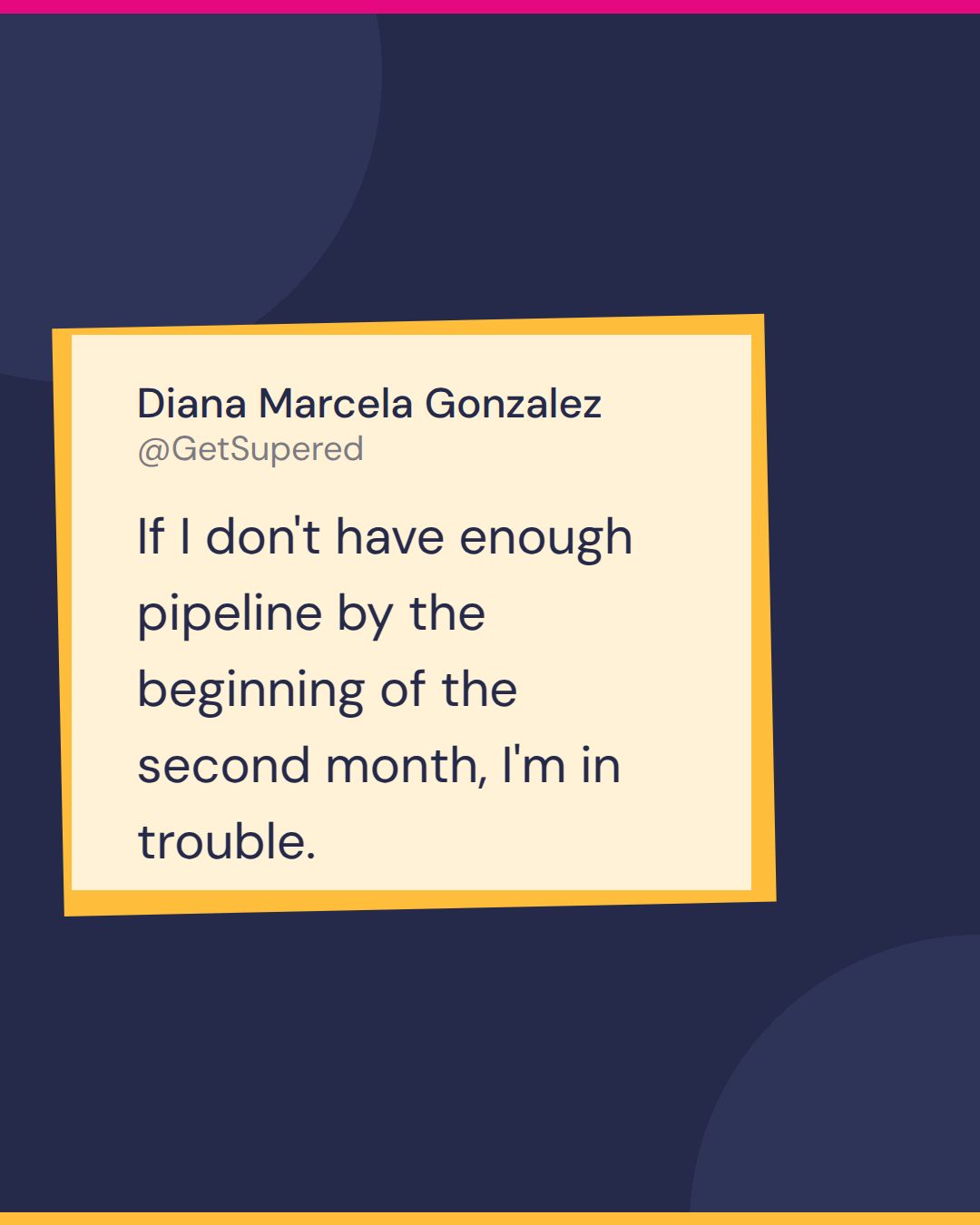
Her sales cycle sets the date for the check. “The rule of thumb is if I don’t have enough pipeline by the beginning of the second month, I’m in trouble, right? because our sales cycle is about 30 to 45 days,” she said. With a cycle that long, a deal that first shows up in month three will not close inside the quarter. She checks while there is still time to act, and she knows what she will do if the number is short. “I need to do a webinar or join a podcast like this or uh do outreach or something specific to be able to get to those numbers.”
Her forecast also drives hiring. RevPartners’ delivery team runs a capacity model, and almost every week Diana lines up the sales forecast against it. “If we are like at 70% of goal or something like that uh within the quarter and we haven’t closed the quarter we need to trigger hiring for that particular service line,” she said. Hire too late and clients wait. Hire too early and “we have somebody in seat without actual work to be done.”
She was frank that the model is half numbers and half feel. It runs on “a lot of yes quantitative information based on you know deal amounts and stuff like that but a lot of gut feeling also.” When her “antennas start twinkling,” she said, “I know that I need to like start poking the bear.”
Diana’s gut feel sits on top of that weekly review with delivery. In The State of Sales Enablement 2026, managers most often inspected deals through CRM dashboards (58%) or ad hoc intuition (26%), while structured deal-review templates, the method tied to the highest quota attainment, were in active use by 3% of respondents (The State of Sales Enablement 2026). Put a date on your coverage check, write down the actions it triggers, and review deals against the same questions each week, as in a pipeline hygiene routine.
What is a good pipeline coverage ratio?
Three times the target is the usual starting point, and Diana’s episode shows how to adjust it:
- The formula. Coverage is qualified open pipeline divided by the revenue target for the period. $1.05M against $350K is 3x.
- The win rate underneath. Coverage is roughly the inverse of the win rate. A new service with low conversion needs 3x to 4x, as Diana’s does. Rob’s hypothetical service that closed 70% of deals would need far less.
- The cycle length. A 30 to 45 day cycle means the pipeline has to exist by the start of month two. A longer cycle moves the checkpoint earlier.
- The segment. A new offer gets its own ratio instead of borrowing the company average.
For the weekly mechanics of keeping those deals accurate, our guide to sales pipeline management covers stage definitions and reviews.
How does allbound keep the pipeline full?
Rob’s last number for Diana was 68. “68% of all B2B stats are made up,” he said, and Diana laughed and agreed. Earlier he had cited a five-minute window for reaching a new lead, which comes from the best-known study on response time. The MIT Lead Response Management Study, run with InsideSales.com across more than 15,000 web leads and 100,000 call attempts, found the odds of qualifying a lead fell 21 times when the first call came at 30 minutes instead of five (Oldroyd and Elkington, 2007). Speed to lead is one of the things allbound is built to fix.
Diana’s answer is allbound, the motion she helped design at RevPartners. Treating inbound and outbound as two disjointed motions, she said, does not fit how buyers shop now, “because we have fed them so much information.” The goal is “to be everywhere at the right time and to the right person.” In practice, “you are creating signal-based list building activities to be able to feed information into your system and when a signal triggers you are immediately surfacing that company into your BDRs or sending automated outbound campaigns,” woven together with paid retargeting. Clay and HubSpot sit at the core, with HeyReach and sequencers alongside.
Rob, who has asked her for this before, made her explain it with a cooler. You search for coolers. The search is a signal. Your record gets enriched, retargeting ads follow you on Google and Meta, emails arrive shaped by what you clicked, and someone calls or messages you. “Within a month of you looking up that Kool-Aid,” she said, meaning the cooler, “you will purchase from the company that you’ll have information about.”
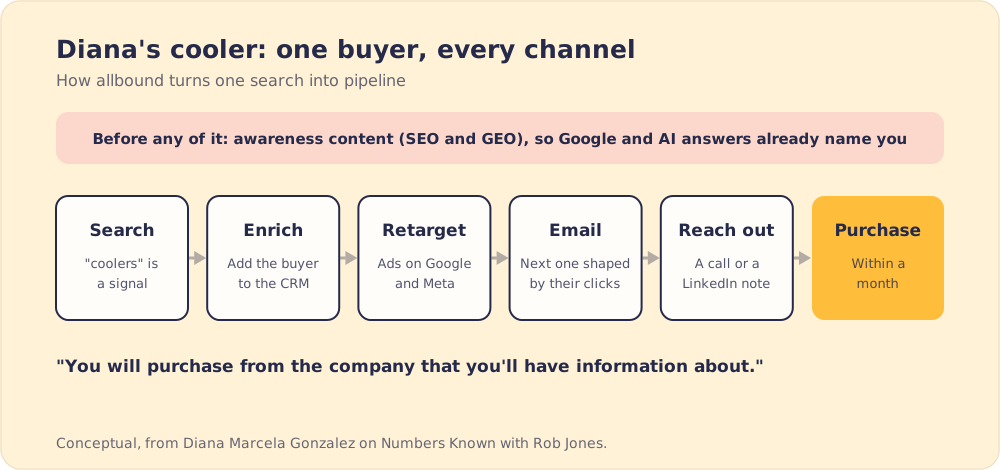
When Rob asked how a challenger beats the incumbent, Diana went a step earlier. In GEO audits, meaning generative engine optimization for AI answers, she usually finds the awareness stage empty: “They don’t have content around awareness.” Filling it comes before outreach and ads. It has paid off for RevPartners itself. ChatGPT, she said, “has become one of our top deal generators as a professional services company,” because buyers ask it “What is the best HubSpot implementation company in the US?”
G2’s March 2026 survey of 1,076 software buyers found 51% now begin their research with an AI chatbot more often than with Google, and 69% chose different vendors because of chatbot recommendations (G2). Diana’s point is that the chatbot can only recommend a company whose awareness content already exists.
Why are three vacations a year part of Diana’s system?
Diana’s second number was three, the vacations she takes each year. “Listen, this is non-negotiable for me,” she said. One is a beach trip of a few days to a week. One is an adventure, usually two weeks in a new country. One is somewhere in Colombia she has not seen. On those trips she is fully offline, “I will not be answering emails,” and without them “the rest of my year is just sort of offbalance and I’m not as motivated or as efficient or as nice to people.”
Rob told a story on himself. Before a trip to St. Lucia, Diana told him to delete Slack. Three days in, he opened it to check on a deal, and while he typed she saw “Rob Jones is typing.” By her own account she was one of the company’s heaviest Slack users that year, and she calls her priority “unblocking people.” Rob’s second number for her was 1936, the founding year of the university where she did her master’s. She finished every course in her master’s program and skipped the degree, because no professor would supervise a thesis on revenue operations and AI. She also wants five conference stages before she turns 40.
What Diana Marcela Gonzalez runs her quarter on
- A number held daily. $350K a quarter for one service line, and a clear idea of who she needs to ping to feed it.
- A ratio set by conversion. 3x to 4x for a new service with a low close rate, which puts the pipeline at $1.05M to $1.4M.
- A checkpoint set by the cycle. With a 30 to 45 day cycle, the full pipeline has to exist by the start of month two, or a webinar, podcast or outreach push starts now.
- A forecast that reaches delivery. Near 70% of goal, the hiring conversation for that service line begins.
- An allbound engine. Signals, enrichment, outreach and retargeting work as one motion, on top of awareness content that AI answers pick up.
- Rest on the calendar. Three vacations a year, fully offline.
What should a revenue leader take from Diana’s pipeline coverage math?
Set coverage per offer from its own win rate, and tie the check to your sales cycle so it lands while new deals can still close. Diana’s version for a 30 to 45 day cycle is easy to copy. She plans 3x to 4x for a new service, takes a hard look at the start of month two, keeps a list of pushes ready if the number is short, and lines the forecast up with the people who will deliver the work each week. When a push brings in new leads, the MIT numbers say to call them within minutes.
Choose the ratio and the date before the quarter starts, the way Diana does, and feed the result into your sales forecasting while there is still time to act on it.
Frequently asked questions
What is a good pipeline coverage ratio?+
How do you calculate pipeline coverage?+
When should you check pipeline coverage during a quarter?+
Why does a new product need more pipeline coverage?+
What is allbound?+
Your process, running itself.
Turn the playbook into rep behavior.
More from Numbers Known

Active Listening in Sales, Taught by a Comedian: Chris Bogue's Improv Rules for Sellers
Chris Bogue
Quit Your Job to Start a Business? Crispy Barnett Wishes He Had Gone Sooner
Crispy Barnett