Sales and Marketing Alignment: The Honest Signal Is Whether Sales Uses the Content
Most sales and marketing alignment advice hands you an SLA, a shared dashboard, and a recurring meeting. Those are documents about alignment. Here is the metric that proves it.
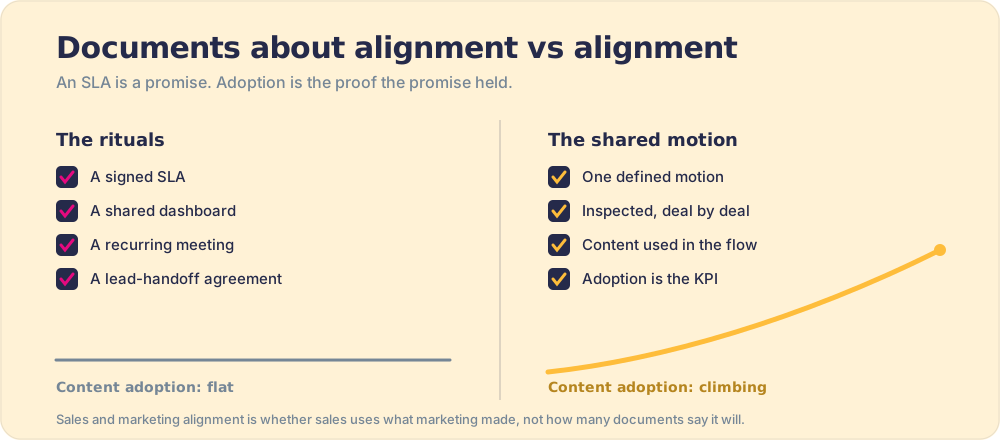
Sales and marketing alignment is two teams running one shared, inspected process against an agreed definition of the motion, and the only honest signal of it is whether sales actually uses what marketing produces in the flow of the deal.
Picture a company that has done everything the alignment playbook asks. Sales and marketing signed a service-level agreement last quarter. They share a dashboard. They hold a standing Thursday meeting where both leaders nod at the same funnel chart. The lead-handoff rules are written down and agreed. On paper, the two teams are as aligned as two teams can be. Now watch a rep on a live call, asked about a competitor they have not faced before. They do not reach for the battlecard marketing built for exactly this moment. They have never opened it. They wing the answer and promise to follow up.
That gap is the whole subject here, and the standard advice walks right past it. The conventional fix for sales and marketing alignment is a set of rituals: an SLA, a shared dashboard, a recurring meeting, a lead-handoff agreement. Those are documents about alignment, not alignment. Two teams are aligned when they run one shared, inspected process and agree on the definition of the motion, and the only honest signal is whether sales actually uses what marketing produces in the flow of the deal. Marketing content adoption is the alignment metric. A deck nobody presents, a case study nobody sends, a battlecard nobody opens, these are the truth of a relationship no SLA can paper over. Everything else is attendance.
So here is the definition worth keeping. Sales and marketing alignment is two teams running one shared, inspected process against an agreed definition of the motion, and the only honest signal of it is whether sales actually uses what marketing produces in the flow of the deal. Judge it by adoption, not by the documents both sides signed.
What is sales and marketing alignment, really?
Strip away the org-chart talk and sales and marketing alignment is one thing: the two teams that touch the buyer agree on the motion and run it together. Marketing builds the message and the assets that carry it, the same line that separates product marketing from sales enablement. Sales takes that message into the deal and uses it to move a buyer from interest to signature. Alignment is the degree to which those two halves are one motion rather than two relay runners who never pass the baton.
The reason the ritual definition fails is that it measures the wrong layer. Read alignment as a set of agreements and every fix looks like another agreement: leads are low quality, write a tighter SLA; the teams argue, add a meeting; nobody trusts the numbers, build a shared dashboard. Read it as a shared motion and the question changes to whether sales does the thing marketing prepared them to do. A battlecard nobody opens mid-deal is not alignment with a delivery problem. It is misalignment wearing a green dashboard.
Some teams call this smarketing, the merged sales-and-marketing function HubSpot named years ago, and the idea behind the word is sound. One team, one set of goals, one definition of a qualified opportunity. The label is fine. What it does not guarantee is the behavior. You can merge the org chart, share the quota, and rebrand the standup, and still have a rep who guesses on a pricing question because the pricing guide marketing wrote lives in a folder the rep has not visited since onboarding. The structure can be perfect and the motion can still break at the only point that matters. The org chart aligns. The deal does not.
Why does sales and marketing alignment keep failing?
Not because the teams dislike each other, though they often do. It fails because three structural gaps survive every meeting and every signed agreement. Name them plainly and you can see why the documents never close them.
- The translation gap. Marketing produces the asset on one bank of the river. The seller fights the deal on the other. The asset has to cross, and most of it never does, because it was built off the deal and never reaches the rep in the deal.
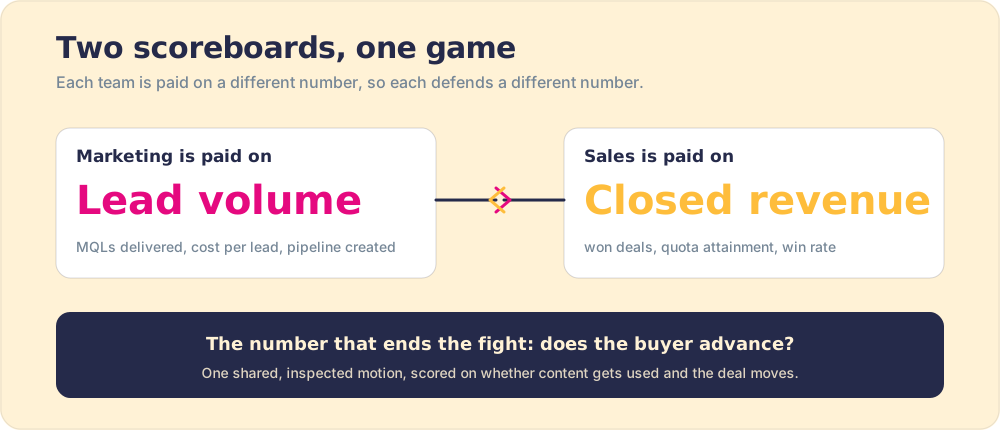
- The leads-versus-revenue fight. Marketing is paid on lead volume; sales is paid on closed revenue. Two scoreboards, two incentives, one inevitable argument at the handoff over whose number is right.
- Content nobody uses. The single largest tell, and the most measurable. Marketing ships the library; sales never opens most of it; both sides assume the other is the problem.
Three gaps, and the documents touch none of them.
Take the translation gap first, because it is the one the playbooks ignore. A marketing team can build nine hundred excellent assets, every one approved, branded, and accurate, and a seller in the middle of a hard call will reach for none of them if reaching means leaving the deal to go searching. The asset was made in a content tool, on a calm afternoon, with the buyer abstract. It is needed on a live call, under pressure, with the buyer specific and impatient. Those are two different worlds, and the bridge between them is where alignment actually lives or dies.
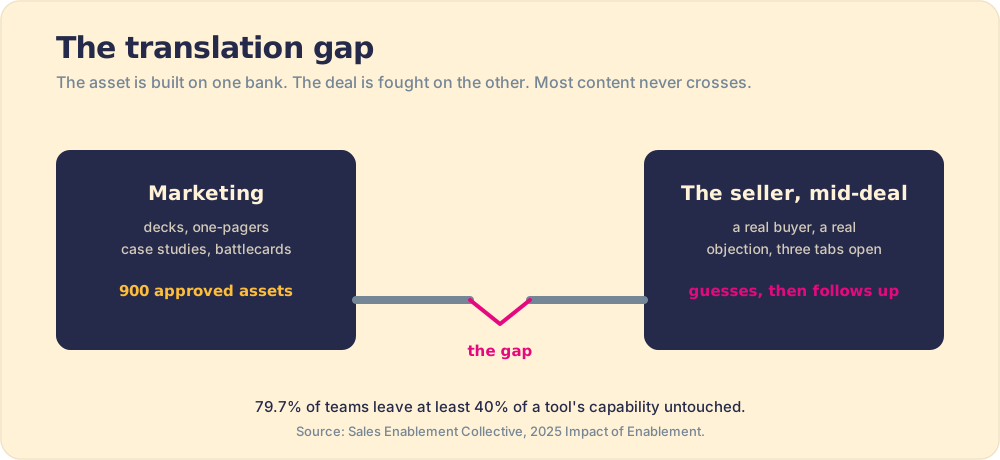
The evidence for how badly content crosses that bridge is blunt. The Sales Enablement Collective’s 2025 Impact of Enablement report found that 79.7 percent of enablement leaders say their reps leave at least 40 percent of a tool’s features untouched (SEC). Read that as a content number, because it is one. Four out of five teams pay to build capability the people it was made for never use. Marketing calls that a sales problem; sales calls it a marketing problem; the truth is structural. Capability built away from the work, and delivered away from the moment of the work, does not get adopted, no matter how good it is or how many SLAs surround it.
The second gap is the incentive split, and it is older than any of the tooling. Marketing optimizes for the number it is paid on, the volume of leads. Sales optimizes for the number it is paid on, closed revenue. Both are doing their jobs. The trouble is that those two numbers can move in opposite directions: a marketing team can hit its lead target by flooding the funnel with names that will never buy, and a sales team can protect its win rate by ignoring most of them. Each side is rational, and the system is misaligned. You cannot meeting your way out of a scoreboard problem. As long as the two teams are graded on two numbers, the Thursday meeting is two people defending two spreadsheets.
What does the alignment industry get right, and where does it stop?
It would be unfair to wave away the whole field, because the people who built it got the diagnosis right. The most-cited modern source on this topic is HubSpot, which coined smarketing and made the case, correctly, that sales and marketing should share goals, a definition of a qualified lead, and a single revenue number. Aberdeen Group’s research, quoted in nearly every alignment article written since, found that companies with strong alignment grow faster than those without. The direction is true and the data backs it.
The numbers are real, and they are large. MarketingProfs found that companies with strong sales marketing alignment generate 208 percent more revenue from their marketing efforts than siloed teams (MarketingProfs, via LaGrowthMachine). LinkedIn’s own research ties tightly aligned go-to-market teams to 24 percent faster three-year revenue growth and 27 percent faster profit growth (LinkedIn, via ZoomInfo). Forrester’s SiriusDecisions reached the same verdict from a different door: analyzing benchmark data from 400 B2B organizations, it found that companies which stay aligned achieve up to 19 percent faster revenue growth and 15 percent higher profitability than those that do not (Forrester, SiriusDecisions). Nobody serious disputes that alignment, when it is real, moves the number. We do not dispute it either.
Where the field stops is the prescription. Having proven that alignment pays, the standard advice then tells you to achieve it by signing an SLA, building a shared dashboard, and holding a recurring meeting. That is the leap we contest. Those artifacts describe alignment; they do not produce it. An SLA is a written promise that marketing will pass leads of a certain quality and sales will work them within a certain window. It is a fine promise. It is not the thing itself, any more than a marriage certificate is a marriage. The 208 percent lift comes from two teams whose motion actually fused, not from the paperwork that announced the intention to fuse. Confuse the certificate for the marriage and you will keep re-signing documents while the relationship stays exactly where it was.
You might object that the documents are how you get started, the scaffolding before the building. Fair, and there is something to it. A shared definition of a qualified lead, written down, is genuinely useful, and a dashboard both teams trust beats two teams quoting different numbers. The objection holds for the first week. It fails by the second quarter, when the documents are signed, the dashboard is live, the meeting is on the calendar, and the rep still has not opened the battlecard. At that point the scaffolding is up and no building has been built. The documents got you to the starting line and then were mistaken for the race.
How do you actually measure sales and marketing alignment?
Measure content adoption, deal by deal. That is the single honest signal, and it is the one the ritual scorecards never show you. Meetings held, SLAs signed, leads passed, these all measure that the machinery turned, not that anything came out of it. The output of alignment is a seller using the message marketing built, at the moment a buyer tests it, to move the deal forward. So measure that directly: for each asset marketing produces, is it reaching the rep in the flow of the work, and is it being used on real deals?
This is where our own field data and the structural argument meet. The State of Sales Enablement 2026 found that teams whose guidance is embedded in the flow of the work hit quota at 49 percent, against 15 percent for teams whose guidance lives in docs, wikis, and a separate tool. Same content. The variable is the moment of delivery. Marketing can build the perfect asset, and whether it counts as alignment or as a folder depends entirely on whether it shows up in the seller’s hand when the buyer asks. The location is the lever, and adoption is what the lever moves.
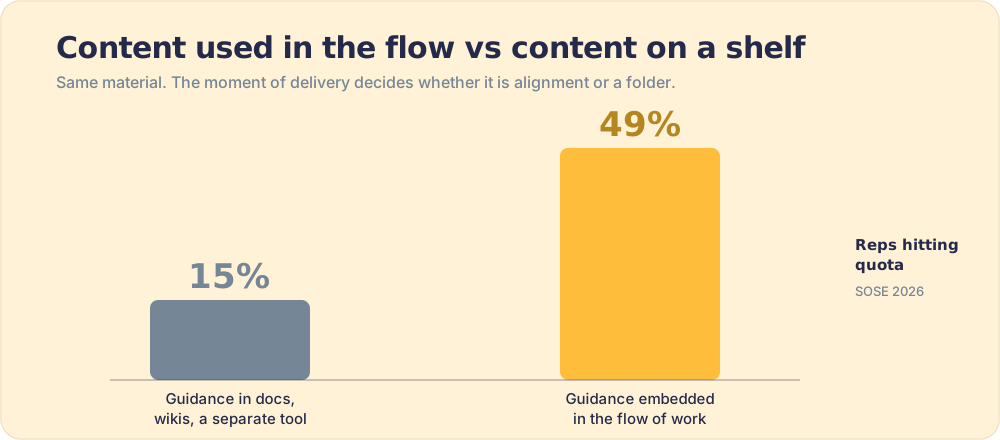
Teams whose guidance is embedded in the flow of work hit quota at 49 percent. Teams whose guidance lives in docs, wikis, and a separate tool hit quota at 15 percent. Same content. The moment of delivery is the lever.
Why does adoption work as the alignment metric when meetings and SLAs do not? Because it is the one number both teams genuinely share. Marketing cannot inflate it the way it can inflate lead volume, since an unused asset shows up as unused. Sales cannot dismiss it the way it dismisses a low-quality lead, since a battlecard that wins deals is a battlecard worth opening. Adoption is the place where marketing’s work and sales’ behavior become a single fact, observable deal by deal, arguable by neither side. It is, in the language we use for any process, the point of inspection, and you can only expect what you inspect. An alignment program with no inspection of content use is a program running on intuition and hope, which is to say not running at all.
There is a deeper reason this is the right number, and it is the buyer. One consistent motion is not an internal control; it earns its keep in the experience on the other side of the table. Gartner has found that 77 percent of B2B buyers describe their most recent purchase as complex or difficult (Gartner). When marketing’s message and sales’ delivery are one motion, the buyer gets a coherent story from first touch to signature: the same value, the same proof, the same answers, whether it arrives in an ad or from a rep on a call. When they are two motions, the buyer feels the seam, the marketing promise that the seller cannot back up, the case study that never arrives. Alignment, measured as adoption, is felt by the buyer as a purchase that finally makes sense.
How do you fix sales and marketing alignment for good?
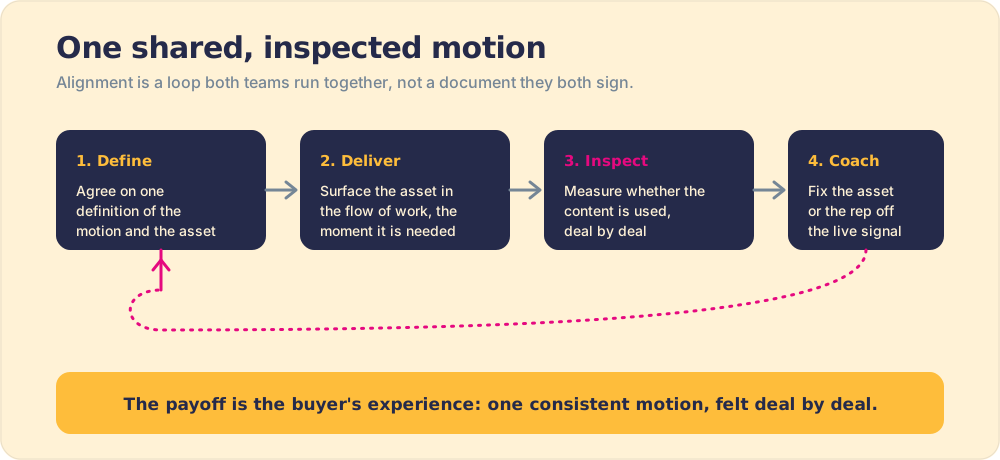
Stop managing the documents and start running one inspected loop. The way to align sales and marketing is not another artifact; it is a motion both teams run together, with content adoption as the score. Four steps, and the order matters.
- Define the motion together. Marketing and sales agree on one definition: the stages, the qualified-lead bar, and which asset belongs at which moment of the deal. Not two definitions reconciled in a meeting. One, written once, owned by both.
- Deliver the asset in the flow of work. Surface the right piece of content to the rep at the moment it is needed, inside the tools where the deal already lives, so using it is the path of least resistance instead of a search the rep skips under pressure.
- Inspect whether the content is used, deal by deal. This is the keystone. Track adoption on real deals continuously, so you can see which assets cross the bridge and which sit on the shelf. Without this step the other three are guesses.
- Coach off the live signal. When an asset goes unused, the loop tells you whether to fix the asset (marketing’s job) or coach the rep (sales’ job), and you fix the right one instead of arguing about which side failed.
The reason this loop aligns the teams when documents cannot is that it gives them a shared object to work on: the deal, and the content’s behavior on it. Marketing stops shipping into a void and starts seeing which assets actually move buyers. Sales stops complaining that marketing is out of touch and starts getting the right asset at the right moment. The Thursday meeting changes from two people defending two spreadsheets to two people looking at one signal and deciding together what to fix. That is what alignment is. Not agreement on paper, but a single motion both teams can see, inspect, and improve.
This is also where the work connects to the rest of the revenue motion. The same inspected loop that aligns marketing and sales is the loop that governs the next handoff, from sales to customer success, and it is the operating model behind revenue enablement as a discipline. If the loop sounds like a sales-enablement problem rather than a marketing one, that is because the line between them is the artifact we are arguing against. For the broader system that puts a shared motion in front of every rep, the sales enablement software guide maps the field, and a sales enablement strategy is where the loop gets a name and an owner.
What we recommend
Two roads sit under this topic, and the field has been pointing down the wrong one. The first road is the one most teams are on: treat alignment as a relationship to be documented, so you write the SLA, build the dashboard, schedule the meeting, and renew them each time the friction returns. It produces a tidy binder and a green dashboard, and it leaves the rep guessing on the call. The second road treats alignment as a motion to be run and inspected, so you define one shared process, deliver content in the flow of the work, measure whether sales uses what marketing built, and coach off that signal.
We recommend the second, without hedging, and the evidence is why. The 208 percent revenue lift MarketingProfs measured comes from teams whose motion actually fused, not from the documents that announced the intention. The 79.7 percent of capability that sits untouched is the translation gap made visible, and no SLA touches it. Our own data, that guidance in the flow of work more than triples quota attainment, says the moment of delivery is the lever, and Gartner’s 77 percent of buyers calling their purchase difficult says the payoff lands on the buyer when the two motions become one. Four sources, one direction: the documents describe alignment, and adoption is alignment. Manage the second and the first takes care of itself.
So keep the shared definition, and stop mistaking the binder for the result. The honest measure of whether your two teams are one is sitting in your content analytics right now: the assets sales actually uses on real deals, against the ones marketing built and nobody opened. If you want the system that turns a documented motion into one reps actually run, start with what sales enablement is; if you want to see how the in-flow delivery is automated, read sales enablement automation; and if you are choosing the platform that makes content adoption measurable, the best sales enablement tools ranks them by the job that actually decides the number.
Frequently asked questions
What is sales and marketing alignment?+
How do you measure sales and marketing alignment?+
Why do sales and marketing teams stay misaligned even after an SLA?+
What is smarketing?+
Does sales and marketing alignment actually drive revenue?+
Your process, running itself.