Solopreneur Tools: Timmy's Top Five, From Sales Navigator to the Bridge He Built
Timmy runs Rooster Booster alone, in a chicken suit, and has done $30K months. On Show Me Your Stack he counted down the five solopreneur tools behind it and what each one taught him about running a firm of one.
Solopreneur tools are the software a one-person business runs on, and Timmy of Rooster Booster judges his by one standard: each tool has to let a single founder do work that would otherwise take a team.
Timmy runs Rooster Booster by himself, and he does it in a chicken suit. The first time he came on a podcast with me, he put the suit on to match what he called our “really unhinged” marketing. Then he made himself a rule. “Actually, this is really fun. Let’s wear this until I hit a million.”
The suit costs him. “I’m losing tons of clients because of it,” he told me. “But, on the other hand, the clients that do come to me are the most fun, most incredible, awesome people.” Inside the costume is a firm of one that has posted record year after record year, with $30K months, selling a LinkedIn-first revenue system to consultancies. He also works as a fractional head of revenue, running four salespeople, a marketer, and a customer success person for a client on the same stack.
When he joined me on Show Me Your Stack, he counted down the solopreneur tools that let one person do the work of a team. He started with a warning: “full honesty, it’s a little bit hard because like these four are really the core of everything.” He ranked them anyway, and added a fifth at the top that he built himself.
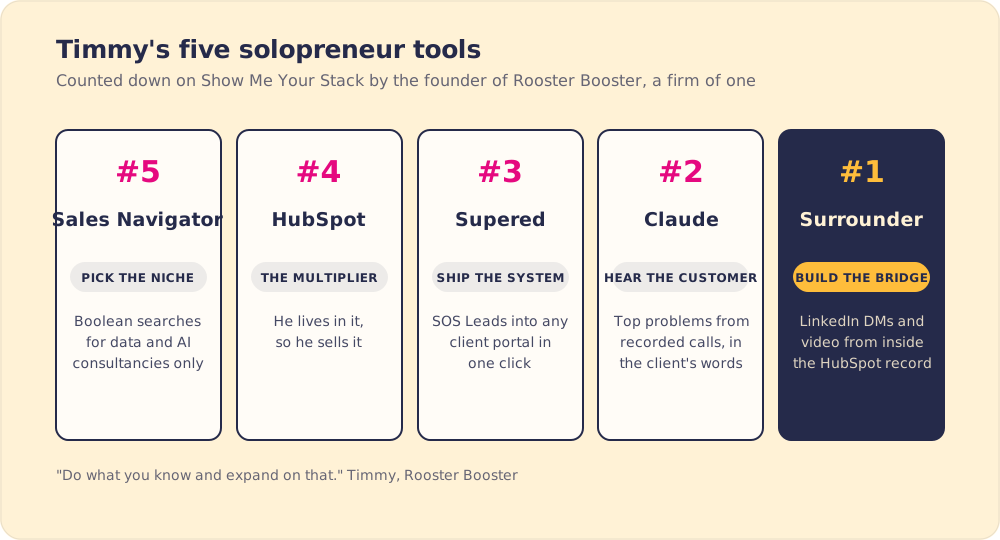
#5 Sales Navigator: why does a solo founder need a niche?
Timmy’s first pick was LinkedIn Sales Navigator, and he talked more about who he searches for than about the software. He sells to data and AI consultancies and almost no one else. “Riches are in the niches,” he said. “I’ve had record year after record year.” He puts those years down to zooming in on data and AI consultancies, with Sales Navigator to find them.
His complaint about other founders is that they cast the net way too wide. A narrow market makes each search tighter, and it makes the outreach easier to write, because after a while you know one kind of buyer’s problems in detail. He builds his searches with Boolean logic, the AND, OR and NOT operators that combine job titles and keywords. I added on the episode that Claude can now write those search strings for you.
The solo market is crowded. Upwork counted 64 million Americans doing freelance work in 2023, 38% of the U.S. workforce (Upwork, 2023). Timmy’s narrow niche means a data consultancy founder sees him as the person who works with firms like theirs. The chicken suit means they remember him.
Timmy’s #5 is the first line of any solopreneur tech stack. Before you pay for a prospecting tool, write down the one kind of company you would most like to serve for five years, and build every saved search around it.
#4 HubSpot: can a CRM carry a one-person business?
Timmy called HubSpot “my bread and butter” and said he lives and breathes in it. He knows the objection, a monthly bill that can run from 90 euros to 500 to 1,000, and he answered it straight. “If you use it the way that you should use it, man it is a multiplier. I am a single person. I am all by myself.”
He sells HubSpot too, as a solution architect, and he was clear about the order. He sells it because he works in it every day, for himself and for his clients. He has little patience for consultants who build workflows for problems they have never had. “A lot of people do workflows that they have nothing to do with and it’s all theoretical BS,” he said. His rule is “do what you know and expand on that.”
I added a worry of my own. AI has made ideas cheap, and it has made execution look cheap. “Ideas are cheap, execution looks cheap, and that’s the issue,” I said, because when you look closely at the people posting about wild builds, they often are not running them. Timmy sells only what he runs in his own portal every day.
If you work alone, pick the CRM you will live in and do not sell anything you have not run inside it yourself. Our sales tech stack post covers how to decide what else belongs around it.
#3 Supered: how does one founder guarantee a client’s pipeline?
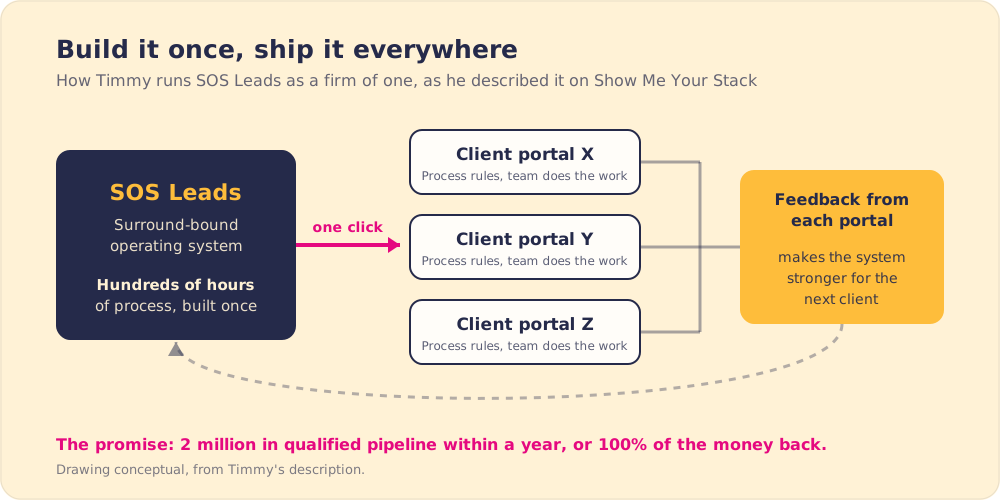
Timmy apologized for putting us third. His reason for including us was the boldest promise I heard on the show. He has put hundreds of hours into a system he calls SOS Leads, short for surround-bound operating system leads, and he sells it with a guarantee: “it literally promises 2 million minimum qualified pipeline within a year or 100% money back.”
One founder can keep that promise only if the system runs the same way in every client’s HubSpot portal. Timmy uses Supered to install it with a click in portal after portal, and he gets feedback from each one. “I’ve completely productized the system,” he said. Each new client makes SOS Leads stronger, the way users improve a SaaS product. He credits our process rules with letting him offer the refund at all, because the result depends on the client’s team doing the work. “If you don’t put in the work, 2 million is not going to fall from the sky.”
Then he talked about where written processes usually end up. “All the processes they die in graveyards, they die in OneDrive,” he said. He wants the process where the reps and marketers already work, inside the CRM, because a new hire’s time is one of the most expensive things a business pays for: “the faster you get them to productivity, the bigger your ROI.”
He explained why measurement changes behavior with an image from driving. Put a dashboard in a car “that says how much fuel you consume, you’re automatically going to consume less.”
Christopher Hart made a related argument about guarantees in Harvard Business Review. A real guarantee, he wrote, forces a firm to set clear standards and to build the feedback that shows where it falls short (Hart, HBR, 1988). Timmy’s portal feedback does that job for SOS Leads.
#2 Claude: will chat windows replace software screens?
Claude came second, and with it Timmy’s biggest prediction. “I really feel that software as we know it is going to disappear. I feel that UI’s as we know it are going to disappear.” He expects people to talk to their software in chat windows, and the value to move to the database underneath, because what the AI can do depends on how clean the data is that you give it. He built his own company website with Claude, Astro and GitHub, something he says he could not have done 10 months earlier.
His daily use is more down to earth. He records every meeting. “If you’re not recording your meetings, you are wasting so many opportunities,” he said, because a conversation that goes unrecorded means “you are losing the voice of the customer.” Once he has a few hundred calls, he asks Claude for the top problems his clients describe, in their own words. “We do not need to call them anymore to do an interview.”
Here he walks through how he mines his recorded meetings.
I disagreed with half of his prediction. I think people will still use screens for what I called last-mile delivery: sending the message, making the call, doing the step. The spending data has room for both of us. Zylo’s 2025 SaaS Management Index found spending on AI-native apps up 75.2% in a year, while companies of up to 500 employees still average 152 apps (Zylo, 2025).
Whoever is right about screens, his advice on calls holds. Start recording now, so there are a few hundred calls to ask about when you need them.
#1 Surrounder: when should a solo founder build the tool?
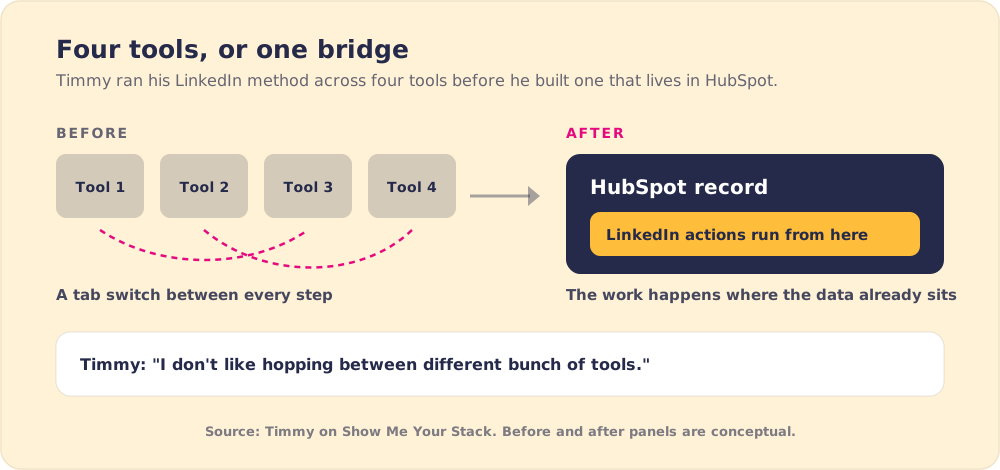
His number one is the product he built. Timmy runs surround-bound, his LinkedIn-first method of surrounding a target audience with useful content and personal outreach. For a long time he ran it across “not one, not two, not three, but four tools.” He kept asking those vendors for fixes and nothing changed, and eventually he understood why: “I’m no one. I’m one seat. So obviously you’re not listening.”
So he built Surrounder, a bridge between LinkedIn and HubSpot. On the episode he demonstrated it live, sending a LinkedIn video DM from inside my HubSpot contact record. The messages and activity land on the record. “I don’t like hopping between different bunch of tools,” he said. He builds only inside HubSpot, unlike some competitors, because “we just want to be where the HubSpot power users are.”
Sales teams know the tab problem too. Salesforce surveyed more than 7,700 sales professionals and found the average sales team closes deals with 10 tools, and 66% of reps feel overwhelmed by them (Salesforce, 2023). A solo founder has no ops team to take the complaint to. Timmy got tired of waiting and wrote the fix.
We would add a rule from his story: build only when you have asked the vendor, waited, and still work around the gap every day. Otherwise, buy the tool.
He closed with two tools he is watching: Ask Elephant, which he likes for building workflows from recorded calls, and Figma.
Key points from Timmy’s solopreneur tools
- A narrow niche. Timmy credits his record years to serving data and AI consultancies. Sales Navigator helps him find them once the choice is made.
- One system you live in. HubSpot is his multiplier because he runs his own firm in it, which is also why he can sell it.
- A method that installs anywhere. SOS Leads goes into any client portal with a click, and its process rules are what let him back it with a refund.
- The customer’s own words. Recorded calls plus Claude replace customer interviews for a founder with no research team.
- A tool of his own, built last. He built Surrounder only after four tools and a string of unanswered feature requests.
What we would do with Timmy’s list
Start where he started, with the niche. Sales Navigator, HubSpot and Claude all do more for a founder who knows exactly whom they serve. Then pick the one system you will live in, and make sure your method runs there, where a client’s team can see the next step and you can see whether they took it. Timmy put a full refund behind his system only after he could watch it run in every portal.
Supered is the part of his stack that installs the method in each portal, and his firm is one of our partners. If you run a firm of one and want to package your own system for clients, our partner program explains how, or you can see Supered in a demo. Then read how a four-person shop grew without hiring its way there in our post on the bootstrapped business.
Frequently asked questions
What solopreneur tools does Timmy of Rooster Booster use?+
How many tools does a solopreneur need?+
Why does a solopreneur need a niche?+
Can a solopreneur offer a money-back guarantee?+
Should a solopreneur record every sales call?+
Your process, running itself.
Turn the playbook into rep behavior.
More from Show Me Your Stack

RevOps Software: Scott Silman's Top Five Tools, and the Opinion Behind Them
Scott Silman
AI for RevOps: Kevin Stout's Top Five Tools, and Why His Team Only Does QA
Kevin Stout