Workflow Documentation: Write Down the Handoffs First
Teams document tasks and lose deals at the handoffs. What workflow documentation is, why the baton pass is where work breaks, and how to document a workflow so it survives contact with turnover.
Workflow documentation is the written record of how a piece of work moves from start to finish across people, tools, and decisions, including the handoffs and exceptions, so the workflow survives turnover and can be inspected, improved, and followed.
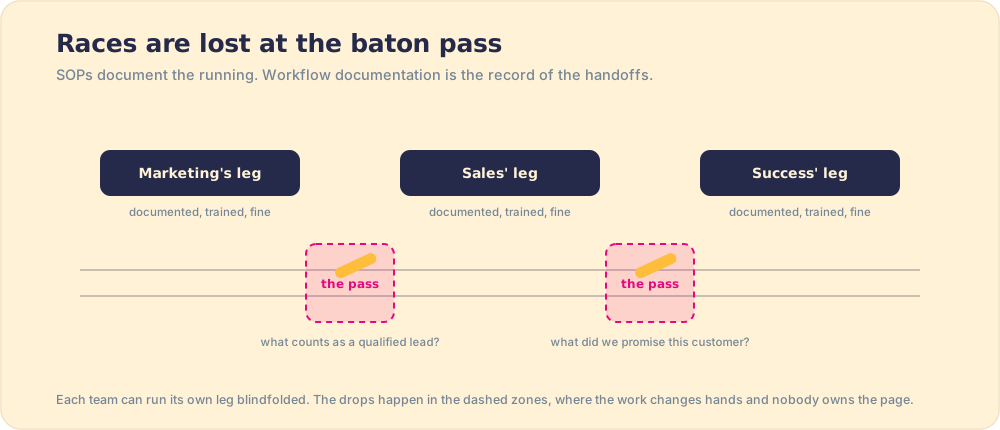
Watch a 4x100 relay closely and you notice something odd about where it is won. The four runners are the visible talent, and the fastest four runners lose routinely, because the race happens in the exchange zones. Sprint coaches treat the baton pass as its own discipline, drilled separately from running, since a tenth of a second fumbled in the handoff erases a season of leg speed. Now look at how your company documents its work. The running is documented: sales has its playbook, success has its onboarding guide, marketing has its campaign checklist. The baton passes are documented nowhere, and that is where your deals are hitting the track.
Workflow documentation is the written record of how a piece of work moves from start to finish across people, tools, and decisions, and its entire reason to exist is the part your task-level documents skip: the handoffs, the decision points, the exceptions. An SOP documents one runner’s technique. Workflow documentation is the record of the relay, exchange zones included, and the exchange zones are the point.
Why do handoffs deserve their own documentation?
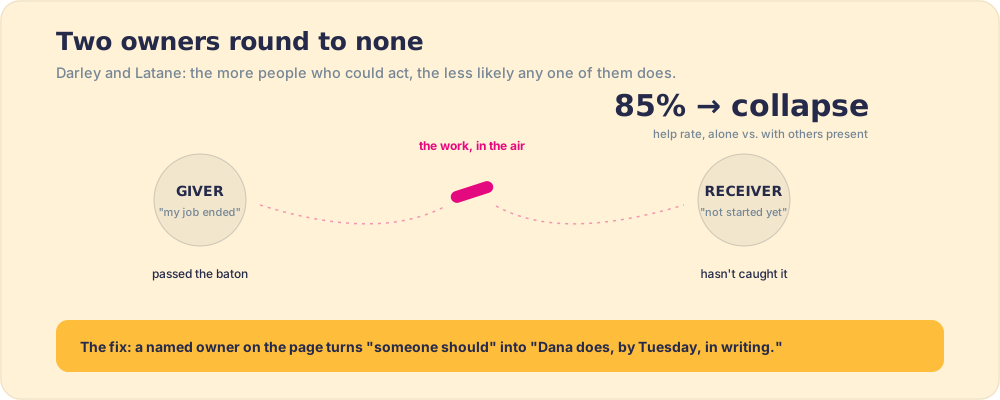
Because a handoff is the one place where a process step has two owners, which in practice rounds to zero. The giver believes their job ended when they let go of the baton; the receiver believes it has not started until it is in hand; and the work itself is in the air between them. “What counts as a qualified lead” is a baton in the air between marketing and sales. “What did we promise this customer” is a baton in the air between sales and success. Each side has a documented leg and a confident opinion, and the disagreement is invisible until a deal or a renewal hits the track.
This is not a quirk of sloppy teams. It is a well-documented feature of how humans behave when responsibility is shared. The social psychologists John Darley and Bibb Latane ran the classic experiments after the Kitty Genovese case and named the diffusion of responsibility: the more people who could act, the less likely any one of them does, because each assumes someone else will (Darley & Latane, 1968). Their finding was that a bystander alone helped 85 percent of the time, but with several bystanders present the rate collapsed. A handoff manufactures exactly that condition: two parties, each able to own the dropped detail, each assuming the other has it. The reason work falls in the exchange zone is not that people are careless. It is that shared ownership reliably produces no ownership, and documentation is the only thing that converts “someone should” into “Dana does, by Tuesday, in writing.” Naming an owner on the page is not bureaucracy. It is the countermeasure to a bias that is in all of us.
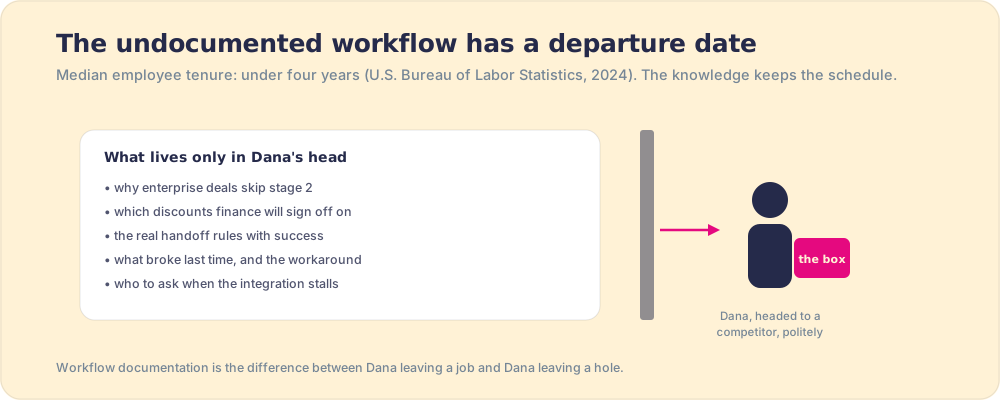
This is also why handoff knowledge is the most tribal knowledge in the building. A task’s steps get written down eventually, because one person owns them and feels the pain of explaining them repeatedly. The rules of the exchange zone live in worked example and hallway memory, in the heads of whoever has been around long enough to have fumbled one. And those heads are on a schedule: median U.S. employee tenure is under four years (Bureau of Labor Statistics, 2024). The undocumented workflow does not stay; it gives notice, works a friendly last two weeks, and walks.
The third number in the case is the daily tax. The McKinsey Global Institute found interaction workers spend 19 percent of the week, nearly a full day, searching for and gathering information (McKinsey, 2012). A documented workflow converts the most expensive searches, the “who owns this and what do they need from me” kind, into a thirty-second read. That day a week is the budget your documentation effort spends from, and it is a generous budget.
How do you write workflow documentation?
Documenting workflows is closer to journalism than to authorship, and how to document a process well comes down to reporting: you are not composing how work should flow, you are recording how it does.
- One real unit, end to end. Pick a live deal, ticket, or hire and follow it the whole way, writing what happens. The gap between the official flow and the followed one is not a nuisance in your data; it is the data. (And before you write anything new, know what already exists; the tooling for capture, storage, and beyond is mapped in process documentation software.)
- The handoffs, with both signatures. For each exchange: who passes, who receives, what exactly is handed over, and what the receiver needs in hand to start. Make the giver and receiver agree on the page. The conversation this forces is the most valuable hour of the whole exercise, because you are documenting the disagreement out of existence. A real example beats a definition here. The marketing-to-sales handoff written badly says “MQLs go to sales.” Written as a documented handoff it says: marketing passes a lead when it hits the agreed score and has a verified work email and company size; sales accepts within one business day or it routes back; what travels is the form fills, the pages viewed, and the campaign that sourced it; and the named owner of disputes is the RevOps lead. The first version is a slogan two teams will read differently. The second is a contract, and a contract is what a dropped baton cannot hide behind. Write that for every exchange and most of your operational fires never start.
- The decision points, with their rules. Wherever the work can branch, write the rule that decides, and the owner of judgment calls. “Deals over $50k route to the AE team” is a rule; “ask Dana” is a single point of failure with a tenure clock on it.
- The exceptions, as you meet them. The official path is the easy 80 percent. The operational gold is what happens when the buyer goes dark, the integration fails, the invoice bounces. Capture each exception the week it occurs, one line at a time; an exceptions section that grows is the sign of a living document.
- Placement at the work, one owner per page. A workflow map nobody opens decays exactly like every other shelved document, so each piece goes where its moment happens, the stage, the queue, the tool, and one named owner updates it on change events, not calendar reviews. Writing each task-level card well is its own discipline, covered in how to write an SOP.
What does this look like for a revenue team?
The revenue workflow is the highest-stakes relay in the building and the easiest to test yourself on. Ask three people, a marketer, a rep, and a CS lead, to describe the lead-to-renewal flow, handoffs included. If you get three answers, you have located the leak in this quarter’s number, and no individual playbook will plug it, because each playbook documents a leg.
We measured the gap between documented and run for sales processes specifically in The State of Sales Enablement: 89 percent of 198 teams had a defined process, 36 percent saw it followed as designed. The same study found the strongest lever was placement, with teams whose process reached reps in the flow of work hitting quota at 49 percent against 15 percent for teams whose process lived in a doc or wiki. Documentation answered “what is the workflow”; placement and measurement decided whether the workflow happened. That second half, the procedure surfacing at the stage where it applies and adherence visible in the flow of work, is what Supered builds for revenue teams, and it only works because the documentation exists to deliver. Write the relay down first.
The recommendation
Document the handoffs before the tasks. It inverts the usual order, and the usual order is why your wiki is full while your exchange zones are empty: tasks have single owners who eventually write them down, and handoffs have two owners and no author. So spend the first week on one workflow, reported end to end from a real unit of work, handoffs signed by both sides, exceptions included. Then place each piece at its moment, name its owner, and measure whether the workflow runs, because you can only expect what you inspect. The umbrella discipline, with the tools and the maintenance loops, is in the process documentation guide, and if the workflow you care about most is the one with quota on it, start with where your sales process should live.
Frequently asked questions
What is workflow documentation?+
What is the difference between workflow documentation and an SOP?+
How do you document a workflow?+
Why is workflow documentation important?+
What tools are used for workflow documentation?+
Your process, running itself.