Bootstrapped Business Lessons From a Four-Person Agency Near $1 Million
Scott Flanigan started Squad4 during COVID with no outside money and runs it with four people at a little under $1 million a year. How he copies himself into the team, keeps delivery simple, and keeps his own portal clean.
A bootstrapped business is a company funded by its founders' own money and its customers' payments instead of outside investors, so it grows only as fast as its own revenue and its own people allow.
When Scott Flanigan started Squad4 in 2021, he did it without a dollar of outside money. He had tried working for himself once before, for a year in the 2010s, and gone back to contracting. He was a long-term contractor when COVID ended the engagement and pushed him out on his own again.
Five years later Squad4 is a bootstrapped business with four people, three of them full-time, a little under $1 million a year in revenue, and new work that comes almost entirely by referral. It reached HubSpot Platinum in December 2025. Scott told me how he built it when he came on Fast & Tierious, and he did not make it sound easy. “I mean success is just gated failure over and over again.”
What he has learned applies to any founder who cannot hire their way out of a busy month. Write down what you expect before you hire. Keep delivery simple enough to repeat. And run your own company on the system you sell.
How did Scott get here?
He spent years inside other people’s CRMs. He worked in Salesforce and Zoho, deployed enterprise field service systems on ServiceNow, and from 2013 or 2014 ran a small HubSpot side practice for local businesses. His first real job was as a technical writer. When HubSpot started building for bigger companies, he picked it. “I want to preach the playbook,” he said. “This is the tool that everyone I interact with can easily adopt.”
Squad4 is run by one number. “My core core guiding principle is revenue per employee,” Scott said. He treats the HubSpot badge as a benchmark, something you look back on “once you’re holding that trophy,” and the firm spends little on marketing because referrals keep the calendar full.
His instinct about size has support in the industry numbers. Promethean Research found the average digital agency earned a 13% after-tax net margin in 2025. Studios with 0 to 9 staff averaged 19%, and agencies with 50 or more averaged 8% (Promethean Research, 2025 data). For a firm like Squad4, staying small can be the plan.
Why does a bootstrapped founder get stuck pulling the wagon?
Scott described the trap with a wagon. “When you start start an organization, you fill the wagon and then if you’re the only person pulling it, uh, that you get into a vicious contractor loop.” He sells the work, loads it on, and pulls. Anyone he brings in has to ask him how each engagement should run, because the instructions live in his head. More clients make the wagon heavier, and a new hire without training ends up riding in it.
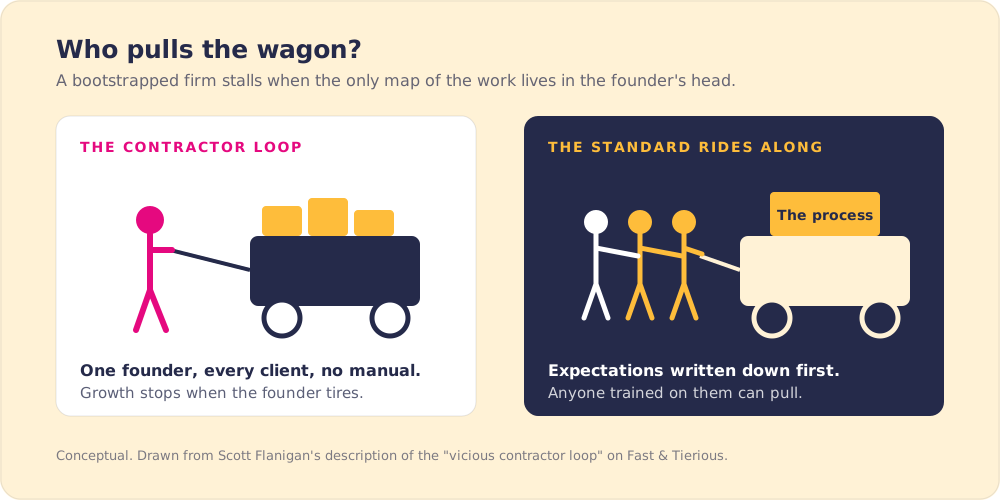
He said the loop slowed him down more than once, and he knows what he would do sooner. “I wish I had started earlier uh, documenting absolutely everything,” he said. “Show it, show your work, show it all.” Writing it down “allows you to yeah hand off other processes, practices, uh expectations to anyone you bring on and train them rapidly.”
Larger firms pay for the same gap. Panopto surveyed 1,000 US workers and found knowledge workers lose 5.3 hours a week waiting on coworkers for information or recreating information that already exists. The same survey found 42% of institutional knowledge is unique to the person in the role (HR Dive on the Panopto report, 2018). At a four-person firm, most of that knowledge sits with the founder. We wrote more about it in our post on institutional knowledge.
What should a founder write down first?
Scott starts with what the client and the team can expect. “Uh start with expectations first,” he said. For a client, that means laying out the 24 to 36 month roadmap, setting benchmarks, and working back to what gets delivered this week. He finds the back and forth hard, “constantly toggling between the macro and micro.”
He writes the same kind of rule for how his team works together. For meetings: “Bottom line up front every meeting has an agenda. You have a purpose. If you don’t have a purpose, don’t be on the call.”
I pushed on this during the episode. In a service firm, the founder is the product, so the founder has to spell out how people deal with clients, down to the recap email after a call and how the client feels leaving a weekly meeting. You have to be “a little bit tyrannical in a loving way at the beginning.” Scott agreed and added the other half. “Give people space to learn and grow, but at the same time, you are kind of trying to reproduce yourself and others.”
Our own survey shows why a small team is the right place to start. In The State of Sales Enablement 2026, 47% of teams where a manager oversaw one to five people reported strong process adherence. At six to eight people per manager, that fell to 23% (The State of Sales Enablement 2026). A founder managing three people can still check the work by hand. Past that, the written standard has to carry more of the load.
Why does “simple scales” make a small team faster?
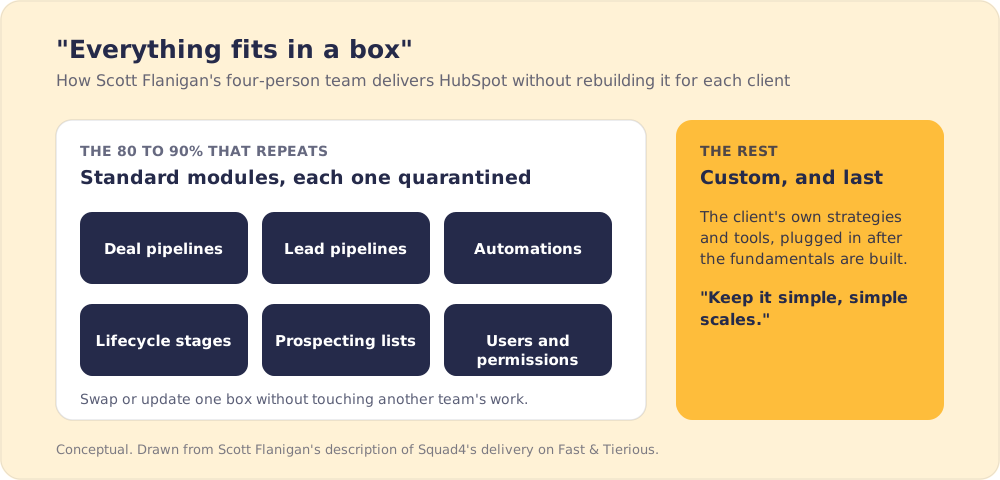
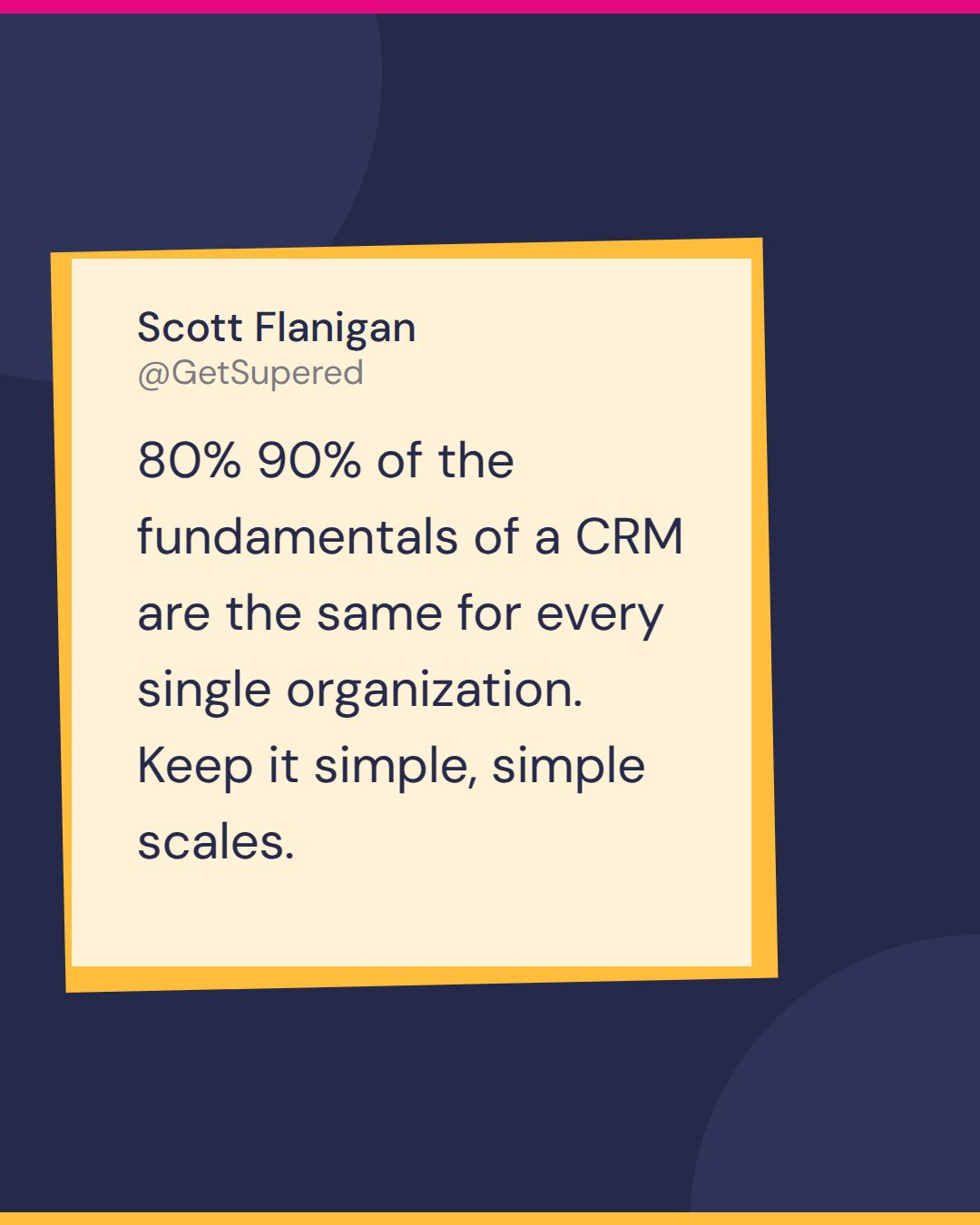
Clients want to customize every part of their go-to-market setup, and Scott pushes back. “80% 90% of the fundamentals of a CRM are the same for every single organization. keep it simple, simple scales.”
He thinks too much customizing hurts the client first. “If we’re customizing your entire CRM, then you’re not in the business of selling your product or service,” he said. “You’re in the business of creating a CRM.”
So Squad4 builds the fundamentals as modules. “From deal pipelines to lead pipelines to automations to how we manage life cycles. Uh everything fits in a box. It’s quarantined.” His team can update or swap one box “without interacting or you know impacting every other department or team.” When a client shows up with years of messy HubSpot history, the team builds new structure alongside it, moves the work over, then tears the old setup down. “Don’t build a house on, you know, shifting foundation.”
Why clean your own house first?
For years, Scott admits, Squad4’s own HubSpot portal was “reminiscent of the cobbler’s kid shoes.” The team fixed client portals all week and left its own a mess. Cleaning it up became a priority: “we’re eating all of our dog food. Uh like every single process is pristine.”
He uses the clean portal in sales calls. “Here’s how a prospecting motion should work. I can click three buttons and I’m immediately outreaching to people I know within a targeted list.” New hires learn from it too, because “every single team member that comes in and interacts with it knows that the digital house is clean.”
I did the same when I ran a partner firm. I demoed our own HubSpot instance and never built a separate demo environment. For Scott, the payoff is confidence on every call: “I know every time I hop on I can hit a button and show what’s live in ours.”
What should a bootstrapped business say no to?
Work that does not fit the boxes. Scott no longer supports clients who want to stay on Salesforce. He will manage the integration, and he stays out of the Salesforce side. “The biggest thing it just kills my time and energy,” he said.
He took that kind of work early on. As I said to him on the episode, “when you’re at zero in revenue, uh you say yes to more things than you should.” Squad4 is past that point now, and Scott ranks his priorities plainly. “Revenue revenue is number one,” he said, and “number two is just velocity.” A week spent relearning a system he left years ago slows down every client on his standard modules.
Scott’s lessons for a lean agency
- A written standard. Document what you expect before you document tasks, so a new person can meet the standard without asking the founder.
- A simple core. Build the 80 to 90% that repeats as standard modules and customize last.
- A clean house. Run your business on the system you sell, and use it for demos and for training.
- A short list of noes. Once revenue allows it, drop work that eats the founder’s time and sits outside the standard.
- Revenue per employee. Treat each hire as a cost that has to earn its place.
Copy the founder, then hire
A founder in Scott’s spot has a few paths. Staying solo is a fine business with a ceiling at the founder’s hours. Hiring ahead of any written standard adds people who have to ask the founder for every answer. Scott took a third path: write the expectations, build the repeatable boxes, clean up his own portal, and hire into a standard that already existed.
We would take his path, and Squad4’s numbers make the case: four people, close to $1 million, growth by referral. Scott’s goals for 2026 are to cross $1 million and bring his whole remote team to Inbound in person.
A written standard only helps if it reaches each person at the step where it applies, inside the tools they already use. Supered puts your process in the flow of work inside HubSpot and Salesforce, so what a founder writes down reaches the next hire without the founder on the call. Partner firms can see how agencies like Squad4 package their delivery on our page for HubSpot partners.
Read our Squad4 partner profile, then our guide to standard work, the manufacturing idea behind “everything fits in a box.”
Frequently asked questions
What is a bootstrapped business?+
How do you scale a bootstrapped service business?+
Is revenue per employee a good metric for a small agency?+
Should a small agency customize everything for clients?+
What should a bootstrapped agency stop doing?+
Your process, running itself.
Turn the playbook into rep behavior.
More from Fast & Tierious

How to Pivot Your Business: Lessons From an Agency That Changed Course Three Times
Przem Orlikowski
How to Plan a Conference: Brendan Tolleson on Building Southbound From 100 Guests
Brendan Tolleson