AI for RevOps: Kevin Stout's Top Five Tools, and Why His Team Only Does QA
Kevin Stout runs Revductive, an AI and RevOps agency where AI does the build and his team only checks it. His five tools, from Gamma to Notion, and the rules he follows before he lets AI touch a client's HubSpot portal.
AI for RevOps means using AI models and agents to plan, build and maintain a revenue team's systems, such as CRM properties, workflows and reports; in Kevin Stout's model, people own the plan and the review, and AI does the building in between.
A week or two before we recorded, Kevin Stout pushed a brand new deal pipeline into a client’s HubSpot portal: 40-some properties and 15 workflows. It was ready in about a day. His team spent the next day checking that everything worked, and they made two changes.
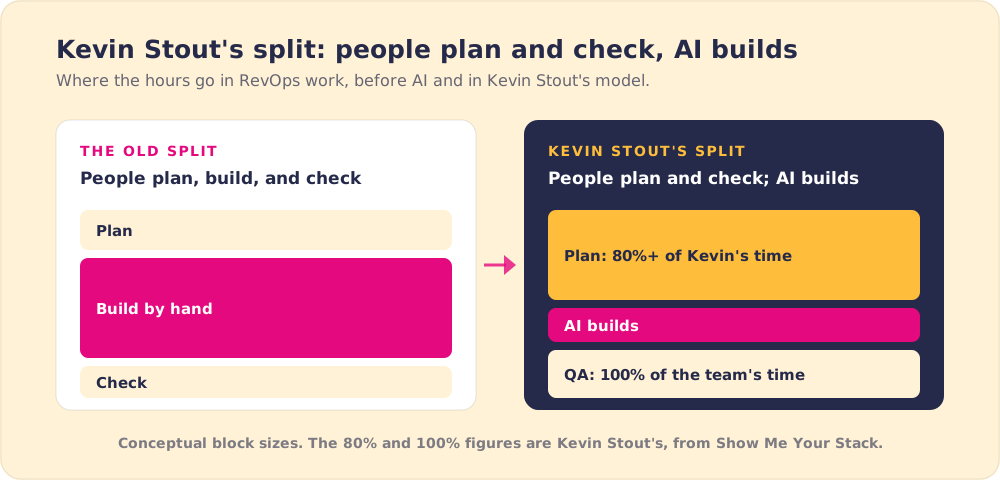
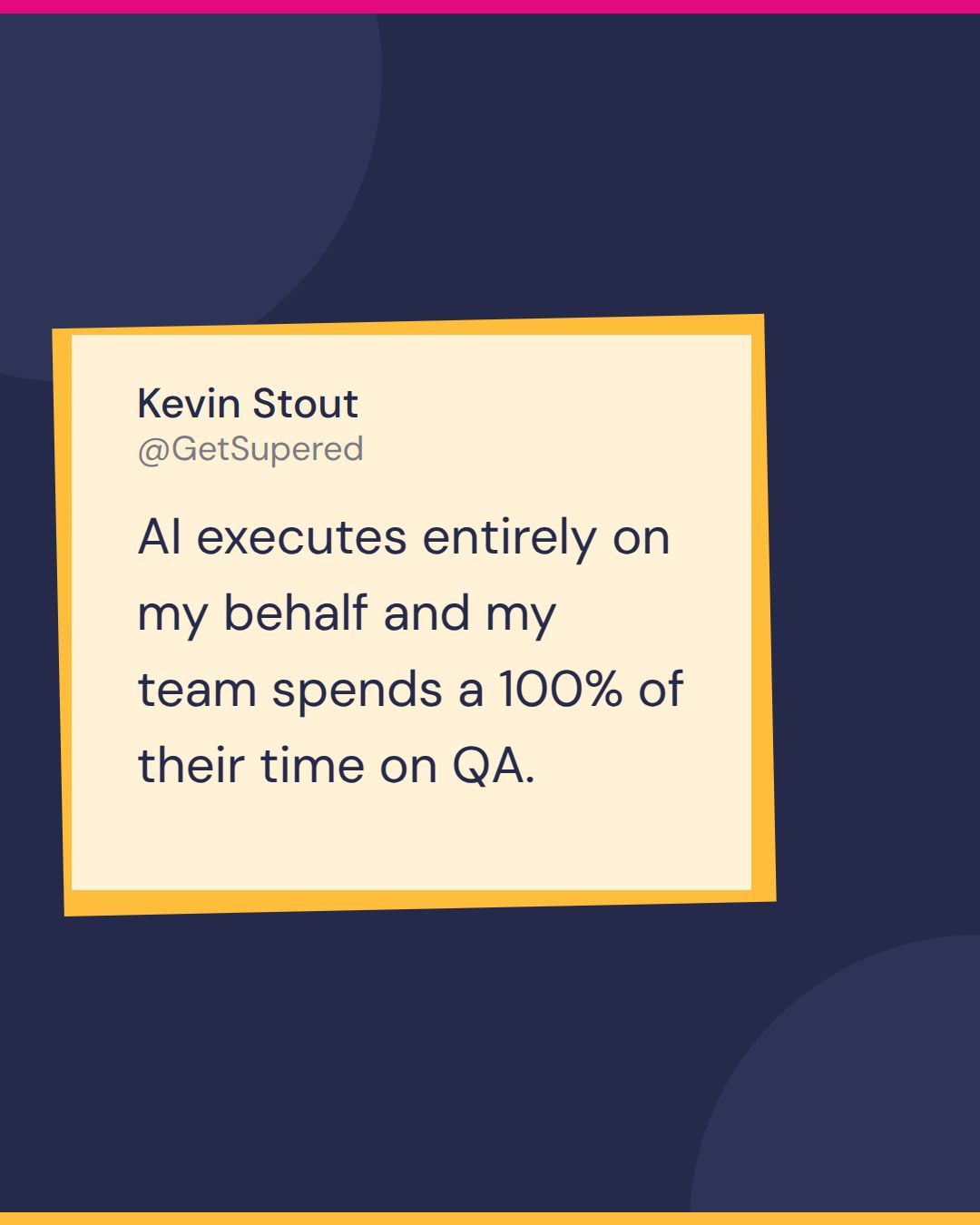
Kevin is CEO and co-founder of Revductive, an agency that helps HubSpot companies with AI for RevOps, and he bought Supered early, back when few people had heard of us. He came on Show Me Your Stack to count down his five most important tools, and along the way he described how his agency now splits the work: “I spend at least 80% of my time if not more just focused on learning the business and coming up with the plan. AI executes entirely on my behalf and my team spends a 100% of their time on QA.”
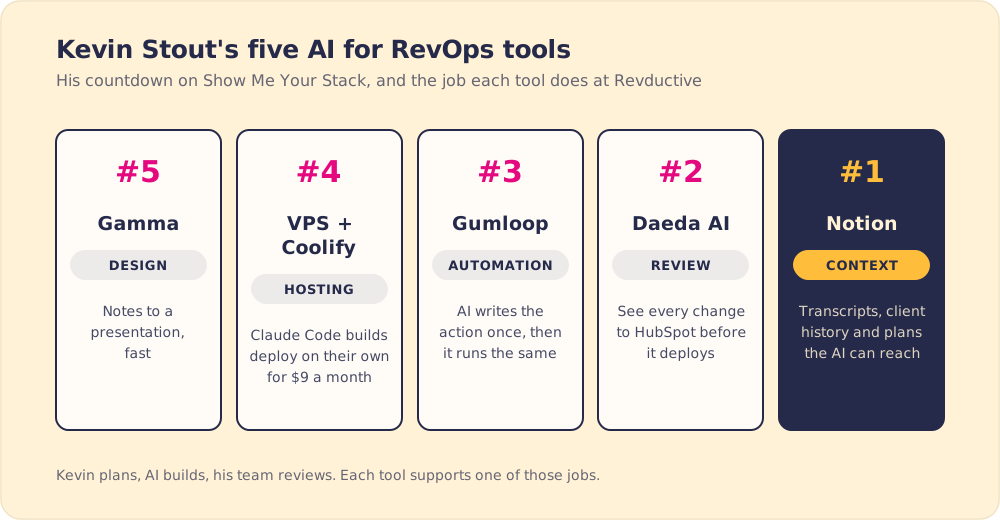
Kevin writes the plan, AI builds from it, and his team reviews what the AI built. Each of his five tools serves one of those jobs.
Before the countdown he named two tools he has recommended to nearly every client for the last year or two: RevenueHero for lead qualification and routing, and SalesMessage for SMS automation, whose AI agents he called “incredible.”
Why does Gamma still make his list?
“I suck at design,” Kevin said. “Once it graduates p past text, I can’t make things look good.” Gamma, his number five, turns his notes into presentations that look the way he wants, and it hosts some of his sales materials on a subdomain, so part of his website lives there.
He admitted that Claude’s design features now do much of the same job, and he has been using them more. Gamma stays because it has been part of his routine for a couple of years and it is still the fastest way from his notes to a finished deck.
What does a nine-dollar server do for a RevOps agency?
Number four is a pair he called a cost-saving measure: a virtual private server from Hostinger plus Coolify, which he described as an open-source Vercel you host yourself. He creates a project in Coolify, connects a GitHub repo, makes changes with Claude Code, and each change deploys to his server automatically. He used to host these tools on Replit, Vercel and others and pay for usage. Now, “I spend like nine bucks a month.”
The server holds tools for himself and dashboards for clients. Reporting moved there on purpose: “building reporting within a tool like HubSpot or within a BI tool is something I’m no longer interested in doing at all.” He is quick to say he is not a developer: “I’m just screwing around with all this stuff like everybody else that’s vibe coding out there.”
If you build internal tools with AI, Kevin’s setup is worth copying for the bill alone: a fixed-price server with automatic deploys means the tenth tool costs the same to host as the first.
Why is Gumloop his favorite no-code tool?
Number three is Gumloop. He has used n8n and Make and watched Zapier add AI features, and “I keep coming back to” Gumloop. Custom nodes and integrations are easy to build with its own AI helper, and people who have never touched a workflow builder pick it up. “I’ve trained a lot of people that are just not very technical on it.”
His main reason is consistency. Gumloop uses AI to help write an action once, then runs that coded action every time, instead of calling a model through the MCP on every run. At scale, he worries about hallucinations. “I’d much rather have a consistent action each time.”
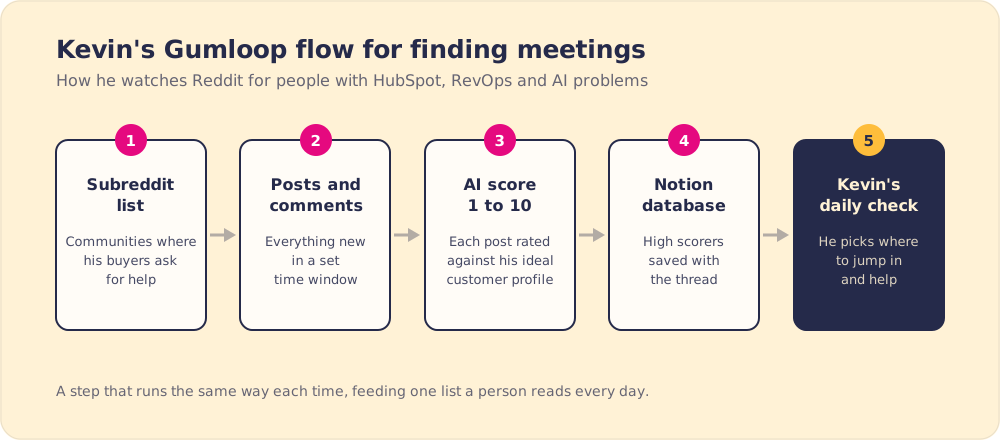
He gave two examples. For clients, a pre-sales prep flow researches the prospect’s website and social media before a meeting and drops a note on the HubSpot deal, work reps used to do in the 15 or 20 minutes before the call. For himself, a flow reads subreddits where people post HubSpot, RevOps and AI implementation problems, scores each post from 1 to 10 against his ideal customer profile, and saves the best ones to a Notion database he checks every day. He called it “an interesting source of” meetings.
Why is Kevin terrified of AI write access?
Number two is the tool his whole way of working depends on, and he picked it because he is scared. “I am terrified of giving Claude or any other LLM direct write access to the HubSpot API,” he said. Writing to records worries him. Changing properties and workflows worries him more, “especially in a mature portal where things are already working.”
The tool is Daeda AI, a HubSpot marketplace app that sits between Claude and HubSpot (Daeda). Kevin writes what he called “pretty crazy requirements documents,” points Claude at one, and asks for everything in one pass: 50 properties, 15 workflows, edits to others. Before anything deploys, Daeda shows him “this secondary interface with write plans,” where “I can see the exact payload of every single change” headed for HubSpot. He said it “changed the way that I interact with my clients and deliver projects entirely.”
That screen is why AI in RevOps works for him, and why his team can spend its time on QA. Kevin learns the client’s business and writes the plan, AI does the build, and his team reviews it. “It leads us to execute much faster but at a way higher level of quality because we only focus on QA.”
I added my own warning on the episode: ask HubSpot’s MCP server a question without context and you can get the wrong answer. Kevin’s review step catches that kind of mistake before a client sees it.
A field experiment with 758 BCG consultants shows why the review matters. On tasks inside the model’s abilities, consultants using GPT-4 finished 12.2% more tasks, 25.1% faster, at more than 40% higher quality. On a task just outside those abilities, they were 19 percentage points less likely to get it right than consultants working without AI (Dell’Acqua et al., 2023). The consultants could not tell from the inside which kind of task they were on. Kevin’s team does not try to guess. They read every change.
Our post on HubSpot workflow dependencies shows how one changed property can break workflows far from where you made the change, which is the kind of mistake a line-by-line review catches.
Why does Notion sit at number one?
“This is probably a little weird,” Kevin said, “but it’s Notion.” It holds all his context. “Nothing that I do with AI would be as effective as it is if I didn’t have everything connected to Notion.” He uses Notion AI more than Claude for daily work, running an Anthropic model inside it, and reaches for Claude when the output belongs somewhere else.
He uses it three ways. It records his meetings from local audio, with no bot joining the call, and he cancelled Krisp once it did. After each client meeting he opens an AI chat on the transcript and writes next steps against everything he already knows about that client. And it is his second brain, down to the grocery lists he shares with his wife. “If anyone got a hold of my notion, they would know everything about me. I would be screwed.”
I pushed him on why client context lives in Notion instead of HubSpot. He said he will “probably graduate to that once once my team gets larger,” and he still runs deal flow in HubSpot, with Claude copying the notes from Notion onto the HubSpot record. I told him about running RevPartners on Coda. It was our project management system until we had five or ten people, and then I could not maintain it anymore and we moved off it.
The plan in Notion matters because AI builds what the plan says. In our survey, AI applied to a broken process scored below 3.0 out of 5 for impact, while AI on an enforced process scored 4 and higher (The State of Sales Enablement 2026). Kevin’s 80% of time on the plan is the part of his model that keeps the AI pointed at a process that works.
Key points on AI for RevOps from Kevin’s stack
- People plan, AI builds, people check. Kevin spends 80% or more of his time on the plan, and his team spends all of theirs on QA.
- No blind writes. Daeda AI shows the exact payload of every change before it reaches HubSpot.
- Coded actions over live prompts. Gumloop turns an AI step into an action that runs the same way every time.
- Context first. Notion holds transcripts, client history and plans, so the AI starts every job with what Kevin knows.
- Cheap hosting for custom tools. A nine-dollar server with automatic deploys hosts the dashboards he no longer builds in HubSpot.
- Honesty about habits. Gamma stays because it is fast and familiar, and Kevin says so.
What we would copy from Kevin
Start with his number two, even if you use a different tool for it. Before any AI change reaches a live portal, a person should read the exact change. Then write the plan in enough detail that a model could build from it, and put your best people on reviewing the output. Kevin’s team built a whole deal pipeline in a day and made two changes in review, and the review is the part he would never skip.
Once AI has built the pipeline, someone still has to check whether reps follow the process those workflows assume. We built Supered for that check, inside HubSpot and Salesforce, and you can see it in a demo. If you are about to hand AI your first HubSpot build, read our guide to the AI sales assistant first, and our guide to sales automation for fixing the process before you automate it.
Frequently asked questions
What AI tools does Kevin Stout use for RevOps?+
Is it safe to give AI write access to HubSpot?+
How does AI change the work of a RevOps team?+
Does AI make RevOps work better?+
Why use Notion as a context layer for AI?+
Your process, running itself.
Turn the playbook into rep behavior.
More from Show Me Your Stack

HubSpot Solutions Architect Kasey Chan's Top Five Tools, From Endel to Claude
Kasey Chan
RevOps Software: Scott Silman's Top Five Tools, and the Opinion Behind Them
Scott Silman