Why Sales Training Fails: Matt Bolian and Lindsey Smith Debate Where the Budget Went
Nobody trained you to sing happy birthday, yet the ritual runs every year. Matt Bolian and Lindsey Smith debate why sales training fails, and whether enablement spent a decade, or thirty years, paying for training when it needed a process reps run and managers inspect.
Why sales training fails, per Matt Bolian and Lindsey Smith on Pardon the POV: it teaches reps weeks before the work and nothing checks what they do after, so without a process managers inspect, the lessons fade.
It was my birthday, and I spent it the way I wanted: up around 3 a.m. to work on our new website, then work, then my kids’ soccer practice. Rob, our host, used the occasion. Once a year, he said, people run the same ritual: a cake, a song, a wish, the candles. “Nobody trained you to do this, necessarily. Your manager didn’t. There’s no documentation. There’s no manager enforcing it.” And people get it right, year after year.
Then he asked the first question of the day, and it started an argument about why sales training fails. Is a sales rep more likely to follow a process they invented than one handed down from leadership?
Lindsey Smith of the Supered team was my opponent on that episode of Pardon the POV. Under all three of Rob’s rounds sat one question: has enablement spent its budget teaching reps things they forget, when it needed a process reps run and someone checks? Lindsey and I agreed more than Rob would have liked. We split on one number.
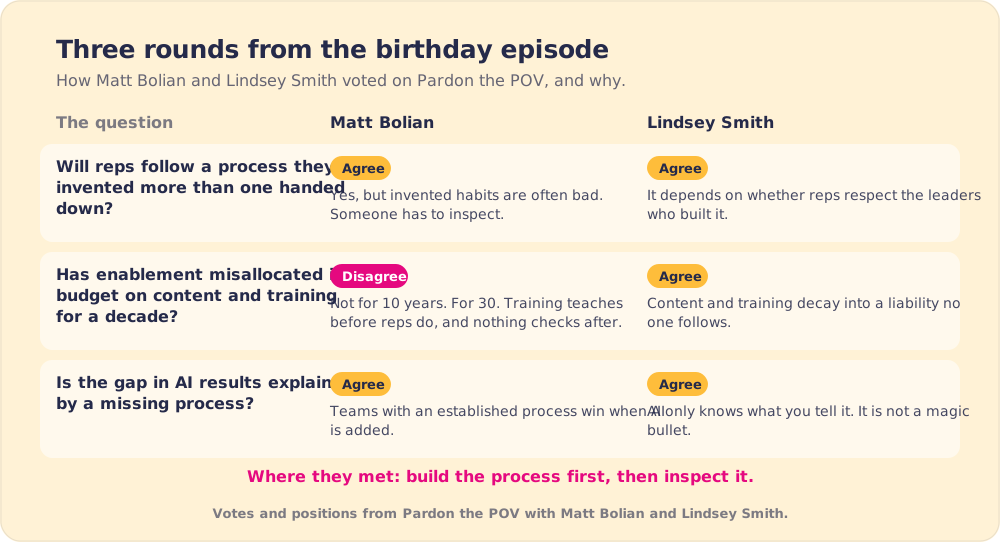
Do reps follow a process they invent themselves?
We both said yes, with conditions.
Mine was that the process reps invent is rarely a good one. “If people help create the thing they’re following, they’re more likely to participate in it,” I said. But reps have their own habits, and I am proof: I work on my birthday. Someone has to look at the habit and say so. So yes, reps follow what they help make, “and uh you don’t want them to make the process often.”
Lindsey’s condition was about the leaders handing the process down. “My stance on the agree is it depends on if your rep respects your leadership. Because if they’re looking at a process that your leadership created, and they’re going, ‘Well, that’s dumb.’ They’re going to do their own thing.” She said reps sometimes have a point, because “there’s a danger of a lot of leaders kind of lead because they can’t do.” Her fix was to build it together, properly: “work with your team to see what they’re doing, and make sure that they’re going to all follow the same process.”
Rob gave me the point, “only cuz it’s his birthday. Not that he had a better answer.” Fair.
Put our two conditions side by side and you get an order of work. Lindsey’s comes first: build the process from what your best reps already do, so the team respects it. Mine comes second: inspect it, so it keeps running. Neither of us put a training session anywhere in that list.
Has enablement spent its budget on training when it needed a process?
Rob brought a number from our own report. In The State of Sales Enablement 2026, when training sessions were the main way a process reached reps, 12% of reps hit 76 to 100% of quota. When guidance was embedded in the workflow, 49% did (The State of Sales Enablement 2026). His question: has sales enablement misallocated its investment for the last decade, building content and training when it should have built enforcement?
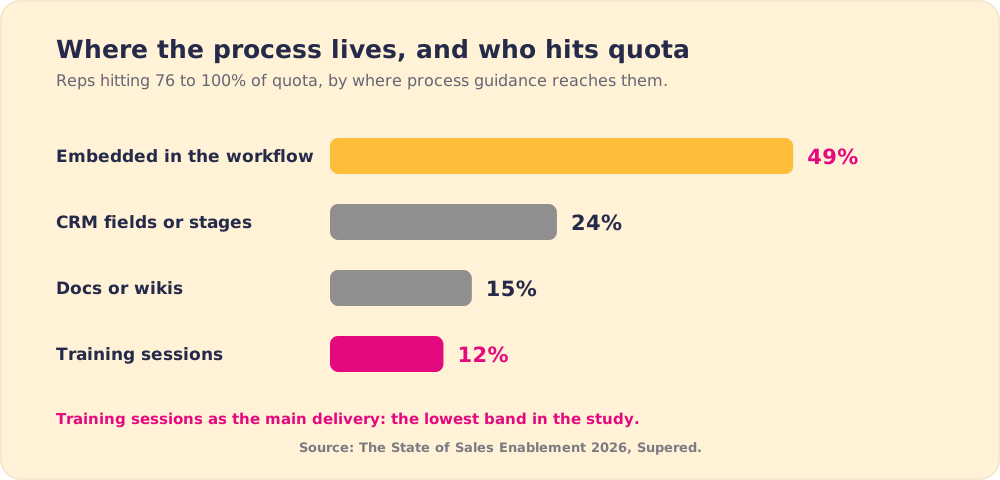
Lindsey agreed, and described the waste from inside an enablement team. Content and training “are a liability. Once you create it, you put it wherever you keep it, it’s going to die, but you’re still paying someone whatever their salary is to go make it, and then no one cares about it.” Teams build material reps do not follow, she said, because “they don’t have the structure.”
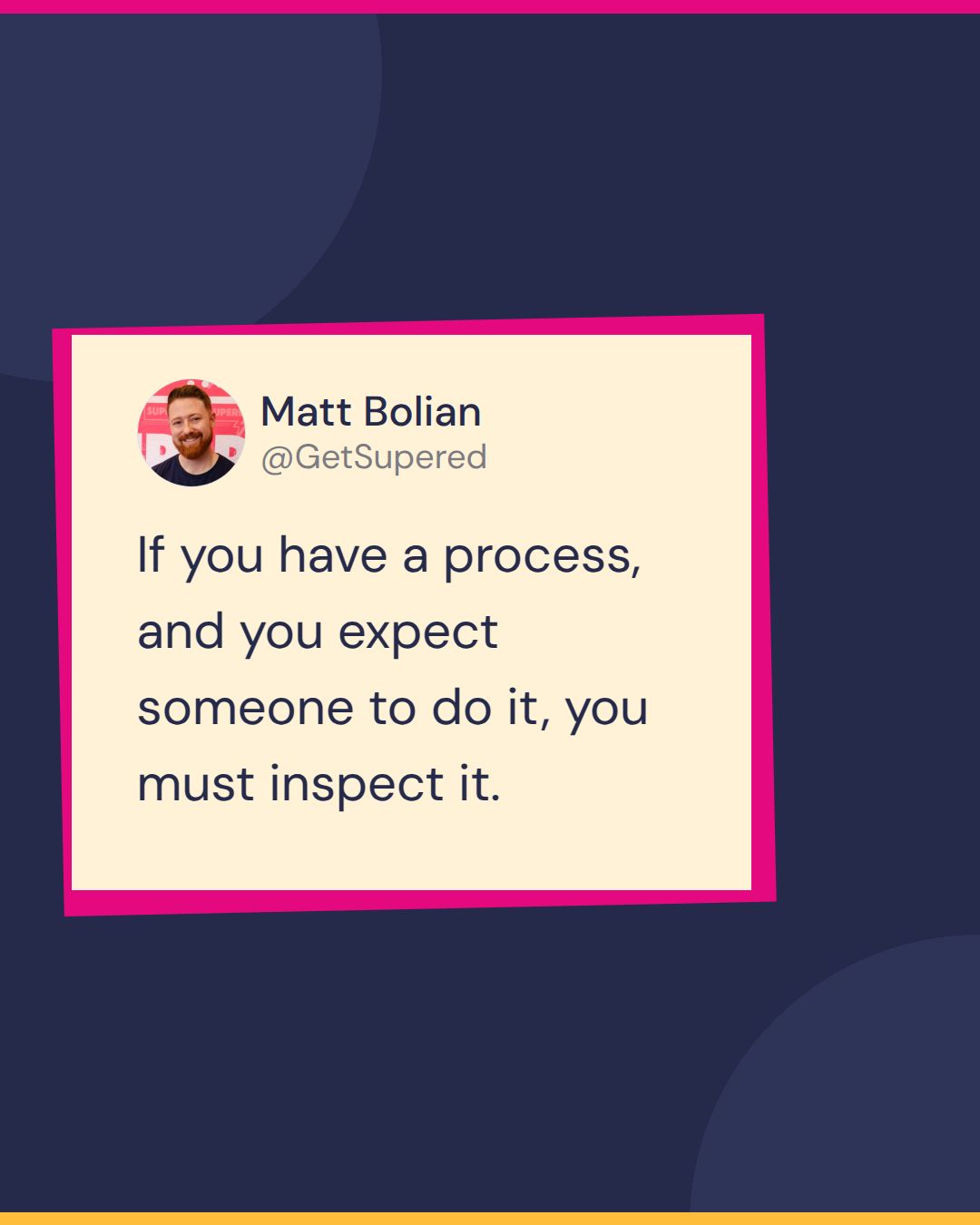
I disagreed, on a technicality I stand behind. “The question said, ‘Have they misallocated for the last 10 years?’ They’ve misallocated for the last 30.” Sales training has taught reps up front and hoped for the best since before either of us sold anything. “We have input-based training, which is teach somebody before they do.” The industry never built the other half: “If you have a process, and you expect someone to do it, you must inspect it. To be able to inspect it, you must be able to see it.” I told Rob, “I’m betting my house on it.”
Rob gave me the point “just because of how petty it was disagreeing and changing the question to 30.”
Why does sales training fail when a process holds?
Go back to Rob’s cake. No one at the party has to remember a lesson about singing. The cake comes out with candles on it, and that is the signal to start.
Psychologists have studied both sides of that. Hermann Ebbinghaus charted his own forgetting in the 1880s, and in 2015 Jaap Murre and Joeri Dros repeated the experiment and got the same curve: a steep drop soon after learning, with much of the loss inside the first day (Murre and Dros, PLOS ONE, 2015). Wendy Wood and her colleagues looked at the other side, what people do without deciding to. They found about 43% of daily behaviors are performed out of habit, set off by something in the setting, a place or the thing you did a moment before (Wood, Quinn and Kashy, Journal of Personality and Social Psychology, 2002).
A training session asks a rep to remember a step for weeks, until the deal that needs it. A process shows the step to the rep when the deal reaches that stage, much as the cake shows up at the party. We cover more of the research in our post on the knowing-doing gap.
What should sales training teach, if the process carries the steps?
We got to this in a different round, when Rob asked whether peer reviews and communities now matter more than sales outreach. Lindsey said a buyer will trust a friend of ten years over “a salesperson who’s going to try to sell you the moon.”
I agreed with her vote and disagreed with her reason. “A good sales person knows who you are, can talk your vernacular, and teaches you something on the call.” The reps who struggle, in my experience, “only know their product, only know their feature,” and never learn what the buyer is trying to solve. “So to be a good sales person is to know the problem better than the person that’s coming to talk to you.”
Training can build that knowledge, and a process has no way to. The process can remind a rep to send a recap within a day of the call. What she writes in it, say, how two other companies with the same problem handled it, comes from what she has learned about the buyer’s world. Our guide to sales training best practices covers how to build that kind of skill.
Does AI fix a training problem or a process problem?
The last round brought AI in. Rob read the numbers from our report: the average AI impact score was 3.2 out of 5, and teams with high AI impact had 40% strong process adherence, against 21% for low-impact teams. Is the gap between what AI promises and what it delivers explained by a missing process?
I agreed. Boards, investors and CEOs are telling sales leaders to “Go buy AI. Get AI. Make your team AI native,” and leaders are meeting a purchasing mandate. “They are not actually solving productivity or efficiency. And so, the teams that already have a process that are well-established are going to win when AI is added, and those that don’t are going to make problems worse.”
Lindsey started at disagree and talked herself around. “I feel like everyone’s approaching AI as a band-aid to something that isn’t working.” Then she said the thing I wish more buyers heard before a purchase: “AI only knows what you tell it. It’s not a magic bullet. It’s not going to come in and magically fix your process.” Rob docked her for switching sides and gave me the point, then told her she won by showing up.
Why sales training fails, reason by reason
Across the three rounds, Lindsey and I named five causes. Each one has a fix that came up on the show.
- Lessons that arrive weeks early. A rep learns a step long before the deal that needs it, and the forgetting curve has taken much of it by then. Put the step in front of the rep at the stage where it applies.
- No one inspecting the work. Training happens before the work, and nothing in it checks what happens after. A manager has to be able to see a step to inspect it.
- Content with nothing to attach to. Lindsey’s point: teams pay to build material that is “going to die” because reps “don’t have the structure.” Build the process first, from what your best reps already do.
- A process from leaders reps don’t respect. Reps follow steps they helped shape, handed down by people they trust. Otherwise, in Lindsey’s words, “They’re going to do their own thing.”
- Training on the product alone. Reps who “only know their product, only know their feature” never learn what the buyer is trying to solve. Spend the training budget there.
AI does not fix any of the five. It speeds up whatever process exists, and it only knows what you tell it.
The verdict: build the process first, then train for judgment
Lindsey and I disagreed about one thing on the show, whether the money went wrong for ten years or thirty. We agreed on the fix. Build the process first, from what your best reps do. Put its steps where reps work, and inspect them. Then spend training dollars where a process cannot help: the buyer’s problem, the reasons behind each step, and the conversations that need practice.
We built Supered for that order. The Behavior Layer delivers your process to each rep in the flow of work inside HubSpot and Salesforce and shows the manager whether each step happened, so the training has a process to attach to.
My last words on the birthday episode were short: “Have fun and mind the gap.” If you run a training budget, read our guide to sales process adoption next. It covers why reps drift from a process once it exists, and how to keep them on it.
Frequently asked questions
Why does sales training fail?+
What is the difference between a sales process and sales training?+
Is sales training a waste of money?+
Do reps follow a process they help create?+
How do you make sales training stick?+
Does AI replace sales training?+
Your process, running itself.
Turn the playbook into rep behavior.
More from Pardon the POV

Presidents Club in Sales: Matt Bolian and Crispy Barnett Argue Over Who the Trip Is For
Matt Bolian & Crispy Barnett
Is Sales Enablement Broken? Matt Bolian and Caleb King Argue Over What Is Failing
Matt Bolian & Caleb King