Sales Training Programs: Why Most Are Events, and the Few That Work Are Systems
Companies spend $15 to $20 billion a year on sales training programs, and 84% of it is forgotten in 90 days. Here are the types that matter, how to choose one, and the design that changes what a rep does.
Sales training programs are structured efforts to build a rep's selling ability. They change behavior only when built as a system (a defined standard, reinforcement in the flow of work, practice, inspection), not a one-time event the forgetting curve erases.
Walk into almost any sales kickoff and you will find a training program that is sincere, expensive, and built backwards. A vendor flies in, the team spends two days in a hotel ballroom learning a methodology, everyone leaves energized, and by March the slides are a folder nobody opens and the selling looks exactly as it did in January. The content was fine. The methodology was sound. The reps even liked it. And almost none of it changed what they do on a live call, because the program was designed as an event, and an event is the one shape that cannot build a skill.
Sales training programs are the structured efforts a company uses to build a rep’s selling ability, and they change behavior only when designed as a system (a defined standard, reinforcement in the flow of work, practice, inspection) rather than a one-time event the forgetting curve erases. Get the shape right and a training budget starts paying back. Get it wrong, and you are buying the most expensive way there is to make a team feel briefly motivated.
This is a guide to the whole topic: what these programs are, the types worth knowing, how to choose or build one, how to make it stick, and how to measure it honestly. We will be fair to formal training, because it does a real job. Then we will make the case that the reinforcement system, not the course, is where the money comes back.
What is a sales training program, and what does it cost?
A sales training program is any structured effort to build the things a rep needs to sell well: knowledge of the product, a shared method, and the skills to run a deal. That definition is broad on purpose, because the category is broad. It runs from a half-day product overview to a multi-week onboarding curriculum to a standing weekly coaching rhythm. What unites the good ones is not the topic. It is the design.
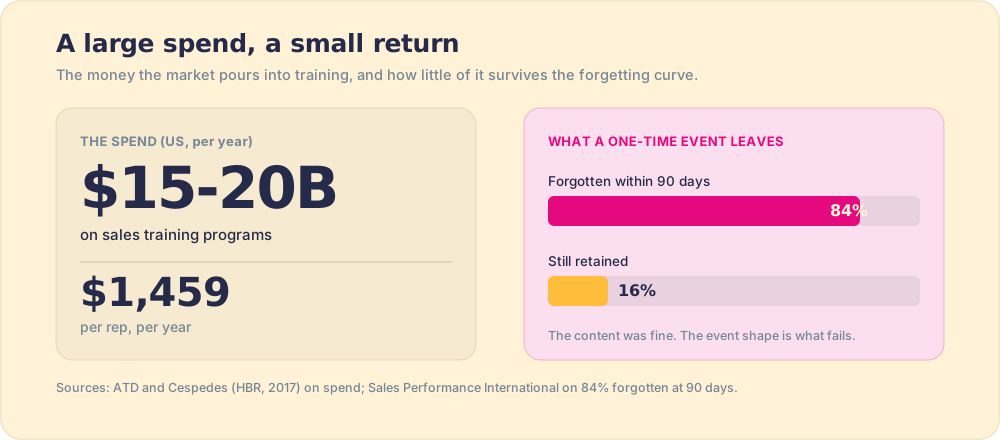
The scale of the spend tells you how seriously the market takes the category, and how badly it is being served. US companies pour roughly $15 to $20 billion a year into sales training, about $1,459 per rep, according to the Association for Talent Development and the work of Harvard Business School’s Frank Cespedes (Cespedes, “Your Sales Training Is Probably Lackluster,” HBR, 2017). That is a serious line item. And the return on it is, by the field’s own measurement, poor. Cespedes’s verdict is blunt: most sales training is an event, disconnected from the actual selling context and rarely reinforced, so it fails on its own terms.
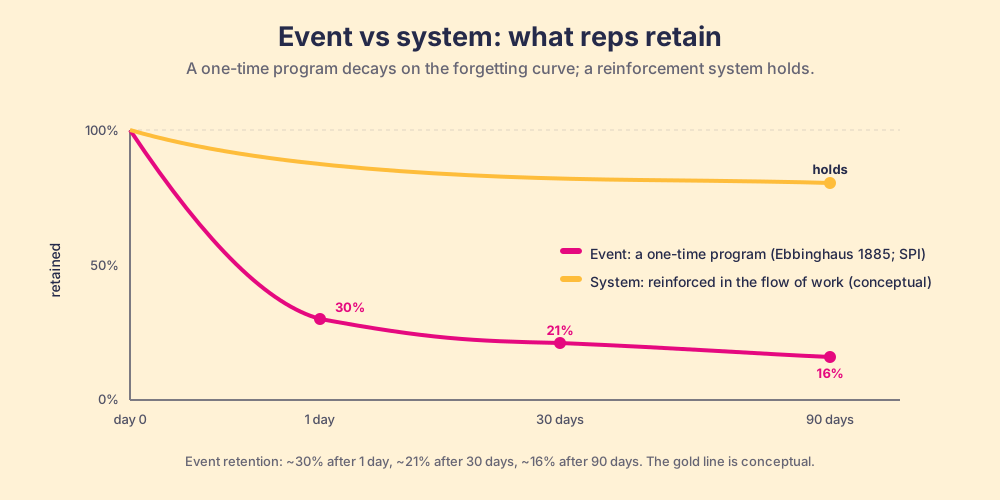
The reason sits in how memory works, and it is not a failing of any particular vendor. Hermann Ebbinghaus mapped the forgetting curve in 1885, and the numbers in a sales context are brutal: a rep loses about 70% of what they were taught within 24 hours and 79% within 30 days. Sales Performance International, studying sales programs specifically, found the same shape, with reps forgetting roughly half of what they learned within about five weeks and 84% of it gone after 90 days. So the central fact of the category is this: most of what a one-time program delivers is gone before the rep has closed a single deal with it. That is not a content problem you can fix with better slides. It is a structural property of the event format.
What are the main types of sales training programs?
Before choosing, it helps to see the field clearly, because “sales training” is five different jobs wearing one name. Treat them as one thing and you will buy a methodology course to fix a ramp problem, or a product deep-dive to fix a skills gap. They are not interchangeable.
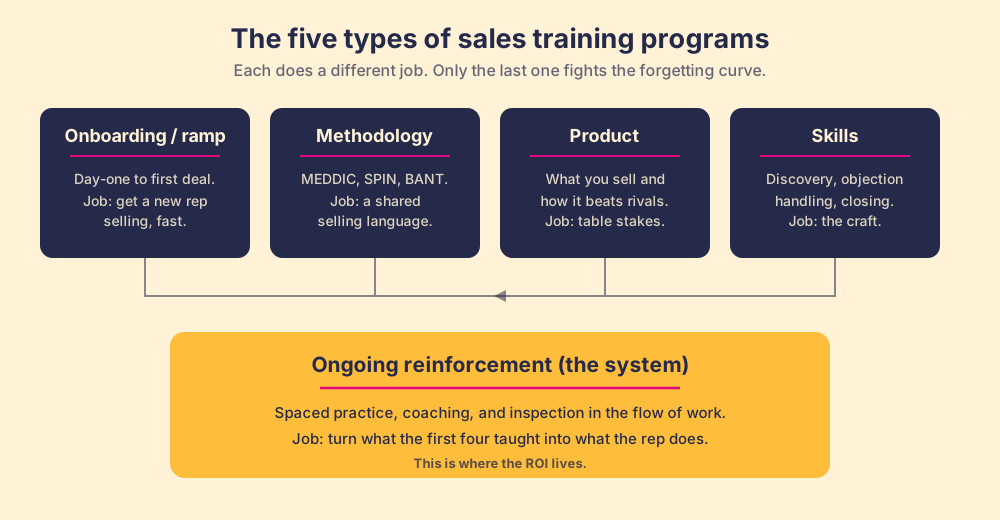
- Onboarding and ramp. The program that takes a new hire from day one to a first closed deal. Its job is speed to productivity, and it is the training with the most at stake, because every week of ramp is a week of carried cost. We treat this as its own discipline in our piece on why sales onboarding is a behavior problem rather than a knowledge one.
- Methodology training. The program that installs a shared selling language, MEDDIC, SPIN, BANT, Challenger, so that “qualified” means the same thing across the team. Its job is consistency, and a method only earns its keep if reps run it. We compare the major frameworks in our guide to sales methodologies.
- Product training. What you sell, how it works, and how it beats the alternatives. Its job is credibility in front of a buyer. It matters, and a rep without it is sunk, but it is table stakes, the part AI has already made nearly free to look up.
- Skills training. The selling itself: diagnostic discovery, objection handling, closing, the discipline to run the process under pressure. Its job is the behavior that moves deals, which is why we treat the sales skills that matter and how they get built as the hard center of the whole topic.
- Ongoing reinforcement. The standing system that turns the other four into what a rep does: spaced practice, coaching, and inspection in the flow of work. This is the type most programs skip, and it is the one that decides whether any of the others survive contact with a real quarter.
Most sales training courses on the market cover the first four well and the fifth not at all. That is the gap that turns a budget into a sunk cost.
How do you choose the best sales training program?
The instinct is to shop the catalog: which vendor has the deepest curriculum, the most modules, the slickest platform. That is the wrong place to start, because curriculum is the part that decays. Start instead from the behavior you want, and work back to the program that can install it.
A useful selection runs in this order. First, name the specific actions a strong rep on your team already takes, deal stage by deal stage, in plain language. Your best reps already run a motion that works; the job of a program is to make that motion the standard everyone runs, not to import a consultant’s template nobody believes in. Second, judge each option not on what it teaches but on whether it can reinforce that motion in the flow of the rep’s actual work and let you see whether the behavior happens. A program that delivers content and then disappears is buying you a workshop, not a change.
- Behavior first, catalog second. Decide the actions you want a rep to perform, then choose the program that reinforces them. A long curriculum that never reaches the rep in the moment is a longer way to forget.
- Fit to the type. A ramp problem needs onboarding, not a methodology refresh; a “we all qualify differently” problem needs a method, not a product deep-dive. Match the program to the job, or you will solve the wrong thing well.
- Reinforcement built in. The single most predictive feature of a program that works is whether it keeps showing up after the kickoff. If reinforcement is an afterthought, the spend is an afterthought.
- Inspection included. A program you cannot measure is a program you cannot improve, and you cannot improve what you cannot see. Favor the one that tells you whether the trained behavior reached real deals.
This is also where corporate sales training tends to go wrong at scale. A large org buys the most thorough program it can find because breadth feels safe, and breadth is exactly what the forgetting curve eats first. The more you front-load, the more you lose. Depth of curriculum is not the variable that predicts a changed team; reinforcement is. The best sales training programs win on how little they let you forget, not on how much they cram in.
What makes sales training stick: the 70-20-10 model
If skill survived in a classroom, the $15 to $20 billion would have produced a generation of uniformly excellent reps by now. It has not, and the reason is one of the most durable findings in how people develop. Anders Ericsson’s 1993 study of violinists in Berlin established that expert performance tracks accumulated deliberate practice, focused repetition with immediate feedback on a specific weakness, rather than hours spent listening to instruction (Ericsson, Krampe & Tesch-Römer, Psychological Review, 1993). A skill is built by doing the thing, repeatedly, with feedback, under conditions close to the real ones. A lecture has almost none of those ingredients. A rep’s working week has all of them.
The most useful summary of this for a sales leader is the 70-20-10 model, developed at the Center for Creative Leadership from research on how managers learn. It holds that roughly 70% of development comes from doing the work, 20% from coaching and feedback, and 10% from formal courses. Treat the exact numbers as a heuristic rather than a law of nature, but the proportions are the point, and they are close to the inverse of how most budgets are spent.
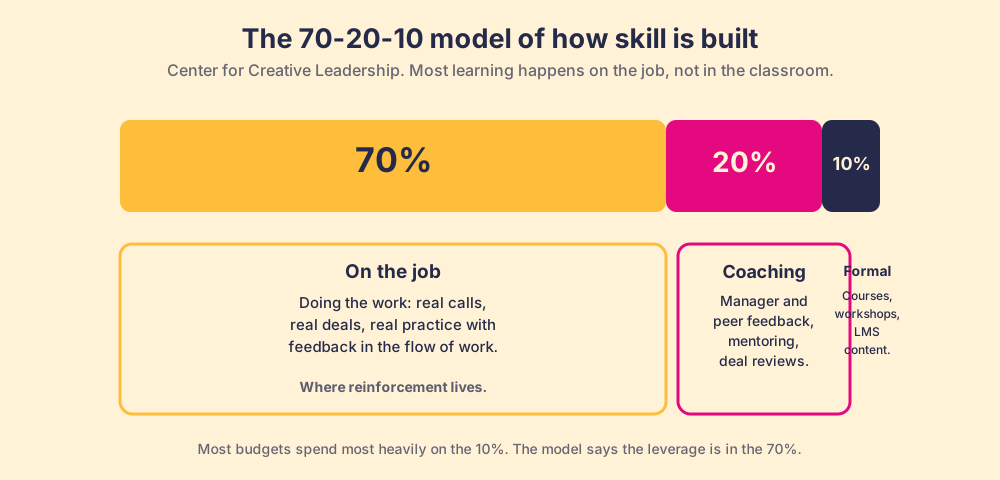
Read against that model, the standard program is upside down. It spends almost the entire budget and all of the ceremony on the 10%, the formal course, and leaves the 70% and the 20%, the doing and the coaching, to chance. The fix is not to abolish the course. The course sets the standard and the floor, and you need both. The fix is to design the program so the 90% that the model says matters most is built, deliberately, into the rep’s week.
The sales training best practices that survive the research all live in that 90%, and they amount to four moves:
- A defined standard. Name the specific behaviors a strong rep performs, in plain language, before you train anyone. You cannot reinforce what you never made explicit, and most teams never write the standard down.
- Reinforcement in the flow of work. Deliver the right prompt the instant the rep needs it, while they are in the deal, not in a quarterly session they will have forgotten by spring. A cue at the moment of action outweighs a hundred slides in a folder, because it lands where the skill is used.
- Deliberate practice. Role-play and rep-specific drills on the one weakness that is costing deals, with immediate feedback. This is the Ericsson mechanism in a sales uniform, and it is the part a passive course can never supply.
- Inspection that feeds coaching. Check whether the behavior happens on real deals, so a manager can coach the specific gap instead of guessing. Inspection is not surveillance; it is the feedback half of deliberate practice, the thing that turns training from a hope into a measurable system.
Event or system: which sales training programs change behavior?
Put the two designs side by side and the choice stops being close. An event delivers a burst of content and then withdraws, and the rep is left alone against the forgetting curve. A system delivers the standard, reinforces it where the work happens, and inspects whether it took, so the learning compounds instead of fading.
There is a deeper reason the system wins, and it shows up in where deals are lost. The Jolt Effect, Matt Dixon and Ted McKenna’s analysis of 2.5 million sales calls, found that 40% to 60% of qualified deals are lost not to a competitor but to no decision, and 56% of those to customer indecision rather than any preference for a rival (Dixon & McKenna, “Losing to Customer Indecision”). The behavior that addresses a buyer’s fear, the de-risking move at the moment of hesitation, is precisely the kind of skill a slide deck cannot install and a reinforced system can. The deals you are losing are being lost to behavior the rep did not perform, not knowledge the rep did not have. That is the case for the system in one sentence.
When a rep does not run the trained behavior, the cause is almost never that the rep is lazy. It is that the right action was not easy, not visible, and not reinforced in the moment. That is a system to fix, not a person to blame, which is why a reinforcement design that meets the rep where they work beats an accountability lecture every time. This is also the work that good sales coaching is built to do, and the reason coaching beats classroom training on nearly every study that compares them: coaching is practice with feedback, and a course is information transfer.
How do you measure whether a sales training program worked?
Most programs are measured on the one number that proves nothing: completion. A 95% completion rate tells you reps sat through the content. It says nothing about whether a single discovery call now runs differently. Measuring training by completion is like measuring a fire drill by how many people signed the attendance sheet, when the only question that matters is whether they would get out of the building.
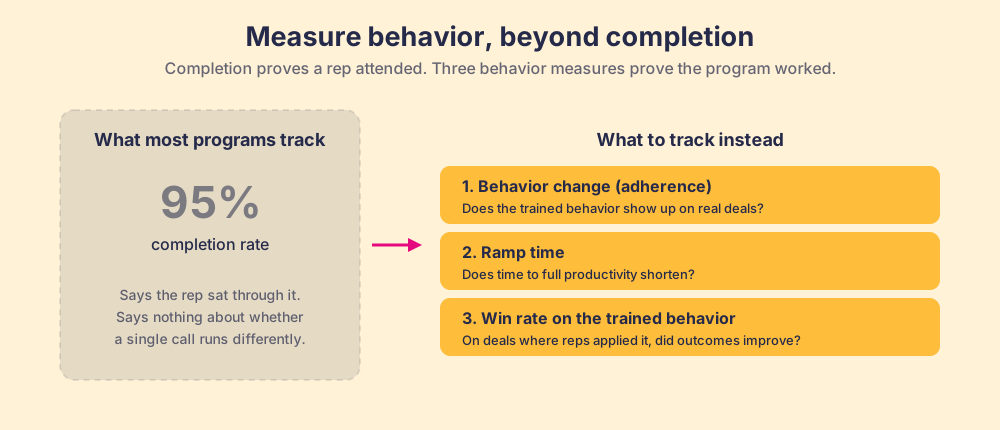
Measure behavior instead, on three axes:
- Behavior change (adherence). Does the trained behavior show up on real deals? This is the leading indicator and the one that predicts the rest. A program that does not move adherence has not worked, whatever the survey scores say. You can only expect what you inspect, so this number has to be inspectable in the first place.
- Ramp time. For onboarding programs, does time to full productivity shorten? Ramp is the cleanest financial read on whether new-hire training is building behavior or filling week one with content that evaporates.
- Win rate on the trained behavior. On the deals where reps applied the skill, did outcomes improve? This is the lagging indicator, and the one that finally connects the budget to the number. Track it on the trained behavior specifically, not pipeline-wide, or the signal drowns.
This is the same input-versus-output distinction that runs through everything we publish in the State of Sales Enablement: legacy training is measured on input (was the content delivered), and it should be measured on output (does the rep do the standard). A ready rep is one whose behavior you can see on a real deal, not one who passed a quiz. Switch your dashboard from completion to behavior and most “successful” programs reveal themselves as the events they always were.
Build, buy, or reinforce: the verdict
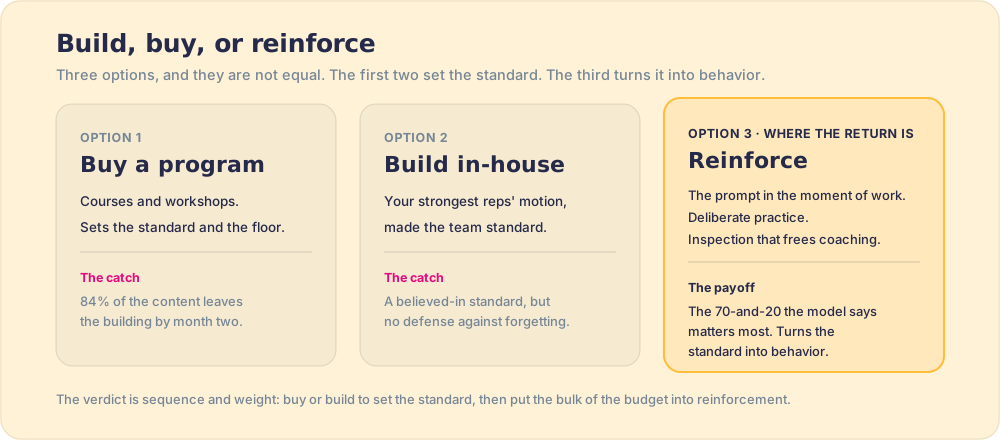
A leader spending on sales training has three real options, and they are not equal. You can buy a formal program, the courses and workshops, which sets the standard and the floor and is worth doing for exactly that, as long as you go in knowing 84% of the content will leave the building by the second month. You can build a program in-house, which gives you a standard your team believes in but does nothing on its own to fight the forgetting curve. Or you can invest in the reinforcement system, the defined standard, the prompt delivered in the moment of work, the deliberate practice, and the inspection that frees a manager to coach the gap.
The verdict the evidence supports is not “skip the course.” It is sequence and weight. Buy or build the formal program to set the standard, because you need one and the best motion already lives in your strongest reps. Then put the bulk of the budget and the design effort into reinforcement, because that is the 70-and-20 the model says matters most, the part that fights the forgetting curve, and the part that turns a standard into behavior on a real deal. A course alone is the most expensive way to make a team briefly enthusiastic. A reinforcement system is the only design that matches how procedural skill is built.
This is the job the sales training software category is finally being judged on: not whether it can deliver a course, but whether it can change what a rep does on the next call. Supered exists to be that layer, the standard and the prompt reaching the rep the instant the question arises, in the flow of the work, so the practice happens where the selling does and a manager can see whether it took.
The program on your kickoff agenda is probably good. The content is probably right. The reason it has not changed your team is that you bought an event and needed a system. Set the standard with the course. Build the behavior with reinforcement. The first is where training starts, and the second is where it finally pays back.
Frequently asked questions
What is a sales training program?+
What are the main types of sales training programs?+
How much do sales training programs cost, and do they work?+
How do you choose the best sales training program?+
How do you measure whether a sales training program worked?+
What are the sales training best practices that make training stick?+
Your process, running itself.