Sales Training Best Practices: Five Rules, and the One Principle Beneath Them
Most sales training best-practice lists are tactics without a principle. The five that matter all serve one idea: training is a behavior system, not an event, and its test is whether reps do the standard.
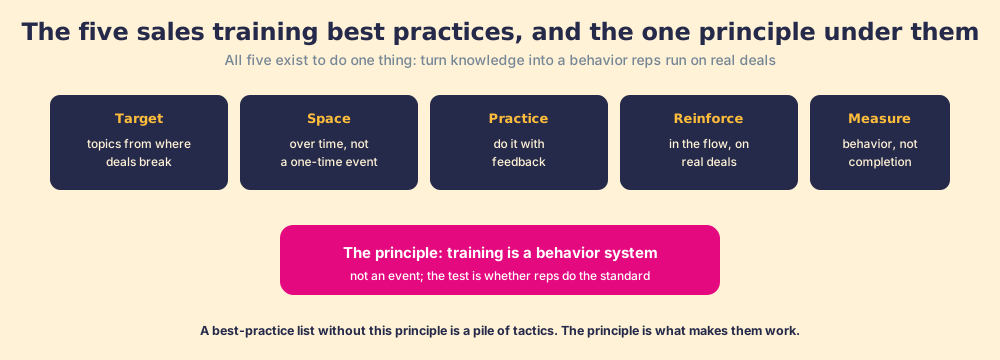
Sales training best practices are the principles that make training change behavior, and they reduce to one idea: training is a behavior system (targeted, spaced, practiced, reinforced, and measured on behavior), not a one-time event judged by completion.
Search “sales training best practices” and you get tactics: make it interactive, use real examples, get manager buy-in, follow up afterward. The advice is not wrong, but as a list it is inert, because it never names the principle that makes any of it work. Pick a few tactics without the principle and you get the same failed training with new decorations: a spaced program still measured by completion, role-play bolted onto an event that changes nothing. The best practices that matter are not a grab-bag of techniques; they are five rules that all serve a single idea, and that idea is the engine. Training is a behavior system, not an event, and its only real test is whether reps do the standard on a real deal. Every best practice worth following is a way of serving that, and a best-practice list that omits it is a pile of tactics with no engine.
Sales training best practices are the principles that make training change behavior, and they reduce to one idea: training is a behavior system (targeted, spaced, practiced, reinforced, and measured on behavior), not a one-time event judged by completion. Hold the principle, and the practices fall into place.
What are the sales training best practices that matter?
Five, and they only work together because each serves the same output. Each also rests on a specific, named piece of research, which is what separates them from the usual tips.
The first is to target: train the two or three topics where your deals break, drawn from loss data, not a generic syllabus, so effort goes where it pays. The second is to space: deliver the training over time rather than a one-time workshop, because Hermann Ebbinghaus mapped the forgetting curve in the 1880s and it has held up ever since, people shed a large share of new material within days unless it is repeated, and a single burst is the worst possible delivery schedule (Ebbinghaus, the forgetting curve). Nicholas Cepeda’s meta-analysis of more than 300 spacing experiments confirmed the corollary: the same total study time produces far more durable learning spread out than packed together (Cepeda et al., 2006, on the spacing effect). The third is to practice: have reps do the behavior with feedback, since Anders Ericsson’s research on expertise shows skill is built by focused repetition against a standard, not by exposure to information (Ericsson, in Harvard Business Review). The fourth is to reinforce: surface the behavior in the flow of work on real deals, where it transfers and sticks. The fifth is to measure on behavior: judge the training by whether reps run the standard, not by completion. Each of these we have treated on its own, the topic choice in sales training topics, the system in sales training programs, the practice in sales role play, the measurement in sales training metrics, but their power is in combination, because they describe one system, not five tips.
- Target. Train the two or three topics where your deals break, from loss data, not a generic syllabus.
- Space. Deliver it over time, not in a one-time workshop, because a single burst decays fast.
- Practice. Have reps do the behavior with feedback, since skill comes from practice, not exposure.
- Reinforce. Surface the behavior in the flow of work on real deals, where it transfers and sticks.
- Measure on behavior. Judge the training by whether reps run the standard, not by completion.
Why is “judge training by behavior” the practice everything depends on?
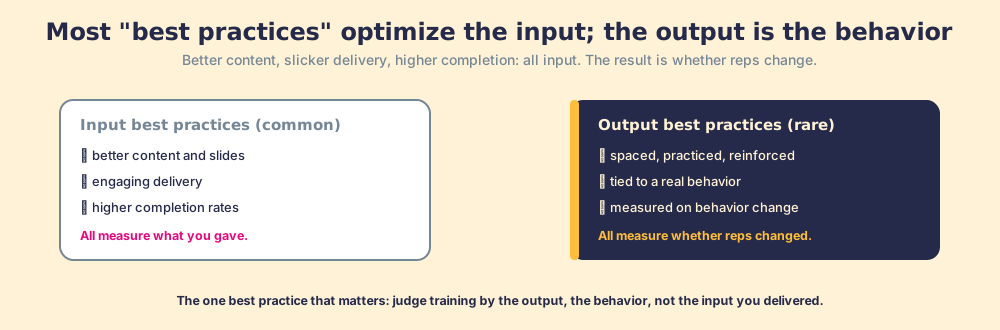
Because most best practices improve the input, and only the output, the behavior, tells you whether training worked. Better content, more engaging delivery, higher completion rates: these are all input metrics, measures of what you gave reps, not what they do. They can all improve while behavior stays flat, which is the central failure of training and the reason it persists, because input metrics cannot see it.
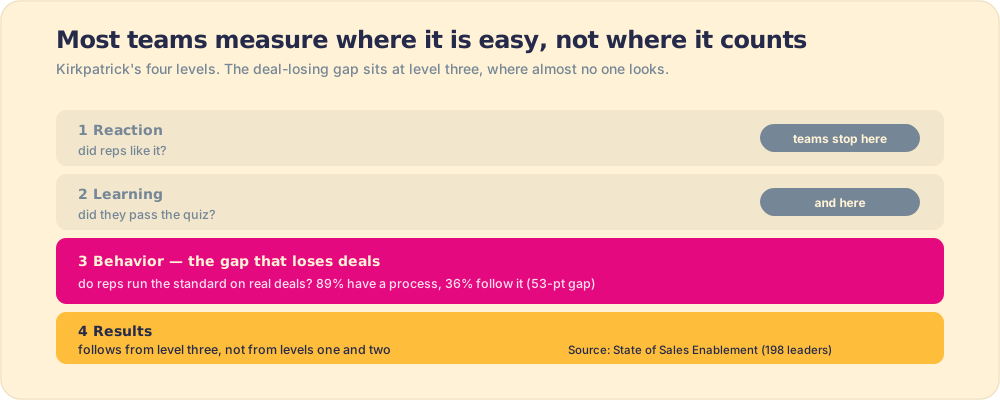
This has a name in the research. Stanford’s Jeffrey Pfeffer and Robert Sutton called it the knowing-doing gap: organizations are full of people who know what to do and do not do it, and most corporate training widens the gap rather than closing it, because it pours in more knowing and never touches the doing (Pfeffer and Sutton, The Knowing-Doing Gap). The training-evaluation literature has known where to look for thirty years. Donald Kirkpatrick’s four levels put behavior change (level three) and results (level four) above mere reaction and learning, precisely because liking the workshop and passing the quiz predict almost nothing about what a rep does on Monday (Kirkpatrick, the four levels). Yet most teams still stop at levels one and two, because they are easy to measure and flattering to report.
Our own field data shows how wide the gap runs in sales specifically. Across 198 sales leaders in the State of Sales Enablement, 89 percent had a defined process and only 36 percent saw reps follow it, a gap of 53 points between the standard a team has trained and the behavior it gets. That gap is the knowing-doing gap with a number on it, and no amount of better content closes it, because content was never the missing piece. The moment you judge training by behavior change rather than delivery, every other best practice gets pulled into line, because you can finally see which ones change what reps do and which ones merely feel productive. Effective sales training is defined by that one shift in the scoreboard.
This reframes the whole list. Target, space, practice, and reinforce are not independent virtues; they are the four things that, done together, produce the output the fifth practice measures. Drop the output measure and the other four drift back toward polishing the input, a slicker event, a fuller curriculum, a higher completion rate, that changes nothing. The behavior measure is the keystone that holds the rest in place. It is also why most lists of sales training tips disappoint: they hand you tactics aimed at levels one and two while the deal-losing gap sits at level three, untouched.
How do you put the sales training best practices into action?
Build your sales training strategy as a behavior system rather than adopting tactics piecemeal, because the practices only work in combination. Start from the principle, training is a behavior system judged by what reps do, and let it dictate the design: pick the few topics where deals break, deliver them spaced, build the skill through practice with feedback, reinforce the behavior in the flow of work, and measure whether reps run it. The reinforcement and measurement are the parts teams skip and the parts that make the rest stick, which is why this is fundamentally a sales process adoption problem: training succeeds when the trained behavior becomes the default on real deals, and that requires surfacing and measuring it in the work. Adopt the five together, anchored to the principle, and you have a training system. Adopt them piecemeal, without the principle, and you have a better-decorated event that still changes nothing.
What we recommend
Treat sales training best practices as one principle expressed five ways, not a checklist of tactics, because the tactics without the principle reproduce the failure they were meant to fix. The principle is that training is a behavior system, not an event, and its only test is whether reps do the standard on a real deal. The five practices that follow, target the topics where deals break, space the training over time, have reps practice with feedback, reinforce the behavior in the flow of work, and measure on behavior change, are the components of that system, and they work because they all serve the same output. The one that anchors the rest is the behavior measure: judge training by what reps do, not by what you delivered, and every other practice falls into line. Adopt the system, not the slogans. A spaced, practiced, reinforced program targeted at your real gaps and measured on behavior is not a list of best practices. It is the only kind of training that changes what reps do.
From here: the topic choice in sales training topics, the system in sales training programs, the measurement in sales training metrics, and the adoption that makes it stick in sales process adoption.
Frequently asked questions
What are the best practices for sales training?+
What is the most important sales training best practice?+
Why do sales training best practices fail in execution?+
How do you build an effective sales training strategy?+
Your process, running itself.