Sales Training Metrics: You're Measuring the Wrong Thing
Most teams measure sales training with completion rates, attendance, quiz scores, and smile sheets. None of them predict whether a rep does anything differently. Here is what the research says the metric should be, and how to measure it.
Sales training metrics are the measures a team uses to judge whether training worked, and the useful ones track output (whether the trained behavior shows up on real deals, whether ramp shortened, whether win-rate moved) rather than input (who attended, who finished, who passed).
Ask a sales enablement leader how last quarter’s training went and you will hear a number fast: ninety-two percent completion, a four-point-six satisfaction score, an average quiz result north of eighty. The numbers are real, the dashboard is green, and almost none of it tells you whether a single rep sells differently than they did before. We have built an entire measurement habit around the parts of training that are easy to count and skipped the part that pays the bill. The smile sheet is full; the pipeline is unchanged.
Sales training metrics are the measures a team uses to judge whether training worked, and the useful ones track output (whether the trained behavior shows up on real deals, whether ramp shortened, whether win-rate moved) rather than input (who attended, who finished, who passed). Get that distinction right and the whole dashboard changes, because most of what teams currently report sits on the wrong side of it.
What are the standard sales training metrics, and why do they fail?
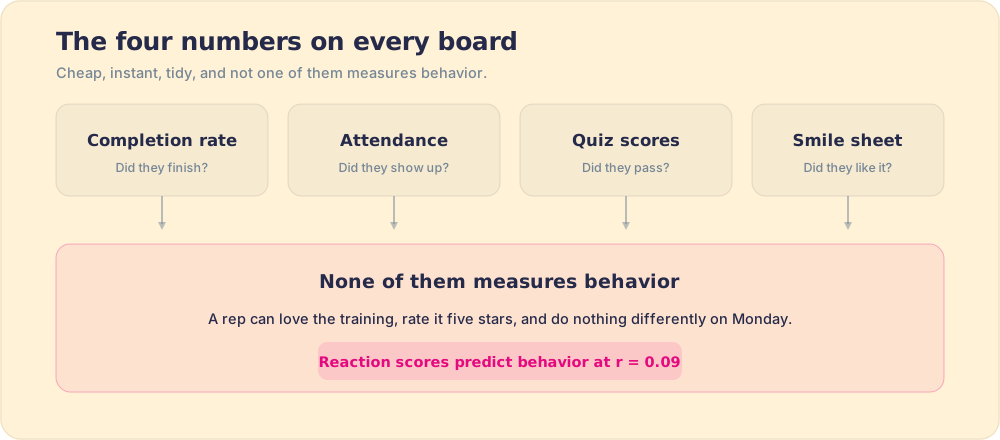
Walk into any enablement team and you will find roughly the same four numbers on the board: completion rate, attendance, quiz or certification scores, and post-session satisfaction, the survey the training world calls a smile sheet because it asks reps how they felt walking out the door. They are cheap, instant, and tidy. You get them the moment the session ends, they go up and to the right, and nobody has to watch a rep on a real call to produce them.
They share a second quality that makes them close to worthless as proof: none of them measures behavior. Will Thalheimer, who has spent a career on the science of training measurement at Work-Learning Research, ran the numbers on the smile sheet and found a result that should retire it. Traditional Level-1 reaction scores, the satisfaction surveys, correlate with on-the-job behavior change at roughly r=0.09 (Thalheimer, Work-Learning Research). That is not a weak signal. In practical terms it is no signal at all. A rep can love the training, rate it five stars, and do nothing differently on Monday, and the smile sheet will never know.
The metrics are not dishonest. They measure the input when we need the output. A captain who logs how many hours the crew spent studying the charts has measured something true and learned nothing about whether the ship is on course.
Where do most teams stop, and where does the ROI hide?
The cleanest map of this problem is sixty years old. Donald Kirkpatrick laid out four levels at which you can measure training, and the model has survived because it names exactly where teams give up. Level 1 is reaction: did they like it. Level 2 is learning: did they absorb the content, which a quiz or certification tests. Level 3 is behavior: did they change what they do back on the job. Level 4 is results: did the business outcome move.
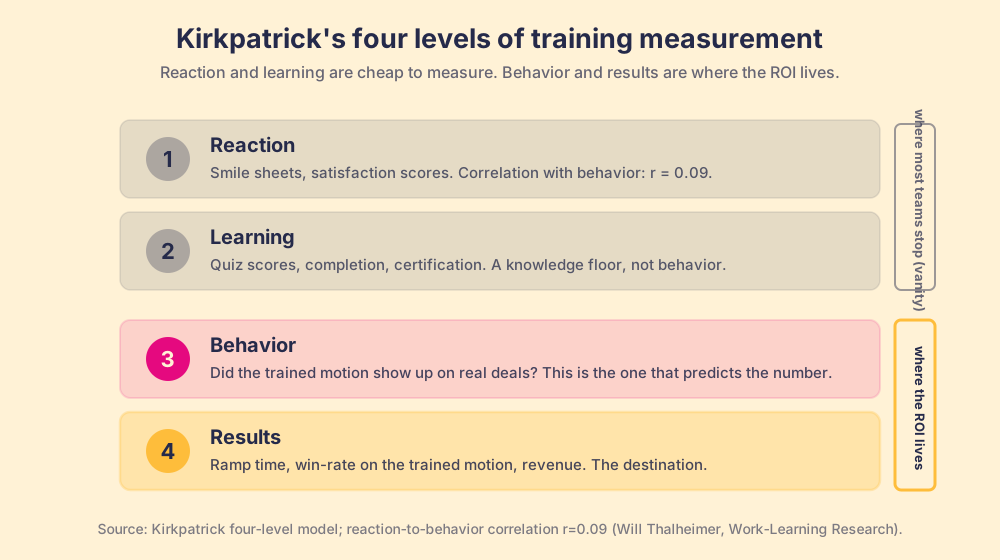
Almost everyone stops at 1 and 2. The reason is not laziness, and it is worth being fair about. Levels 1 and 2 can be measured with a survey and a quiz the platform emails automatically. Levels 3 and 4 require somebody to inspect what a rep does on a deal, weeks after the session, and tie it to a result that has a dozen other causes. Level 3 is hard, Level 4 is harder, and the budget reviews come due before either has had time to show up. So the team reports the levels it can reach and hopes the rest followed.
It usually did not. Behavior is the level the entire exercise was meant to produce, and it is the one almost nobody measures. That is the gap where sales training ROI lives, untouched, because the measurement habit stops one level short of the only level that matters.
Why the easy metrics are leading vanity, not proof
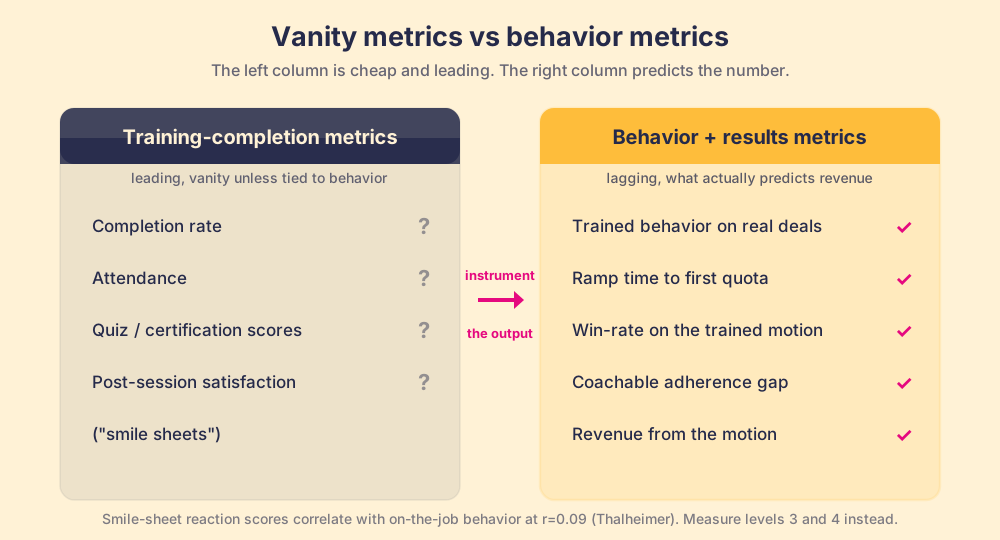
There is a fair version of the case for the easy metrics. Completion and knowledge checks are not nothing. A rep who never opened the course and cannot pass a basic check on the new pricing is not going to perform the new pricing conversation. The floor metrics rule out the obvious failure for almost no cost, and that has value. Keep them. The mistake is reporting them as if they were the result.
A completion rate is a leading indicator: it tells you something happened upstream of the outcome you care about, the way a step count tells you someone moved without telling you where they went. Tracking what a rep did is genuinely useful, it is how you confirm the process ran at all. The error is treating a training-completion number as a behavior-change number, because the two are not the same measurement and one does not stand in for the other. The forgetting curve guarantees the gap. Hermann Ebbinghaus mapped memory decay in 1885, and Sales Performance International found the sales-specific version is brutal: about 84 percent of training content is gone within 90 days. So the certification you ran in January, the one with the green completion bar, is measuring knowledge that has largely evaporated by April, while the dashboard still shows the spike.
How do you measure sales training so the number means something?
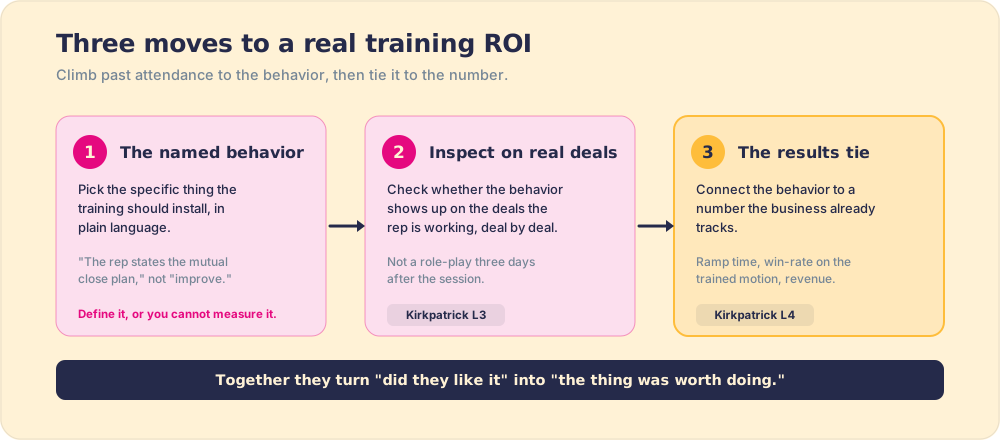
If the question is how to measure sales training honestly, the answer is to climb to Levels 3 and 4 and instrument the behavior, not the attendance. This is harder than emailing a survey, and it is the only thing that produces a real sales training ROI figure rather than a feeling of one. Three moves get you there, and they are the same discipline that turns any expectation into something you can manage.
- The named behavior. Pick the specific thing the training was meant to install, in plain language: the rep runs a multi-threaded discovery, the rep states the mutual close plan, the rep enters the competitor on every qualified deal. You cannot measure a behavior you have not defined, and “improve discovery” is not a behavior, it is a wish.
- Inspection on real deals. Check whether that named behavior shows up on the deals the rep is working, deal by deal, not in a role-play three days after the session. You can only expect what you inspect, and a behavior nobody inspects is a behavior nobody is doing. This is Kirkpatrick Level 3, and it is the metric the standard dashboard is missing.
- The results tie. Connect the behavior to a number the business already tracks: ramp time to first quota, win-rate on the trained motion, revenue from the deals where the behavior appeared. This is Level 4, and it is what converts “they did the thing” into “the thing was worth doing.”
Notice what these are not. They are not a longer survey or a harder quiz. They measure whether the rep does the standard on a deal that counts, which is the only definition of training that worked. Frank Cespedes of Harvard Business School put the underlying failure plainly: most sales training is an event, disconnected from the selling context and rarely reinforced, so it fails on its own terms (Cespedes, “Your Sales Training Is Probably Lackluster,” HBR, 2017). An event you measure only at the door will always look like it worked. A behavior you measure on the real deals will tell you the truth.
The deeper reason behavior is the metric that matters comes from the science of how skill forms in the first place. Anders Ericsson’s 1993 study of expert performers established that ability tracks accumulated deliberate practice, focused repetition with feedback under real conditions, not hours in a lecture hall (Ericsson, Krampe & Tesch-Römer, Psychological Review, 1993). A completion metric counts the lecture. A behavior metric counts the practice. Only one of them is connected to whether the rep can do the job, which is why the sales skills a team needs are built by doing and measured by doing, never by a certificate.
What to do with your sales training KPIs
There are three honest options for what you put on the training dashboard, and only one of them earns its place. The US spends somewhere around 15 to 20 billion dollars a year on sales training, which is precisely why measuring it properly is not a nicety. Money this size deserves a number that means something.
You can keep the easy metrics and call them the result. This is the common path, and it produces a green dashboard attached to an unchanged pipeline. You can drop the easy metrics entirely as vanity, which overcorrects: completion and knowledge checks are a cheap, useful floor, and throwing them out costs you the one thing they do well, catching the rep who never showed up. Or you can keep the floor metrics as hygiene and build your actual sales training KPIs on behavior and results: the named motion inspected on real deals, ramp time, win-rate on the trained motion.
We recommend the third without hedging, because it is the only one tied to whether selling changed. Keep completion and quiz scores; demote them from “proof” to “floor.” Then add the metric the dashboard is missing, the one that asks whether the trained behavior shows up where the work happens. This is the same inspection that makes a ready rep measurably ready rather than merely certified, the same discipline that runs underneath good sales coaching, and the reason the sales training software category is now judged less on whether it can deliver a course and more on whether it can show the behavior changed. It is the same logic behind the sales KPIs that move revenue: measure the output, inspect the behavior, set aside the activity counts that flatter you. Supered exists to be the Behavior Layer that makes this measurable, surfacing the standard in the moment the rep is working so inspecting whether they followed it stops being a manual chore and starts being a number on the dashboard.
The smile sheet was never the problem to solve; it was the easiest thing to count, so we counted it and called it measurement. The training your team ran was probably fine. What you measured about it was leading, and what you needed was output. Move the metric to the behavior, and the dashboard finally tells you whether the money worked.
Frequently asked questions
What are the right sales training metrics to track?+
Do training completion rates and quiz scores matter at all?+
How do you measure sales training ROI?+
Why doesn't most sales training show measurable results?+
Your process, running itself.