Sales Enablement vs Product Marketing: Message vs Motion
Product marketing owns what gets said. Sales enablement owns whether reps say it in live deals. Launches die in the handoff between them, and the fix is one clock that runs from launch day to the deals where the message shows up.
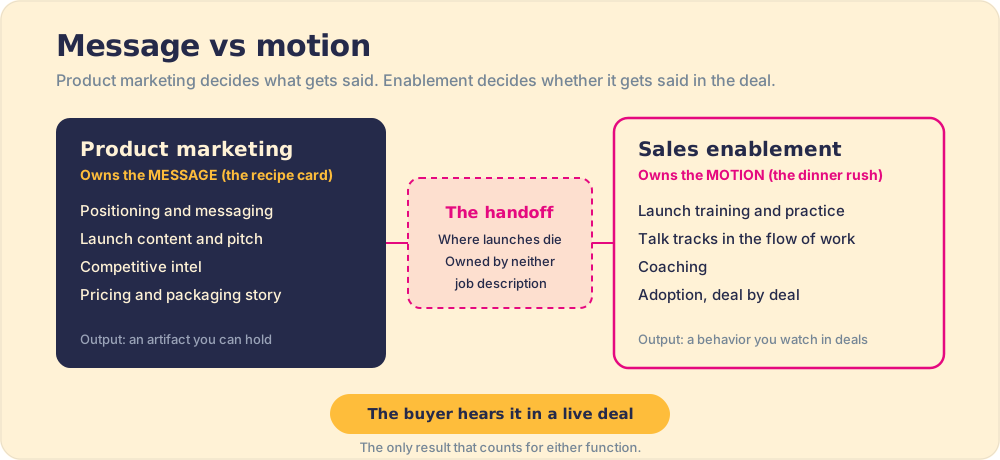
Sales enablement vs product marketing is the split between the function that decides what a company says about its product (positioning, messaging, launches, competitive intel) and the function that makes sure reps say and do it in live buyer conversations.
A product marketer spends weeks on a launch. The positioning is sharp, the deck is clean, the battlecard names the three objections the competitor always raises and answers each one. She presents it to the sales team, posts the kit in the content library, and moves on to the next release. A month later a sales manager plays her a call recording: a rep pitching the new product with last year’s story, stumbling on the exact objection the battlecard answered, then promising to “send over some material.”
Blame is hard to place here. The message was right. The reps were trained. The recording shows it never reached the deal.
That scene is the useful way into sales enablement vs product marketing. The standard explainers compare job descriptions: product marketing does positioning and launches, enablement does training and content, and the two “should collaborate.” All true, and it skips the part that costs money. Product marketing owns the message, what gets said. Sales enablement owns the motion, whether reps say it and do it in live deals. Each function tends to do its own half well. Launches die in the handoff between them, and neither job description assigns the handoff to anyone.
A kitchen makes the split easy to see. The recipe card is product marketing’s work: what goes in, in what order, and why this dish beats the one across the street. The dinner rush is enablement’s world, twelve tickets on the rail and a line cook who has seen the recipe once. A brilliant recipe does not cook itself, and a fast line cook with a bad recipe serves bad food quickly. A lot of sales and marketing arguments are two people pointing at the same cold plate.
What does product marketing own?
Product marketing is the function that decides what the company says about its product, to whom, and why it wins. It sits between product and market: it translates what engineering built into a story a buyer cares about.
- Positioning and messaging. Who the product is for, the problem it solves, and the three or four claims that separate it from the alternatives.
- Launches. The go-to-market plan for new products and features, including the pitch, the one-pager, and the demo narrative.
- Competitive intelligence. What rivals claim, where they win, and the win/loss research that shows why deals go one way or the other.
- Pricing and packaging story. How the offer is framed so the price reads as value.
Product marketers carry a lot of the sales-facing load already. In the Product Marketing Alliance’s State of Product Marketing 2023, 80% of product marketers were responsible for creating sales collateral, and 75% worked closely with sales (Product Marketing Alliance). So the confusion in the product marketing vs sales enablement question is earned. The PMM is often the person standing at the front of the room during launch training.
What does sales enablement own?
Sales enablement is the function that makes sure reps can do the job and then do it: onboarding, launch training, coaching, and, increasingly, the guidance that reaches a rep in the moment of work. We cover the whole discipline in what is sales enablement, but the short version is that enablement exists to change behavior.
That puts its center of gravity somewhere different from product marketing’s. Product marketing’s output is an artifact: a message, a deck, a card. Enablement’s output is a behavior: the rep who runs the new discovery question, handles the objection the new way, and positions against the competitor with the new proof point. You can hold an artifact in your hand. You can only observe a behavior by watching deals. I made the same point to a partner agency owner on a demo call:
From the field
People’s process is based on what they do, not what a document says.
And in 2026 the artifact is the cheap half. Any rep can find the deck, and any AI can summarize the battlecard in seconds. In the Sales Enablement Collective’s 2024 industry report, a quarter of enablement teams used AI regularly and another 55% used it occasionally (Sales Enablement Collective). Knowledge is solved. What a rep does with it, mid-call, with the buyer waiting, is the part still up for grabs.
Sales enablement vs product marketing: where is the line?
Ask one question of each piece of work: does it decide what gets said, or does it decide whether it gets said in the deal? The first is product marketing. The second is enablement. Almost every turf fight sorts itself once you ask it.
| Dimension | Product marketing | Sales enablement |
|---|---|---|
| Core question | What do we say, and why do we win? | Do reps say it and do it in live deals? |
| Output | An artifact: positioning, deck, battlecard | A behavior: the rep running the play |
| Primary audience | The market, with sales as a channel | The rep and the manager |
| Owns | Messaging, launches, competitive intel, pricing story | Onboarding, launch training, coaching, in-flow guidance |
| Success metric | Win rate, launch pipeline, message resonance | Ramp, adoption, adherence |
| Failure mode | The wrong message, delivered perfectly | The right message, never used |
| Time horizon | The launch and the market cycle | The rep’s next call |
The last two rows matter most. A wrong message delivered perfectly is product marketing’s failure. A right message never used is enablement’s. The two failures look identical on a win-rate chart, which is why the functions spend so much time blaming each other.
Where do sales enablement and product marketing overlap?
In three places, and each one is a handoff.
- Content. Product marketing writes it; enablement decides what a rep sees, when, and in what shape. Forrester found reps have an average of 1,400 sales assets to choose from (Forrester). A good asset sits among fourteen hundred others, and the rep has to find it mid-call.
- Launches. Product marketing builds the kit; enablement turns it into practiced behavior. Product marketing’s work ends on launch day and enablement’s starts there, and the gap between the two is where the momentum drains out.
- Competitive. Product marketing owns the intel and the battlecard; enablement owns whether a rep uses it the moment the competitor’s name comes up. We go deeper on building cards reps reach for in how to build a sales battlecard.
The picture that fits all three is a relay race. In the 4x100 metres, the baton has to change hands inside a marked takeover zone, 30 metres long since World Athletics merged the old acceleration and changeover boxes in 2018 (World Athletics). The incoming runner cannot let go early and the outgoing runner cannot grab it late. Coaches drill that exchange obsessively, because, as the standard reference on the event puts it, “polished handovers can compensate for lack of basic speed to some extent” (Wikipedia).
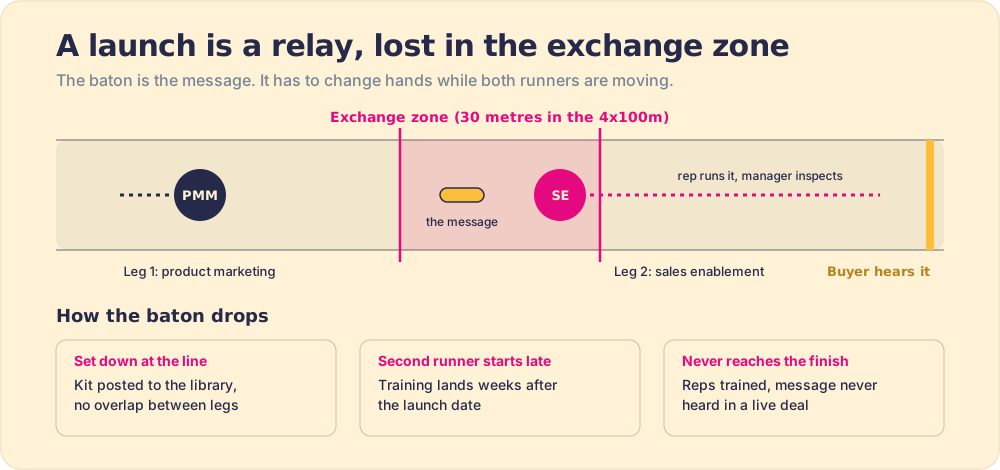
A typical launch runs the exchange badly. Product marketing sprints its leg, then stops at the line and sets the baton on the track: a kit in the library, a recorded training, a Slack post. Enablement arrives a few weeks later, picks it up from a standstill, and starts running. Neither runner was slow. They never overlapped. And a launch has a third leg a track relay does not: the race is won only when the buyer hears the message in a deal, a leg that belongs to the rep and gets inspected by the manager.
Why do product launches die in the handoff?
Because the evidence shows the message leaking at each checkpoint between the deck and the deal, and no single function owns the whole path, which is the gap GTM enablement exists to close.
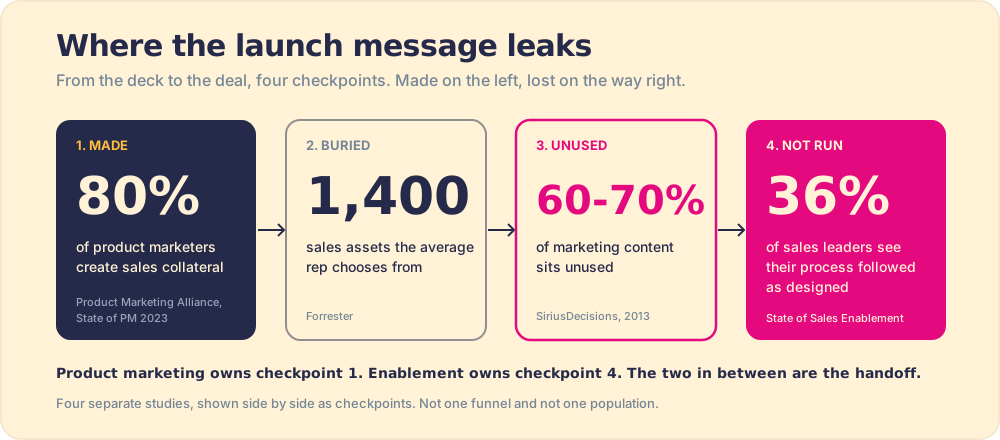
Walk the path in order.
- The message gets made. Product marketing is productive: 80% of PMMs create sales collateral (Product Marketing Alliance).
- The message gets buried. It lands in a library where the average rep has 1,400 assets to choose from (Forrester).
- The message goes unused. At its 2013 summit, SiriusDecisions (now part of Forrester) reported that “fully 60 to 70 percent of content churned out by B2B marketing departments today sits unused” (Forrester). The figure is old; nothing since has shown the library getting smaller.
- The motion does not change. In our own survey of 198 sales leaders, 89% have a defined sales process and only 36% see it followed as designed, a 53-point execution gap (State of Sales Enablement 2026).
Memory makes the handoff worse. Hermann Ebbinghaus charted the forgetting curve in 1885. He measured memory as savings, the share of the original learning effort he could skip when relearning a list, and after one day only about a third was saved. A 2015 replication found the same shape: savings of about 47% after 20 minutes, 32% after a day, and 4% after a month, from one subject learning nonsense syllables (Murre and Dros, PLOS ONE, 2015). A launch training delivered in one session, weeks before the rep meets the first buyer who asks about the new feature, is a baton set down on the track and left there.
On our own team, we stopped relying on memory for the message. Process rules check each buyer email instead:
From the field
We have some process rules that are like, did you send the video? Did you send your trust center? Even how this email is formatted, it’s all based on process rules that I’m enforcing across our teams and our CS team. So when you get emails, they all look the same.
And launches are fragile before the handoff even starts. Gartner’s survey of 205 product managers found 45% of launches slip by at least a month, and only 11% of organizations said all their products hit 100% of internal launch targets (Gartner). When the date moves, the training moves, and the gap between “kit shipped” and “rep practiced” widens.
None of this is a rep problem. A rep who reaches for last year’s pitch is doing the rational thing: using the story that is in their head, because the new one lives in a library they would have to leave the call to search. When reps skip the process, the system failed them. Fix the delivery, and the behavior follows.
Who owns what between product marketing and sales enablement?
Start from the work, not the org chart. The RACI below covers the shared ground (R = responsible, A = accountable, C = consulted, I = informed).
| Work | Product marketing | Sales enablement | Sales managers | RevOps |
|---|---|---|---|---|
| Positioning and messaging | A, R | C | C | I |
| Launch content (deck, one-pager, demo story) | A, R | C | C | I |
| Battlecard content and competitive intel | A, R | C | C | I |
| Launch training and certification | C | A, R | C | I |
| Talk tracks and next steps in the flow of work | C | A, R | C | R |
| Battlecard use in competitive deals | C | A, R | R | I |
| Inspecting message adoption deal by deal | I | A | R | R |
| Field feedback into the message | A | R | R | C |
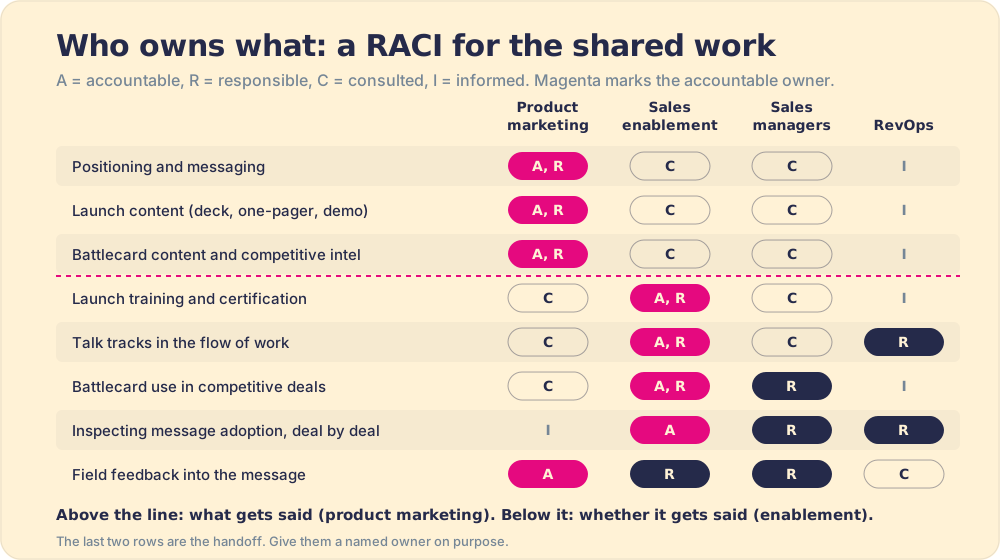
Two design choices in that table carry the argument.
- Enablement is accountable for adoption. “Inspecting message adoption deal by deal” belongs to enablement, with managers and RevOps doing the looking. You can only expect what you inspect, and in our survey teams that consistently inspect deals against a defined process hit quota at 6.3 times the rate of teams that rarely do (State of Sales Enablement 2026).
- Product marketing is accountable for the loop back. When the field shows a message failing, product marketing owns the rewrite. Enablement is responsible for bringing the evidence, because enablement is the function watching the deals.
How should you measure product marketing and sales enablement?
Measure each on its own output and both on the handoff.
- Product marketing metrics. Win rate against named competitors, pipeline and revenue influenced by a launch, and how buyers describe the product in win/loss interviews. These test whether the message is right.
- Sales enablement metrics. Ramp time for new reps, message adoption (the share of live deals where the new talk track or step shows up), and process adherence. These test whether reps run it. We lay out the full set in sales enablement KPIs.
- The shared metric. Time to message in deals: how many days pass between launch and the point where the new message shows up in half of the deals it applies to. Neither function can move it alone, which is why it belongs to both. The next section shows how to build it.
Content downloads and course completions belong on neither list as a headline number. They measure the baton leaving the first runner’s hand, and say nothing about whether it arrived. The Sales Enablement Collective found only 51% of enablement teams agree with their leadership on what enablement should be measured on (Sales Enablement Collective). A shared launch-to-adoption number settles a lot of those arguments before they start.
How do you measure the handoff itself?
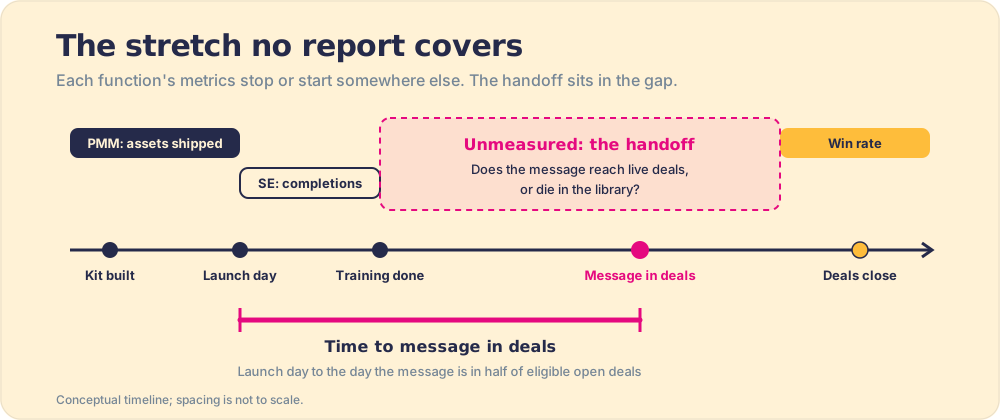
Look at the clocks each function already keeps. Product marketing’s clock stops on launch day: kit shipped, deck approved, training delivered. Enablement’s input clock stops at training completion. The win-rate clock starts much later, when deals close. The stretch in between, where the message either moves into live deals or dies in the library, has no clock at all. So a handoff can fail for months without a single report turning red.
So give it one. We call it time to message in deals: the number of days from launch until the new message shows up in half of the open deals it applies to. Half is our choice of line, not a law; pick a threshold and keep it fixed across launches so you can compare them. The metric does two jobs at once. It tells you how fast a launch reaches buyers, and it tells you which function to call when a launch underperforms.
To build it in HubSpot or Salesforce, take a new pricing tier as the example launch.
- The launch date. One date, written down once: the day the new tier and its talk track went live for reps.
- The eligible deals. A saved filter of open deals where the new tier applies, such as every deal in the segment the tier was built for. These deals are the denominator.
- The evidence. One observable sign that the message reached the deal. The strongest is the buyer-facing words themselves: HubSpot’s conversation intelligence lets admins create tracked terms that flag where a phrase appears in call transcripts, on Sales Hub or Service Hub Enterprise (HubSpot). Other good signals are a deal field that can only be filled by asking the new discovery question, or a guided step completed in the CRM. A rep ticking “used new pitch” is the weakest signal; use it only alongside one of the others.
- The date stamp. When the evidence first appears, stamp a custom deal date property called “New message first used.” In HubSpot, a deal workflow’s set-property action can write the “Date of step” (HubSpot Community). In Salesforce, a record-triggered flow can set a custom date field when the evidence field changes (Salesforce Help).
- The readout. A weekly report: eligible open deals with the stamp, divided by all eligible open deals. The day that share crosses half is your time to message in deals for this launch.
The payoff is the diagnosis. Earlier we saw that a wrong message and an unused message look identical on a win-rate chart. Put time to message in deals next to win rate and they separate.
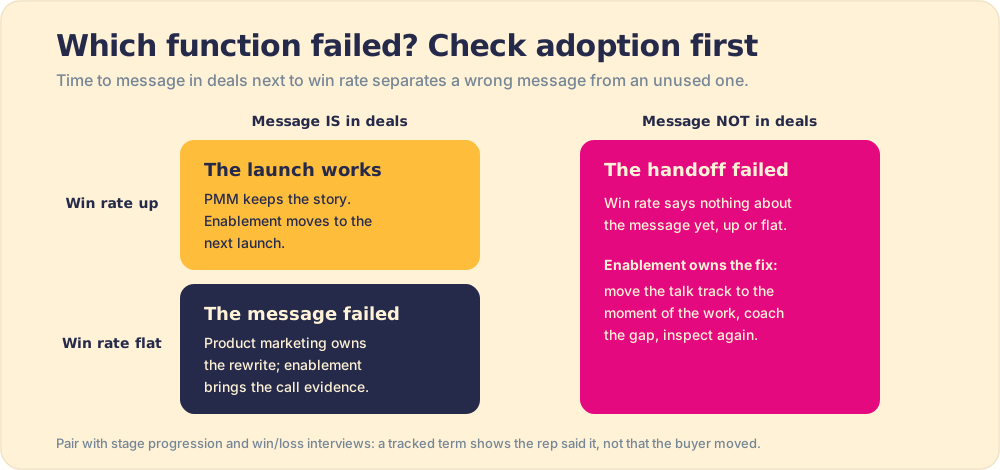
- Message in deals, win rate up. The launch works. Product marketing keeps the story; enablement moves to the next launch.
- Message in deals, win rate flat. The handoff worked and the message did not. Product marketing owns the rewrite, with enablement bringing the call evidence.
- Message not in deals. The handoff failed, and win rate cannot tell you anything about the message yet. Enablement owns the fix: move the talk track to the moment of the work, coach the gap, inspect again.
Keep the buyer in the picture. A tracked term firing means the rep said it, which is the behavior you asked for. Whether the buyer moved is a separate question, answered by stage progression and win/loss interviews, and the diagnosis needs both.
Who should product marketing and sales enablement report to?
Reporting lines vary more than the work does. In the Sales Enablement Collective’s 2024 report, 39% of respondents named a lack of formal internal alignment on what enablement is or does as one of their biggest challenges (Sales Enablement Collective). Where enablement sits is often where that confusion starts.
Our recommendation for mid-market and SMB teams:
- Product marketing in marketing or product. It needs to be close to the roadmap and the market.
- Sales enablement under the sales leader or RevOps. It needs to be close to the managers who inspect deals and the CRM where the work happens. The sibling argument, system versus behavior, is in sales enablement vs sales operations.
- Enablement under product marketing only with a guardrail. When enablement reports to PMM, it tends to get judged on assets shipped. If that is your structure, give it an adoption metric the PMM leader is also on the hook for.
The broader sales enablement vs marketing question follows the same logic. Marketing creates demand and the story; enablement makes the story usable in a sales conversation. We cover the wider seam in sales and marketing alignment.
What if one person does both at a smaller company?
At a company with ten or fifteen reps, “sales enablement and product marketing” is often one person, sometimes a founder. That is fine. Our survey oversampled this world: 38% of respondents ran teams of 10 to 50 reps (State of Sales Enablement 2026).
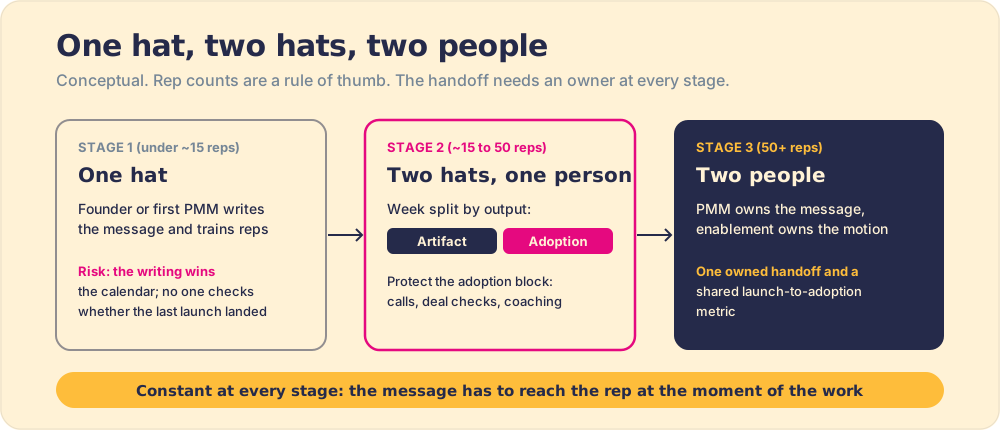
The danger for the one-person version is predictable. Writing produces something you can show: a deck, a page, a card. Adoption produces a slow, invisible change in how twelve reps run calls. So the writing wins the calendar, and the next launch gets built before anyone checks whether the last one landed.
- Split the week by output. Reserve fixed time for adoption work: listening to calls, checking whether the new step shows up in deals, and coaching the gap.
- Ship less, inspect more. One launch that reaches most live deals beats three that live in the library.
- Put the message where the rep works. A talk track inside the CRM at the moment the question comes up does more than a deck the rep would have to leave the call to open. In our survey, teams with the process embedded in the workflow hit quota at 49%, against 15% for teams whose process lived in docs and wikis (State of Sales Enablement 2026).
So which function decides whether a launch works?
Hold product marketing accountable for the message, hold sales enablement accountable for whether reps use it in live deals, and give the handoff between them one named owner and one shared number: time to message in deals.
The evidence walked through above explains why the handoff needs its own owner. Product marketing is productive, with 80% of PMMs creating sales collateral, yet reps face 1,400 assets, 60 to 70% of marketing content sits unused, and only 36% of sales leaders see their process followed as designed. Neither job description covers the stretch where that loss happens. Leave it unowned and you get the call recording from the top of this page: a rep a month past launch, pitching last year’s story and promising to “send over some material.”
Both functions are necessary, and they fail in opposite directions. A team with a sharp message and no adoption loses to a team with a decent message that every rep runs. A team with flawless adoption of a weak message loses too, only more consistently. Time to message in deals is how you tell which failure you have.
That handoff, putting the new message in front of a rep at the moment of the work and inspecting whether it got used, is what we call the Behavior Layer. Supered is one way to run it.
If you want the other half of this org-design question, read sales enablement vs sales operations, which draws the same line between the system and the behavior. And if you want the numbers behind the handoff, the State of Sales Enablement is where the 53-point gap lives.
Frequently asked questions
What is the difference between sales enablement and product marketing?+
Does sales enablement report to product marketing?+
Who owns battlecards, product marketing or sales enablement?+
Can one person do both product marketing and sales enablement?+
How do you measure product marketing vs sales enablement?+
What is time to message in deals?+
Your process, running itself.