Sales Enablement vs Sales Operations: System vs Behavior
Most guides split sales enablement and sales operations by task list: ops owns the CRM and forecasting, enablement owns training and content.
The sharper line is system versus behavior, and it changes who owns the most important question on the team.
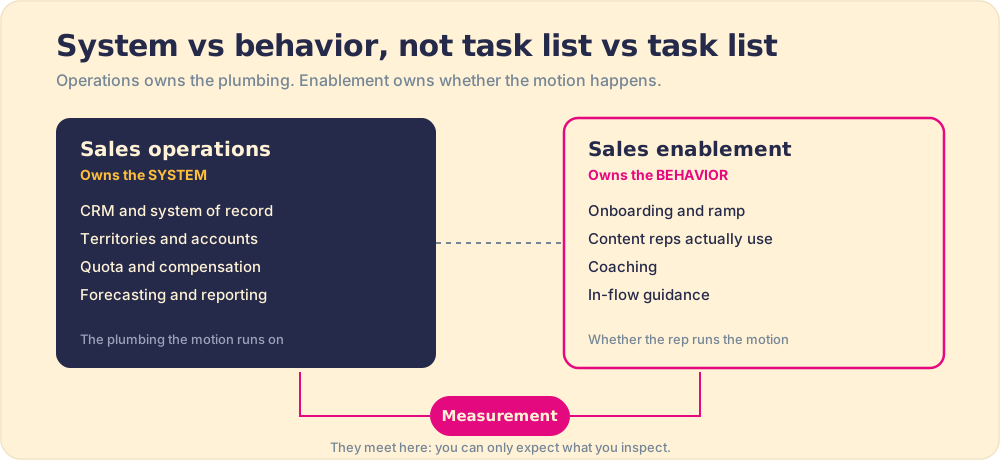
Sales enablement vs sales operations is the split between the function that builds rep behavior (training, content, coaching) and the one that builds the system it runs on (CRM, territories, comp, forecasting): ops owns the plumbing, enablement owns whether reps run the motion.
Two people on the same revenue team are looking at the same slipping deal, and they see completely different things. The sales operations analyst sees a record stuck in stage three for forty days, a forecast category that should move from commit to best case, and a territory that may be carrying too many accounts. The sales enablement lead sees a rep who skipped the discovery questions, never confirmed the economic buyer, and is now sending a proposal into a vacuum. Both are right. Neither owns the thing that actually went wrong.
That gap is the whole subject here, and almost every explainer on sales enablement vs sales operations walks right past it. The field splits the two functions by task list: operations owns the CRM, territories, compensation, and forecasting; enablement owns training, content, and coaching. Tidy, and not wrong, and not the useful line. The sharper division is this: sales operations owns the system, the plumbing the sales motion runs on, and sales enablement owns the behavior, whether reps actually run the motion. They meet at exactly one place, measurement, because you can only expect what you inspect. And the place teams break is the seam between them: ops ships dashboards, enablement ships content, and nobody owns whether the rep ran the play.
So here is the definition worth keeping. Sales enablement vs sales operations is the division between the function that builds rep behavior and the function that builds the system that behavior runs on. Ops builds the plumbing. Enablement builds whether the motion happens. Knowledge and structure are the solved part; behavior in the moment is the part still up for grabs.
What is sales operations, really?
Strip the brand names off and sales operations is the function that keeps the machine of selling running. It owns the CRM as a system of record, designs the territories, sets and tracks the quotas, runs compensation, and produces the forecast the executive team bets the quarter on. It is the engineering and the accounting of a sales org at once, the discipline that turns a pile of activity into numbers a leader can steer by.
List its responsibilities and a pattern jumps out. The CRM, the territory map, the quota model, the comp plan, the forecast, the reporting layer: every item is part of the system, and none of them is a rep doing the thing. Ops makes sure the pipes are laid, the water pressure is right, and the meters read true. What comes out of the tap when a rep is on a call is not, strictly, its job.
That is not a knock. A cracked foundation sinks everything above it, and a misconfigured CRM or a badly drawn territory will starve a great rep of the air they need. Ops is the floor the whole motion stands on. The point is only that a floor, however level, does not walk anyone across the room.
What is sales enablement, really?
Sales enablement is the function that builds what a rep can actually do. It owns onboarding and training, the content reps sell with, the coaching that sharpens the motion, and, increasingly, the in-the-moment guidance that reaches a rep mid-deal. Where ops asks whether the system is built right, enablement asks whether the rep runs it well. We have walked through the full scope of the discipline in what is sales enablement, but the one-line version is that enablement exists to change behavior.
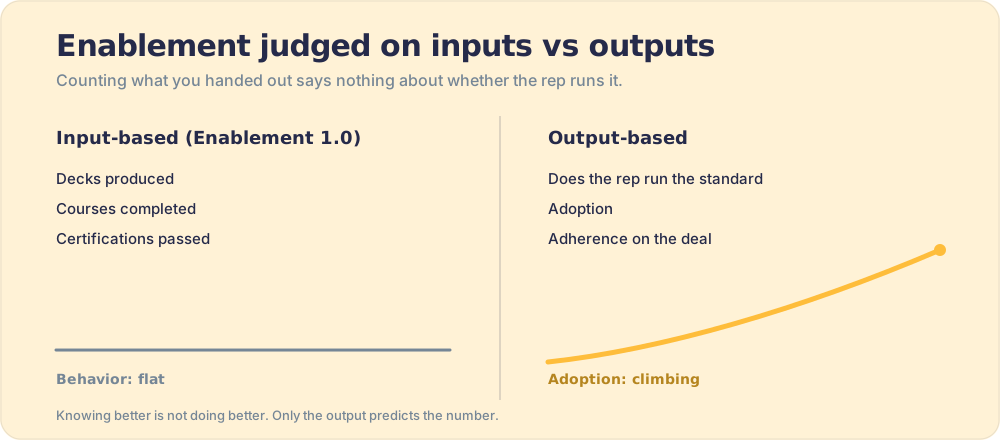
And this is where most enablement, historically, has gone wrong, which is worth naming honestly. The old version of the function, call it Enablement 1.0, was input-based: it measured itself by what it gave reps. Decks produced. Courses completed. Certifications passed. The trouble is that knowing better is not doing better. A rep can pass every quiz on Tuesday and freeze on a discovery call in March, because information delivered away from the moment of the work decays before the work arrives. Hermann Ebbinghaus’s first experiments on memory, in 1885, charted the forgetting curve. He measured memory as savings, the share of the original learning effort he could skip when relearning a list, and after one day only about a third was saved. A 2015 replication found the same shape: savings of about 47% after 20 minutes, 32% after a day, and 4% after a month, from one subject learning nonsense syllables (Murre and Dros, PLOS ONE, 2015). Front-load the knowledge in week one and most of it is gone before the rep ever needs it.
So the better definition of enablement is not “the team that makes content.” It is the team that owns the output, which is whether the rep runs the standard, not whether the rep was handed the standard. That distinction is why the function exists at all, and it is the one most cleanly lost when enablement is judged on what it produced rather than what changed.
Sales enablement vs sales operations: where is the real dividing line?
Draw the sales enablement vs sales ops question as system versus behavior and a lot of arguments dissolve. Almost every responsibility people fight over sorts cleanly once you ask one question of each: is this part of the plumbing the motion runs on, or is it whether the motion happens?
- Sales operations owns the system. The CRM and its configuration, stage definitions and required fields, territory and account assignment, quota and comp design, the forecast, and the reporting layer that tells leadership what is true. If it is infrastructure the sale flows through, it is ops.
- Sales enablement owns the behavior. Onboarding and ramp, the content reps actually use in a deal, ongoing coaching, and the in-the-moment guidance that puts the next right step in front of a rep. If it is whether the rep runs the motion, it is enablement.
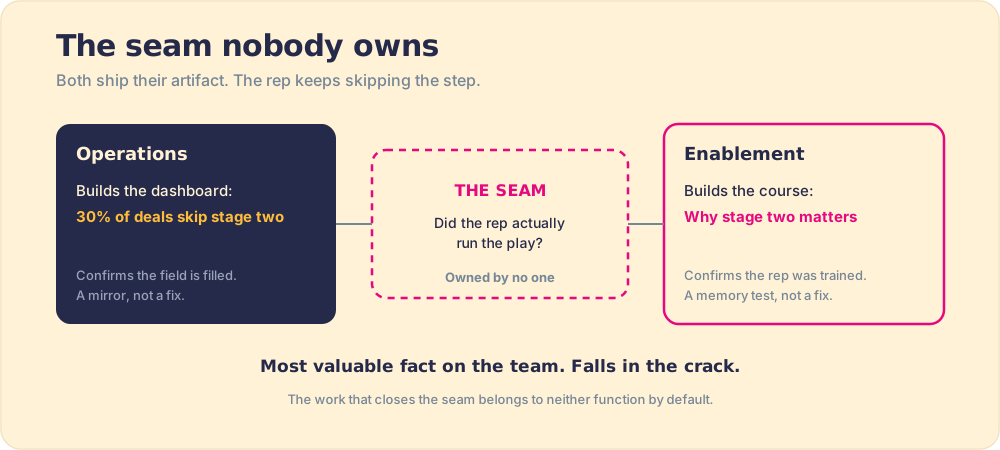
- The seam is whether the rep ran the play. Ops can confirm the field is filled; enablement can confirm the rep was trained on it. Neither, alone, confirms the rep ran discovery the way the process says. That confirmation is the most valuable fact on the team, and it is the one that falls in the crack.
Here is the trap, stated plainly. Operations builds a beautiful dashboard showing that 30% of deals skip stage two. Enablement builds a beautiful course on why stage two matters. Both ship their artifact, both report it done, and the rep keeps skipping stage two, because a dashboard is a mirror and a course is a memory test, and neither one reaches the rep in the moment the skip happens. The work that would close the gap, surfacing the right step while the rep is in the deal and inspecting whether it got run, belongs to no one. That is the difference between sales enablement and sales operations doing their jobs separately and a revenue team actually moving the number.
Set the two functions side by side and the split is easy to read.
| Dimension | Sales operations | Sales enablement |
|---|---|---|
| Core question | Is the system built right? | Do reps run the motion? |
| What it owns | CRM, territories, quota, comp, forecasting | Onboarding, content, coaching, in-flow guidance |
| Layer | The system (the plumbing) | The behavior (whether the motion happens) |
| Primary metric | Forecast accuracy, pipeline coverage, data quality | Adoption, adherence, ramp to productivity |
| Failure mode | A perfect system nobody follows | Great training running on broken plumbing |
| Time horizon | The quarter and the plan | The deal and the rep’s next action |
| Where they meet | Measurement: you can only expect what you inspect |
Where do sales operations and sales enablement overlap?
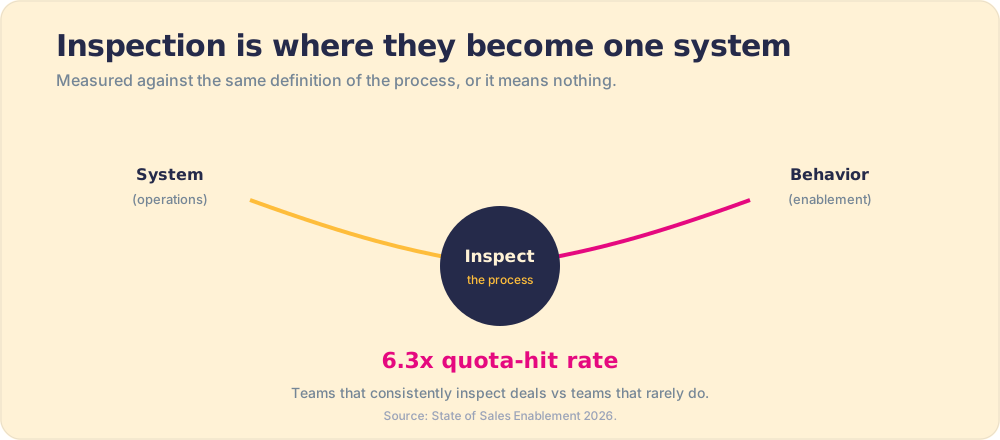
At measurement, and the overlap is not a turf problem, it is the point. Neither the system nor the behavior means anything until it is inspected against the same definition of the process. Ops cannot forecast a deal honestly if the stages reflect seller activity instead of buyer reality. Enablement cannot prove a rep adopted the motion without a signal that the motion was run. Both functions are starved without the same thing: inspection of the process against what a rep was supposed to do.
This is the principle underneath the whole comparison. You can only expect what you inspect. A process exists only to the degree adherence to it is checked, which means the dividing line between system and behavior is held together by a shared act of looking. In our own field data, teams that consistently inspect deals against a defined process hit quota at 6.3 times the rate of teams that rarely do, the single largest effect we measured (State of Sales Enablement 2026). Inspection is the hinge. It is the place ops and enablement stop being two departments and start being one revenue system.
The modern name for that convergence is revenue operations. RevOps is the umbrella that pulls sales, marketing, and customer success operations onto one data and process spine, so the system the behavior runs on and the behavior itself are measured against a single source of truth. Sales operations is the sales-specific slice of it; enablement increasingly plugs into the same spine. We trace the fuller story of that shift in revenue enablement, but the short version is that the wall between the functions is dissolving precisely because measurement forced them to share a definition of the process.
Who owns what, and what about the seam in the middle?
Start from the questions, not the org chart, because the reporting line moves around far more than the work does. In many mid-market teams enablement reports into sales operations or into a shared RevOps leader; in others it reports straight to the head of sales. The title tells you little. What tells you everything is which function owns the output.
- Operations owns the inputs to the system. Clean data, sound territories, a defensible forecast, a CRM that reflects reality. Judge it on forecast accuracy and data quality.
- Enablement owns the inputs to behavior. Ramp speed, the right content reaching the deal, coaching that lands, guidance in the flow of the work. Judge it on adoption and adherence, not assets shipped.
- The seam, whether the rep ran the play, is the part to assign on purpose. It is not naturally either function’s, which is why it defaults to no one. Someone has to own surfacing the next step where the work happens and inspecting whether it got run.
The reason the seam matters more every year is that the buyer made it matter. Gartner’s research finds that B2B buyers loop back through six buying jobs (problem identification, solution exploration, requirements building, supplier selection, validation, consensus creation) rather than marching down a tidy funnel, and that 99% of B2B purchases are driven by organizational change rather than a simple need (Gartner). A buyer that nonlinear punishes inconsistency. When one rep runs the motion and the next improvises, the buyer feels the seam, and a perfect forecast model cannot save a deal a rep handled three steps out of order. The system can be flawless and the behavior still loses the deal.
This is the real answer to the difference between sales enablement and sales operations: they are two halves of one accountability, and the half that decides the number is whether the behavior happened. That is also why the sales enablement manager role is shifting from content producer to behavior architect, and why the metrics that matter are moving from consumption to adoption, a shift we lay out in sales enablement KPIs.
Here is where the seam gets closed in practice, and it is one concrete instance of the principle, not the point of the piece. The work that neither function naturally owns, putting the next right step in front of a rep at the moment of the work and inspecting whether it got run, is the Behavior Layer.
So which function actually decides the number?
Both build something necessary, and the honest verdict is that they fail for opposite reasons. A team with a flawless system nobody runs and a team with great training running on broken plumbing both miss quota. You need both. But if you are forced to say which half decides the number in 2026, it is the behavior, and the reasoning is not a preference, it is what the evidence keeps showing.
Sellers spend only about 25% to 40% of their day in live selling, the rest lost to prep, admin, and hunting for information (Sales Enablement Collective). That sliver is where behavior either happens or does not, and no amount of system polish enlarges it. Knowledge is solved: any rep can find the doc and any AI can summarize it in seconds. Structure is largely solved too, the CRM and the forecast model are commodities now. What a rep does in the moment of the work, on a buyer who is looping nonlinearly through six jobs, is the part still genuinely hard, and it is the part the number turns on.
So the recommendation, plainly. Keep sales operations strong, because the behavior cannot run on a broken system, and a bad forecast or a lopsided territory will sink a great rep. Keep sales enablement strong, but judge it on output, on whether reps run the standard, never on decks produced or courses completed. And then assign the seam, on purpose, to someone: the act of delivering the next step in the flow of the work and inspecting whether it was run. That is the half the org chart forgets, and the half that decides whether the system and the training were worth building at all.
If you want the broader picture of how these functions plug into one revenue spine, start with the sales enablement software guide; if you want the data behind the inspection effect, the State of Sales Enablement is where the 6.3x number lives.
Frequently asked questions
What is the difference between sales enablement and sales operations?+
Does sales enablement report to sales operations?+
Is RevOps the same as sales operations?+
Who owns the sales tech stack, enablement or operations?+
Do I need both sales enablement and sales operations?+
Your process, running itself.