Sales Training Software: Why Course Completion Is the Wrong Metric
Most sales training software is an LMS that tracks course completion and optimizes the smallest lever there is. The history, why training rarely transfers to the field, what AI changes, and what to buy instead.
Sales training software is the category of tools that deliver and track learning for sales teams: onboarding, skill modules, certifications, and AI role-play. Most of it is a learning management system whose native metric is course completion, which measures attendance rather than skill; the tools that change results go past completion to whether reps apply the training on a real deal.
You cannot learn to swim from a book. You can read the best book ever written on swimming, pass a written test on it, recite the catch and the kick and the bilateral breath, and still sink the first time you are in deep water, because swimming is a behavior built in the water with feedback, not a body of knowledge transferred on dry land. Most sales training software is the book. It delivers excellent courses, tracks who finished them, issues a certificate, and reports a completion rate to leadership, and then the rep gets in the water of a real deal and reverts to whatever they did before. This guide is about that gap, why the category's favorite metric measures the wrong thing, and what to buy if you want training that reaches the field.
The thesis, stated plainly so a reader can argue with it: most sales training software is a learning management system that optimizes the smallest lever there is and measures the wrong outcome. It is built to deliver content and certify that a rep sat through it, which is an input, and it reports completion, which measures attendance. The thing that pays, whether the rep runs the trained motion when a live buyer is in front of them, it does not measure and was never designed to. That is not a knock on any one vendor. It is a description of what the category inherited from the LMS it grew out of, and it is why a team can hit a 95 percent completion rate and sell exactly as it did before. The rest of this guide is the evidence for that claim, the behavioral science of why it is true, two worked examples of it happening, the mistakes that flow from it, and what to do instead.
Where did sales training software come from?
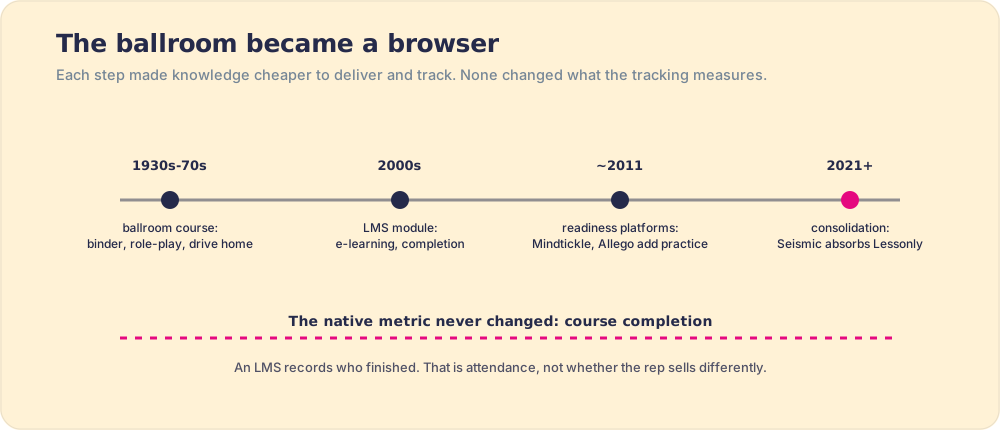
From the classroom, digitized, which explains both its strength and its defect. Sales training began as in-person instruction, the Dale Carnegie courses of the 1930s and the Xerox-built Professional Selling Skills program of the 1970s, the first attempt to turn selling into a teachable curriculum rather than a born talent. For most of the twentieth century that training lived in a hotel ballroom: a two-day offsite, a binder, a role-play with a peer, and a long drive home during which most of it evaporated. The arrival of e-learning and the learning management system in the late 1990s and 2000s changed the delivery and nothing else. The ballroom became a browser. The binder became a module. The thing that had always been hard to do, get a busy adult to change a habit under pressure weeks after the lesson, stayed exactly as hard, and the new software did not address it because it was not built to. An LMS is built to deliver a course and record who finished, because that is what it was invented for in corporate compliance training, where finishing the harassment module genuinely is the goal.
Sales-specific readiness platforms followed, Mindtickle and Allego both launched around 2011, and they were a real advance: they added structured practice, video role-play, and certification on top of the LMS core, so a rep could rehearse a pitch and a manager could score it. That moved training closer to behavior than a slide deck ever had. Then the category did what the whole enablement space did: it converged. Seismic acquired the training platform Lessonly in 2021, folding standalone training into a broader enablement suite, and by the time Gartner published the inaugural Magic Quadrant for Revenue Enablement Platforms on November 10, 2025, training and coaching were listed as one capability among several (content management, guided selling, buyer-engagement analytics) inside a consolidated platform category, with Allego, Highspot, and Bigtincan named Leaders. Standalone "sales training software" is becoming a feature of something larger. That is a sensible market correction, because training in isolation was always a partial product. But consolidation did not change the underlying measurement. Each step in this history made knowledge cheaper to deliver and easier to track. None of them changed what the tracking measured, which is attendance, not skill.
What is sales training software, and what does it measure?
At its core it is a learning management system tuned for sales: courses, modules, quizzes, certifications, and a dashboard of completion rates. The category has grown beyond that core, with practice modules and AI role-play bolted on, but the LMS spine is still load-bearing, and so is its native metric. Completion is the original defect of the category. It measures that a rep sat through the content, which is an input, and tells you nothing about output, whether the rep does the thing when a buyer is on the line. This is the distinction that runs underneath all of enablement, so it is worth defining in kitchen words before going further. An input is something you give the rep: a course, a script, a certification. An output is something the rep does: runs the discovery the way the course taught, asks the qualifying question, follows the process on a deal that matters. Training software lives almost entirely on the input side. It is excellent at giving reps things and recording that they received them. It is mostly silent on whether anything changed.
The consequence is a measurement that flatters everyone. A team can hit 100 percent course completion and change nothing about how it sells, and the dashboard will report a successful program in confident green. From the leader's chair a completed program is indistinguishable from an effective one, because the only signal on the screen is completion, and completion happened. The truth surfaces later and somewhere else, when the forecast comes in soft and nobody can connect it back to the training that was supposed to lift it. The course did its job, which was to be completed. It was simply asked to measure attendance and then trusted to report skill, and those are not the same number. This is why "knowing better is not doing better" is the spine of this whole topic: training transfers knowledge once, knowing is not doing, and a tool that stops at "the rep knows" has stopped one step short of the only thing that pays.
Why does sales training rarely stick?
Three well-documented reasons, and not one of them is fixed by a better course. They are worth understanding at the level of mechanism rather than as a list of complaints, because a leader who knows why training fails stops reaching for the fix that cannot work (more content, sterner mandates) and starts reaching for the one that can.
The first reason is transfer failure, and it is the oldest finding in the field. "Transfer" is the technical word for the thing a training buyer is really paying for: knowledge learned in one setting showing up as behavior in another. Timothy Baldwin and J. Kevin Ford reviewed the whole literature on it in 1988, and their opening lines are the most quoted sentence in corporate learning for a reason. They wrote that "it is estimated that while American industries annually spend up to $100 billion on training and development, not more than 10% of these expenditures actually result in transfer to the job." Read that again with a sales budget in mind: nine of every ten dollars spent on training produce no change in what people do at work. Transfer is hard for structural reasons Baldwin and Ford spell out, and none of those reasons is solved by making the course better. You can build a perfect course and still land in the failing 90 percent, because transfer is a property of the system around the course, not the course itself.
The reason that claim is worth more than a startling number is the model Baldwin and Ford built to explain it, which is still the standard framework forty years on. They grouped everything that determines whether training reaches the job into three sets of factors, and the grouping is the lesson. The first is trainee characteristics: the ability, motivation, and personality the rep brings to the room, including how much they believe the training will help and how able they feel to use it. The second is training design: how the learning is built, whether it includes practice, whether it resembles the actual job, whether it is sequenced so a principle has somewhere to attach. The third, and the one the software category systematically ignores, is the work environment: whether the manager and peers support the new behavior, whether the rep gets the chance and the cue to perform it, whether anything in the day-to-day reinforces it or works against it. Baldwin and Ford's central structural point is that transfer is produced by the interaction of all three, and that the work environment exerts a direct pull on whether a learned behavior survives, independent of how good the course was. A rep can have the motivation (factor one) and sit through a beautifully designed course (factor two), and the behavior will still die if the environment they return to offers no support, no occasion to use it, and no reinforcement (factor three). Most sales training software is a factor-two product. It is sold as if a better course were the whole answer, when the model says the course is one of three levers and not the decisive one.
Set that against how the category sells itself, and the mismatch is the whole problem in miniature. A demo walks a buyer through authoring tools, a content library, branching scenarios, certification paths: design, design, design. The work environment, where the model says transfer is made or lost, is not on the screen, because a standalone training tool has no presence there. It hands the rep a finished course and has no view of the manager who never asks about it, the call that never reuses it, the deal where the old habit was easier. A skeptic could check this against the research and find it holds: subsequent reviews of the transfer literature, including Ford and colleagues' own updated analysis, kept finding the same thing, that the work environment, support and the opportunity to perform, is among the strongest predictors of whether training shows up on the job. The design of the course is necessary and nowhere near sufficient. This is why "buy a better course" is the fix that cannot work: it pours more into the one factor the buyer can see and leaves the two that decide the outcome unaddressed.
The second reason is decay, and it sets a clock on everything you teach. Hermann Ebbinghaus ran the first rigorous experiments on memory in the 1880s, testing himself on nonsense syllables at intervals from twenty minutes to thirty-one days, and the curve he found has survived every replication since. He opened his discussion of it with a line that reads like common sense and turns out to be a law: "All sorts of ideas, if left to themselves, are gradually forgotten." His own numbers are the part that should alarm a training buyer. One hour after learning, he had to re-expend half the original effort to recover the material; after a day, only about one third remained; after a month, one fifth. The drop is steepest in the opening hours and the first day after the lesson, then it slows. A skills course delivered in a single sitting, with no reinforcement, is therefore mostly gone before the rep's next real call, which means even the fraction that did transfer is decaying on a curve Ebbinghaus drew before the telephone was common. Training without reinforcement is a bucket with a hole in it, and the hole is not a defect you can patch with more water.
The remedy the memory literature settled on long ago is spacing, and it is one of the most robust findings in all of psychology, which is why it is worth stating with the evidence behind it rather than as a slogan. Revisit material at widening intervals and each revisit flattens the curve and pushes the next forgetting further out. The scale of the effect is not a matter of opinion. Nicholas Cepeda, Harold Pashler, and colleagues pooled the whole experimental record in a 2006 meta-analysis in "Psychological Bulletin," drawing on 839 separate comparisons across 317 experiments in 184 articles, and the verdict was lopsided: spaced study produced markedly better long-term retention than the same study time massed into one sitting. Their more specific finding is the operational one for a sales leader. The interval between repetitions should grow as the time you need to remember the material grows, so a behavior a rep must still be running months into a deal cycle needs reinforcement spaced out across that span, not crammed into onboarding week. A single course cannot space itself. Only a system that brings the lesson back at the moment of use can, which is the practical reason reinforcement is not a nice-to-have bolted onto training but the mechanism that decides whether training survives at all. The same science that condemns the one-sitting course prescribes the fix, and the fix is structural, not editorial.
The third reason is proportion, and it is the one that indicts the category most directly. The 70-20-10 model of how people build capability came out of work at the Center for Creative Leadership in the 1980s. Morgan McCall, Michael Lombardo, and Ann Morrison documented it in their 1988 book "The Lessons of Experience," and Robert Eichinger and Lombardo later popularized the numbers in corporate L&D. The finding came from asking roughly two hundred executives where the abilities that made them effective had come from, and the answer they gave was lopsided: about 70 percent of their development traced to challenging on-the-job experience, about 20 percent to other people such as bosses and mentors, and only about 10 percent to formal coursework.
Here honesty requires a concession, and it is the kind that makes the rest of the argument stronger rather than weaker. The 70-20-10 ratios are not an empirical law. They came from executives self-reporting, in hindsight, where they believed their skill had come from, and critics have rightly hammered the gap between that and a controlled measurement. Charles Jennings, one of the model's best-known modern advocates, concedes the point plainly: he has written that the numbers are "not a recipe" and should be read as a reminder that most learning happens outside the classroom, not as a precise formula. The reviewers Andrew Kajewski and others went further, concluding there is little hard empirical data behind the exact split. So we do not lean on "70-20-10" as if the decimals were measured. We lean on the part that survives every critique and is supported well beyond this one model: that the great majority of durable skill is forged in doing the work and in feedback from people, and that formal coursework, whatever its precise share, is the smallest of the three contributors. Grant the skeptics the ratios and the conclusion does not move. Even if the real split were 60-30-10, or 50-30-20, a tool that optimizes the formal slice is still optimizing the smallest one. Most sales training software optimizes that slice with great sophistication and leaves the larger territory where skill is genuinely built almost entirely untouched.
Stack the three mechanisms and they point one way. Transfer says the course mostly does not reach the job; decay says the part that did reach it is fading by the day; proportion says the course was the small lever to begin with. A tool that stops at delivery and completion is fighting all three at once and losing all three, and no amount of production value on the course changes that, because the failures are not failures of content.
What does change it is the fourth idea, the positive one underneath the swimming analogy, and the most important thing in this guide: skill is built by doing the thing, getting feedback, and doing it again. The psychologist Anders Ericsson spent thirty years studying how experts are made, and his finding was that talent is mostly accumulated practice of a particular kind, deliberate practice, which is effortful, specific, and feedback-rich. The sentence of his that matters most here is about how skill physically forms in the mind. Ericsson wrote in "Peak" that "you don't build mental representations by thinking about something; you build them by trying to do something, failing, revising, and trying again, over and over." That is the whole case against learning to swim from a book in one line from the man who studied it. A course is thinking about something. The deal is trying to do it. The mental representation of how to run discovery, the thing that fires automatically when a buyer dodges a question, is built in the second place and not the first, which is why the field is where 70 percent of the learning lives, and why training that never touches the field cannot deposit much.
What does the gap look like in practice?
The mechanisms are abstract, so here are two teams, drawn from the pattern we see repeatedly in mid-market sales organizations. Neither is a single named customer; both are composites of a story that recurs, and both turn on the same hinge.
The first team did everything the category tells you to do. They bought a well-reviewed sales training platform, built a structured onboarding path, and ran their summer cohort of six new reps through it: forty hours of modules on their methodology, the product, and objection handling, capped by a certification every rep passed. The completion dashboard was perfect, 100 percent, and the VP of Sales reported a fully ramped cohort to the board. Then the deals came, and ramp told a different story. The cohort's median time to first closed deal was longer than the prior class that had no formal program at all, and call reviews showed why: the reps could recite the discovery framework word for word and did not run it on live calls, defaulting under pressure to feature-dumping, the habit the course was built to break. Nothing was wrong with the course. The reps knew the material; they had passed a test on it. What they had not done was build the mental representation Ericsson describes, because passing a module is thinking about discovery, not doing it, failing, and revising. The completion dashboard measured the input perfectly and was silent on the output, and the output was unchanged.
The second team started from the other end. They had the same content, but they refused to treat completion as the finish line. Each piece of the training was tied to a stage of their actual sales process, and the relevant guidance surfaced for the rep inside the CRM at the moment that stage came up on a real deal, so the discovery framework appeared when the rep opened a discovery call, not six weeks earlier in a classroom. A manager could see, deal by deal, whether the trained motion was being run, which made the forgetting curve survivable, because the lesson reappeared at the moment of use rather than decaying untouched. Their measurement was not "did the rep finish the course" but "is the rep running the discovery the course taught," and that number, not completion, was what they coached against weekly. The cohort ramped faster than any before it, and the difference was not a better course. It was the same content delivered where the work happens, reinforced against decay, and measured on behavior instead of attendance. That is the entire argument of this guide, run forward as a story: the first team optimized the 10 percent and the second team built the 90.
Sit with what separated the two teams, because it is smaller than it looks and that is the encouraging part. They were not divided by budget, by content quality, or by the discipline of their reps. They were divided by where the lesson lived and what got measured. The first team's training lived in a portal and was measured on completion; the second team's lived in the CRM at the moment of use and was measured on whether reps ran it. Same swimmers, same instruction manual; one team studied it on the deck and the other got in the water with a coach watching. The point is not that the second team bought a magic tool. It is that the three mechanisms, transfer, decay, and proportion, are not laws of fate but design constraints, and a team that designs around them gets a different result from identical inputs. A leader who internalizes that stops asking "which course is best" and starts asking "where does the lesson reach the rep, what keeps it alive, and how do I see whether it is being used," which are the only three questions the evidence says move the number.
It is worth voicing the strongest objection to all of this, because a fair reader will already be holding it. You might say: the problem is not the training, it is the reps, who are lazy or undisciplined and will not apply what they were taught no matter how good the system is. Grant the objection its full weight, because it feels true to any manager who has watched a well-coached rep revert to bad habits the week after a great session. But the evidence points the other way, and it is worth following. Transfer fails for the structural reasons Baldwin and Ford catalogued, the training does not resemble the job, the environment does not support the new behavior, nothing reinforces it, and those are properties of the system, not the person. The first composite team's reps were not lazy; they passed every module and wanted to do well. They reverted because under the pressure of a live call, with a course they had taken weeks earlier and no prompt at the moment of need, the old habit was the path of least resistance. Blaming the rep is not only unkind, it is a diagnostic error: it sends you looking for accountability when the fix is a system that delivers the lesson at the moment of use and reinforces it. When reps do not run the trained motion, the honest first assumption is a system failure, and the productive question is what made the right behavior harder than the wrong one.
The training-versus-enablement distinction earns its keep right here, because it is the difference between an event and a system. Training is an event that transfers knowledge: the rep now knows the thing, which is an input. Enablement is the ongoing system that turns that knowledge into behavior in the flow of work, and it is judged on output, whether the rep now does the thing on a deal. A standalone training tool can deliver the event flawlessly and still leave the system absent, which is precisely why the market has been folding training into broader enablement platforms rather than selling it alone, and why Gartner now scores learning and coaching as one capability inside a Revenue Enablement Platform rather than a category unto itself. The consolidation is the market admitting, in M&A, that an event without a system does not change the number. A buyer evaluating "sales training software" in 2026 is really evaluating where the event hands off to the system, and a tool with no answer to that handoff is selling you the front half of a motion and calling it the whole one.
What are the common mistakes when buying sales training software?
If the mechanisms above are right, then the predictable buying mistakes are the ones that optimize an input the buyer can see instead of the output that pays. They are common because each one feels, in the moment of a vendor demo, like diligence. Naming them is the fastest way to keep a purchase honest.
- Library size as the buying criterion. Choosing the platform with the most courses, the slickest authoring, the biggest content library, on the theory that more and better content produces more skill. Baldwin and Ford's 90 percent says it does not; content was never the constraint. A larger library is a bigger 10 percent lever, which is still the 10 percent lever. Buy for transfer and reinforcement, not for the size of the catalog.
- Completion as proof of change. Treating a 90-plus percent completion rate as evidence the program worked. Completion measures attendance, and the first team above had a perfect one while ramping slower than a class with no program. A completion dashboard is a useful operational metric (it tells you who is behind on required training) and a worthless effectiveness metric (it cannot see whether selling changed). Confusing the two is the single most expensive error in the category.
- A standalone tool reps must leave the work to use. Buying training that lives in its own portal, so applying the lesson on a deal costs a context switch out of the CRM and back. Small frictions reliably beat good intentions, so the lesson the rep would have to go fetch is the lesson that does not get used. Training that does not surface in the flow of work fails the forgetting curve by default, because nothing reappears at the moment of need.
- No reinforcement plan. Buying the course and budgeting nothing for the reinforcement that makes it survive. Ebbinghaus settled this in the 1880s: a single sitting decays to roughly a third within a day. A program with no spaced reinforcement is buying a bucket with a hole and measuring how much water you poured in.
- AI role-play scores mistaken for field behavior. Treating a high score against a practice bot as evidence the rep will do it live. Practice is genuinely valuable and AI has made it nearly free, but a simulator score is still an input, one step closer to behavior than a quiz and still not behavior on a real buyer. The gap between the two is the transfer problem, and a practice score cannot certify it has been crossed.
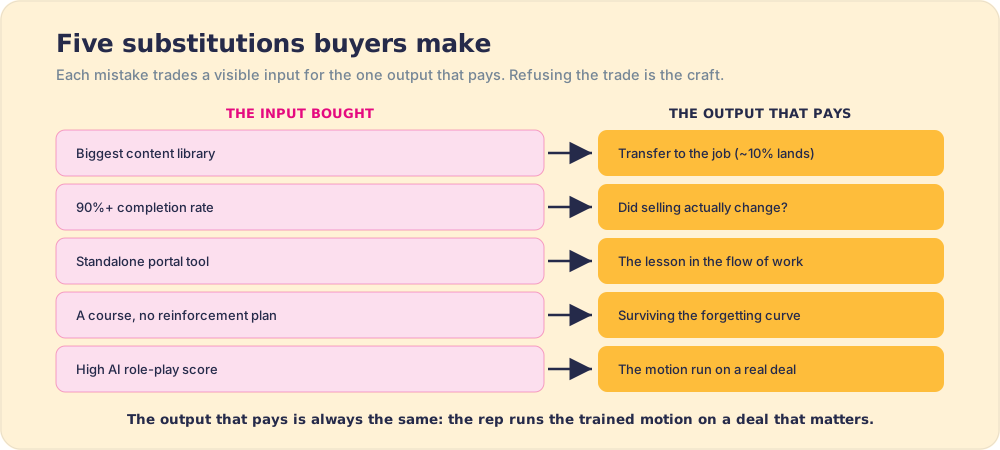
Read down the list and the pattern is the same one that runs through the whole topic: each mistake substitutes something measurable and convenient, hours of content, a completion rate, a practice score, for the harder thing it was supposed to stand in for, a rep doing the trained motion on a deal that matters. The craft of buying training well is refusing those substitutions.
How do you choose sales training software?
Judge it on whether it reaches the 90 percent, not how well it delivers the 10. Three criteria separate training that transfers from training that certifies, and they map cleanly onto the category.
| Archetype | Delivers in the flow of work | Measures field behavior | Reinforces over time |
|---|---|---|---|
| LMS / course platform | No, a separate destination | Course completion only | No, one-and-done |
| Readiness platform (Mindtickle, Allego) | Onboarding and practice, not live deals | Certification scores | Periodic, scheduled |
| AI role-play (Second Nature, Hyperbound) | Practice, not the live deal | Practice scores, not field use | On demand, but off the deal |
| In-flow behavior layer (Supered) | Yes, at the stage it applies | Adherence on real deals | Yes, reinforced in the work |
The three columns are not arbitrary; each one answers one of the three failure mechanisms. Delivers in the flow of work answers transfer: the lesson reaches the rep at the moment a deal needs it, in the tool where the deal is being worked, rather than weeks earlier in a classroom the rep has to mentally drive back to. Reinforces over time answers decay: the lesson reappears against the forgetting curve instead of being poured in once and left to drain. Measures field behavior answers proportion and proof at once: it watches the 90 percent, the doing, rather than the 10 percent, the knowing, so you can tell whether any of it transferred instead of inferring success from a completion bar. A platform that scores well on all three is rare; most of the category scores well on delivery and is silent on the other two.
This is also the place to be fair to the tools the matrix ranks below the behavior layer, because the honest answer is that several of them are the right buy for a real job. A readiness platform like Mindtickle or Allego is genuinely strong at onboarding fundamentals and certifying baseline knowledge, and for a team standing up a training function from nothing, that is worth buying. An AI role-play tool like Second Nature or Hyperbound gives reps cheap, safe, unlimited practice, which is the closest a simulator gets to Ericsson's "try, fail, revise," and it is a real advance on the flashcard quiz. The branch is on the job, not on the vendor. If your problem is that new reps lack baseline knowledge and reps, a readiness or role-play platform solves it well. Supered is the buy when your problem is the other one, that reps who already know the material and have practiced it still do not run it on real deals, because that problem lives in the field, not the classroom, and only a tool that reaches the field can touch it.
What does AI change about sales training?
It makes the part the category was already good at nearly free, which exposes the part it was never good at. AI role-play tools now run unlimited practice scenarios against a convincing simulated buyer and score them automatically, so access to repetition, once the scarce and expensive resource (it used to require a manager's hour or a willing peer), is now abundant. The money is following the capability: Hyperbound raised a $15 million Series A led by Peak XV Partners in September 2025 on exactly this premise, scalable AI roleplay, after stringing together months of seven-figure ARR growth. That is real progress, and it is progress on exactly the right thing in one sense: Ericsson's deliberate practice needs many repetitions with feedback, and AI supplies both at a price that makes them routine rather than rationed. For the practice half of training, this is the largest improvement in decades.
It is worth being precise about what these tools do, because they are not interchangeable and the differences map onto the transfer problem. Second Nature runs conversational role-play against a simulated buyer and certifies whether a rep can hold the conversation, which is the closest of the three to Ericsson's "try, fail, revise" on a sales motion. Hyperbound builds buyer personas a rep can cold-call, discover, and try to close against, scoring the attempt. Yoodli is a different animal worth separating out: it is a speech coach that analyzes filler words, pacing, and clarity, so it grades how a rep sounds, not whether they ran discovery or handled the objection. All three are genuine advances on the flashcard quiz, and a team standing up a practice function could do far worse than any of them. But notice the ceiling they share. Every one of them measures performance in a simulation. None of them sees the live deal.
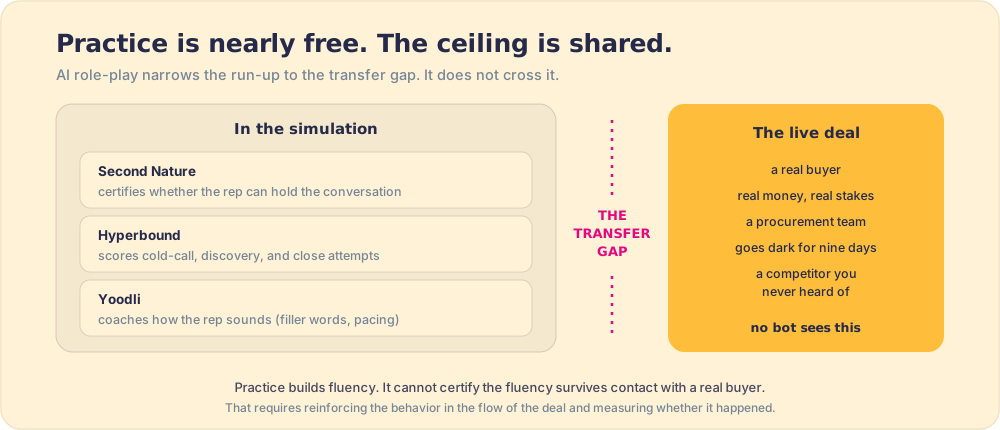
That is why AI role-play does not touch the larger territory where skill is built, and it is worth being precise about why, because the marketing around it implies otherwise. Practice in a simulator is still practice; it is an input, one rung closer to behavior than a quiz and still not behavior on a real buyer with real money and real stakes. A bot does not flinch, does not have a procurement team, does not go dark for nine days, does not surprise the rep with a competitor they have never heard of. The gap between a confident bot score and a live call is the transfer problem the research has named for forty years, and a simulator does not cross it, it narrows the run-up to it. Said as a rule: practice can build fluency and confidence with a known scenario, and it cannot certify that the fluency will survive contact with a real buyer, because the work environment, Baldwin and Ford's third factor, is exactly what the simulation strips out. AI moves the constraint closer; it does not remove it. The scarce resource was never access to practice and is even less so now. The scarce resource is the trained motion showing up on a real deal when it counts, and that advantage belongs to whoever can reinforce the behavior in the flow of the real deal and measure whether it happened.
There is a sharper turn here that follows our broader view of AI in sales: AI amplifies the process you already have. Point it at a team with a defined, adopted selling motion and it compounds that motion, drilling the right behaviors and surfacing the right guidance at the right moment. Point it at a team with no agreed motion and unlimited cheap practice, and it will help reps get fluent at whatever they were already doing, including the habits the training was meant to break. AI can help deliver reinforcement; it cannot, on its own, decide what good looks like or make a rep do on a real call what they did with a bot. Get the behavior right first, then let AI multiply it. The full version of that argument is in the sales enablement software guide.
The recommendation
The way forward has three honest options, and they are worth naming plainly before stating which we recommend. You can buy the biggest, best content platform and run a tight completion program, which is the default and which the evidence says will leave most of your spend in the failing 90 percent. You can layer AI role-play on top, which is a genuine upgrade to the practice half and still stops at the simulator's edge. Or you can treat training as the front half of a longer motion whose back half is reinforcement and measurement in the field, and weight your effort accordingly.
We recommend the third, and the recommendation is not neutral, because the science is not neutral. Buy training software for the job it provably does well, onboarding new reps on the fundamentals and giving them cheap, safe practice, and refuse to let a completion dashboard stand in for results, because Baldwin and Ford's 90 percent and the first composite team both say completion and effectiveness are different numbers. Then put your real weight where the 70-20-10 math says skill is built, in the field, with reinforcement against the forgetting curve and measurement of the behavior itself. Deliver the trained motion in the flow of the deal, at the stage it applies, and inspect whether reps run it, because a rep doing the thing on a deal that matters is the only signal that training became selling. A mediocre course reinforced and measured in the field will outperform a brilliant one that decays untouched, for the same reason a swimmer who practices in the water beats one who only studies the book.
That reinforcement-and-measurement layer is the job we built Supered for: the lesson surfacing in HubSpot and Salesforce the moment the deal needs it, with adherence measured deal by deal, so the training you paid for reaches the water instead of staying in the book. It is one concrete instance of the principle, not the principle itself, and the principle holds whether or not we are in the room. How that fits the wider sequence is in the sales enablement software guide, and the new-hire case is in sales onboarding.
Read the connected pieces: sales onboarding for ramping new hires, sales coaching for the reinforcement layer, the sales coaching guide for the manager system, sales enablement software for where training fits the stack, and The State of Sales Enablement for the data underneath it.
Sales training software FAQ
What is sales training software?+
Does sales training software work?+
What is the difference between sales training and sales enablement?+
How do you measure sales training effectiveness?+
Why does sales training not stick?+
What are the common mistakes when buying sales training software?+
What does AI change about sales training software?+
Is sales training software the same as a sales LMS?+
How often should sales training be reinforced?+
Can AI role-play replace real sales coaching?+
Completion is not skill.