Is Sales Enablement Broken? Matt Bolian and Caleb King Argue Over What Is Failing
Is sales enablement broken and failing revenue teams? Matt Bolian said yes, Caleb King said the word was too strong. Five rounds later they agreed on the fix: expectations before content, and behavior as the measure.
Sales enablement is broken where it grades itself on content and certifications instead of checking what reps do with buyers; on Pardon the POV, Matt Bolian called it failing, Caleb King called that too strong, and both put behavior first.
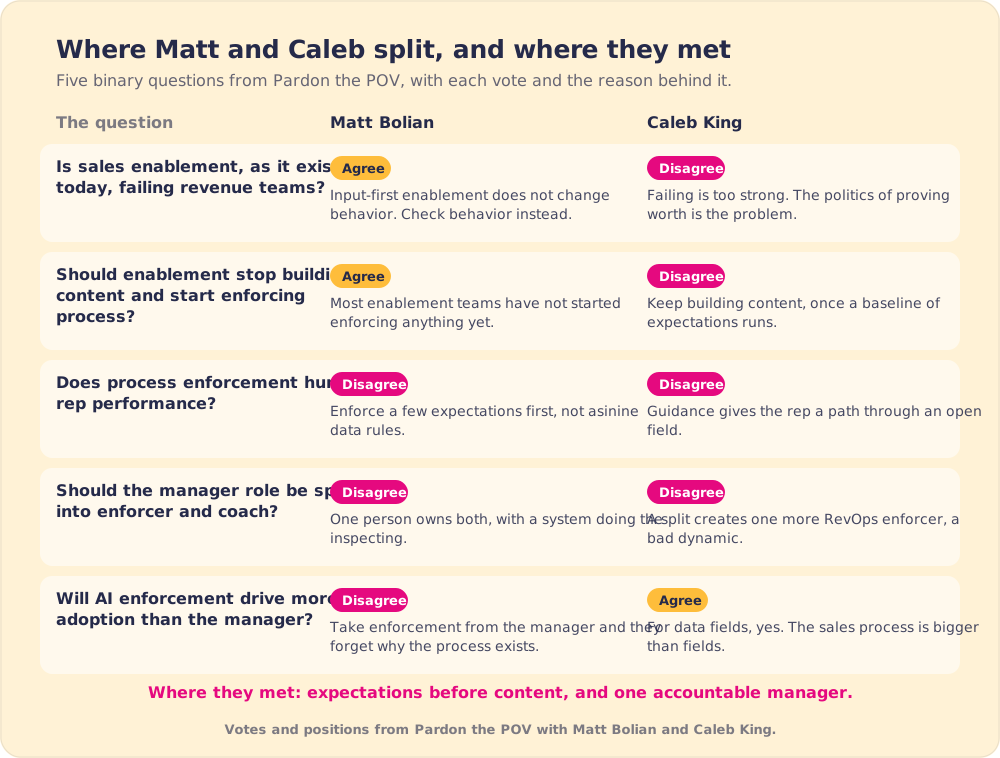
Rob, our host, opened with the case against enablement. It has more teams, more budget and more headcount than ever, and sales leaders still name rep productivity as their top priority. Then he asked the binary question: is sales enablement, as it exists today, failing the revenue teams it was built to serve?
I said agree. Caleb King, a seller on our team, said disagree.
That was the first of five questions on our Pardon the POV debate, Is Sales Enablement Broken. Along the way we took on the sales enablement problems leaders usually argue about in private: whether content is the job, whether enforcing a process slows reps down, whether the manager role should be split, and whether AI can do the enforcing. By the end we agreed on the main one. Enablement goes wrong when it grades itself on what it made and never checks what reps did. Our breakdown of sales enablement challenges maps the rest of the list.
Is sales enablement broken?
Rob’s word was failing, and my case was about how enablement gets built. Most of it assumes that “if you read something, it will change your behavior because you know the right thing and you’ve learned to do the right thing. That idea, that concept does not work. Knowing does not equal doing better.” The fix I argued for was to change what enablement measures: “You actually have to check behavior. And when we do that, we’ll start to finally see ROI out of your enablement process.”
Caleb thought “failing” was too strong, and he had a story behind the objection. He had been reading an email newsletter from an enablement publication, and one of its first points was how important certifications are, pitched as the way enablement people prove their worth and protect their jobs. “It’s not that they’re failing, but it’s become so political where it’s just like, ‘Hey, let me prove my worth. So, I’m going to show you a book of everything I’ve written on how to enable people.’ And that is not helpful.”
So I put the blame on the method, and Caleb put it on the pressure enablement teams are under to justify themselves. He ended his turn agreeing that enablement should put behavior first, and that a thick binder proves only that someone wrote a lot.
Jeffrey Pfeffer and Robert Sutton described the same pattern across whole companies in 1999. Organizations let talk, plans and documents stand in for action, and end up knowing far more than they do (Pfeffer and Sutton, The Knowing-Doing Gap). Our own survey measured the gap in sales. In The State of Sales Enablement 2026, 89% of teams said they have a defined sales process, and 36% see reps follow it consistently (The State of Sales Enablement 2026). We cover the psychology in our post on the knowing-doing gap in sales.
Should enablement stop building content and start enforcing process?
Rob framed the second question as two camps. One says reps need better playbooks and decks. The other says reps already have what they need and do not use it.
Caleb took the middle, and gave the most practical answer of the episode. Enablement teams should keep building content, he said, but first they should focus on “baseline process expectation, behavioral expectations,” and he admitted that getting the whole team to that baseline is “a big lift.” Content comes after you can see, day after day, that the basics are running. “The content can’t come first. The process expectation of baseline has to come first.”
I agreed with Caleb and pushed on how the question was worded. It asked whether enablement should stop building and start enforcing, “meaning they haven’t even started enforcing process.” My test for enablement comes from the rep. If reps don’t say “you make my job easier to do, thank you for holding me to an expectation and when I don’t know what to do, then you help me,” then “you’re not doing enablement.”
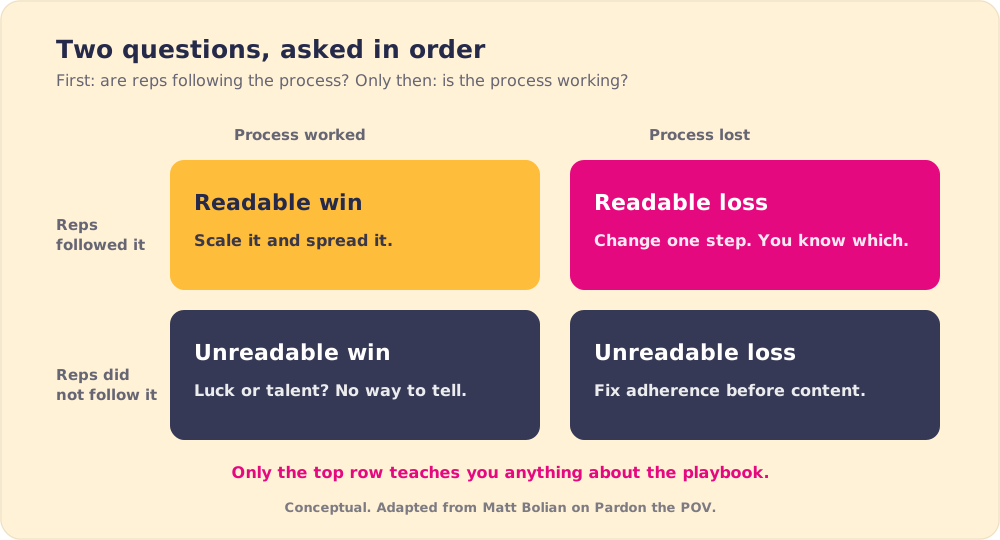
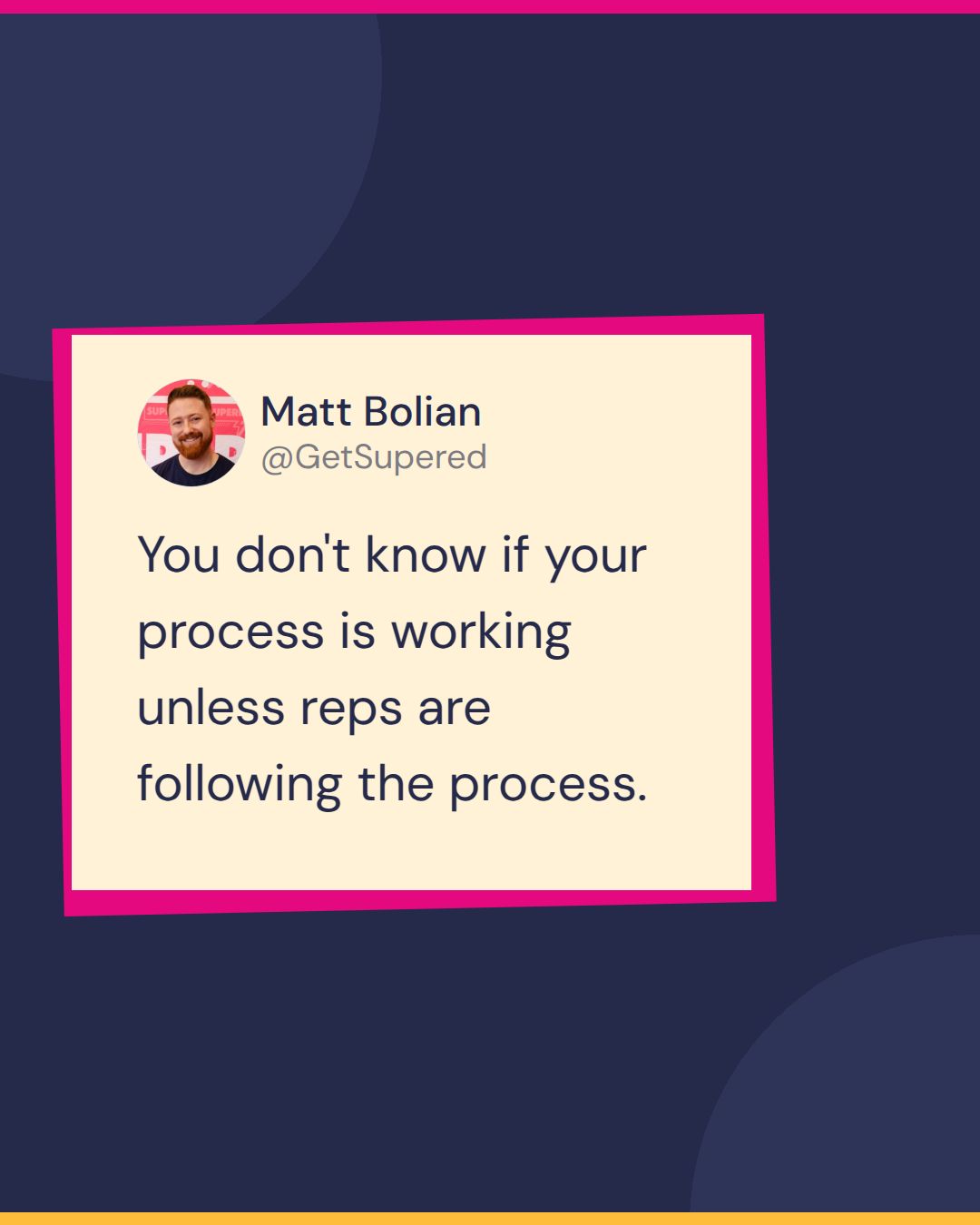
Rob followed up with the question I most wanted. Suppose reps follow the process every time and still miss. Whose fault is that? I said a sales leader has two questions, and they come in order. “Is my rep following the process? And is my process working? The issue is you don’t know if your process is working unless reps are following the process.”
I went further. “If every rep is following the process and now I know the process isn’t working, that’s actually a really good place to be. I argue most sales management teams aren’t in that place.” Rob tied it to school: “We learned in sixth grade science to manipulate one variable at a time.”
Does enforcing a sales process hurt rep performance?
Rob brought the case for yes: CRM rules, stage gates and hygiene reviews add admin work, and reps route around them. Caleb and I both disagreed.
I start by dropping the word. “I don’t even say the word process. I say expectations.” A team needs a base level of them, enforced first, and “not the asinine data rules” that fill so many CRMs. My examples were plain on purpose. Is each rep sending a follow-up email, yes or no? Are you contacting the people in the deal? Are you “touching them with value ads every seven days? Yes or no?”
Caleb answered as a rep. With the expected steps in front of him, he has a straight line to the close. Without them, “there’s an open field, but I know there has to be a path taken.” Rob asked whether most sales teams have that kind of guidance today. “No, but some do,” Caleb said. We agreed that a wall of required fields does cost reps time, and that a handful of expectations shown where they work helps them.
Research on seller time supports keeping the list short. Salesforce’s State of Sales survey of 7,775 sales professionals found reps spend 28% of their week selling (Salesforce, 2022). Gartner reports that 83% of sellers experience high or medium “drag,” the work that saps effort, and that low-drag sellers reach 1.7 times the quota attainment of high-drag sellers (Gartner). The four checks I listed each tell a manager whether a buyer heard from the rep.
Should the manager enforce the process, or should AI?
The last two questions asked who holds the process. First, should the sales manager role be split, with one person enforcing and another developing people? We both said no.
Caleb said a split would only move the problem to a new desk. The enforcer becomes “the rev ops person, the sales ops person,” which he called “a bad dynamic.” He wants the system to flag the input work and reps to own their part, because a choice like adding a second contact “actually affects how you move a deal forward because it makes you think about it.”
I said the two jobs belong to one person, which is “a seemingly impossible task” without help. The manager “needs to know why those exist, needs to understand the expectations. In fact, they might set the expectations and they need more time to coach.” Rob added the piece I liked best: once the system handles the policing, the manager has time for “insight extraction,” spotting where the process itself needs to change.
Then Rob asked whether AI-enforced compliance would drive higher adoption than manager-enforced compliance. Here Caleb and I split again. He leaned yes for data fields: when an AI flags a missing field, “I can click yes or no. Like I do think that is helpful.” But “when I think about sales process, it’s greater than just like the data inputs.” I said no, and went back to the question before it: can you split enforcing the process away from the manager? “And the answer is hell of no.” If you take enforcement away from the manager, “the manager will forget why the process exists in the first place,” and “will be less informed to coach.”
Time is the manager’s constraint. At one to five reps per manager, 47% of teams report high process adherence. At six to eight reps, it falls to 23% (The State of Sales Enablement 2026). A manager with eight or more reps cannot check every expectation by hand, so a system has to do most of the checking if it is going to happen at all.
What should a leader do about these sales enablement problems?
- Behavior as the measure. Grade enablement on what reps did with buyers. Content and certifications only count what the team produced.
- Expectations before content. Caleb’s order: get the whole team to a visible baseline, then add material that helps reps once the baseline holds.
- Two questions in order. Ask whether reps followed the process before asking whether it works. A followed process that loses tells you what to change.
- A short, checkable list. Follow-up sent, the right people contacted, value delivered on a cadence, each one answerable yes or no.
- One accountable manager. Keep enforcement and coaching in one role, with a system carrying the inspection so the manager’s hours go to coaching.
- AI on the fields, people on the judgment. Let AI flag the missing data. Keep the manager responsible for whether the process is followed and why.
The verdict: check behavior before you build more content
Rob gave me the win for the episode, “only because I feel bad for you.” I will take it on those terms.
Caleb’s objection to the word “failing” was fair. Enablement teams are asked to prove their value, and certifications and content libraries are the easiest things for them to count. Where we landed together is where I would point any sales leader working through sales enablement challenges on their own team. Measure enablement by what reps do. Set a few expectations, check them on every deal, keep the manager accountable for them, and build content for the steps where reps who follow the process still stall.
My parting words on the show were blunt, and I stand by them. “Number one, you should be judging people’s behavior, not creating more content. Number two, you cannot divorce and get rid of hard conversations.” And three, you need a tool that lets you do both, “or you will get lapped.”
That third point is why we built Supered. The Behavior Layer puts your expectations in front of reps in the flow of work inside HubSpot and Salesforce, checks whether each one happened, and shows the manager adherence next to results, so enablement content has a baseline to build on. Our post on sales enablement ROI makes the budget case, and sales process adoption covers how to keep reps on the process once it exists.
For the full map of where the gap opens, read our breakdown of the sales enablement challenges that share one root cause next.
Frequently asked questions
Is sales enablement broken?+
Should sales enablement teams stop creating content?+
How do you know if your sales process is working?+
Should the sales manager role be split between inspection and coaching?+
Can AI enforce the sales process instead of the manager?+
Your process, running itself.
Turn the playbook into rep behavior.
More from Pardon the POV

Deal Inspection or a Better System? Crispy Barnett and Matt Bolian on Why Reps Skip the Process
Matt Bolian & Crispy Barnett
Presidents Club in Sales: Matt Bolian and Crispy Barnett Argue Over Who the Trip Is For
Matt Bolian & Crispy Barnett