Presidents Club in Sales: Matt Bolian and Crispy Barnett Argue Over Who the Trip Is For
Is President's Club about culture or motivation? Should your best rep become your manager? Should enablement serve the top or the middle? Matt Bolian and Crispy Barnett argue it out, and where they agree tells you what to do with your winners.
A presidents club in sales is an annual reward, usually a trip, for the reps who finish the year at the top, and on Pardon the POV Matt Bolian and Crispy Barnett agreed it earns its cost as a way to reward and keep those reps.
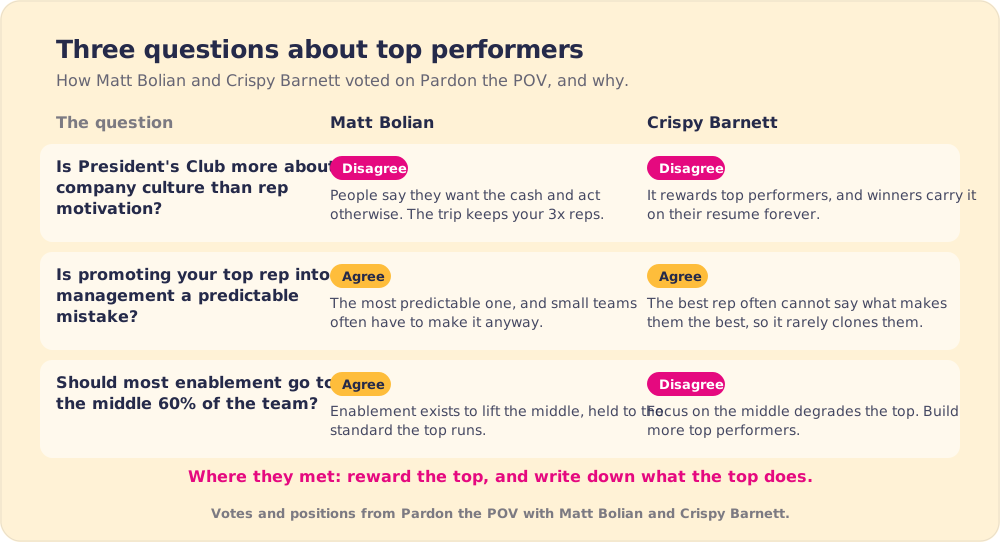
Rob, our host, has been on President’s Club trips as a spouse, so he admitted the next question was a sensitive one for him. Is President’s Club in sales more about company culture than rep motivation, and are companies confusing the two? He came armed with the poll that set LinkedIn arguing: asked whether they would rather have the trip or the cash, 56% of reps took the cash.
Crispy Barnett and I both pushed back on the question, from different directions. Then Rob spent two more rounds on what companies do with their best reps: promote them into management, and decide whether enablement serves them or the middle of the team. On that last one, Crispy and I split.
Crispy came to sales from athletics, and he brought it up more than once on that Pardon the POV episode in May 2026. What started as a presidents club sales question became a longer argument about top performers: what the trip is for, why the best rep so often makes a shaky manager, and who enablement should serve. We agreed on two of the three questions, and the one where we split is worth hearing out.
Would sales reps take the cash over a President’s Club trip?
I started with the poll, because I think it measures the wrong thing. People, I said, “are really bad at understanding why they do something as humans. And so when they say I’d rather have the cash, everybody always says I’d rather have the cash.” As a behavioral scientist, I do not trust that answer. “People often say they want something but they don’t act that way.”
My case for the trip is about who it keeps. Losing a rep who produces three times the average costs far more than a middle performer staying where they are, “because a 10x 3x 5x rep is much better than a 1x rep will ever be.” To keep those reps, “you need the recognition to do that.”
Crispy came at it from the rep’s side of the table. “If you think about someone who has ever won President’s Club, uh they carry it around on their resume forever.” The line means one thing to any hiring manager: “I have surpassed my quota time and time again over time.” So he rejected the culture framing outright. “So, it’s not about company culture. It is about rewarding your top performers that are going beyond their expected number that they’re supposed to hit.”
Rob added the comparison that stuck with me. For a sales professional, the trip has become “almost like what soccer awards are,” an honor that follows you to your next job. He gave points to both of us.

The outside data supports the way we both framed it, as a reward for a small group. Insight Partners, which advises software companies on running these programs, recommends sending the top 5% to 20% of performers, at roughly $15,000 per couple, and notes that a well-built comp plan puts 50% to 65% of reps at or above plan, so “hit quota” is too loose a bar (Insight Partners, 2023). The cash poll came from RepVue’s CEO asking LinkedIn directly (RepVue).
Neither of us claimed the sales incentive trip lifts the rep sitting at 60% of plan in October, and the research on sales contests gives a reason to doubt it does. In a field test with real salespeople, Noah Lim, Michael Ahearne and Sung Ham found contests with several winners outsold contests with one, $1,391 against $897 per rep (Lim, Ahearne and Ham, Journal of Marketing Research, 2009). A 2025 field experiment went further: a sales contest where each rep competed against the whole sales force produced no improvement over running no contest at all, while contests split into peer groups lifted performance (Bommaraju, Arunachalam and Hohenberg, Journal of Marketing Research, 2025). President’s Club, where the whole sales force chases a handful of spots, looks more like the second kind, which is one more reason to judge it as a reward for the top.
Should your best rep become your sales manager?
Rob called it a crime committed in almost every sales org once a year: the top rep crushes quota, and leadership makes them a manager. Crispy and I both agreed it is one of the most predictable talent mistakes in revenue.
My twist was that you often have to make it anyway. “It is the most predictable mistake you’re going to make and you have to make it.” A small team does not want to bring in an outsider and damage the culture. “You need someone to rise.” And no one knows whether they like managing until they are doing it: “you don’t know if you like doing that set function even if you’re trained until you’re doing that set function.” Some find they hate it, and leave.
Crispy named why the promotion disappoints even when the new manager tries hard. The goal is to clone the star: “the intent of the promotion of your best sales rep is to replicate more of them and have them cascade their knowledge onto everyone else.” It rarely works that way, because “the best rep, I would say arguably, is not fully aware of what makes them the best compared to everyone else.” When you look closely, the traits are ordinary and hard to see from the inside: they “are relentless about follow-up. They have great administrative skills.” His fix was a set of internal processes that “ensure that everyone’s aligning towards the same exact sales process providing the same exact experience.”
Rob gave Crispy two points, one for the answer and one for not interrupting him. The research is on Crispy’s side. Alan Benson, Danielle Li and Kelly Shue studied sales workers at 214 firms and found strong sales performance raised the odds of promotion and was associated with sales declines on the teams those new managers led (Benson, Li and Shue, NBER, 2018).
Should enablement serve the top 10% or the middle 60%?
Rob set this one up with his best line of the day. The top 10% “hit quota with a crayon and a phone book,” the bottom 10% are on their way out, and “nobody talks about the middle 60.” Should most enablement and coaching go to the middle? Here Crispy and I disagreed.
Crispy argued from sport. “I come from the world of athletics,” he said, and in sports science, “when you focus on the middle of the pack you degrade the top performers and that’s bad. Top performers guide the direction and the standard for what everyone else should be at.” Enablement should go to making more of them. “I’ve seen this tried and tried again. It just never never works.” And the reward stays with the top: “Top performers need to be rewarded always.”
I agreed with the reward and disagreed about enablement. The function of sales enablement “is to literally take the middle of the pack and make them better,” and in my experience “the best of the best often won’t even participate in your sales enablement programs quite frankly.” The job is to work out what makes one rep the best and spread it across the rest. The failure I see most is a standard nobody checks: “you’re not holding everyone to the same standard.” When you do hold it, “you cascade behaviors and you expect the middle to act like the top. And if they don’t, the top remain the top. They get better and the middle fall off.”
Rob declined to pick a winner and gave the point to himself.
Where do Matt and Crispy agree about top performers?
Looking back, Crispy and I were closer than the argument sounded, and his answer on promotions shows it. If the best rep is “not fully aware of what makes them the best,” then the top can guide the standard only once somebody writes it down. Crispy’s fix for the promotion problem, one process everyone aligns to, is the same thing I meant by holding the middle to the top’s standard.
Our survey points the same way. In The State of Sales Enablement 2026, teams in the top quota band averaged 3.83 on a 1 to 5 scale of deal-execution consistency, against 3.00 in the bottom band, while training volume did not differ much between them (The State of Sales Enablement 2026). The top teams did not train more. They ran the same steps on more of their deals, and steps can be written down and handed to the middle of the team.
What I would take from the three questions:
- The trip as a keeper. President’s Club rewards and retains the reps who produce several times the average, and it follows them as a credential. Judge it on that job.
- The cash poll with a grain of salt. What reps say they want in a poll and what moves them in a hard month can differ.
- The promotion with eyes open. Promote a top rep if you must, and expect to teach management from scratch. Do not expect the promotion to clone them.
- The winner’s method on paper. Top reps often cannot say what makes them the best, so someone has to watch their deals and write the steps down.
- One standard for the middle. Hold the rest of the team to the steps the top already runs, and check that they happen. I would put the enablement budget there.
The verdict: reward the top, then copy what they do
Keep the trip. Crispy and I both argued for it, the poll notwithstanding, and the research says it is a tool for the few at the top. Promote with care, because the evidence and Crispy agree that selling and managing are different jobs. On the top-versus-middle fight, take Crispy’s point and mine together: reward the top, write down what they do, and make that the standard for the rest of the team.
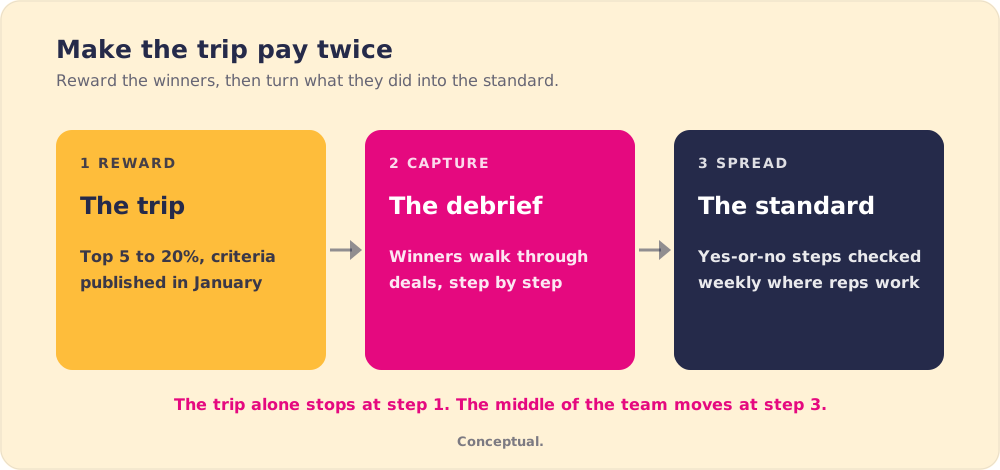
That last step is the job we built Supered for. The Behavior Layer takes the steps your winners run and turns them into expectations that reach each rep in the flow of work inside HubSpot and Salesforce, then checks them so the manager sees who is keeping pace. Our post on quota attainment runs the numbers on what a lift across the middle is worth, and our sales playbook guide covers how to write the winners’ steps so a manager can check each one.
If you want rewards for the middle of the team alongside the trip, read our guide to sales contest ideas that don’t backfire next.
Frequently asked questions
What is President's Club in sales?+
Do sales reps prefer cash over a President's Club trip?+
What percentage of reps should qualify for President's Club?+
Should you promote your best sales rep to manager?+
Should sales enablement focus on top performers or the middle of the team?+
Your process, running itself.