Sales Enablement ROI: You Cannot Prove It Until You Can Inspect Adherence
Everyone wants a sales enablement ROI formula.
The honest truth is that ROI is unprovable until you can show your program changed what reps did. Here is the adherence-first way to attribute it.
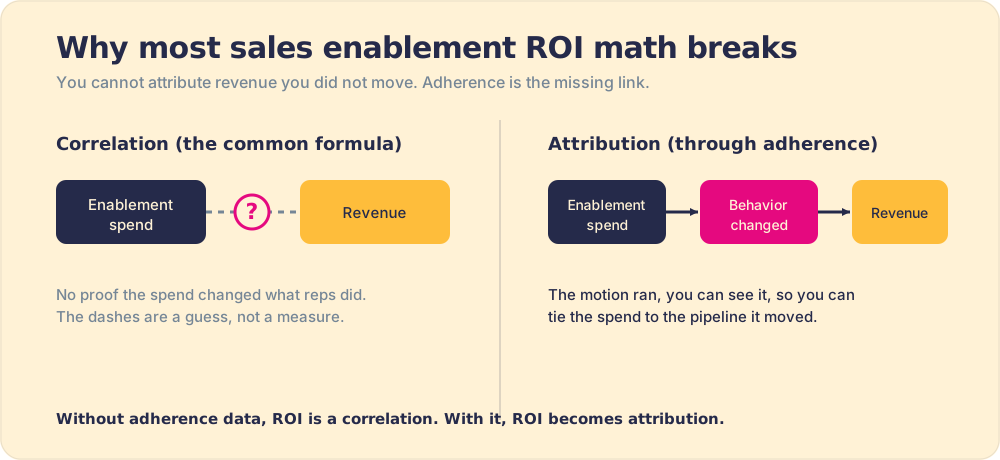
Sales enablement ROI is the return a revenue team earns on what it spends to change selling behavior, and it can only be proven once you can inspect whether the program actually changed what reps did on real deals.
A VP of Sales sits across from her CFO at the budget review, asked the question she knew was coming: what did we get for the enablement spend last year. She has a number ready, the program cost divided into the year’s revenue growth, and it looks healthy. The CFO nods, then asks the only question that matters: how do you know the enablement caused any of that, and not the price increase, the new product line, or the two enterprise logos marketing handed you. The slide stalls. She does not have an answer, because the spreadsheet was built to flatter, not to prove.
That gap is why so many sales enablement ROI numbers fall apart the moment a skeptic leans in. The contrarian claim, up front: sales enablement ROI is unprovable until you can inspect adherence. You cannot attribute revenue to a program if you cannot show the program changed what reps actually did. Without adherence data, you are correlating spend with a number you do not control, which is not measurement, it is hope with decimal places. The defensible path runs the other way. You tie enablement to pipeline through the behavior it changed, the motion that did or did not run on real deals, and never through training completion or raw activity counts. Knowing is not doing, and motion is not the buyer moving.
So let us define the term plainly before we argue about it. Sales enablement ROI is the return a revenue team earns on what it spends to change selling behavior, and it can only be proven once you can inspect whether the program changed what reps did on real deals. The behavior is the bridge between the spend and the number. Knock the bridge out, and you are left guessing.
How do teams try to measure sales enablement ROI?
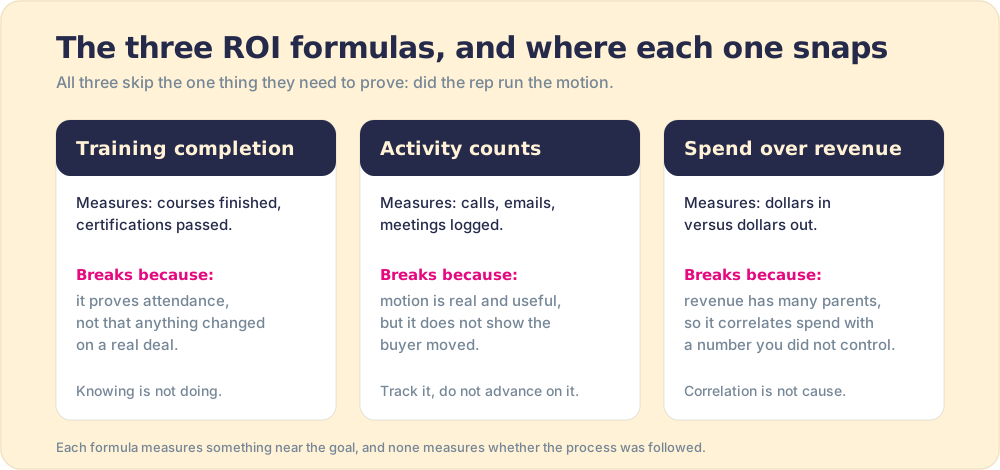
Walk into any enablement function and you will find one of three formulas on the wall, sometimes all three. Each measures something close to the goal. None measures the one thing the others need.
- Training completion. Courses finished, certifications passed, the LMS dashboard glowing green. It is the easiest number to produce and the most common one reported, and it proves only that people attended. A rep can ace every quiz and still go blank on a live discovery call.
- Activity counts. Calls dialed, emails sent, meetings booked. This is real and worth tracking, it is how you verify a rep is working the motion at all, and it shapes the buyer’s experience. The trap is treating the motion as the outcome. Logged activity tells you the rep moved; it does not tell you the buyer did.
- Spend over revenue. Total program cost set against the year’s revenue or growth, expressed as a ratio. It looks like finance, and it is the slide the CFO distrusts most, because revenue has many parents and this formula credits all of them to enablement.
The reason these persist is not stupidity. It is that they are cheap to compute and adherence is not. Completion comes free from the LMS. Activity comes free from the CRM and the dialer. Adherence, whether the rep actually ran the defined motion on a given deal, has historically required a manager to read call recordings and inspect deals by hand, which almost nobody has time to do at scale. So teams report what they can pull, and call it ROI.
Why do these sales enablement ROI formulas break?
They break for one shared reason, and it is the hidden cost of measuring sales enablement ROI the cheap way: every one of them skips the step where you prove the program changed behavior. They jump from input (we spent, we trained, reps were busy) straight to output (revenue went up) and assume the middle held. The middle almost never holds on its own, and the research is blunt about why.
Start with the input that is supposed to do the work. The Sales Enablement Collective’s 2025 Impact of Enablement report found that 79.7% of enablement leaders say their reps leave at least 40% of a stand-alone tool’s features untouched (SEC). Read that as an ROI problem and it is devastating: four out of five teams are paying for capability the intended users never adopt. If you count that spend in your ROI denominator, which most formulas do, you are dividing revenue by a number that is partly fiction, because a large slice of it bought behavior that never happened.
Then there is the attribution problem itself, which is older than enablement. A revenue number is the joint product of pricing, product, market timing, the rep’s own talent, and the program. Credit any one of them in isolation and you are guessing. The marketing discipline learned this the hard way and built multi-touch attribution to fight it, and even there the verdict is humbling: a body of academic and practitioner work shows that last-touch and simple attribution models routinely misallocate credit, because they cannot see the causal path, only the correlation (Harvard Business Review on the limits of attribution). Enablement has the same disease and usually a worse case of it, because it rarely even tries to isolate its one controllable variable.
That variable is behavior. The thing enablement uniquely controls is not the price or the product, it is whether reps run the motion the company decided wins. If you cannot see that, you cannot subtract everything else out, and an ROI claim that cannot subtract everything else out is not a claim, it is a coincidence with a number attached. This is the third tenet of how we think about all of this: you can only expect what you inspect. A program that is never inspected for adherence has no proof it produced anything, no matter how green the completion dashboard looks. The science behind training is just as harsh. Decades of work on the intention-action gap, from Peter Gollwitzer onward, show that knowing what to do is a weak predictor of doing it; intention explains only a modest fraction of actual behavior (Gollwitzer, implementation intentions). Which is exactly why training completion, the most-reported ROI metric, is the weakest one. We cover the deeper version of this in the knowing-doing gap.
What does an adherence-first sales enablement ROI calculation look like?
Flip the order. Start from the behavior, not the dollars. A defensible sales enablement ROI calculation is less a formula than a chain of evidence, and it runs in four steps.
- Define the motion. Name the specific selling behavior the program exists to install: the discovery framework, the multi-threading standard, the qualification gate. State it as something you could watch happen on a real deal, not as a topic that got covered.
- Inspect adherence. Measure the share of deals where reps actually ran that motion. This is the step everyone skips and the one the whole calculation rests on. Without it, the next three steps have nothing to stand on.
- Compare adherent and non-adherent deals. Set the outcomes side by side: win rate, sales cycle length, average deal size, for deals that followed the motion against deals that did not. The delta is the behavior’s contribution, isolated from price and product because both populations sell the same thing.
- Multiply and net out cost. Scale that per-deal delta across deal volume, subtract the program cost, and you have a return you can defend line by line, because every line traces back to a behavior you can show happened.
The difference is the one between a ledger and an audit. An ROI figure with no adherence data behind it is an unaudited ledger: the numbers are written down, they total to something, and not one line can be verified. Adherence inspection is the audit that walks each line back to a real event, so the bottom number means what it says. A figure you cannot trace back to what was done is a figure you cannot trust, and a CFO knows it on sight.
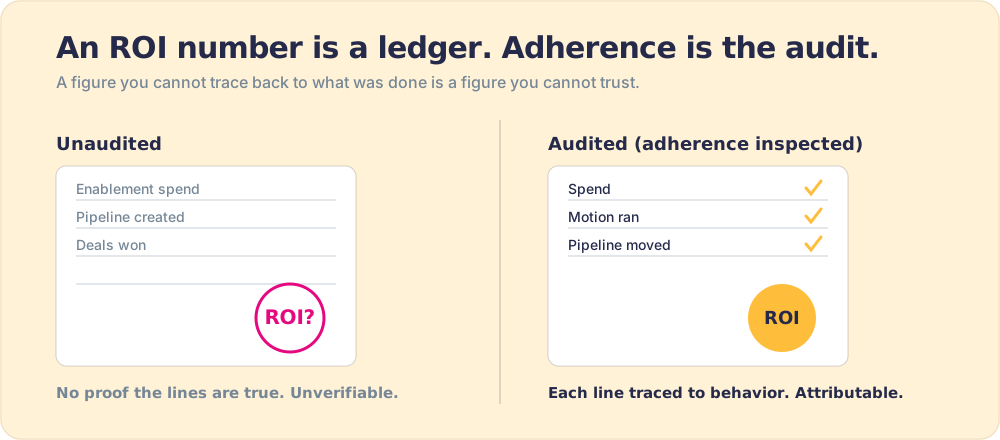
This is also why adherence is the prerequisite to every other answer, the sixth thing we believe. You cannot ask what to change about a program until you can answer whether the program was followed. A motion that was never actually run cannot be judged a failure, and one that was never inspected cannot be judged a success. Get adherence first; the rest of the analysis becomes possible only after.
What metrics actually prove enablement worked?
The hierarchy that survives a CFO puts adherence at the top and everything else underneath it as supporting evidence. Lead with the behavior, then read the outcomes it produced.
- Adherence rate. The share of deals where reps ran the defined motion. This is the proof metric; the others are corroboration. Track it deal by deal so the signal is granular enough to coach on.
- Outcome delta. Win rate, cycle time, and average deal size compared between adherent and non-adherent deals. This converts adherence into dollars.
- Leading indicators. Ramp time for new reps, and which content actually appeared in won deals. These tell you the program is working before the lagging numbers confirm it.
- Lagging indicators. Quota attainment and retention. They are the score, not the diagnosis, and they arrive too late to steer by, which is why they cannot be the only thing you watch. Our sales enablement KPIs breakdown maps the full set.
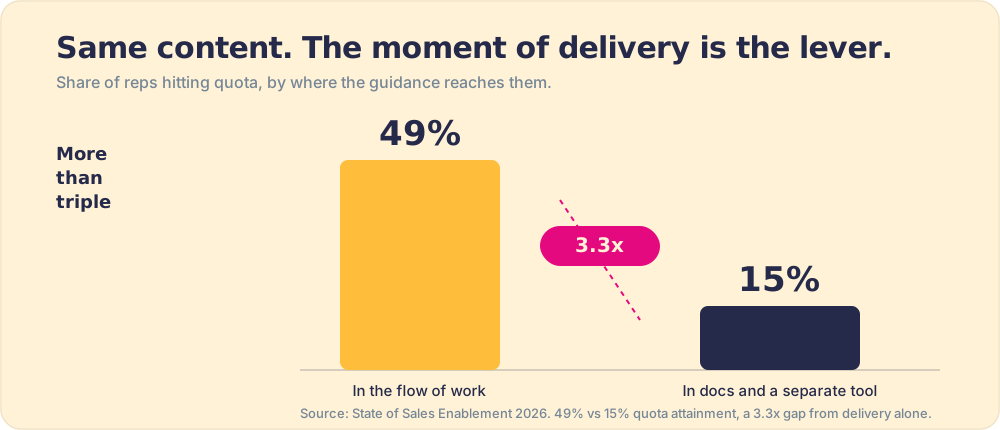
The evidence that this hierarchy is the right one is the strongest single number we have. In the State of Sales Enablement 2026, teams whose guidance is embedded in the flow of the work hit quota at 49%, while teams whose guidance lives in docs and a separate tool hit quota at 15% (SOSE 2026). Same content. More than triple the result, a 3.3x gap, from delivery alone. That is the behavioral variable showing up in the only number a CFO cares about, and it is invisible to every formula that measures completion or spend.
Teams that consistently inspect deals against a defined process hit quota at 6.3 times the rate of teams that rarely do. Inspection is the largest single effect we measured.
That 6.3x figure, also from our 2026 survey, is the engine under the ROI argument. Inspection is what turns adherence from a vague aspiration into a number, and a number is what turns a program from an act of faith into an investment with a defensible return. The convergence is the point: our field data (49% versus 15%, and the 6.3x inspection effect) lines up with the academic finding that intention poorly predicts behavior, and both say the same thing. Measure what reps do, not what they were told.
There is a corroborating outside number worth holding alongside ours. CSO Insights, the research arm now inside Korn Ferry, found that teams running dynamic, data-backed coaching post win rates roughly 28% higher than teams without it (cited via SEC). Notice the modifier: dynamic and data-backed. The lift comes from coaching tied to what reps actually did, not from owning a coaching tool. The data behind the coaching is the adherence signal. Strip it out and the 28% goes with it.
What is the sales enablement ROI formula, with a worked example?
The sales enablement ROI formula is (incremental gross profit from the behavior change minus program cost) divided by program cost. The only hard term is the first one, and adherence data is what makes it computable: incremental gross profit equals the outcome gap between adherent and non-adherent deals, times the number of adherent deals, times average deal size, times gross margin.
The arithmetic below runs on a hypothetical mid-market team. The inputs are invented for illustration; the method is the point.
| Input | Example value |
|---|---|
| Qualified opportunities in the year | 300 |
| Deals where reps ran the defined motion (adherent) | 180 (60%) |
| Win rate, adherent deals | 30% |
| Win rate, non-adherent deals | 20% |
| Average deal size | $30,000 |
| Gross margin | 75% |
| Program cost (people, content, software) | $120,000 |
The win-rate gap is 10 points. Across 180 adherent deals, that is 18 extra wins, or $540,000 of revenue the behavior produced over the non-adherent baseline. At a 75% margin, $405,000 of gross profit. Subtract the $120,000 program and divide by it: ($405,000 minus $120,000) divided by $120,000 is about 2.38, an ROI of roughly 238%.
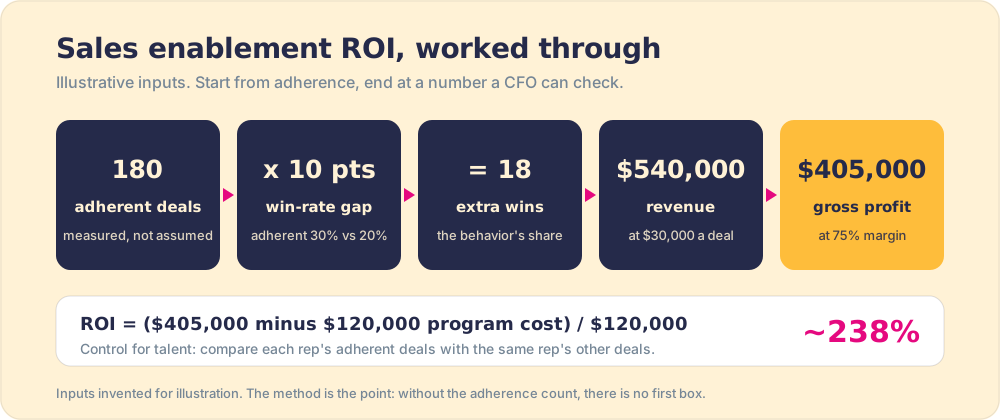
One correction keeps the number defensible under questioning, and a sharp CFO will ask for it. Better reps tend to adhere more, so a raw adherent-versus-non-adherent gap partly measures talent, not the program. Two fixes handle it. Compare each rep’s adherent deals against the same rep’s non-adherent deals, so talent cancels out. Or roll the motion out to half the team a quarter early and compare the two halves over the same period, which is the closest a sales floor gets to a controlled trial. Either way, the gap that survives is the behavior’s contribution, and that is the figure to put in the formula.
How do you evaluate sales enablement pricing against the expected ROI?
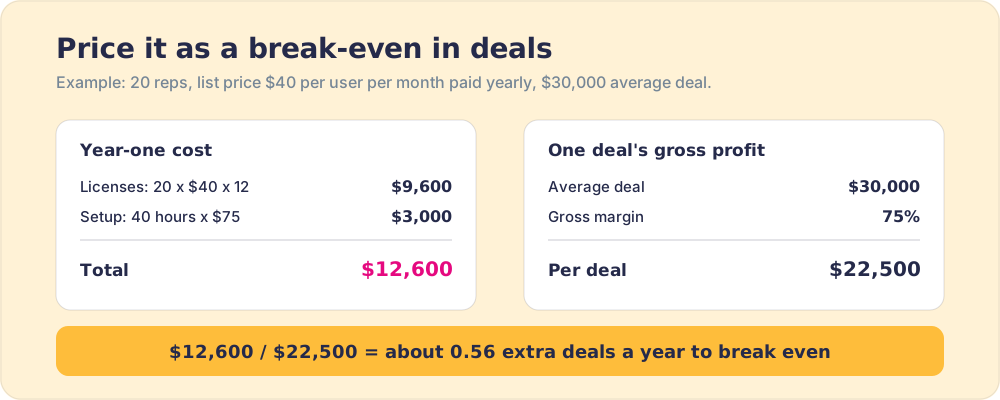
Turn the price into a break-even in deals, then ask whether the tool can plausibly move adherence enough to clear it. Divide the full annual cost by the gross profit of one average deal. The full cost includes setup and admin time, which buyers routinely leave out.
A concrete case using list prices: Supered’s Process Compliance plan is $40 per user per month paid yearly (pricing), so 20 reps cost $9,600 a year. Add 40 hours of RevOps setup at a loaded $75 an hour, $3,000, and the year-one cost is $12,600. At a $30,000 average deal and 75% gross margin, one deal is worth $22,500 of gross profit, so the tool pays for itself at about 0.56 extra deals a year. Run the same math on a $100,000 platform with a three-month implementation and the break-even climbs to several deals, which changes the question you ask in the demo.
A low break-even is necessary and not sufficient. The bar a tool has to clear is behavioral: will reps run the motion more often because of it? The State of Sales Enablement 2026 gives the benchmark that matters for that judgment. Teams whose guidance is embedded in the CRM hit quota at 49%, teams whose guidance lives in CRM fields or stages hit 24%, and teams whose guidance lives in docs or wikis hit 15% (State of Sales Enablement 2026). A tool that moves your guidance from the third row to the first is buying a different quota outcome; a tool that adds a fourth place for reps to look is buying more shelfware, which 48% of the same survey’s respondents traced to tools not embedded in the workflow.
What is the ROI of sales enablement automation?
Its return comes mostly from manager hours, because automation makes inspection affordable. Manual inspection is the step that breaks first as a team grows. In SOSE 2026, 47% of teams with one to five reps per manager reported 76 to 100% process adherence; at six to eight reps per manager that fell to 23%, and among the 29% of respondents who named manager non-enforcement as the main reason reps skip the process, capacity was cited more often than indifference. Managers are not choosing to skip inspection. They are out of hours.
Automation changes that arithmetic. When adherence is recorded as the work happens, a manager with eight reps gets the inspection coverage of a manager with four, and the hours that went into reading deals go into coaching against what the data shows. Count the return in two places: the manager hours recovered (multiply by loaded cost), and the adherence that holds as the team grows past the six-rep cliff. The second is usually the larger number.
How do you measure sales enablement success before the ROI shows up?
Knowing how to measure sales enablement success before revenue can show it comes down to reading the signals in order: adherence moves first, leading indicators next, revenue last. Win-rate and quota effects take at least one full sales cycle to show up, so a program judged only on revenue gets judged too late to fix.
- First 30 days, adherence. The share of new deals where the defined motion ran. If it is not rising, nothing downstream will move, and the problem is delivery, not content.
- Days 30 to 90, leading indicators. Stage conversion on the stages the motion targets, ramp time for reps hired since launch, and the share of deals that reach the next stage with the required fields and steps complete.
- After one full cycle, outcomes. The adherent versus non-adherent gap in win rate, cycle length, and deal size, which feeds the ROI formula above.
For the full metric set, see sales enablement KPIs and how to read sales enablement success across Kirkpatrick’s levels.
How do you make adherence measurable without burning your managers?
The catch in everything above is that inspection has always been expensive. Reading recordings and grading deals by hand is the work no manager has time for, which is why adherence stayed unmeasured and ROI stayed unprovable. Budgets are not the constraint; the Sales Enablement Collective reports that 41.9% of enablement leaders planned to grow their budgets this year (SEC). The constraint is that more spend without an inspection mechanism just buys more uninspected activity, and you end up with a bigger unaudited ledger.
The way out is to lift the inspection burden off the manager so adherence is captured automatically as the work happens, and the human time goes to coaching off the signal rather than chasing it. That is what the Behavior Layer does: it surfaces the defined process to the rep at the moment of the work, inside HubSpot, Salesforce, Salesloft, Gong, and Gmail, so the right next step reaches them where they already are, and it records whether the motion ran, deal by deal, without a manager grading anything by hand. Adherence stops being a quarterly archaeology project and becomes a live number. That number is the missing input every ROI formula on the wall has been guessing at. Strong CRM hygiene is the floor this rests on, which is why CRM adoption and ROI measurement are the same project, not two.
So when the CFO asks what the enablement bought, answer with the motion the program installed, the share of deals that ran it, and the outcome gap between the deals that did and the deals that did not. A spend-over-revenue ratio collapses at the first follow-up question about cause; the adherence answer is one a CFO can check, and a number a CFO can check is a number a CFO can fund. Build the adherence signal first; the ROI calculation that everyone wants is downstream of it, and impossible without it. If you want the deeper diagnosis of why the gap between knowing and doing is where revenue leaks, the sales execution gap is where this argument starts, and the sales enablement software guide is the system that makes adherence measurable in the first place.
Frequently asked questions
What is sales enablement ROI?+
How do you calculate sales enablement ROI?+
Why is sales enablement ROI so hard to measure?+
What metrics actually prove enablement worked?+
What is the sales enablement ROI formula?+
How do you evaluate sales enablement pricing against the expected ROI?+
Is training completion a good ROI metric for enablement?+
Your process, running itself.