Sales Activity Metrics: Matt Bolian and Caleb King Debate Whether to Kill the Count
Goodhart's law says a measure that becomes a target stops measuring. So should sales teams eliminate activity metrics? Matt Bolian and Caleb King both said no, and explained how to use calls and emails to find the gap worth coaching.
Sales activity metrics count what reps do to move deals, such as calls, emails and meetings booked, and on Pardon the POV Matt Bolian and Caleb King argued they do more good than harm when managers read them as a diagnostic.
Rob, our host, read Goodhart’s law aloud and asked for an amen. “When a measure becomes a target, it ceases to be a good measure.” Sales, he said, has a Goodhart problem “the size of Texas.” Calls, emails and meetings booked started as stand-ins for the work that creates revenue, and now in many sales orgs they are the work. His binary question: are sales activity metrics doing more harm than good, and should they be eliminated in favor of outcome-based measurement?
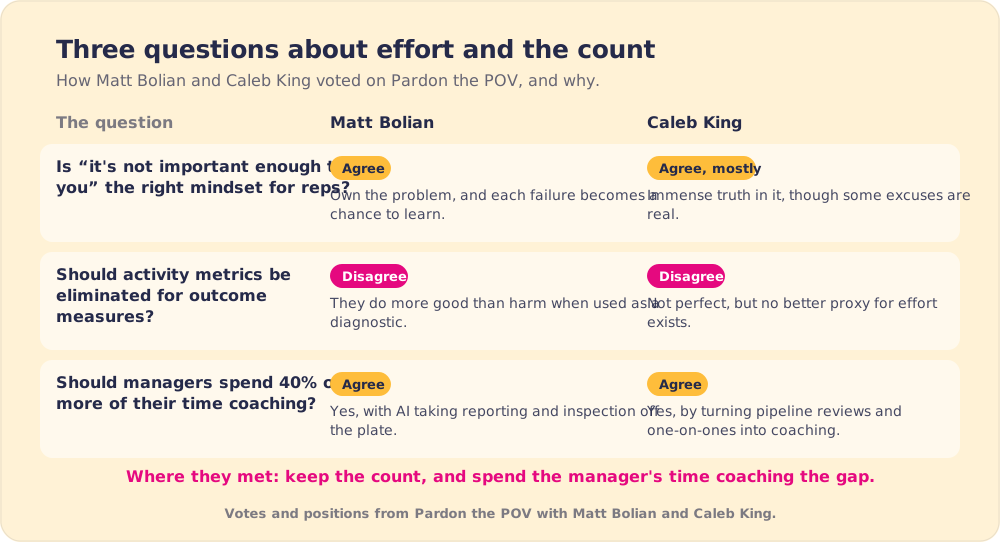
Caleb King and I both said disagree. Rob admitted it was “a bit of a not very good question, but it was provocative,” and then pushed on both answers.
Caleb is a seller on our team, and the Pardon the POV episode had three rounds that bear on sales activity metrics: this one, a round on how much time managers should spend coaching, and a round on a line from Caleb’s ninth-grade coach. We both conceded reps can game a count. We kept it for different reasons, and those reasons say a lot about how to use the numbers you already have.
Should you eliminate sales activity metrics?
Rob’s side has real history behind it. In 2016 the Consumer Financial Protection Bureau found that Wells Fargo employees had opened roughly 1.5 million deposit accounts and submitted about 565,000 credit card applications without customers’ authorization, “to hit sales targets and receive bonuses,” and the bank paid $185 million in combined penalties (CFPB, 2016). Lisa Ordóñez and three colleagues catalogued the milder version in 2009: narrow goals produce “a narrow focus that neglects non-goal areas, a rise in unethical behavior, distorted risk preferences, corrosion of organizational culture, and reduced intrinsic motivation” (Ordóñez et al., Harvard Business School, 2009).
Caleb granted all of it. When things go badly, he said, reps “will start to optimize, especially when things are not going well towards like calls, updating CRM, things like that, covering your butt.” Then he said what he would lose without it. “I just don’t know of another way to break down the sales motion incrementally and have a focus, right? Like there’s just no other proxy uh other than activity.” His point, as I took it, was that win rate and revenue show up too late to coach from. “So, it’s not perfect, but I don’t know of anything that’s better.”
Rob found that too mild. “Didn’t seem like a very harsh aggressive stance, but we’ll see what Matt does with this one.”
My answer was that they do more good than harm, and the trouble starts with how they get wielded. I think of activity as one branch of a diagnosis. A rep is not hitting quota. “Do you have enough leads? Yes or no?” If not, is the rep doing the activities that would generate the leads? If the activity is there and the leads are not, “you start looking at the quality.” If the leads are fine, the problem sits later, in “what’s happening in the deal management.” The activity count answers the second question on that list.
The damage comes when the count becomes the goal. “Well, it’s because the question isn’t did I do 100 calls. The question is did I create enough leads?”
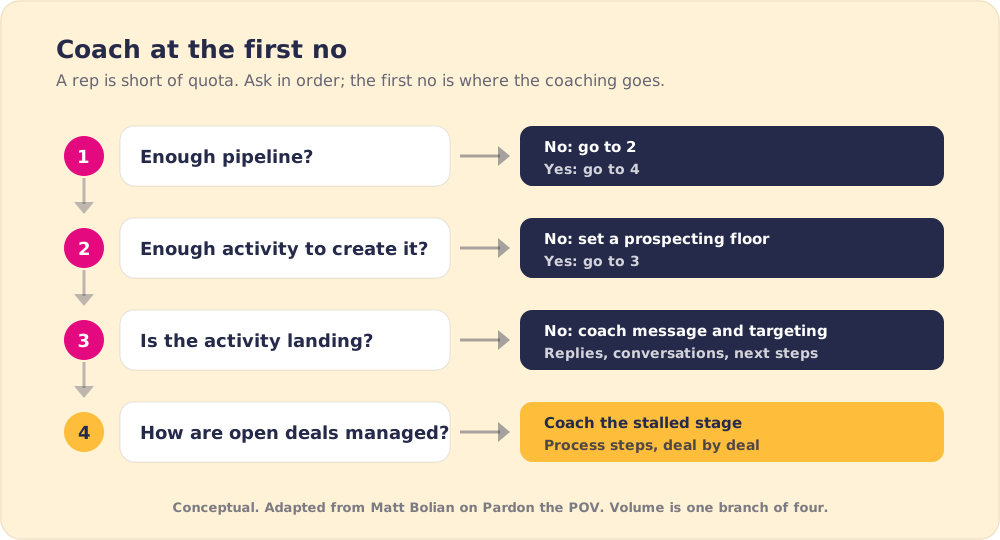
Rob closed the round with a point I agree with. If an activity is not working, change the activity: try another channel, another message. The alternative, doing nothing, “doesn’t work at all.”
Why do activity metrics need a minimum?
Caleb and I landed on the same side for slightly different reasons, and the difference matters when you set targets.
For Caleb, activity is the smallest unit of the sales motion a manager can see and coach. My reason is that a rep needs enough attempts before there is anything to learn from. “There has to just be a level of activity that will produce something so you can actually have something to coach and get good at.” Two hundred calls with no meetings booked gives a manager plenty to listen to.
So my recommendation is a floor. Set a minimum level of prospecting as a plain expectation and check it. Pay and rank on outcomes, such as leads created and deals won. Once reps are ranked on raw call counts, they have a reason to make calls that look good on the report, which is the behavior Ordóñez and her colleagues described. Kept as the manager’s tool for finding where a rep is stuck, the count gives reps no reason to pad it.

Where does a manager find time to coach from the numbers?
The next question tested whether we meant it. Should sales managers be required to spend at least 40% of their time coaching, even if it means dropping forecasting, reporting and pipeline review? We both agreed.
I opened with a confession: “I’m a sales manager right now, and I spend 2% of my time coaching reps.” Then the serious part. The questions a rep needs answered are coaching questions: “am I doing enough activities? Are the activities the right ones?” How should I deliver this message on this call? How do I write this email? The answers shape what the buyer hears next. What makes 40% possible now is AI taking the reporting load off the manager, “especially if inspection is taken off.”
Caleb described how good managers find the time without adding meetings. His team holds “a standing meeting which is a call review once a week,” and the whole team treats it as a coaching call. “The beauty is also when a pipeline review or a one-on-one becomes a coaching call as well.” The failure he has lived through is the opposite: “the worst managers are like, they just care about the accuracy of your forecast number. That’s all they care about.” Good ones talk through “the specific deals and the emails and the place where you’re getting stuck.” He has had both kinds.
The research agrees with both of us. CSO Insights’ 2018 Sales Enablement Study found organizations with a random, unstructured coaching approach won 43.9% of forecast deals, and that moving to a dynamic, structured approach was worth 13.8 percentage points, a 31.4% lift in win rate (CSO Insights, 2018). And in The State of Sales Enablement 2026, 48% of reps on the most highly inspected teams hit 76 to 100% of quota, against 6% on rarely inspected teams (The State of Sales Enablement 2026). Activity data is what makes that inspection possible, and our guide to sales coaching covers what to do with the time it frees.
Does the rep own the miss?
The episode opened on Caleb’s ninth-grade coach, who answered every excuse for being late to practice the same way: “It’s not important enough to you.” Traffic on the way meant you should have left earlier. An alarm that did not go off meant you should have set more than one.
Caleb found “immense truth in this statement that there’s a level of responsibility versus victimhood,” and still balked at the example where a teacher held the whole class late. I went further. I quoted Dallas Willard’s line that 100% of your actions reveal 100% of your beliefs, and said: “I only like working with people who say it’s my fault, not your fault.” The reason is learning: “every mistake, every failure is an opportunity to learn.”
A rep who says “it’s my fault” still needs to know which part was her fault, and the diagnostic path shows her. That part is on the manager. The manager has to set expectations clear enough to check, get the checking done without chasing people, and spend the saved time coaching. Our post on sales accountability covers how to hold that standard without turning one-on-ones into audits.
What to take from the debate
- Activity as a diagnostic. Read the count to find the branch where a rep is stuck: pipeline, activity volume, activity quality, or deal management.
- A floor for effort. Set a minimum level of prospecting as an expectation, so there is enough work to coach.
- Outcomes for pay and rank. Reward leads created and deals won. Paying on raw counts invites Goodhart.
- A different activity when one fails. Rob’s rule: change the channel or the message before you add volume.
- Coaching inside the meetings you have. Turn call reviews, pipeline reviews and one-on-ones into coaching on specific deals and emails.
- Inspection off the manager’s plate. Let the system check the counts so the manager’s time goes to the conversation.
What is the verdict on sales activity metrics?
Rob gave Caleb a point later in the show for saying you always “sell the idea, not the tool.” On activity metrics there was no contest. Neither of us would eliminate them, and the law Rob read us shows the danger lies in making them the target. Keep counting. Set a floor, pay on outcomes, read the numbers to find the gap, and give the manager the hours to coach it. Our post on sales KPIs sorts the leading and lagging numbers that sit around these counts.
We built Supered for that job. The Behavior Layer checks the steps your process asks for in the flow of work inside HubSpot and Salesforce and flags the gaps, so a manager spends the one-on-one on the branch where the rep is stuck.
For the coaching conversation that follows the diagnosis, read our guide to data-driven sales coaching next.
Frequently asked questions
What are sales activity metrics?+
Should you get rid of activity metrics in sales?+
What is Goodhart's law in sales?+
How do managers use activity metrics to coach?+
How much time should sales managers spend coaching?+
Your process, running itself.
Turn the playbook into rep behavior.
More from Pardon the POV

Presidents Club in Sales: Matt Bolian and Crispy Barnett Argue Over Who the Trip Is For
Matt Bolian & Crispy Barnett
Is Sales Enablement Broken? Matt Bolian and Caleb King Argue Over What Is Failing
Matt Bolian & Caleb King