Sales Enablement Challenges: Five Symptoms, One Disease
Every list of sales enablement challenges names the same five or six problems: alignment, content nobody uses, slow onboarding, no measurement, dead tools. They are not five problems. They are one problem wearing five coats. Here is the root, and what actually treats it.
Sales enablement challenges are the recurring obstacles that stop enablement from changing what reps do: weak alignment, unused content, slow onboarding, poor measurement, and abandoned tools, almost all tracing to one root, the gap between knowing the process and running it.
Open any article on sales enablement challenges and you will meet the same lineup. Alignment between sales and enablement. Content that reps cannot find. Onboarding that takes too long. Measurement that never connects cleanly to revenue. Tools that gather dust. The lists are tidy, the advice is reasonable, and a leader who follows it will end up chasing five problems with five budgets, five tools, and five quarterly initiatives, and wondering, a year later, why the number still has not moved.
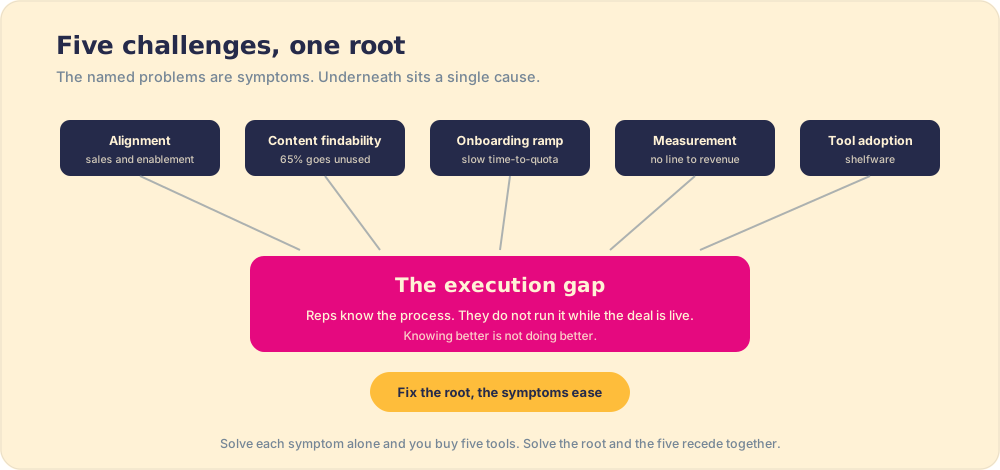
Here is the claim this piece makes, and it is worth stating plainly before the evidence: these are not five problems. They are one problem wearing five coats. Underneath alignment and content and onboarding and measurement and adoption sits a single root, and until you name it, every fix you buy is a coat of paint over the same crack in the wall.
What are the most common sales enablement challenges?
Sales enablement challenges are the recurring obstacles that stop enablement from changing what reps do. Survey the field and the same five surface almost every time. Call them problems or issues, the labels vary by framework; the shape does not:
- Alignment. Enablement builds what it thinks reps need; reps need something else; the two drift.
- Content that goes unused. The library grows, and most of it is never opened on a real deal.
- Slow onboarding. New reps take months to reach full productivity, and the ramp is uneven.
- Measurement. Leaders cannot draw a clean line from an enablement program to a closed deal.
- Tool adoption. The platform gets bought, lightly used, and written off as shelfware.
Each is real. Each has a cottage industry of advice attached. And each, looked at closely, turns out to be the same underlying failure surfacing in a different department.
What is the one root cause underneath them all?
The root is the execution gap, and it has a one-line definition any rep would recognize: knowing better is not doing better. People can be taught a process, agree it is right, and still not run it when the work gets busy. That is not a failure of intelligence or will. It is the ordinary distance between intention and action, and in sales it is enormous.
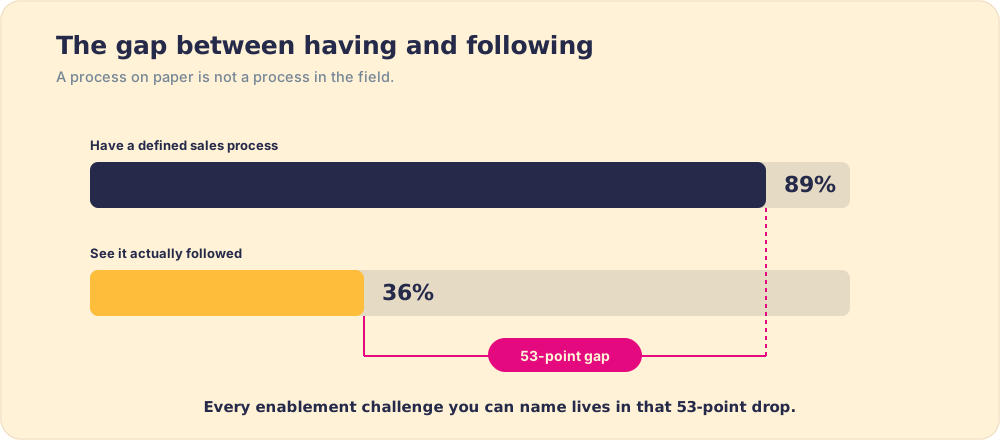
Our own State of Sales Enablement put a number on it that stops leaders cold. Across the teams surveyed, 89 percent had a defined sales process. Only 36 percent saw that process followed (The State of Sales Enablement). A 53-point drop between writing the playbook and running it. Nearly every challenge on the list above lives inside that drop.
Walk the list back through that lens and watch it collapse into one cause. Content goes unused not because it is missing but because the rep does not reach for it while the deal is live; Forrester’s SiriusDecisions research has put that unused share around 65 percent for over a decade, through every generation of better libraries (Forrester / SiriusDecisions). Onboarding is slow because a new rep is handed knowledge and left to convert it into behavior alone. Measurement fails because you cannot measure adherence to a process nobody is running. Alignment frays because enablement is judged on what it ships, not on what reps do with it. And tools become shelfware for the most telling reason of all.
Why do enablement tools keep becoming shelfware?
This one deserves its own look, because it is where the root cause is easiest to see. When we asked teams why their enablement tools failed to stick, three reasons came back, and they are one reason in three costumes: reps do not see the value (55 percent), managers do not reinforce it (51 percent), and the tool is not embedded in the workflow (48 percent) (The State of Sales Enablement).
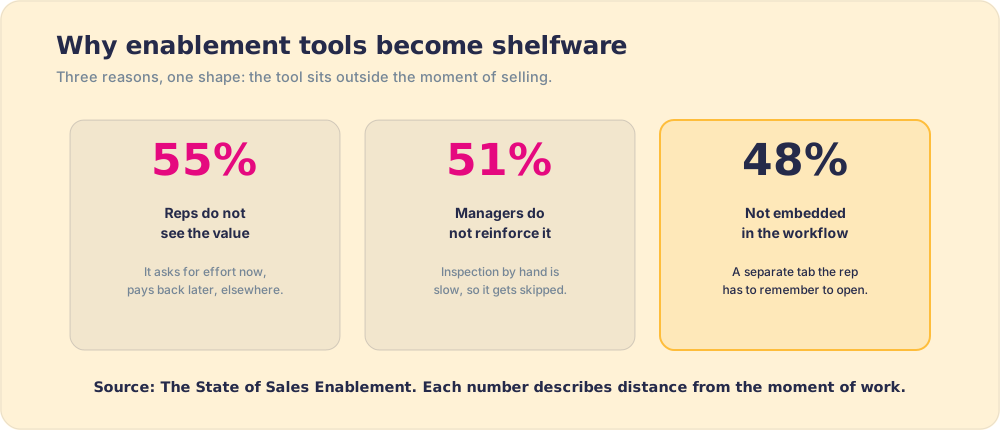
Read those three again and notice they all describe distance. A tool the rep does not value is one that asks for effort now and pays back later, somewhere else. A tool the manager does not reinforce is one whose adherence is too costly to inspect by hand, so inspection gets skipped. A tool not embedded in the workflow is one the rep has to leave the work to use. Gartner’s research on sellers has made the same point from the buyer-of-software side: reps are already drowning in information and tools, and adding another destination they must visit makes the problem worse, not better. The shelfware challenge is the execution gap, sitting in plain sight.
How do you solve sales enablement challenges?
If the five challenges share one root, then the leader who treats them as five projects is making a strategic error, spending five times the budget to keep painting over the crack. The higher-yield move is to treat the root and let the symptoms ease together. Four steps, drawn from how behavior change actually works:
- Set a clear expectation. Name the process, for this segment, in concrete terms. An unwritten expectation is a process you never bothered to make followable.
- Deliver the next action in the moment. The guidance has to reach the rep inside the tools they already use, at the instant the deal calls for it, so doing the right thing costs nothing and skipping it is the harder path.
- Measure whether they did it. You can only expect what you inspect. Adherence, deal by deal, is the signal that turns every downstream question from a guess into a fact.
- Reinforce from the signal. With inspection automated, the manager’s time goes to coaching the few reps and moments that need it, instead of chasing reports.
The same study that measured the gap also measured the payoff of closing it. Teams whose process guidance is embedded in the flow of work and measured attained quota at 49 percent. Teams whose guidance lived in documents and separate training tools attained at 15 percent (The State of Sales Enablement). CSO Insights, the research arm now part of Korn Ferry, found for years that teams whose sales process is dynamically adopted and adhered to win deals at materially higher rates than teams whose process is merely documented and informal; the dividing line was never owning a process but running it. Same content, same playbook on paper. Where and when it reached the rep did the work. That is one intervention answering the whole list: content gets used because it arrives in the moment, onboarding speeds up because new reps are guided rather than lectured, measurement appears because adherence is now visible, and the tool stops being shelfware because it lives where the work happens.
So here is the recommendation, and it is a recommendation, not a survey. Do not buy a content tool for the content challenge, a coaching tool for the coaching challenge, and a measurement tool for the measurement challenge. Buy, or build, one capability that closes the execution gap: guidance delivered in the flow of work and adherence measured deal by deal. Everything else on the challenge list is downstream of that. This is the principle behind what we build at Supered, the Business Logic Layer that surfaces the next right step inside HubSpot, Salesforce, Gmail, and the tools where reps already work, and shows whether they took it. The mechanism is general, though, and it holds whatever you buy: enablement only changes outcomes when it reaches the rep in the moment and someone can see that it landed.
From here, go deeper on the root itself: why adoption, not documentation, is the real metric, how to build a sales enablement strategy around behavior instead of content, and which sales enablement tools are built for the moment rather than the shelf. When you want to see the execution gap closed on your own process, book a demo. The five challenges are real. They share one address.
Frequently asked questions
What are the most common sales enablement challenges?+
What is the root cause of most sales enablement challenges?+
Why does sales enablement content go unused?+
How do you actually solve sales enablement challenges?+
Your process, running itself.