Knowledge Silos: Breaking Them Is Necessary, Not Enough
Knowledge silos get framed as an org and tooling problem, and tearing them down is real work.
But pooled knowledge still goes unused if it never reaches the person at the moment of the work.
Knowledge silos are bodies of know-how trapped inside one team, tool, or person, where the answer exists but cannot cross to the people who need it, so the company keeps re-solving problems it already solved.
A grain farmer with three silos has a particular kind of headache. The corn is dry and sound, the wheat is in good order, the barley is fine, and not a kernel of any of it is feeding the cattle waiting in the yard. Full silos, hungry animals. The problem was never storage. The grain was stored beautifully. The problem was that nothing carried it from the tower to the trough.
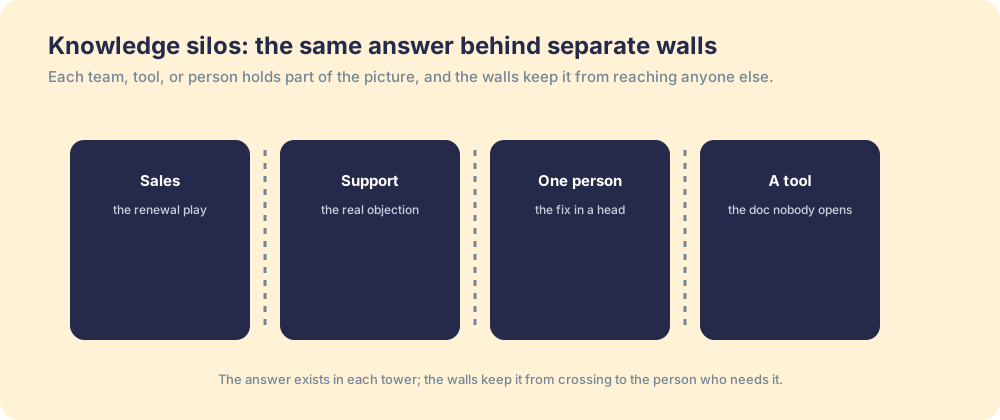
Companies have the same towers. Sales holds the renewal play in a private channel, support holds the real objection in a ticket queue, one tenured rep holds the workaround in their head, and a doc last opened in March holds the rest. We call these knowledge silos, and the standard advice is to tear down the walls between them. That advice is right. It is also half the job, and the half that gets skipped is the one that feeds the cattle.
What are knowledge silos?
Knowledge silos are bodies of know-how trapped inside one team, tool, or person, where the answer exists but cannot cross to the people who need it. The expertise is real and the cause is rarely malice. A team builds a fix and keeps it in its own tools. A specialist solves something hard and never writes it down because writing it down is not their job. Over time the company holds a great deal of hard-won expertise and depends, for any given answer, on whoever happens to sit near it.
The cost is not abstract. When know-how is walled off, the people outside the wall do one of three things: interrupt a colleague, rebuild work that already existed, or guess. The McKinsey Global Institute estimated that knowledge workers spend close to a fifth of the workweek searching for and gathering information (McKinsey Global Institute). A silo turns a one-time discovery into a recurring tax, paid every time someone hits the wall and starts over.
So far the conventional story holds, and the conventional fix follows from it. If the problem is walls, take down the walls. Pull the scattered know-how into one place, give it an owner, make it searchable. Breaking knowledge silos usually means exactly that, and the teams doing it are right to.
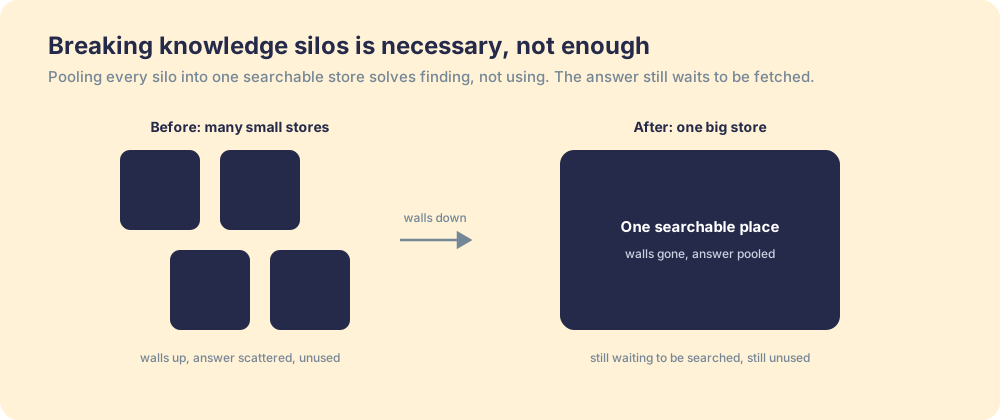
We part from the conventional account at the next step. Breaking the silos is necessary and it is not enough. Even perfectly un-siloed knowledge, every tower emptied into one searchable store, still goes unused if it never reaches the person at the moment of the work. You can trade many small unused stores for one big unused store and call the project done. It is the open slot that separates the leading knowledge base tools from one another. The walls are gone. The cattle are still hungry.
What are the signs of knowledge silos?
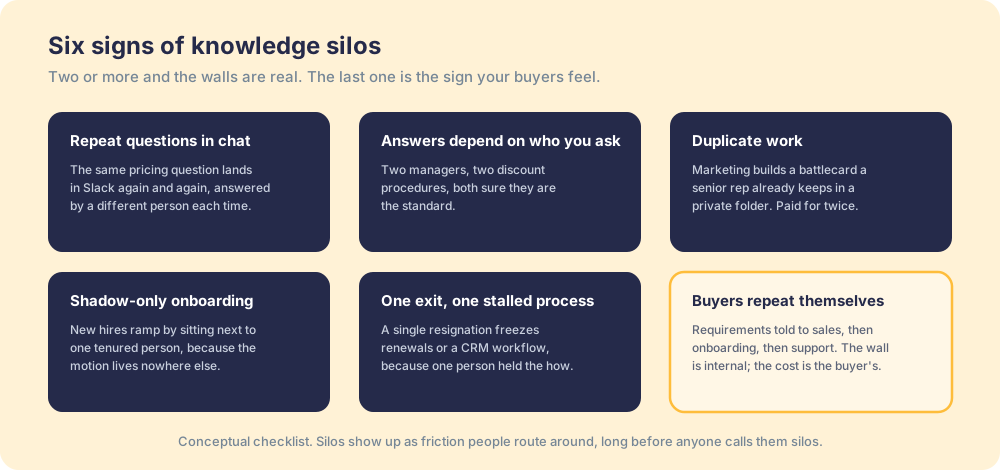
The clearest sign of a knowledge silo is the same question getting a different answer depending on who you ask. Silos rarely announce themselves. They show up as friction that people have learned to route around, and in a revenue team six signs surface first:
- Repeat questions in chat. The same pricing or process question lands in Slack again and again, and a different person answers it each time, sometimes with a different answer.
- Answers that depend on the person. Ask two managers how a discount gets approved and you get two procedures. Each is right inside its own corner and wrong for the other team.
- Duplicate work. Marketing builds a competitor battlecard while a senior rep keeps a sharper one in a private folder. The company paid for the same asset twice.
- Shadow-only onboarding. New hires ramp by sitting next to one tenured person, because the motion that works lives nowhere else.
- One exit, one stalled process. A single resignation freezes renewals, a partner program, or a CRM workflow, because one person held the how.
- Buyers repeating themselves. The customer explains their requirements to sales, then to onboarding, then to support. The wall is internal; the cost lands on the buyer.
Two or more of these and the walls are real. The last sign deserves the most weight, because a buyer who hears three versions of the answer judges the company by the worst one.
What causes knowledge silos, and what are their effects?
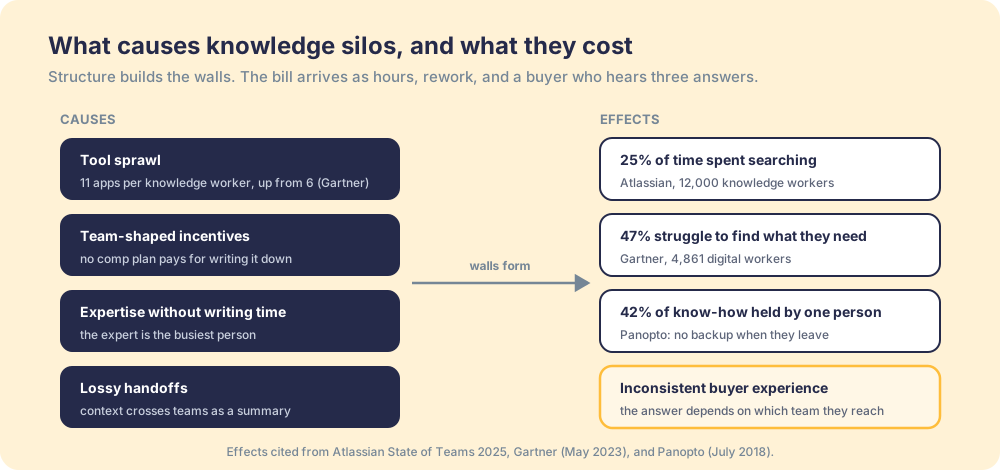
Knowledge silos are caused by structure, far more often than by people hoarding what they know. Four causes recur:
- Tool sprawl. Gartner’s survey of 4,861 digital workers found the average knowledge worker now uses 11 applications, up from six in 2019, and that 47% struggle to find the information they need to do their jobs (Gartner, May 2023). Each new app is one more place for an answer to hide.
- Team-shaped incentives. Sales is paid on bookings, support on resolution time, marketing on pipeline. No comp plan pays a team to write down what it learned for the next team, so the lesson stays where it was learned.
- Expertise without writing time. The specialist who solved the hard problem is the busiest person in the building. Documenting the fix competes with the next fire, and the fire wins.
- Lossy handoffs. SDR to AE, AE to onboarding, onboarding to support. Context crosses each handoff as a summary, and the summary drops the detail the next person needed.
The effects compound. Atlassian’s State of Teams 2025, a survey of 12,000 knowledge workers and 200 executives, found leaders and teams waste 25% of their time searching for answers (Atlassian, State of Teams 2025). Panopto’s research found 42% of institutional knowledge is unique to the individual employee who holds it (Panopto, 2018), so when that person leaves, close to half of what they knew has no backup. The rest of the bill arrives as duplicated work, slower ramps, and a buyer who gets a different answer depending on which team picks up.
Why is breaking knowledge silos not enough?
Because tearing down the walls fixes where the answer lives, and the failure was never only about where it lives. It was about when it arrives.
Take the rep on a renewal call when the buyer hints at leaving. In the old siloed world the retention play sat in another team’s tools, unreachable. So the company runs the silo project, consolidates everything into one shared store, and now the play is right there, findable in seconds. The rep is still on the call. They will not put the buyer on hold to go search a store, however well organized. They answer from instinct, the same as before. The wall came down and the answer still did not reach the corner where the decision was made.
The org-chart framing misses this. Consolidation solves finding. It does not solve using.
Memory finishes what timing starts. Hermann Ebbinghaus showed more than a century ago that we shed most of what we learn within days unless something brings it back at the moment of need. A team trained on the consolidated playbook in a Monday session is running on a fading copy by Thursday. Panopto’s workplace knowledge study found employees lose about 5.3 hours every week waiting on knowledge a colleague holds or rebuilding expertise that existed somewhere already (Panopto, Valuing Workplace Knowledge). Those hours do not disappear when you merge the silos. They move from “I cannot find it” to “I found it last week and cannot recall it now.”
There is a second trap inside the win. A consolidated store feels like progress because it is measurable: one place, full of articles, with a search bar. Volume of stored answers and amount of answers used are different numbers, and only the first one shows up on the dashboard. So the team mistakes a full store for a working one, the same way the farmer might admire three brimming silos and forget to look at the yard.
None of this means the consolidation was wasted. It means the project was scoped to half the distance.
What does it take to make un-siloed knowledge get used?
Pair the silo project with delivery and adherence, or you have only moved the unused knowledge to a tidier address. The moves are concrete, and they pick up exactly where breaking the walls leaves off:
- Consolidation. Break the silos into one home with a named owner. The standard advice already covers this necessary first step, and skipping it leaves the answer scattered and stale.
- Delivery in the work. Carry the answer to the person inside the tools where they work, the instant the situation calls for it, instead of waiting for them to remember it exists and go search. The silo project leaves this step out.
- Curation to one step. Surface the single move the person needs now, not the whole consolidated library. A precise answer in the moment beats a complete store they have to triage mid-call.
- Inspection of use. Measure whether the answer changed the next action, not whether the store is full. The number that matters is adherence to the right move, and a project that ends at “consolidated” never counts it.
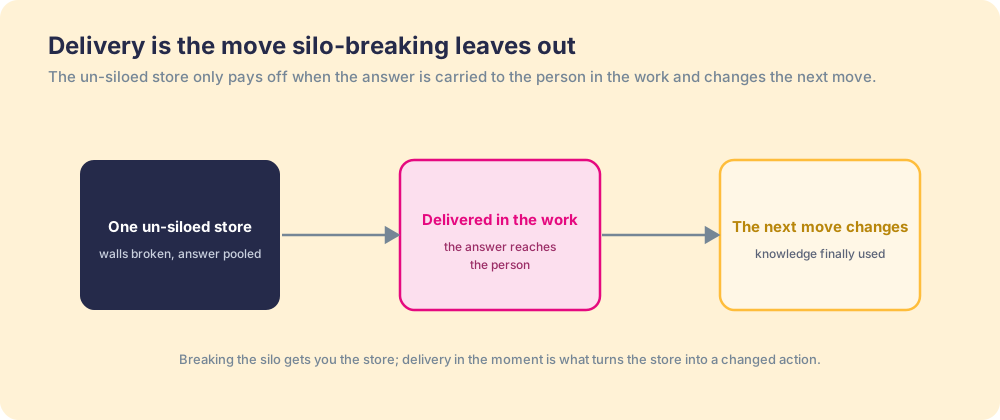
The last move separates a team that consolidated from a team that improved. A store measured on article counts rewards filling it. A system measured on whether the answer changed the next action rewards use. The same shift sits behind a well-built internal knowledge base and behind capturing the tribal knowledge your best people carry off in their heads: the value was never in the storing, it was in the arrival.
Treat knowledge sharing as a delivery problem and the org-chart questions soften. People are usually willing to share, and the tools to consolidate are everywhere, as we argue in the case for knowledge sharing as a behavior problem rather than a culture one. The wall was real and worth removing. It was not the last wall between the answer and the person.
The evidence that delivery is the lever, not storage, is in our own data. The State of Sales Enablement found teams whose guidance reaches them in the flow of the work hit quota at 49 percent against 15 percent for teams whose knowledge sits in a separate destination (The State of Sales Enablement). Same content, same people; the difference was whether the answer arrived where they stood or waited to be fetched. Tearing down the walls put the answer in one place. It did not put it at the corner.
What tools stop knowledge from getting siloed?
No single tool stops knowledge silos, because each kind of tool removes a different wall. Match the tool to the wall you have:
| The wall | What removes it | Example tools (October 2026) |
|---|---|---|
| Answers scattered across chats, drives, and inboxes | A shared wiki or knowledge base with named owners | Confluence, Notion, Guru |
| Answers stored but unfindable across 11 apps | Enterprise search or an AI answer layer | Glean, Atlassian Rovo |
| Know-how locked in a top performer’s calls | Capture: call recording and conversation intelligence | Gong, Loom (owned by Atlassian since 2023) |
| Answers that exist but never reach the work | In-flow delivery inside the CRM and inbox | Digital adoption platforms; Supered for sales teams |
The first three rows are mature, well-funded categories. Glean alone raised a $150M Series F at a $7.2B valuation in 2025 on the strength of the search job (Glean). The fourth row is where silo projects stall, because a pooled, searchable store still waits for someone to stop working and go look. We map all five lanes, with what each tool does best, in knowledge management tools.
What we recommend
A knowledge-silo project can be scoped to the walls: consolidate the scattered stores into one searchable home, give it an owner, declare the silos broken, and keep losing a quarter of the week to search inside one tidy archive. Or it can be scoped to the whole distance: break the walls, then deliver the answer into the work, curate it to one step, and inspect whether it changed what the person did.
Scope it to the whole distance. The numbers point one way. Knowledge workers lose close to a fifth of the week to information they cannot find or recall. Institutional knowledge that sits in a consolidated store still decays without a prompt at the moment of need. And answers delivered in the flow more than triple quota attainment over knowledge parked in a separate place. Breaking the silo was the necessary half. Getting the answer to arrive when it counts is the half that feeds the cattle.
So tear down the walls, and then keep going. The store is the start of the work, not the end of it. Begin with where that knowledge should live in the internal knowledge base, the expertise worth capturing first in tribal knowledge, and the sales-specific version in the sales knowledge base.
Frequently asked questions
What are knowledge silos?+
Why are knowledge silos a problem?+
How do you break down knowledge silos?+
Does breaking knowledge silos actually improve performance?+
What are the signs of knowledge silos?+
What causes knowledge silos?+
What tools stop knowledge from getting siloed?+
What is the difference between knowledge silos and a knowledge base?+
Your process, running itself.