PhantomBuster vs Waalaxy in 2026: A Workshop and a Machine on the Same Socket
PhantomBuster vs Waalaxy, checked October 2, 2026: an automation workshop priced per workspace against a LinkedIn outreach tool priced per seat, both running from the cloud on the rep's account. Prices, limits, risk, and when to choose neither.
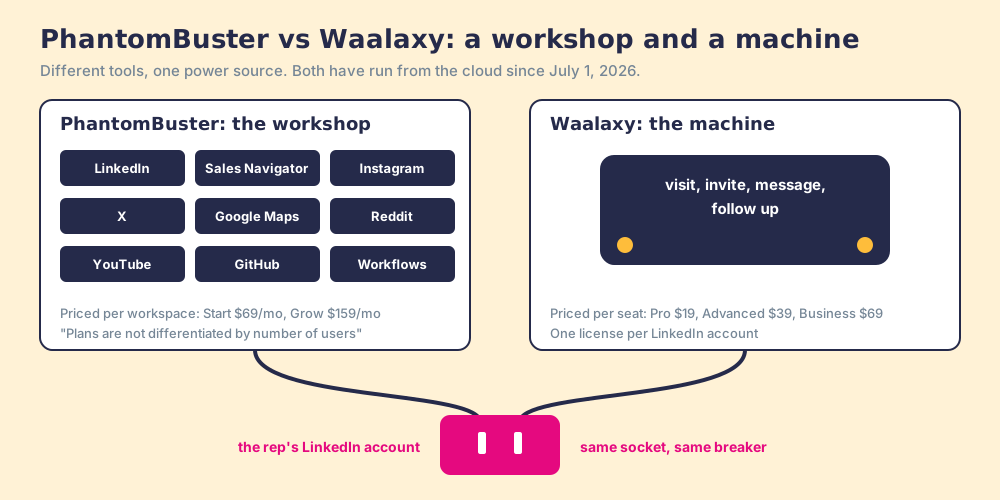
PhantomBuster vs Waalaxy is a choice between PhantomBuster, a cloud workshop of scraping and outreach automations priced per workspace, and Waalaxy, a cloud tool built for LinkedIn invitation and message sequences priced per seat; both act on the rep's own LinkedIn account.
PhantomBuster vs Waalaxy is a choice between PhantomBuster, a cloud workshop of scraping and outreach automations priced per workspace, and Waalaxy, a cloud tool built for LinkedIn invitation and message sequences priced per seat; both act on the rep’s own LinkedIn account. The short answer, by who it fits:
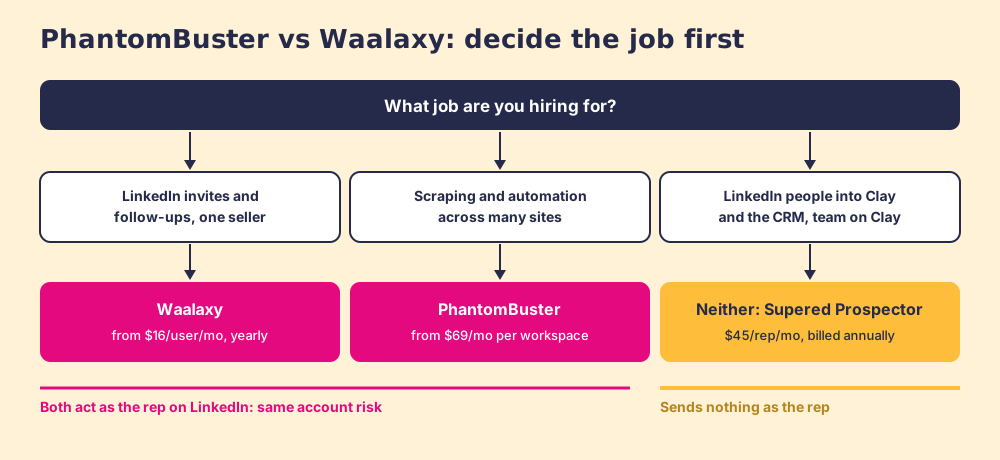
- Waalaxy. One seller, or a small team, that wants LinkedIn invitations and follow-ups running in an hour: from $16 a user a month, billed yearly.
- PhantomBuster. A growth or ops person who scrapes and automates across LinkedIn, Instagram, X, Google Maps and more: from $69 a month per workspace.
- Supered Prospector. A team on Clay whose real job is getting the right LinkedIn people into Clay and the CRM, with nothing sent as the rep: $45 per rep per month, billed annually.
A workshop wall holds a hundred tools, a drill and a router and a sander and a jig for every job, and a capable person can build almost anything there. A bench machine does one job, and does it the moment you switch it on. You choose between them by what you are building. What you cannot choose is the socket. Both plug into the same wall outlet, and when the breaker trips, the lights go out on both.
PhantomBuster is the workshop. Waalaxy is the machine. The socket is the rep’s LinkedIn account, and since July 1, 2026, when Waalaxy pulled its Chrome extension and moved fully to the cloud, both draw from it the same way: from a server, as the rep.
How do PhantomBuster and Waalaxy compare at a glance?
All figures checked October 2, 2026, from each vendor’s pricing page and help center.
| PhantomBuster | Waalaxy | |
|---|---|---|
| What it is | No-code automation platform across many sites | LinkedIn and email outreach sequences |
| Where it runs | ”PhantomBuster runs them on its servers” | Fully cloud since July 1, 2026; extension removed |
| How it acts as the rep | Session cookie via extension, email and password, or a copied li_at cookie | LinkedIn login; Infinite Login stores password and 2FA secret key |
| Pricing basis | Per workspace; “Plans are not differentiated by number of users” | Per seat; one license per LinkedIn account |
| Entry price | Start $69/mo, $56 annual | Pro $19/mo, $16 yearly |
| Invitation limit it states | LinkedIn “~100/week, dynamic by account” | LinkedIn “200 per week”; up to 100 a day on Advanced |
| Email finding | 500 to 10,000 email credits a month per workspace | 25 credits a seat on Pro and Advanced, 500 on Business |
| CRM | HubSpot with advanced sync; Salesforce, Pipedrive one-way | HubSpot, Pipedrive native; Salesforce through Zapier |
| Clay | Clay pushes rows to a Phantom, cookie pasted in | None listed |
| G2 | 4.4 from 138 reviews | 4.5 from 1,604 reviews |
The row that decides most purchases, account risk, gets its own section below. Neither tool’s corporate status changed in 2026: news searches on October 2, 2026 found no acquisition, merger, or rebrand for either company.
Why trust this comparison?
I started RevPartners, a HubSpot partner that did only sales implementations, sold roughly twice as much Sales Hub as any other partner, and reached Elite tier in 13 months. Supered came out of that work and is rated 4.9 from 81 reviews on G2 and 5.0 from 122 reviews on the HubSpot App Marketplace (both checked October 1, 2026). We make Supered Prospector, which is neither of these tools and does not send LinkedIn invitations or messages. It appears below as the third option for teams on Clay, and only there.
What changed at Waalaxy and PhantomBuster in 2026?
The old way to compare them was by where they ran. Waalaxy ran inside your Chrome browser, so the laptop had to stay on and the activity left from your own machine. PhantomBuster ran on its servers.
That distinction ended on July 1, 2026. Waalaxy’s help center: “The Waalaxy Chrome extension has been removed. Waalaxy works directly in your browser at app.waalaxy.com.” It adds that “you don’t need to stay on LinkedIn while it works,” and points users who want faster imports to a separate extension called Alien Copilot (Waalaxy Help Center). To keep sending with the laptop closed, Waalaxy’s Infinite Login asks for your LinkedIn email, password, and two-factor secret key, so its cloud “can send your actions (invitations, messages, profile visits, etc.) without interruption, even when your computer is turned off” (Waalaxy Help Center, July 8, 2026).
PhantomBuster went the other way and kept its extension, now a session connector that “works silently in the background” and a lead panel on standard LinkedIn profiles (not Sales Navigator), with 200,000 users and a 3.3 rating from 86 ratings on the Chrome Web Store. A G2 reviewer in February 2026 wrote that “they changed their pricing at the end of 2025, which significantly limited our usage” (G2).
So in 2026 the two tools reach LinkedIn the same way. The workshop and the machine draw on one socket.
Is PhantomBuster or Waalaxy safer for your LinkedIn account?
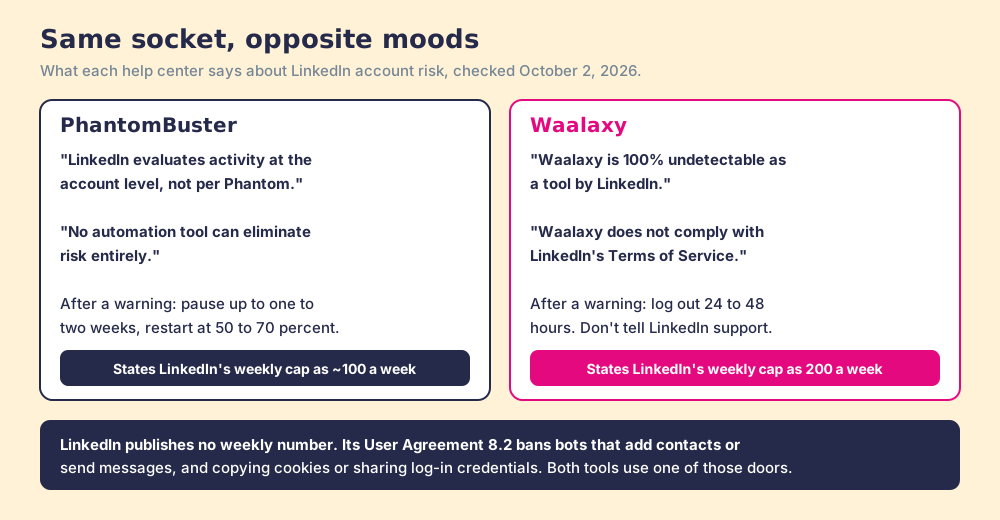
Neither, by any measure either vendor documents, and their help centers describe the risk in opposite moods.
| Question | PhantomBuster’s help center | Waalaxy’s help center |
|---|---|---|
| Can LinkedIn tell? | ”LinkedIn evaluates activity at the account level, not per Phantom." | "Waalaxy is 100% undetectable as a tool by LinkedIn.” |
| Is there residual risk? | ”No automation tool can eliminate risk entirely." | "Unfortunately, Waalaxy does not comply with LinkedIn’s Terms of Service.” |
| What to do after a warning | Pause all activity “for up to one to two weeks,” then restart at 50% to 70% of the recommended limits | Log out “for 24 to 48 hours,” then reduce quotas by half after a second warning |
| What to tell LinkedIn | Not addressed | ”We strongly advise against telling LinkedIn support that you use Waalaxy.” |
| The weekly invitation cap | ”~100/week, dynamic by account" | "200 per week” |
The two vendors disagree by a factor of two on LinkedIn’s weekly cap, and LinkedIn settles nothing: its help page says all members “are subject to these limits,” that a restriction “typically lasts one week,” and that “LinkedIn Support cannot disclose the type or reason for the restriction” (LinkedIn Help). A limit LinkedIn does not publish is a tripwire, and two vendors guessing its height differently are guessing.
What LinkedIn does publish is the rule. Section 8.2 of its User Agreement, effective November 3, 2025, bars using “bots or other unauthorized automated methods to access the Services, add or download contacts, send or redirect messages” and using another’s account by “sharing log-in credentials or copying cookies” (LinkedIn User Agreement). Both tools reach the account through one of those two doors. Waalaxy says so outright, which deserves credit for candor, and offers to move a subscription to a new LinkedIn profile if the old one is banned.
Which is cheaper, PhantomBuster or Waalaxy?
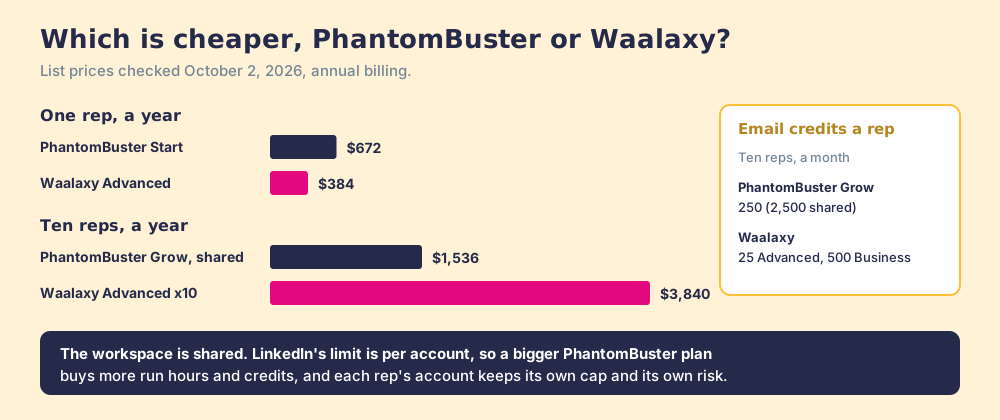
The pricing models differ at the root. PhantomBuster sells a workspace: Start $69 a month ($56 billed annually) with 20 hours of run time and 500 email credits; Grow $159 ($128) with 80 hours and 2,500 email credits; Scale $439 ($352) with 300 hours and 10,000 email credits; “Plans are not differentiated by number of users” (PhantomBuster Help Center). Waalaxy sells a seat per LinkedIn account: Pro $19 a month with 300 invitations a month, Advanced $39 with 800, Business $69 with cold email and 500 email-finder credits; yearly billing takes 20% off, to $16, $32, and $55, with a 14-day free trial (Waalaxy pricing, October 2, 2026). Waalaxy’s help center warns that “no reminder is sent before your first charge” when a trial converts.
| Team | PhantomBuster | Waalaxy |
|---|---|---|
| One rep, monthly | Start $69 | Advanced $39 |
| One rep, annual | Start $672 a year | Advanced $384 a year |
| Ten reps, annual | Grow $1,536 a year, one shared workspace | Advanced $3,840 a year, ten seats |
| Email credits a rep, ten reps | 250 a month (2,500 shared) | 25 a month on Advanced, 500 on Business |
For one rep, Waalaxy is cheaper. For ten, PhantomBuster’s workspace looks cheaper, and the look is the trap. The plan is per workspace and LinkedIn’s limit is per account, so ten reps share one plan’s 80 hours and 2,500 email credits while each account carries its own cap and its own risk. Upgrading, PhantomBuster’s help center says, “never lifts LinkedIn’s own limits.” A bigger workshop does not widen the socket.
What is each one best at?
Graded 1 to 5 on the same jobs, from the help-center facts above.
| Job | PhantomBuster | Waalaxy | Edge |
|---|---|---|---|
| LinkedIn invitation and message sequences | 3 | 4 | Waalaxy, built for it |
| Scraping and automation beyond LinkedIn | 5 | 1 | PhantomBuster, by a mile |
| Email finding | 3 | 3 | Even: credits on a found email only, on both |
| CRM sync | 3 | 3 | Even: PhantomBuster’s HubSpot sync is deeper; Waalaxy’s Pipedrive sync creates deals |
| Clay | 3 | 1 | PhantomBuster, with the cookie caveat |
| Setup for a non-technical seller | 2 | 5 | Waalaxy |
| Account exposure | 1 | 1 | Neither; both act as the rep |
- Waalaxy’s edge. One job, done with few settings. Pick a sequence, import a Sales Navigator search, set quotas, and Waalaxy paces invitations at a random 80% to 100% of the daily maximum so no two days look alike.
- PhantomBuster’s edge. Breadth. Its Phantoms pull from “LinkedIn, Sales Navigator, Instagram, Facebook, X/Twitter, YouTube, GitHub, Reddit, Slack, Google Maps, Yellow Pages, and more,” and Workflows chain them. A G2 reviewer in August 2025 wrote that “the interface and setup can feel a bit complex at first,” which is the price of a workshop.
- The shared weakness. Both find contact data through a few partners (Dropcontact and Icypeas for PhantomBuster’s extension; BetterContact, FullEnrich, and Dropcontact for Waalaxy), a smaller waterfall than the 200+ providers a team on Clay already has.
Do you need PhantomBuster or Waalaxy if your team has Clay?
It depends on the job you meant. If the job is automated LinkedIn invitations and messages, a Clay team still needs an outreach tool, and Clay’s outbound page lists HeyReach as an export destination (Clay); the LinkedIn automation tools page grades the field. The account risk comes with the job, whichever tool does it.
If the job is getting the right LinkedIn people into Clay and the CRM, choose neither. PhantomBuster’s Clay route needs the rep’s session cookie: “Paste your LinkedIn session cookie into the required field so PhantomBuster can access your account” (PhantomBuster Help Center). Waalaxy lists no Clay integration.
Supered Prospector runs inside the Supered Chrome extension and puts the team’s Clay tables in the rep’s hands. Clay plus Supered is the best way for a sales team to prospect: GTM engineers build in Clay, reps never open Clay. On a Sales Navigator lead or list, the rep adds leads to a prospect list and pushes it to the team’s Clay table; on a LinkedIn profile, the rep sees the matching CRM record, its owner, and whether the person was prospected before. Clay’s waterfall across 200+ providers fills the verified email and phone, and Clay charges nothing when an enrichment comes back empty (Clay pricing). One click sends the record to HubSpot, Salesforce, or Pipedrive. The leader sees each list as Found, Worked, and Closed, where Closed means Qualified, Recycled, or Disqualified.
Supered’s own statement on LinkedIn: Prospector works within LinkedIn’s terms and does not copy search results in bulk; the contact data comes from Clay’s waterfall on the customer’s Clay account. We do not claim LinkedIn approval or partnership.
Prospector is $45 per rep per month, billed annually, from one rep, on your own Clay account, and it starts with a demo (Prospector). Choose something else if you want invitations and messages sent automatically, if you are not on Clay, or if your sellers work from phones in the field, since Supered has no mobile product.
PhantomBuster vs Waalaxy: which should you choose?
Waalaxy vs PhantomBuster turns on two facts: what you are building, and who will run it.
- Waalaxy. The pick for a seller who wants LinkedIn invitations and follow-ups running this afternoon, priced per seat, with native HubSpot and Pipedrive sync.
- PhantomBuster. The pick for an ops or growth person who scrapes and automates across many sites and will spend an afternoon building a Workflow; the PhantomBuster review grades it in depth.
- Neither, for a Clay team. The pick when the job is LinkedIn people landing in Clay and the CRM: Supered Prospector, with the rep in the seat and nothing sent in their name.
Both automation tools carry the same socket risk, and no plan on either one changes it. What we recommend is to decide the job first: if it is outreach, pick the tool that fits the person running it and read its help center before the trial converts; if it is the list, keep the robots off the account and let the rep send the right people to Clay from the page they are on. The PhantomBuster alternatives page grades the list-building route in full, and a Prospector demo shows a Sales Navigator list landing in your CRM on your own Clay account.
Frequently asked questions
Is PhantomBuster or Waalaxy better?+
Is Waalaxy safer than PhantomBuster?+
Which is cheaper, PhantomBuster or Waalaxy?+
Does Waalaxy still have a Chrome extension?+
Can PhantomBuster or Waalaxy send leads to Clay?+
How many LinkedIn invitations can PhantomBuster and Waalaxy send?+
Everything we have written on PhantomBuster
More on PhantomBuster
Looking past PhantomBuster? See Supered Prospector on your own Clay accountEverything we have written on Waalaxy
More on Waalaxy
Looking past Waalaxy? See Supered Prospector on your own Clay accountYour Clay waterfall, where reps already work.