Guru Alternatives: Five Jobs, Scored, With a Verdict
Most Guru alternatives lists rank tools by feature count.
The sharper method is to score five jobs a knowledge buyer is hiring for, weight the two that move quota, and show the math.
Guru alternatives are the knowledge tools buyers weigh against Guru's verified answer layer, and the right pick depends on the job: capturing knowledge, verifying it, delivering answers in context, delivering process in the CRM, or measuring adherence.
A family buys a house for the closet. They see the shelves, picture everything put away, and sign. A year later the shelves are full and the floor is still covered, because storage was only half the problem. Nobody put anything away in the moment they had it in their hand.
Most Guru alternatives pages make the same mistake at scale: they rank ten tools by feature count, as if every buyer were hiring for the same job. A Guru buyer is hiring for one or more of five distinct jobs, and no tool on the market does all five well. So this comparison names the five jobs, scores each tool against them, weights the two jobs that carry quota, and shows the math. Guru wins two columns outright, and we will say so plainly before we say anything else.
What jobs is a Guru buyer hiring for?
Strip the category language away and a knowledge purchase decomposes into five jobs:
- Knowledge capture. Getting what your best people know written down and organized in the first place.
- Verification and freshness. Knowing which of the six versions is current, and having a named expert re-certify it on a schedule.
- In-context answers. Delivering the answer where the person already is, through a browser extension or in-app layer, instead of a wiki tab.
- Process delivery in the CRM. Surfacing the next step of the sales process at the deal stage where it applies, inside HubSpot or Salesforce.
- Adherence measurement. Answering the question a revenue leader is paid on: was the process followed, deal by deal, and how would we know?
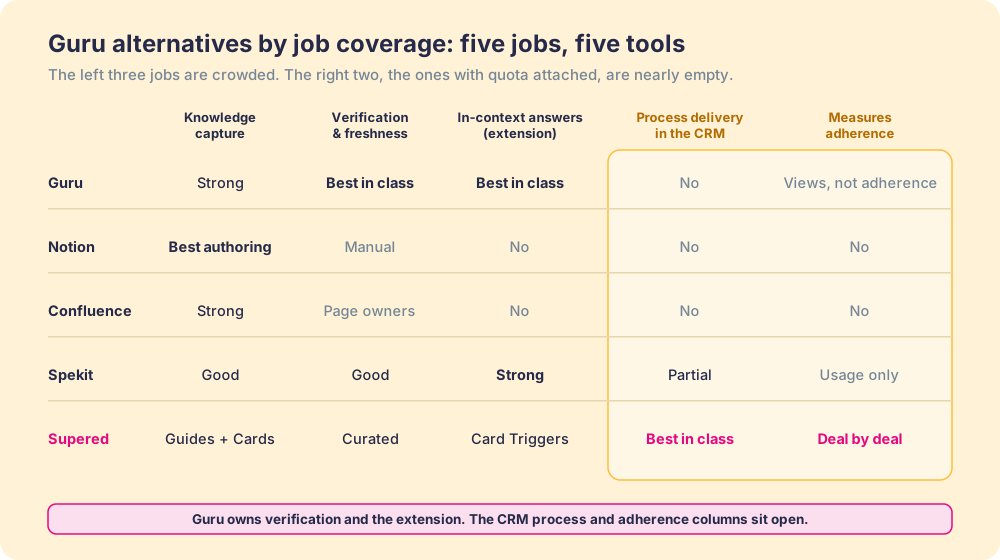
Picture a museum. Notion built the archive where every piece is catalogued. Guru hired the curator who certifies which pieces are genuine and stands at the door answering questions. Both are real work done well. But a museum’s certificate of authenticity has never once made a visitor take the painting home and hang it. Delivery into the buyer conversation, and proof the process ran, are jobs neither the archive nor the curator was built for.
Where is Guru still the best pick?
Credit where it is earned, with specifics. Guru is independent as of July 2026: Philadelphia, founded 2013, led by CEO Rick Nucci, roughly $68 million raised over six rounds, more than 2,500 customers including Shopify and Spotify. It has rebuilt itself as an AI Source of Truth, a governed, permission-aware knowledge layer, and two of its capabilities lead the field.
The first is the verification workflow. Every card carries a named verifier and a re-certification schedule, so trust has an owner and an expiry date. A stale answer in Guru gets flagged the way milk gets a date printed on the carton; in Notion or Confluence, someone has to open the page and smell it. If your pain is six conflicting versions of the pricing answer, this workflow is the cure, and no alternative on this page does it better.
The second is the browser extension. Guru’s answer layer rides along wherever the rep works and serves the verified card without a tab switch. That is genuine in-context delivery of knowledge, the capability a wiki in a tab cannot match. In March 2026 Guru extended the same idea to machines, shipping a Model Context Protocol integration that lets AI agents query its knowledge, including live Slack conversations, in real time.
That MCP launch is worth pausing on, because it proves the larger point of this page. When any AI agent can pull the verified answer in seconds, the answer itself stops being scarce. Knowledge is the solved problem in 2026. What a rep does with it, in the flow of work, is the unsolved one. Guru is racing to make retrieval perfect at the exact moment retrieval stopped being the bottleneck.
Why does a verified answer still go unused?
Because verification and delivery of an answer are still, structurally, a pull. The rep must notice the question and go ask it. A pull system is a well: the water is clean, the curator has certified it, and someone still has to walk over with a bucket. When the rep is calm, the walk is nothing. When the quarter is short and a buyer is waiting on a reply, the walk is the step that does not happen, and the rep guesses.
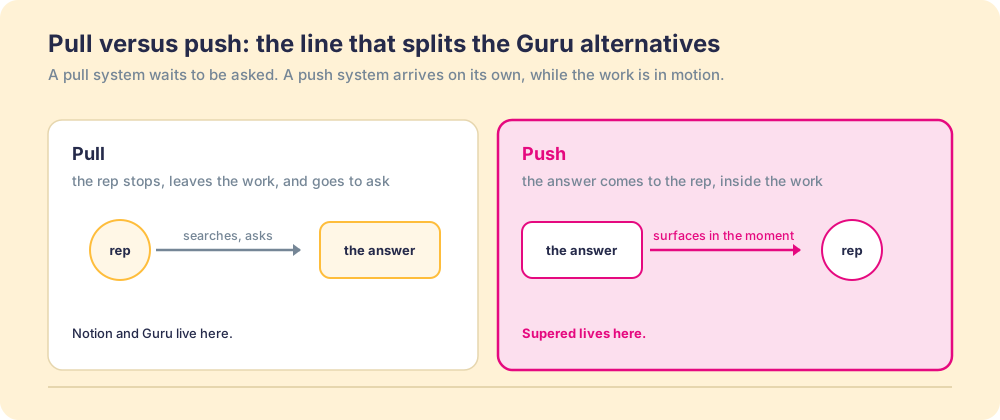
The cost of the walk is measured. The McKinsey Global Institute put the search-and-gather overhead at close to a fifth of the knowledge worker’s week (McKinsey Global Institute). A better well makes the water cleaner; it does not shorten the walk. And the walk is only half the gap. Across 198 sales teams in The State of Sales Enablement, 89 percent had a defined, documented sales process and 36 percent saw it followed as designed. The knowledge existed. It was even findable. The behavior did not follow, and no verification badge closed that 53-point gap.
This is the line to carry out of this section: a verified card nobody acts on is still shelf-ware. The certificate is real, the shelf is real, and the deal advanced without either.
The same research shows what closes the gap. Teams whose guidance reached reps in the flow of the work hit quota at 49 percent, against 15 percent for teams whose knowledge lived in a separate destination. Same knowledge, more than three times the attainment, and the variable was placement plus measurement rather than quality of content.
How do the Guru alternatives score across the five jobs?
First the coverage, read by column. The corporate facts are current as of July 2026, checked this month, because a comparison that misses a merger or an IPO filing is wrong in the way that loses trust.
| Tool | Knowledge capture | Verification & freshness | In-context answers (extension) | Process delivery in the CRM | Measures adherence | Status (July 2026) |
|---|---|---|---|---|---|---|
| Guru | Strong | Best in class | Best in class | No | Views and trust scores | Independent, ~$68M raised, MCP shipped Mar 2026 |
| Notion | Best authoring | Manual | No | No | No | S-1 filed Feb 12, 2026; ~$11B tender valuation |
| Confluence (Atlassian) | Strong | Page owners, manual | No | No | No | Rovo AI bundled in paid Cloud plans |
| Spekit | Good | Good | Strong | Partial | Usage only | Independent, ~$60M raised, acquired Cquence |
| Supered | Guides + Cards | Curated | Card Triggers | Best in class | Deal by deal | Independent, from $13.50 per user per month |
Notes the table cannot hold. Notion filed its S-1 on February 12, 2026, after an early-2026 employee tender valued it near $11 billion on roughly $600 million of revenue; it is the best place on this list to write knowledge down, and it does nothing to deliver or measure it. Confluence ships Rovo AI in every paid Cloud plan, which strengthens retrieval and changes nothing about behavior. Spekit is the nearest neighbor to Supered’s philosophy, delivering enablement inside the rep’s apps; it stops short of measuring process adherence in the CRM, and we compare the two directly in Spekit alternatives. Spekit is independent, has raised about $60 million, and acquired the AI startup Cquence to mine deal insights from conversations.
The weighted score, with the math shown
A raw checkmark count treats the five jobs as equals, and they are not. The default failure in the field is documented-and-unfollowed work: 89 percent written down, 36 percent followed. So the two jobs that decide whether documentation changes anything, in-flow process delivery and adherence measurement, count double. Each tool scores 1 to 5 per job. Argue with the weights if you like; they are printed so you can.
| Tool | Capture (×1) | Verify (×1) | Extension (×1) | CRM process (×2) | Adherence (×2) | Weighted total (of 35) |
|---|---|---|---|---|---|---|
| Supered | 3 | 3 | 4 | 5×2 = 10 | 5×2 = 10 | 30 |
| Spekit | 3 | 3 | 5 | 3×2 = 6 | 2×2 = 4 | 21 |
| Guru | 3 | 5 | 5 | 2×2 = 4 | 1×2 = 2 | 19 |
| Notion | 5 | 2 | 1 | 1×2 = 2 | 1×2 = 2 | 12 |
| Confluence | 4 | 2 | 1 | 1×2 = 2 | 1×2 = 2 | 11 |
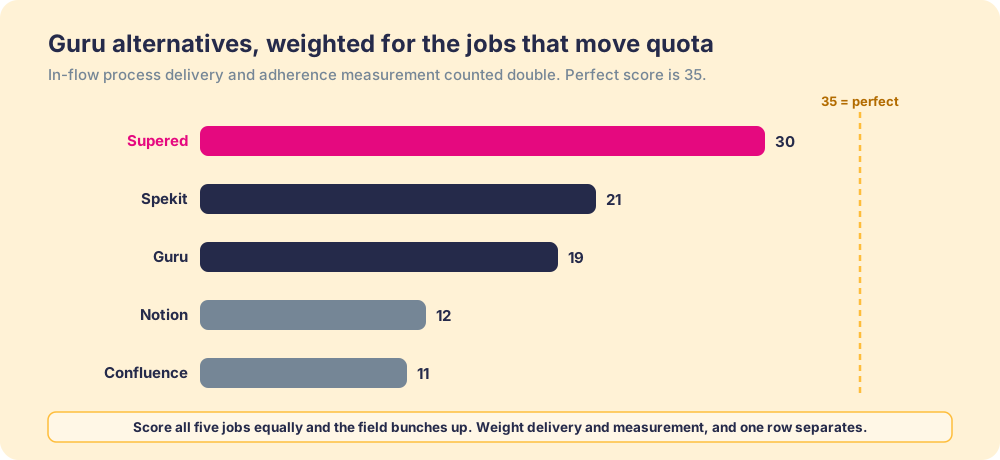
Read the scores as written. Guru posts the two perfect 5s on this page, verification and the extension, and no other tool touches either. Notion tops raw authoring. Supered concedes both of those columns: its capture is guide-building rather than one-click auto-capture, and its extension exists to fire Card Triggers rather than to answer any question in any department. It tops the weighted total because it is the only row scoring above 2 on the doubled columns. Bases hold the content, Cards carry the article, Guides add the walkthrough, and Card Triggers surface the right card inside HubSpot, Salesforce, Gong, Gmail, or LinkedIn the moment the page calls for it, with adherence measured deal by deal. That is the Behavior Layer, a different product category from a source of truth, which is why this comparison ends in a fork rather than a ranking.
The verdict
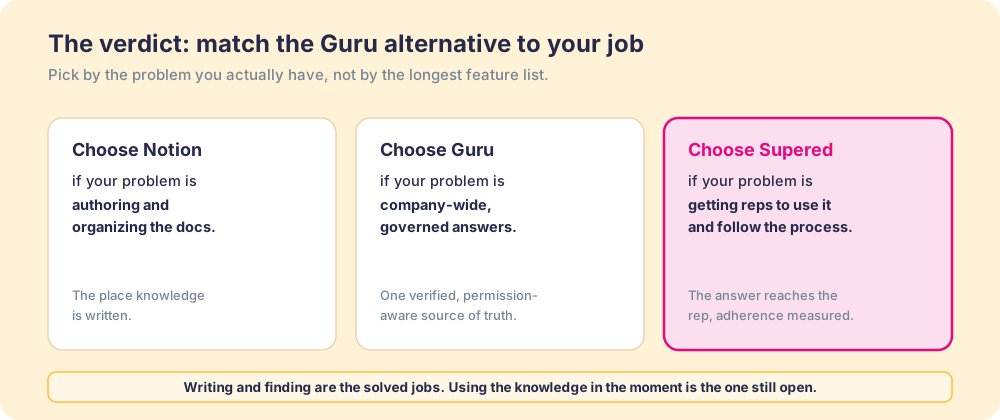
Here is the fork. If your bottleneck is scattered and conflicting knowledge, buy the source of truth, and Guru is the best one. If your bottleneck is a documented process your reps do not run, buy the Behavior Layer, and that is Supered. Buying the first tool for the second problem gets you cleaner shelf-ware.
- Guru. Choose it if you need one governed, permission-aware answer across the whole company, verified on a schedule, served through the best extension in the category. Nothing here outscores its 5s on verification and in-context answers.
- Notion. Choose it if the knowledge does not exist yet and authoring is the job. The IPO filing prices what that workspace is worth.
- Confluence. Choose it if your company already lives in Jira and the wiki must sit beside the tickets.
- Spekit. Choose it if you want enablement content delivered in-app and can live without adherence measurement in the CRM; its 21 reflects real in-flow strength.
- Supered. Choose it if the process is written, the answers are findable, and deals still drift. When the job is making reps run the standard and proving it, the 30 is earned on the two columns no other row on the table fills. Book a demo to see adherence measured on your own pipeline.
The number underneath the whole verdict has already appeared twice, and it will decide your renewal either way: 49 percent quota attainment when guidance reaches reps in the flow of work, 15 percent when it waits in a destination. Guru made the well clean. Someone still has to carry the bucket, and the carrying is the part you can now buy.
If you are still mapping the territory, start with knowledge management for the storage frame, the sales knowledge base for the revenue-team version, and knowledge sharing for why the artifact alone never closes the gap.
Frequently asked questions
What are the best Guru alternatives?+
Is Guru still an independent company?+
What is the difference between Notion vs Guru?+
Is Supered a knowledge base?+
Does Guru measure whether reps follow the process?+
Your process, running itself.