A Sales Knowledge Base Is a Using Problem, Not a Writing One
Most teams treat a sales knowledge base as a writing and search problem.
The hard part is getting reps to use it in the moment, and the behavioral science says why.
A sales knowledge base is the central place a revenue team keeps the answers reps need to sell, the playbooks, objection responses, pricing, and process steps, and its value depends on whether reps use it while they work, not on how complete it is.
A sales team builds a knowledge base the way a household fills an attic. Every useful thing goes up there: the pricing sheet, the competitor battlecard, the onboarding deck, the objection responses someone wrote after a hard quarter. The attic fills. Then, on the call that matters, the rep does not climb the stairs.
A sales knowledge base loses slowly, and on paper the loss looks like success. The writing got done. The search works. The content is, by any audit, complete. Yet the rep on a live discovery call answers from memory, or guesses, or repeats the thing the last manager said, because the answer sat one tab away, and one tab away might as well be one mile.
So set aside how to build a better library and ask why the library goes unvisited, and what to do about it. Our position is that a knowledge base should be judged by what reps do with it in the moment. How much it holds tells you almost nothing.
What is a sales knowledge base, and why isn’t it enough?
A sales knowledge base is the central store of the answers a revenue team needs to sell: the playbook, the pricing, the security responses, the process steps, the words that work. Build one well and you have solved two real problems. The knowledge exists in one place instead of five people’s heads, and a rep can find it.
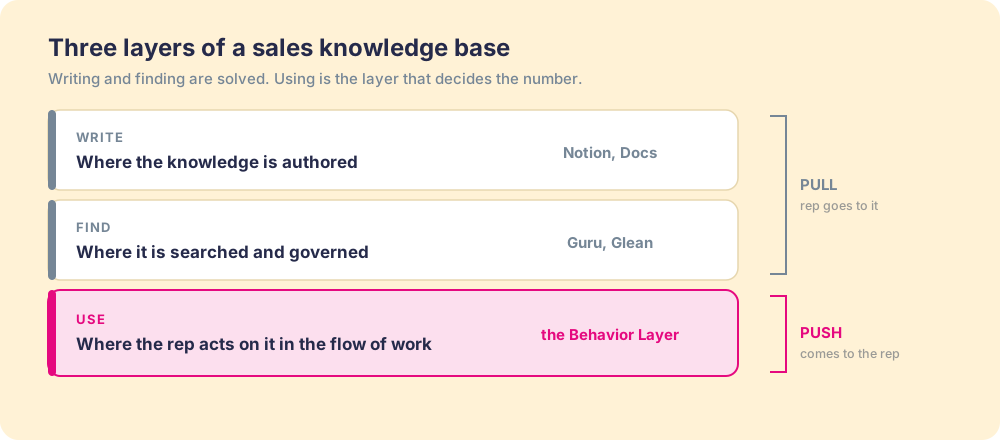
Both were genuine pains, and in 2026 both are close to solved. Notion, Confluence, and a dozen others made authoring cheap. Guru, Glean, and the AI search layer made finding cheap; ask a question, get a cited answer in seconds. If writing and finding were the whole job, the problem would be over.
They are not the whole job. There is a third layer, and the authoring and search tools do not cover it: using. A rep can have the perfect answer surfaced and still not act on it, because acting means stopping the work, reading, deciding, and changing course, all while a buyer waits on the line. The knowledge was available. The behavior did not change. That distance, between the answer existing and the rep acting on it, is where deals are lost, and no amount of better content closes it.
The CRM taught the same lesson a decade earlier. As we argue in CRM adoption, a system can hold every field you want and still sit empty, because the rep has to leave the work to feed it. A knowledge base has the mirror problem: the rep has to leave the work to consult it.
Why don’t reps use the knowledge base?
Because using it costs more, in the only currency that matters mid-deal, than not using it. That currency is attention in the moment, and the math is plain. The answer lives in another tab. Getting it means breaking off the conversation, searching, scanning, and coming back. The rep who guesses keeps things moving. The system is asking them to trade momentum for accuracy, and under pressure momentum wins.
The rep makes that trade all day long, mostly without noticing.
The numbers say the tax is real. Salesforce’s seventh State of Sales report, published February 3, 2026, found reps spend 60 percent of their time on non-selling tasks, much of it searching for and assembling information rather than talking to buyers (Salesforce State of Sales, 2026). The wider knowledge-work picture is as heavy: the McKinsey Global Institute estimated that employees spend close to a fifth of the workweek, on the order of 1.8 hours a day, searching and gathering information (McKinsey Global Institute, 2012). A fifth of the week spent looking for things is a fifth of the week not spent doing them.
There is a second tax the knowledge base cannot see: forgetting. Hermann Ebbinghaus showed more than a century ago that we shed most of what we learn within days unless something pulls it back. A rep trained on the new objection script in January is running on fumes by March, and carelessness has nothing to do with it. Memory works that way. So the knowledge base holds the right answer, the rep half-remembers a worse one, and the gap between them never gets crossed, because crossing it means stopping to look.
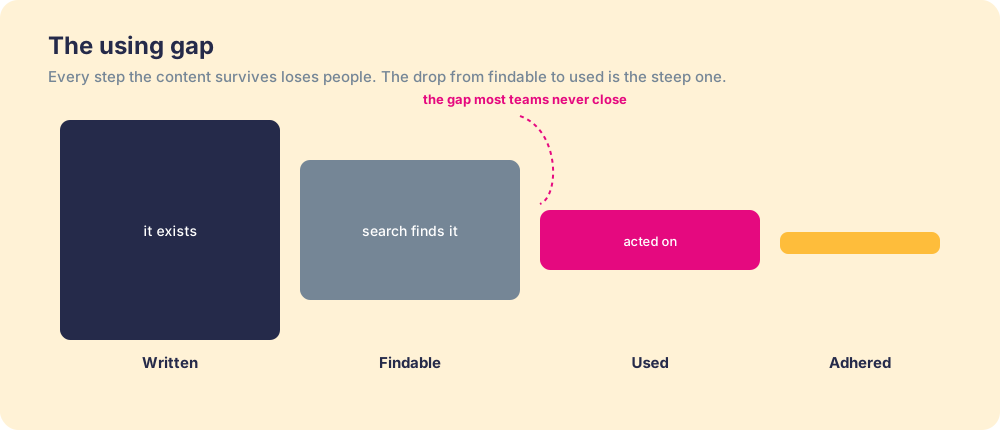
None of this is a discipline failure, and treating it as one is the common, costly mistake. When reps do not use the knowledge base, the cause is friction and timing, not laziness. As we lay out in the sales execution gap, the fix is never a sterner email. It is removing the reason the right action was the harder one.
How do you turn an internal knowledge base into action?
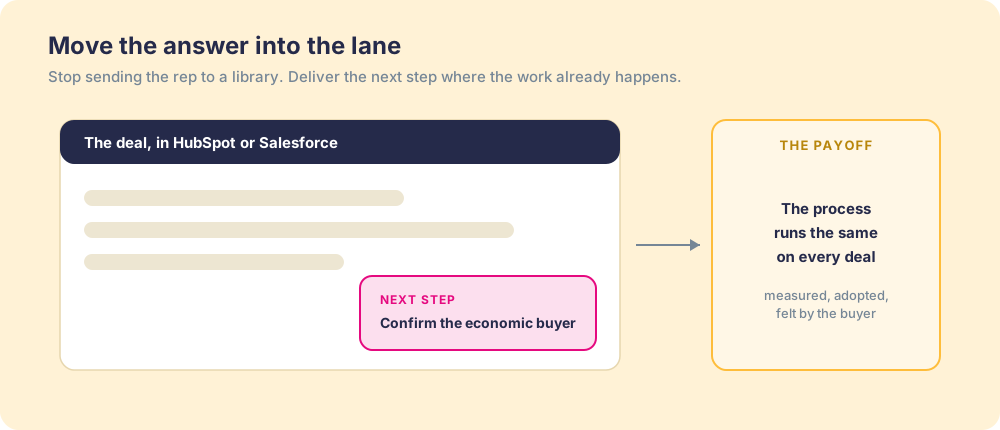
Stop asking the rep to visit the knowledge, and bring the knowledge to the rep. The principle is the one that fixes CRM adoption and every in-the-flow problem: the right action has to be the easy one, delivered the second it is needed, without taking the rep off the work. The name for this is knowledge base adoption, and like CRM adoption it is won by design rather than willpower.
The moves are structural, the same ones that govern any internal knowledge base worth keeping:
- The answer, in the flow. The next step, the objection response, the pricing rule should appear inside HubSpot, Salesforce, the inbox, the dialer, wherever the rep already is, so consulting it costs no detour.
- One next action. One right answer beats ten plausible ones. A rep mid-call needs the single next move, not a results page to triage while the buyer waits.
- Context as the trigger. The system should notice the rep is on a renewal, or a security review, and offer that answer unasked, rather than waiting to be remembered and queried.
- Use as the measure. Count whether the answer changed what the rep did, not whether the article exists or got a click. A published-article count flatters the team and tells you nothing.
That last move decides the rest. You can only improve what you inspect. A knowledge base measured on article counts and search volume is measuring its own existence. A knowledge base measured on whether the guidance changed the rep’s next action is measuring the only thing the business cares about.
At this point the layer needs a name. When the answer arrives in the moment of work, surfaced by context and curated to the next step, it stops being a library and becomes a behavior system. The same shift drives the best digital adoption platforms: guidance that meets the user in the flow rather than waiting to be looked up. We call it the Behavior Layer, and it is what a sales knowledge base becomes once you stop counting its shelves and start measuring its effect.
The convergence is the strongest part of the case. Our own State of Sales Enablement found teams whose guidance lives in the flow of the work hit quota at 49 percent against 15 percent for teams whose knowledge sits in a separate destination (The State of Sales Enablement). The gap tracks where the answer lives, whether it reached the rep where they were standing or waited for them somewhere else. When field data and a century of memory research agree that delivery in the moment is the deciding variable, that is as close to settled as this work gets.
What we recommend
There are two ways to run a sales knowledge base. You can keep investing in the first two layers, write more, organize better, bolt on smarter search, and keep wondering why adoption stays flat. Or you can treat using as its own layer and build for it: deliver the answer in the flow, curate to the next action, trigger by context, and measure whether behavior changed.
We recommend building for use, because each piece of evidence above lands on the same side. Reps lose most of the week to non-selling work and search. Memory decays on its own. And teams with guidance in the flow hit quota at more than three times the rate of teams whose guidance sits in a separate tool. Writing it was never the hard part. Finding it stopped being hard years ago. Using it, and holding the process to it, is the work that remains, and it is the work that moves the number.
So build the library if you must, then go further. Make the answer meet the rep in the moment, and the knowledge base finally does the job you built it for. Start with the broader pattern in the sales execution gap, the same fix applied to the system of record in CRM adoption, and what it looks like as a daily discipline in sales process adoption.
Frequently asked questions
What is a sales knowledge base?+
Why don't reps use the sales knowledge base?+
What is the difference between a knowledge base and the Behavior Layer?+
How do you measure sales knowledge base adoption?+
Is a sales knowledge base the same as an internal knowledge base?+
Your process, running itself.