Knowledge Management System: Storage Solved, Use Did Not
A knowledge management system stores and finds answers beautifully. It still leaves the work unchanged, because storing was never the hard part. Use is.
A knowledge management system is the software a company uses to capture, organize, store, and retrieve the answers its people need to work, so knowledge lives in one searchable place instead of in a few people's heads.
A new hire on her second week needs the refund rule, and she knows exactly where it lives. The company spent real money on a knowledge management system, and the answer is in there, indexed, searchable, three keystrokes away. She also has a customer on the line and a manager walking past. So she guesses. The system worked perfectly and helped no one, which is the puzzle worth sitting down with, because it happens in nearly every company that buys one.
Storing the answer is easy now. Finding it is close to free. Yet the system still goes unopened on the afternoon someone needs it, and the work goes on unchanged. Our position, and the thread running through everything below: a knowledge management system records knowledge, not behavior, and it is judged by whether its answers reach people at the moment of the work, not by how much it holds or how well it searches.
What is a knowledge management system?
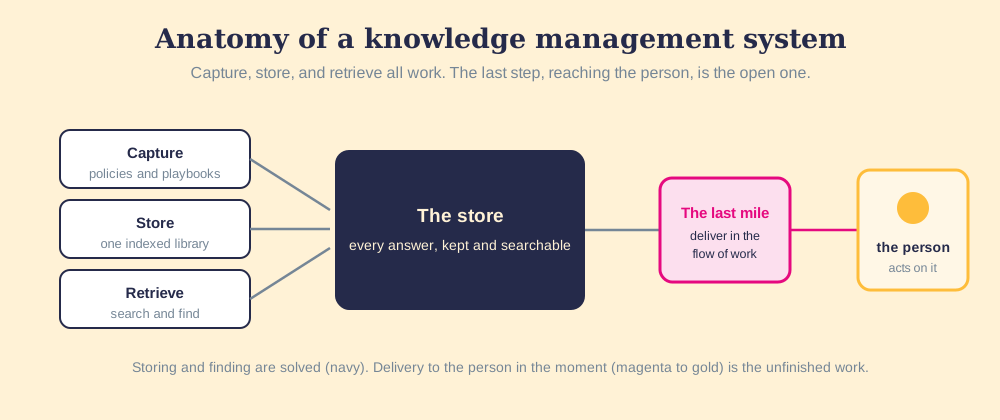
A knowledge management system is the software a company uses to capture, organize, store, and retrieve the answers its people need to work: the policies, the processes, the product and pricing details, the playbooks. Build one well and the knowledge stops living in five people’s heads and starts living somewhere a colleague can reach without tapping a shoulder. That is a real gain, and it is most of what the category was built to do.
The terms blur, and the blur is fine. An internal knowledge base is the store of answers. Knowledge management software is the wider apparatus around it: capture, structure, search, permissions, reporting. The plumbing differs vendor to vendor, and it matters less than people think, because all of it answers the same first question well and the same second question barely at all. The first question is, can we keep the answer and find it again? Yes. The second is, does the answer reach the person while they are working? That one the category mostly leaves to chance.
It helps to picture what the system is. Think of a card catalog in a grand old library. Every book has a card, the cards are alphabetized and cross-referenced, and a patient reader can find anything on the shelves. The catalog is a marvel of storage and retrieval. It is also completely silent on whether anyone walks to the shelf, opens the book, and does what it says. A knowledge management system is that catalog, made faster and searchable. It solved the cataloging. It never claimed to solve the reading.
Why does a knowledge management system leave the work unchanged?
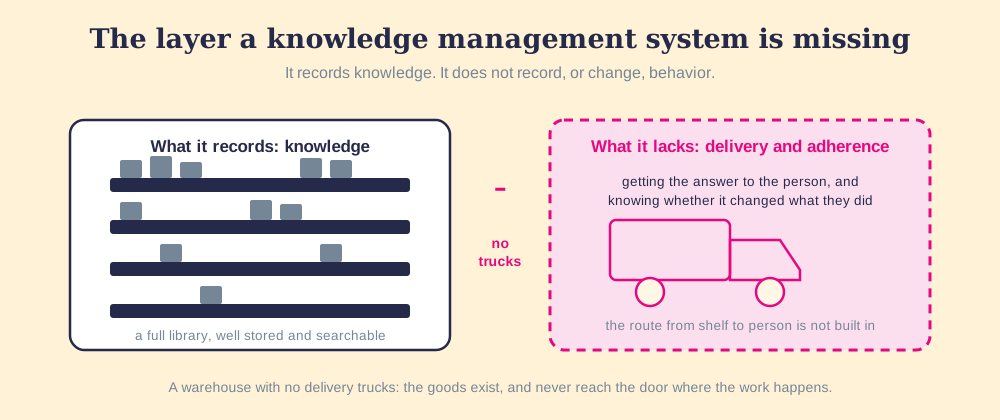
Because it records knowledge, and the thing you want changed is behavior, and those are not the same object. The system knows the refund rule exists. It does not know whether the new hire applied it. It logs that an article was published, never that a person read it and acted. You can have a perfect store of true answers sitting on top of a team that does the wrong thing every day, and the system will report nothing wrong, because by its own measure nothing is.
This is the layer the category is missing, and it is worth being plain about. A knowledge management system is a vast warehouse with no delivery trucks. The goods are real, sorted, and labeled. The warehouse is genuinely well run. But a warehouse without delivery is careful storage and nothing more, and the order never reaches the door where the work is happening. Someone still has to drive the answer to the person, at the moment they need it, and that route is the part the software does not build for you.
The cost of that missing route is not small, and we can put numbers on it. The McKinsey Global Institute estimated that employees spend close to a fifth of the workweek, on the order of 1.8 hours a day, searching for and gathering information (McKinsey Global Institute). Salesforce, in its State of Sales report published February 3, 2026, found that sales reps spend 60 percent of their time on non-selling tasks, a good slice of it hunting for information instead of talking to buyers (Salesforce State of Sales, 2026). The system was bought to end that hunt. When it sits one detour off the road, the hunt continues and the warehouse watches from the shelf.
And there is a second decay running alongside the first. Most answers go in without an owner or a review date, so when the process changes, the page goes wrong and stays up, sitting next to the pages that are still right and looking identical. A store you cannot trust is a store you stop opening. The content rots from the inside while the habit of checking fades from the outside, and the two meet in the middle as a full library that is half stale and rarely read.
The shelves were never the problem.
This is the same wall an internal knowledge base hits, and the same one the CRM hits from the other side. As we argue in CRM adoption, people skip a system not from laziness but because the right action costs more effort than the wrong one. A knowledge management system inverts the CRM’s bargain: where the CRM asks the rep to leave the work to put data in, the knowledge system asks them to leave the work to take an answer out. Same detour, same loss. When people do not use it, that is a system failure, a route that was never built, not a failing of the people who guessed because guessing was faster.
How do you build a knowledge management system people use?
Build it for use rather than for completeness, and treat delivery as the real product. The moves are structural, not motivational, and they map straight onto the two decays:
- Curation over coverage. Cut the store to the answers people reach for, so it stays small enough to trust. A smaller, true store beats an exhaustive one nobody believes.
- An owner on every answer. Each entry gets a person and a review date, so a changed process updates the page instead of orphaning it. Ownership is what stops the content from rotting.
- Delivery in the flow of work. Surface the answer inside the tools where the work happens, the CRM, the inbox, the help desk, so consulting it costs no detour and the habit never has to fight friction.
- A measure of the act, not the page. Track whether the answer changed what someone did, not how many articles exist or got opened. You can only improve what you inspect, and page counts inspect the wrong thing.
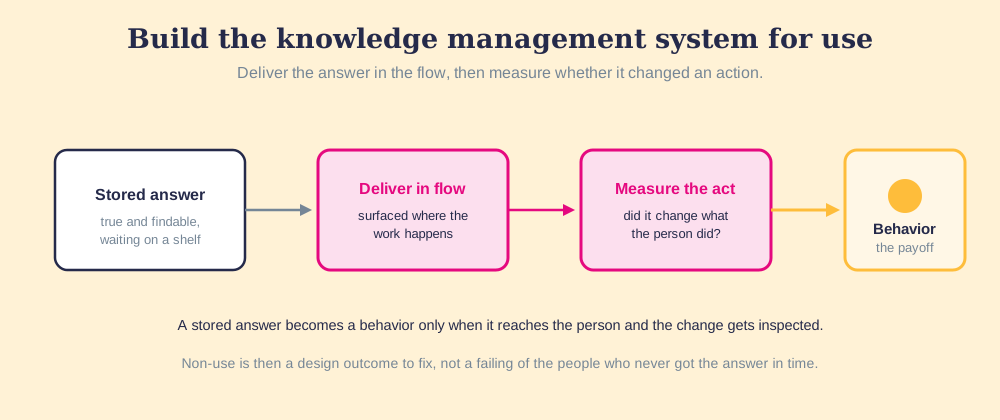
The third move is the one that breaks the old model. A knowledge management system is built to be visited; a system built for use comes to the person instead. When the answer arrives in the flow, surfaced by what the person is doing, the store stops being a destination and becomes a behavior. That is the same shift behind the knowledge sharing that finally spreads beyond the few who already know, and it is what turns a catalog of answers into actions taken.
The proof is whether behavior changed, and the gap is large. Our State of Sales Enablement found that teams whose guidance reaches them in the flow of the work hit quota at 49 percent, against 15 percent for teams whose knowledge sits in a separate destination (The State of Sales Enablement). Same content, same people. The difference was whether the answer reached them where they stood. A system measured on page counts would have rated both teams the same. A system measured on use tells them apart, which is the only thing a buyer of one should care about.
What we recommend
Two ways to run a knowledge management system. You can keep refining the container, a tidier tool, stricter knowledge base structure, faster search, and keep wondering why the launch enthusiasm fades back into the same fog. Or you can build for use: curate it, give every answer an owner, deliver it in the flow, and measure whether it changed what people did.
We recommend the second, and the evidence carries the verdict without help. People lose close to a fifth of the week to searching. Content rots without owners. Answers delivered in the flow more than triple quota attainment over knowledge parked in a separate tool. Storing the answer was solved years ago. Finding it is close to free. The work that decides whether any of it earned its budget is the last mile, the one the warehouse never built, getting the answer to the person at the moment they need it.
So buy the system, then go past the shelf. Make the answer find the person in the flow of the work, measure whether it moved an action, and the knowledge management system finally does the job you bought it for. For the store itself, start with the internal knowledge base; for what good delivery looks like next door in the pipeline, read CRM adoption; and for the broader pattern that ties them together, see knowledge sharing.
Frequently asked questions
What is a knowledge management system?+
What is the difference between a knowledge management system and an internal knowledge base?+
Why do knowledge management systems fail to get used?+
How do you measure a knowledge management system?+
What should a knowledge management system contain?+
Your process, running itself.