Spekit Alternatives: In the Flow Is Not the Same as On the Deal
Spekit gets one thing right that most enablement tools miss: it lives in the flow of work. Here are the alternatives by job, and the honest line between delivering knowledge in-app and changing behavior while the deal is live.
Spekit alternatives are the tools teams weigh against Spekit's in-app, in-the-moment enablement, and the right pick depends on whether the job is delivering knowledge in the flow of work or measuring whether reps run the process in the moments that decide deals.
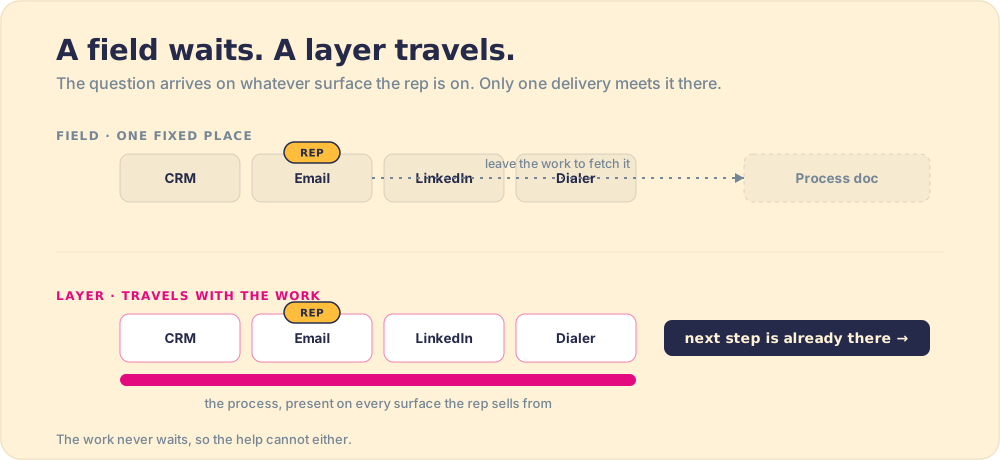
Most enablement comparison posts open by explaining why the incumbent is bad. This one opens by admitting Spekit got the most important thing right. Spekit lives in the flow of work. Instead of building one more library reps have to leave the deal to visit, it surfaces knowledge and in-the-moment guidance inside the tools they already use. That instinct, meet the rep where the work is, is the single thing the heavy content suites get wrong, and Spekit was early to it. An honest alternatives list says that before it says anything else.
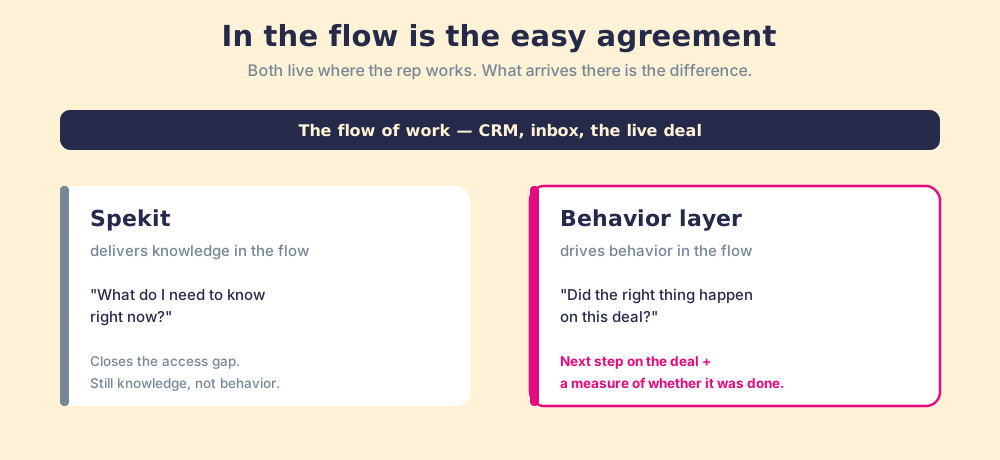
Spekit alternatives are the tools teams weigh against Spekit’s in-app, in-the-moment enablement, and the right pick depends on whether the job is delivering knowledge in the flow of work or measuring whether reps run the process in the moments that decide deals. That last distinction is subtle, because Spekit is already in the flow, so the usual “stop making reps leave the deal” critique does not apply. The real question is sharper: in the flow, what are you delivering, knowledge, or behavior? The spekit competitors worth weighing, and the wider sales enablement software field, sort on exactly that line.
Why do teams look for a Spekit alternative?
Two reasons, pulling in opposite directions.
The first is “we need more.” Some teams find Spekit’s in-app delivery excellent but want a fuller content management platform underneath it, governance, deep analytics, a large managed library, and look at Seismic or Highspot. Others want stronger digital adoption guidance for complex software and compare WalkMe or Whatfix. These are scope questions: Spekit does in-flow delivery well, and the team wants more of one capability around it.
The second is “we need something else.” A team adopts Spekit expecting in-app knowledge to fix performance, and finds reps now have answers at their fingertips and still do not run the process, skip qualification, let deals drift, forget the next step. That is not a Spekit failure. Delivering knowledge in the flow is real value, and it is still knowledge. Whether the rep does the right thing while the deal is live is a different problem, even when the knowledge is right there.
What are the best Spekit alternatives, by job?
| Alternative | Job it does | Where it fits vs Spekit |
|---|---|---|
| Seismic / Highspot | Enterprise content management | Heavier content platforms (now merged into one company) |
| WalkMe / Whatfix | Digital adoption / in-app walkthroughs | More software-guidance, less sales content |
| Mindtickle | Training and readiness | Skill-building off-deal, not in-flow delivery |
| Supered | Process adoption in the CRM | In-flow like Spekit, but drives and measures behavior |
If the job is a fuller content platform, Seismic and Highspot are the heavier peers, with the caveat that they merged in August 2026 and are now one company, covered in the Highspot-Seismic merger. If the job is general software adoption, WalkMe and Whatfix do digital adoption more deeply than sales content. If the job is training and readiness, Mindtickle builds skill off the deal. And if the job is process adoption, getting reps to run the steps in the moments that decide deals and seeing whether they did, that is the same in-flow philosophy Spekit pioneered, pointed at behavior instead of knowledge.
One current development worth noting: Spekit has joined the Gong Collective, surfacing Gong’s call data and conversation insights directly within Spekit’s in-app workflow. Spekit remains an independent company (Denver-based, around 106 employees, last itself an acquirer when it bought the AI startup Cquence in December 2024); this is a partnership, not an acquisition. What the integration signals is that the market is converging on the insight that showing up in the flow of work matters, but the delivery of call analytics in-flow and the delivery of behavioral process steps in-flow are still two distinct jobs done by two different tools. That convergence is the tell. When everyone agrees on where enablement should live, the flow of work, the remaining argument is about what should arrive there, and that argument is the entire comparison below.
Knowledge in the flow, or behavior in the flow?
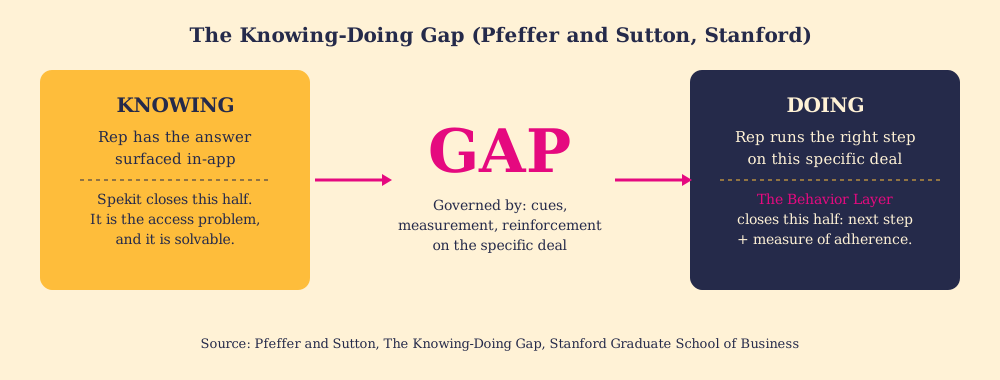
Here is the mechanism, and it is why even in-flow knowledge can leave performance flat. Information is necessary and not sufficient. A rep can have the perfect answer surfaced at the perfect moment and still not run discovery, because knowing what to do and doing it are different acts, governed by different things. The knowing-doing gap is well documented: Pfeffer and Sutton’s work at Stanford named it, and it persists precisely because organizations keep treating a behavior problem as a knowledge problem (Pfeffer & Sutton, The Knowing-Doing Gap). Spekit closes the access half of the gap, which matters. It does not, by design, close the doing half, because it delivers knowledge, not a measured next step on the specific deal.
What governs the doing half is worth naming, because it is not access and it is not motivation. It is the trio behavioral science keeps returning to: a clear cue at the deciding moment, a measurement that makes the behavior visible, and reinforcement that follows. Gollwitzer and Sheeran’s meta-analysis of 94 studies on implementation intentions found that a plan bound to a concrete moment (“when situation X arises, I will do Y”) produces a medium-to-large jump in follow-through, an effect size around d = 0.65, where a vague intention to “do better” produces almost none (Gollwitzer & Sheeran, 2006). Knowledge surfaced in-app is the situation-X half. The “I will do Y,” and the record of whether Y happened, is the half a knowledge tool leaves on the table. This is the precise seam between delivering information in the flow and driving behavior in the flow, and it is why two tools that both live in the same place can produce different numbers.
This is the category we build, and it is genuinely close to Spekit in spirit, which is why the comparison is fair rather than a strawman. A behavior layer like Supered runs inside HubSpot and Salesforce, in the same flow Spekit respects, but what it surfaces is the next right step on this deal, and what it adds is measurement: did the rep run the process, deal by deal. Our research found teams whose enablement reached reps in the flow of work hit quota at 49 percent versus 15 percent for those whose tools sat in separate destinations (The State of Sales Enablement). Spekit and a behavior layer are on the same side of that line, both in the flow. The further question is whether the flow delivers knowledge or drives and verifies behavior. On G2, Supered holds a high score on a smaller, newer base, the signature of a younger, focused product.
The verdict: which Spekit alternative, and when to stay
- Spekit itself. The right call when your job is in-app knowledge delivery and in-the-moment guidance, and it is doing that well. It got the in-flow instinct right, and switching to a heavier tool that makes reps leave the deal would be a step backward.
- Seismic or Highspot. The pick when you need a fuller content management platform, with eyes open that they are now the same company.
- WalkMe or Whatfix. The move when the real problem is general software adoption rather than sales content.
- A behavior layer like Supered. The answer when your problem is that reps do not run the process in the moments that decide deals. It keeps Spekit’s in-flow philosophy and adds the missing half: the next step while the deal is live, and a measure of whether it happened.
The throughline: Spekit’s best idea, live in the flow, is the right idea, and the best Spekit alternative does not abandon it. It either deepens one capability around it or carries the same in-flow instinct from delivering knowledge to driving and measuring behavior. Name the job, then choose.
From here: the full field in the best sales enablement tools, the merger reshaping the content tier in the Highspot-Seismic merger, the adoption problem in sales process adoption, and why reps avoid tools that sit outside the flow in CRM adoption.
Frequently asked questions
What are the best Spekit alternatives?+
What does Spekit do well?+
What is the difference between Spekit and Supered?+
Is Spekit a digital adoption platform or a sales enablement tool?+
Your process, running itself.