Knowledge Management Process: 7 Steps and Who Owns Each
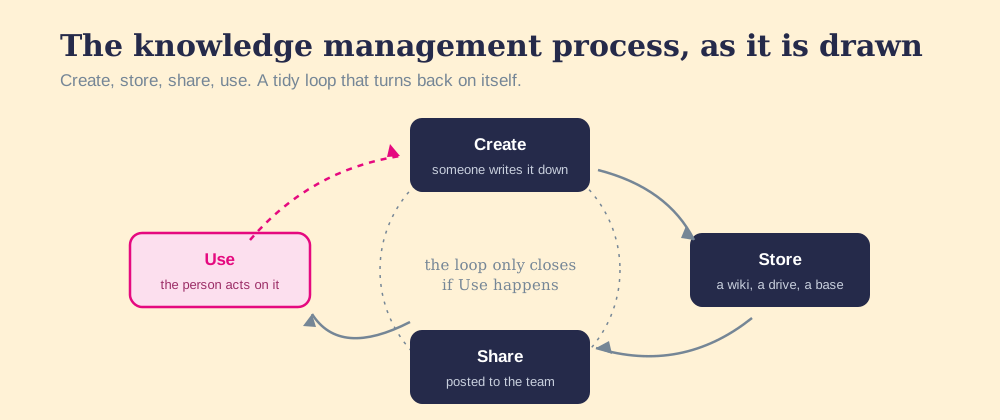
The knowledge management process is usually drawn as four tidy steps with no names on them.
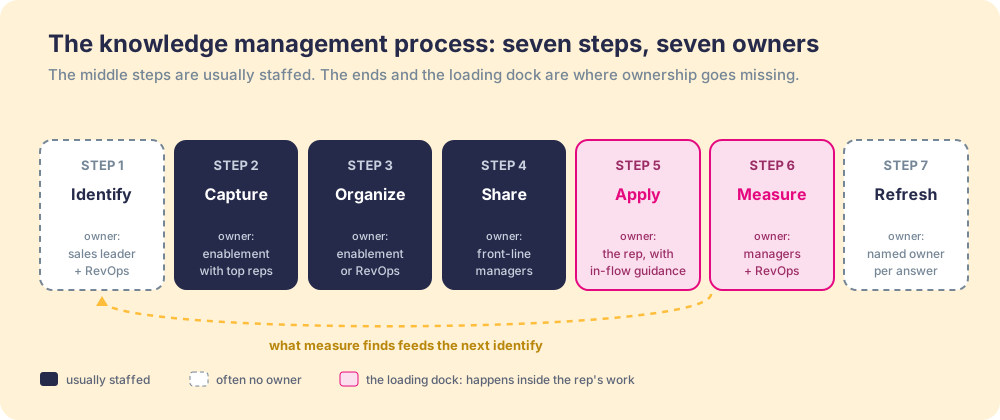
Drawn as seven steps with an owner each, it shows exactly where knowledge stops moving, and who fixes it.
The knowledge management process is the set of steps an organization runs to find, capture, organize, share, apply, measure, and refresh what it knows, so that knowledge reaches the work and stays current instead of piling up in storage.
There is a kind of factory that builds a product all day and never ships it. The line runs, parts get cut, assembled, painted, and set on a shelf at the end of the floor. Visit and you would swear it was thriving: machines humming, crates filling. Walk to the loading dock, though, and the trucks are empty. Everything got made. Nothing went out the door.
A knowledge management process can run that factory for years. Answers get written up and announced, the wiki grows, and the people doing the work keep making the same mistakes. The usual diagram does not show why, because it draws four steps with no names on them. Draw the knowledge management process as seven steps and put an owner on each, and the cause is plain: the steps before the factory floor and the step at the loading dock have no one assigned to them.
What is the knowledge management process?
The knowledge management process is the set of steps an organization runs to find, capture, organize, share, apply, measure, and refresh what it knows, so that knowledge reaches the work and stays current. It is the operating side of knowledge management: the repeating cycle that runs every time a team learns something worth keeping, whether that is a new competitor objection or a change to how deals get approved.
The four-step version (create, store, share, use) is fine as a sketch. Its weakness is that three of its four steps happen to a document, and only the last happens to a person. Documents are easy to count, so effort pools in the document steps. The McKinsey Global Institute found knowledge workers spend close to a fifth of the workweek searching and gathering information. That is a day a week of people walking to the shelf at the end of the factory floor because the process stopped before the dock.
What are the steps of the knowledge management process?
Seven steps, each with an owner. On a mid-market sales team the owners are usually a sales leader, enablement or RevOps, front-line managers, and the reps themselves.
- Identify. Name the knowledge that changes outcomes: the situations where reps most often get it wrong, and who already gets it right. Owner: the sales leader with RevOps, using loss reasons and stalled-deal data. Identify is the first step in knowledge management, and skipping it is how a wiki fills with pages the team never asked for.
- Capture. Get the know-how out of the people who hold it, in their words: a short interview with the top rep, a recorded call, notes from a deal review. Owner: enablement. Much of it is tribal knowledge that the holder does not know they have, so capture works best by watching and asking, not by sending a template.
- Organize and store. Put it where it can be found, tagged by the situation it answers rather than by department. Owner: enablement or RevOps. The tools are mature; our comparison of knowledge management tools covers the main options, and an internal knowledge base is the usual home.
- Share. Tell the people who need it that it exists and when it applies. Owner: front-line managers, in team meetings and deal reviews. Day-to-day knowledge sharing between reps feeds this step too.
- Apply. The rep uses the knowledge in a live deal at the moment it applies. Owner: the rep, with the system doing the reminding. The value chain calls this the last step, and it is the step with the weakest ownership, because it happens inside someone else’s day.
- Measure. Check whether the knowledge got used and whether it helped: did reps run the new objection response, and did those deals move. Owner: managers and RevOps.
- Refresh or retire. Update answers when pricing, product, or the market changes, and delete the ones that no longer apply. Owner: a named person per answer, with a review date. Without this step, the knowledge base becomes a museum.
What models describe the knowledge management process?
Two models show up in nearly every textbook, and each explains a different part of the seven steps.
The first is the knowledge management value chain from Kenneth and Jane Laudon’s Management Information Systems textbook. It runs acquire, store, disseminate, apply, with each step adding value to the one before. The last step in the value chain is apply, and the model makes a point the four-box diagrams lose: knowledge that is acquired, stored, and disseminated but never applied has produced cost without return.
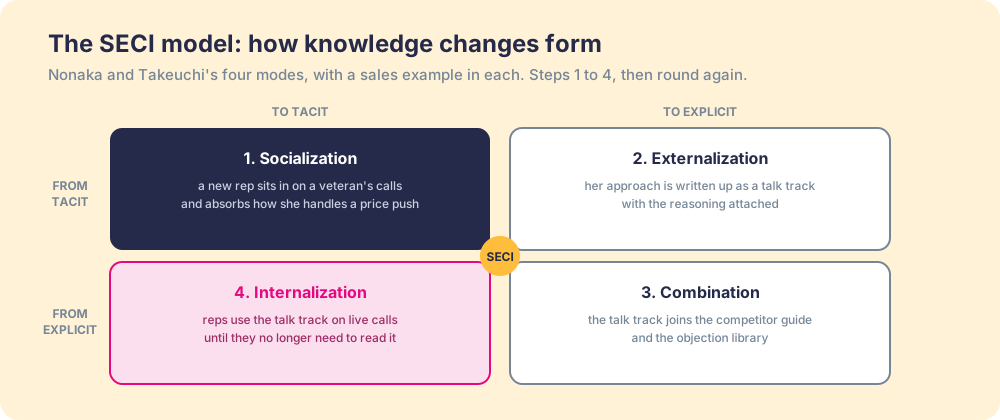
The second is the SECI model from Ikujiro Nonaka and Hirotaka Takeuchi’s 1995 book The Knowledge-Creating Company (SECI model). Where the value chain treats knowledge as a thing that moves, SECI describes how it changes form, between tacit know-how in people and explicit knowledge in documents, in four modes:
- Socialization. Tacit to tacit: a new rep sits in on a veteran’s calls and absorbs how she handles a pricing push.
- Externalization. Tacit to explicit: the veteran’s approach gets written up as a talk track with the reasoning attached.
- Combination. Explicit to explicit: the talk track joins the competitor guide, the pricing rules, and the objection library.
- Internalization. Explicit to tacit: reps use the talk track on live calls until they no longer need to read it.
| Seven-step process | Laudon value chain | SECI mode it relies on |
|---|---|---|
| Identify | (not a separate step) | none; a management decision |
| Capture | Acquire | Socialization, then externalization |
| Organize and store | Store | Combination |
| Share | Disseminate | Combination and socialization |
| Apply | Apply | Internalization |
| Measure | (not a separate step) | none; feedback into identify |
| Refresh or retire | (not a separate step) | Externalization again, when practice changes |
The table shows what the four-step models leave out. Identify, measure, and refresh have no box in the value chain, and they are the steps that keep the process aimed at the right knowledge and keep the knowledge true.
Where does the knowledge management process break?
At the loading dock, which is the apply step, and its partner, measure.
Apply is hard because it has to happen inside someone’s working moment, with a buyer on the line, and the process usually leaves it to memory. The rep read the new objection response in a team meeting. Three weeks later the objection comes up on a call, and the response is somewhere in a channel. Peter Gollwitzer’s research on implementation intentions explains why the timing decides it: a plan tied to a specific cue (“when the buyer raises X, I do Y”) gets carried out far more reliably than a general intention, with a medium-to-large effect (d = 0.65) across 94 studies (Gollwitzer and Sheeran, 2006). Knowledge that arrives at the cue gets applied. Knowledge that waits on a shelf depends on the rep remembering it mid-call.
Measure breaks for a plainer reason: it is the step where someone has to look at what reps did, deal by deal, and that takes manager time the calendar rarely holds. Yet it is the step that pays. In our State of Sales Enablement research, teams that inspect deals against a defined process at the highest frequency hit quota at 6.3x the rate of the lowest band (The State of Sales Enablement). Inspection is how a team learns which knowledge got applied, which got ignored, and which was wrong, and that feeds the next round of identify.
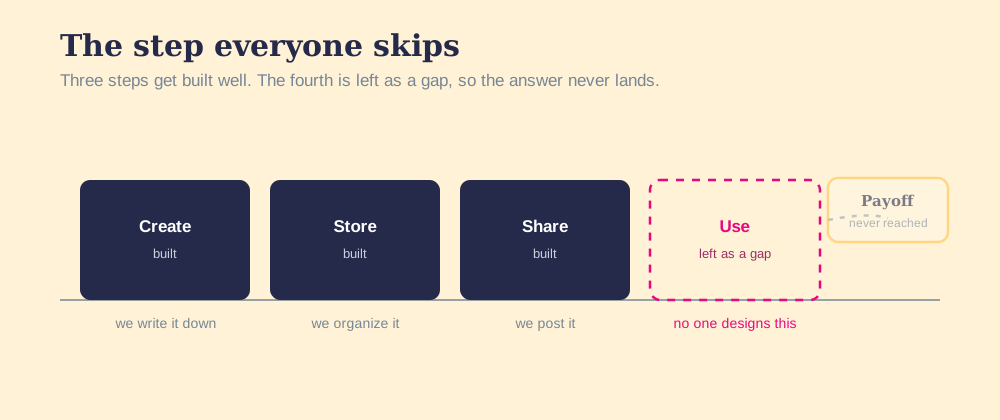
None of this is a willingness problem on the rep’s side. When the knowledge management process fails at apply, the answer sat in a place the rep had to leave the work to reach, at a time that did not match the moment they needed it. That is a design fault in the process, and it is the same conclusion we reach on process adoption: a documented process is not a running one until it reaches the rep in the work and someone checks that it was followed.
What does a knowledge management process look like in practice?
Take one piece of knowledge through all seven steps. A competitor launches a cheaper tier, and deals start stalling on price.
- Identify. RevOps pulls the last month of stalled and lost deals and sees the competitor named in a cluster of them. The sales leader names the gap: reps do not have a response to the new tier.
- Capture. Enablement interviews the two reps who have won against the new tier anyway and records one of their calls. The write-up keeps their reasoning along with their words.
- Organize and store. The response goes into the knowledge base under the competitor and under the “price objection” situation, with the call clip attached.
- Share. Managers walk through it in the next team meeting and role-play it once.
- Apply. When a rep moves a deal with that competitor tagged into the proposal stage, the response appears in the CRM at that step, so the rep sees it when the objection is likely, not three weeks earlier.
- Measure. Managers check in deal reviews whether reps ran the response, and RevOps tracks win rate against the competitor before and after.
- Refresh or retire. The write-up carries a review date. When the competitor changes its pricing again, the owner updates the response or pulls it.
Run that way, the process takes a few weeks, and each step has a person who can say whether it happened. For a broader look at the choices above the process, which knowledge to prioritize and how much to codify, see knowledge management strategy. For how a single person picks up another’s know-how in a handover, see knowledge transfer.
What we recommend
Put a name on all seven steps this month, then spend the next effort on the four that usually have none: identify, apply, measure, and refresh. Leave the repository alone unless it is broken. Buying a better one strengthens organize and store, the steps that already work, and a documentation push only fills the shelf faster.
The case rests on three numbers. Knowledge workers lose close to a fifth of the workweek searching, which is what a process that stops at the shelf costs. Gollwitzer and Sheeran’s meta-analysis of 94 studies found plans tied to a specific cue get carried out far more reliably, which is why knowledge delivered at the step where it applies gets used. And in our research, teams that inspect at the highest frequency hit quota at 6.3x the rate of the lowest band, which is the measure step paying for itself. The factory floor was never the bottleneck. The loading dock was.
Start with the store in the internal knowledge base, see what well-run ones look like in these knowledge base examples, and read how teams keep knowledge moving day to day in knowledge sharing.
Frequently asked questions
What is the knowledge management process?+
What are the steps of the knowledge management process?+
What is the first step in knowledge management?+
What is the last step in the knowledge management value chain?+
What is the SECI model of knowledge management?+
What is the difference between a knowledge management process and a knowledge management strategy?+
Your process, running itself.