Guru Pricing in 2026: The Price Tag Came Off, and a Package Went On
Guru pricing in 2026: the per-seat price went from $15 to $25 in 2025, then left the pricing page for custom packages.
What buyers pay, what a 50-rep team spends, and when a sales team should buy something else.
Guru pricing in 2026 is custom: getguru.com no longer publishes a per-seat price and sells a package of platform, solution engineers, and governance scoped to your size and AI maturity, with Vendr's data on 168 purchases putting the median contract at $39,521 a year.
There used to be a price tag on Guru. In August 2025 it read $15 a seat. A month later it read $25. Today there is no tag at all, only a button marked “Talk to sales” and a promise that the package will be built around you.
Guru pricing in 2026 is custom: getguru.com no longer publishes a per-seat price and sells a package of platform, solution engineers, and governance scoped to your size and AI maturity, with Vendr’s data on 168 purchases putting the median contract at $39,521 a year. The short answer to “how much does Guru cost,” by who it fits:
- Guru. Companies that need one governed, cited answer layer across support, HR, IT, and sales. Quote-only; median $39,521 a year.
- Supered. Sales teams in HubSpot or Salesforce that need the answer to reach the rep in the moment and need to see whether the process was followed. $13.50 or $40 per user per month, published.
- Notion. Teams that mainly need a place to write things down. $10 or $20 per member per month.
How does Guru’s price compare with the alternatives?
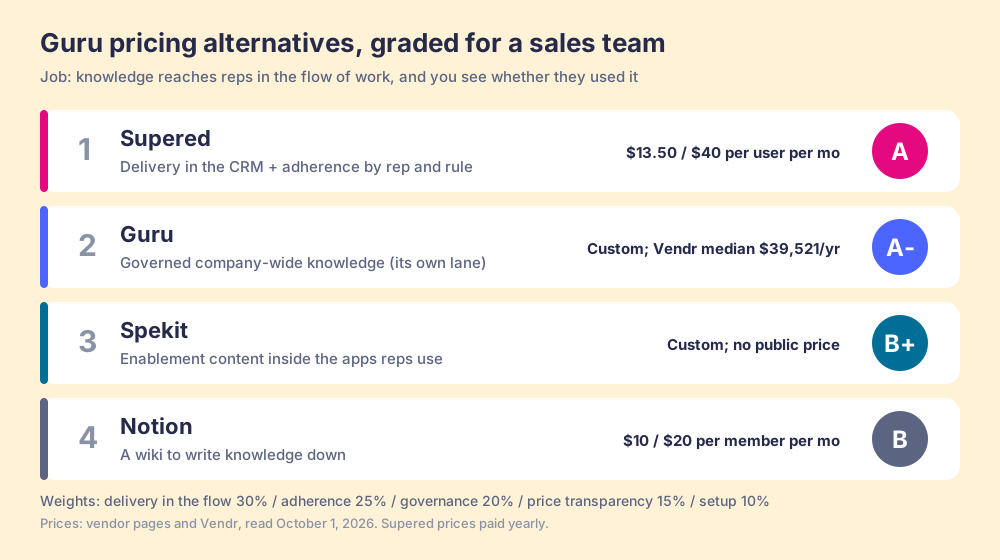
Prices were read from each vendor’s pricing page or Vendr on October 1, 2026. The grades answer one job, the one a sales leader brings to this page: get the right knowledge to reps while they work, and know whether they used it. Weights: delivery in the flow of work 30%, adherence measurement 25%, verification and governance 20%, price transparency 15%, setup effort 10%. Flip the weights toward governance across a whole company and Guru moves to the top; we say so below.
| Rank | Tool | Grade | Best fit | CRM integration | Setup effort | Pricing (plan with the feature) | Reason to switch |
|---|---|---|---|---|---|---|---|
| 1 | Supered | A | Sales teams running a process in HubSpot, Salesforce, or Pipedrive | Native | Live in under a week (Supered) | Digital Adoption $13.50/user/mo; Process Compliance $40/user/mo, 5-user minimum; paid yearly | Published price, and adherence measured by rep and rule |
| 2 | Guru | A- in its lane | Company-wide governed AI knowledge | Integrations (100+, Salesforce among them) and MCP | A scoped package with solution engineers | Custom; Vendr median $39,521/yr | Stay if governance across every department is the job |
| 3 | Spekit | B+ | Enablement content inside the apps reps use | Browser extension and integrations | Content build-out | Custom; no public price | Bite-size training in context |
| 4 | Notion | B | Writing and organizing team knowledge | API only | Self-serve | Plus $10, Business $20 per member/mo billed yearly | Lowest published price for a wiki |
Why trust this breakdown?
I started RevPartners, the HubSpot partner that reached Elite tier in 13 months, and then co-founded Supered inside it. Supered competes with Guru when the readers are a sales team inside the CRM, so read this page knowing we sell one of the options. The Guru figures here come from Guru’s own pages, Vendr’s transaction data, or a dated third-party snapshot, linked so you can check them against your quote. Guru holds 4.7 out of 5 from 2,323 reviews on G2; Supered holds 4.9 out of 5 from 81 reviews on G2 (both read October 1, 2026).
How much does Guru cost in 2026?
Guru knowledge base pricing used to fit on one line. In 2026 it takes a table, because the only firm numbers now come from contracts and old snapshots.
| Question | The number | Source, date |
|---|---|---|
| Published price | None; “Talk to sales” | getguru.com/pricing, Oct 1, 2026 |
| Median annual contract | $39,521 | Vendr, 168 purchases, Feb 2026 |
| Contract range | $8,219 to $120,194 a year | Vendr, Feb 2026 |
| Average negotiated savings | 18% | Vendr, Feb 2026 |
| Renewal increases | 5 to 10% a year unless capped | Vendr, Feb 2026 |
| Last published seat price | $25/user/mo annual, $30 monthly, 10-seat minimum | Featurebase, Dec 2025 |
| Seat price before that | $15/user/mo annual, $18 monthly | PriceTimeline, Aug 2025 |
The pricing page now describes Guru as “a platform and expertise solution” and says the investment “is tailored to your organization’s scale, knowledge complexity, and AI maturity” (Guru pricing, October 1, 2026). The package has three layers: the platform (Knowledge Agents, AI search, 100+ integrations and MCP delivery, verification workflows), an “AI & KM Strategy Team” of solution engineers who design the knowledge architecture and tune the agents, and enterprise governance (SSO, SCIM, data loss prevention masking, audit logs, SOC 2 Type II, HIPAA, and GxP).
A self-serve door may still exist. getguru.com/signup resolves to a new-user signup page, and two third-party guides updated in late September 2026 still quote the $25 seat. But Guru does not advertise it, so treat $25 as history and ask for a written quote.
What changed in Guru pricing, and why?
Two moves in about a year, and they point the same way.
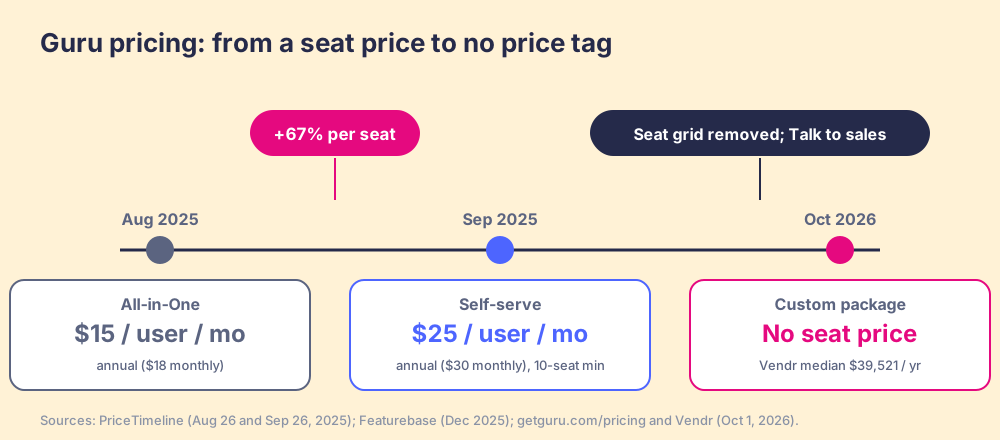
- The seat repricing. PriceTimeline recorded the All-in-One plan at $15 per user per month billed annually ($18 monthly) on August 26, 2025, and a renamed Self-serve plan at $25 ($30 monthly) on September 26, 2025. The same seat cost 67% more.
- The disappearing tag. By October 2026 the per-seat grid was gone, replaced by a package and a call. G2’s pricing page for Guru now shows a single custom edition (G2).
The reason sits in the release notes. In 2026 Guru shipped Slack MCP support, third-party MCP connections, and Knowledge Agents that verify content automatically (Guru release notes), and in May it joined Boomi Connect as a launch partner, describing itself as “the AI Source of Truth for enterprise knowledge” (Business Wire). When any AI agent can fetch a verified answer through MCP, an answer is cheap. What stays expensive is the architecture behind it: who owns which card, which source wins a conflict, which agent may see what.
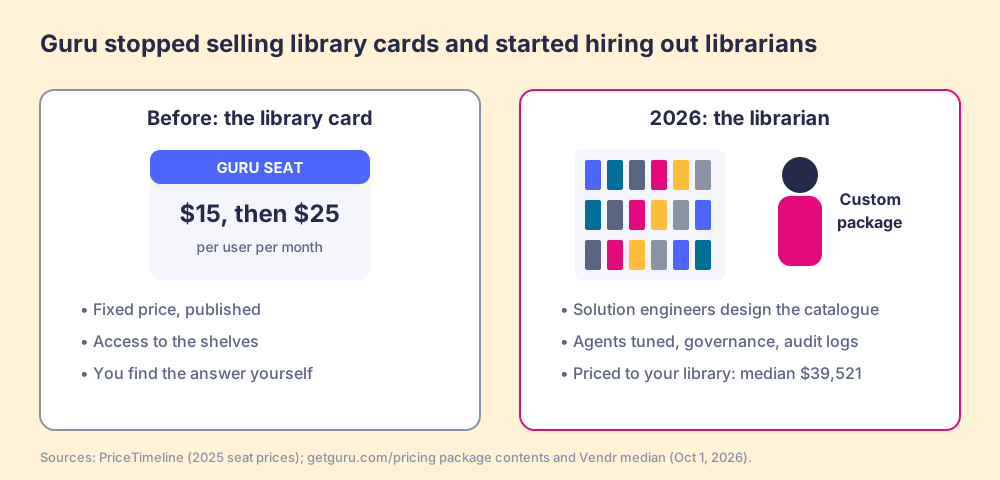
So Guru stopped selling library cards and started hiring out librarians. A library card is a fixed price for access to the shelves. A librarian is a person who designs the catalogue, weeds the stale books, and decides who may enter the rare-books room, and a librarian is priced by the size of your library. Guru’s package suits an enterprise drowning in conflicting answers across forty systems. For a 30-rep sales team it means paying for a catalogue designer when the shelves were never the problem.
What does Guru cost for a 50-rep sales team?
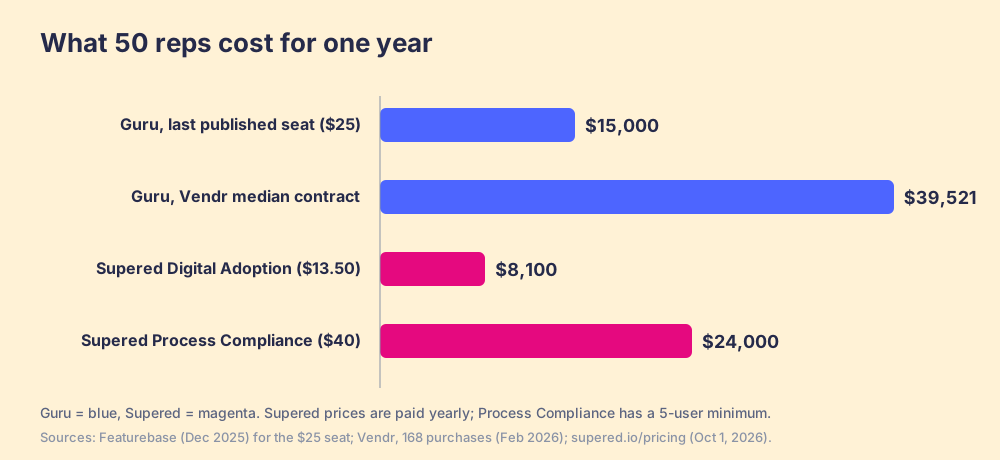
Run the numbers three ways, because a custom quote has no single answer.
- At the last published seat price. 50 reps at $25 per user per month billed annually is $15,000 a year; at the $30 monthly rate it is $18,000.
- At Vendr’s median. $39,521 a year, the middle of 168 real contracts. A first quote near that number is normal for a package that now includes solution engineers.
- After negotiation. Vendr’s average buyer saves 18%, which takes the median to about $32,400. Vendr also reports multi-year terms “commonly achieve 10-20% lower annual pricing.”
Then budget the lines a quote tends to leave out. Vendr lists professional services for onboarding and training quoted separately, premium connectors and API access that may cost extra, overage fees when you add users mid-contract, and renewal increases of 5 to 10% a year. A 7% escalator on a $39,521 contract reaches about $45,250 by year three unless you cap it in writing.
Why do teams leave Guru?
G2 reviewers who like Guru name the same few frictions, and each one turns into a buying criterion.
- Stale cards. “Some of the cards in Guru are still outdated and haven’t been updated yet” (John M., December 2025). Verification only works if someone owns it.
- Verification noise. “The verification system can feel demanding…reminders can become a bit noisy for teams” (Javier N., November 2025). The feature that keeps answers fresh also creates a chore.
- Search misses. “Sometimes the options and search results don’t always bring up the most relevant cards” (khushboo s., February 2026).
- Cost for small teams. “For small teams or startups on tight budgets, the per-user pricing can be a real barrier” (Fernanda M., July 2025).
Read those four together and a pattern shows. Three of them are complaints about the rep having to go and get the answer: search for it, trust it, find it current. The fourth is the bill for that pull. The criteria a sales team should carry into any quote follow from it: does the answer arrive without a search, and can you see whether the rep acted on it?
What does a Guru package not buy?
A verified answer, delivered fast, is a lighthouse. It shines for any ship that looks, the rocks are marked, and the light is accurate. A lighthouse cannot steer. The ship that ignores it, or never looks up in the fog, hits the same rocks as a ship with no lighthouse at all. Harbors that cannot afford that send a pilot instead, a person who climbs aboard at the narrow channel, takes the wheel at the turn, and logs that the ship came through.
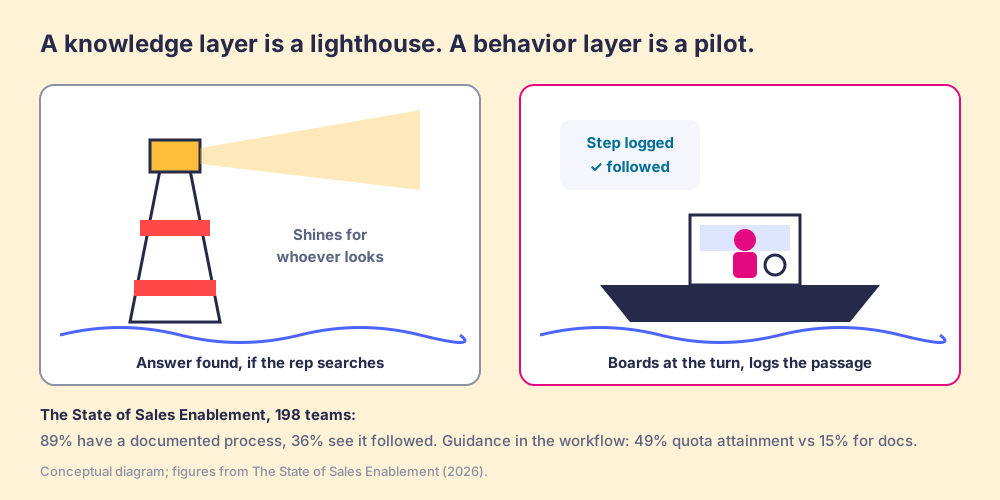
The numbers say which one sales teams are missing. Across 198 sales teams in The State of Sales Enablement, 89% had a documented sales process and 36% saw reps follow it. The knowledge existed. Teams whose guidance sat inside the workflow hit quota at 49%, against 15% for teams whose process lived in docs or wikis. Neither gap is a findability problem.
The mechanism has a name. Peter Gollwitzer’s implementation intentions, plans of the form “when situation x arises, I will do y,” produced a medium-to-large effect on follow-through, d = 0.65, across 94 studies (Gollwitzer and Sheeran). The cue tied to the moment is what moves behavior. A search box, however good, waits for the rep to remember to ask.
Guru prices the lighthouse, and prices it well. Where the lighthouse fails, the cause is the system: the answer sat one search away when the rep had a buyer waiting. If your reps already know the answers and still skip the steps, the package buys more light for a ship that needs a pilot.
Is Supered a better fit than Guru for a sales team?
Where the readers are reps and the work happens in the CRM, yes. Supered is the Behavior Layer for HubSpot, Salesforce, and Pipedrive, and it is the #1 sales enablement app on the HubSpot marketplace, with a 5.0 rating from 122 reviews and 6,000 installs there. The rules live in Supered; reps follow them in the CRM or in Claude and other LLMs; managers see who followed them. Two plans, both on a published price list:
- Digital Adoption. Cards, step-by-step guides, Action Plans, embedded triggers that surface the right card inside HubSpot or Salesforce when a record reaches a stage, the Supered AI Assistant, a Slack bot, and MCP access. $13.50 per user per month paid yearly ($15 monthly). For a sales team that wants Guru’s answers without the search, this is the like-for-like plan, and 50 reps cost $8,100 a year.
- Process Compliance. Everything in Digital Adoption plus Process Rulesets and Process Rules that flag a record when it breaks the standard, Process Boards that report compliance by rep and by rule, and Streaks. $40 per user per month paid yearly ($45 monthly), 5-user minimum. 50 reps cost $24,000 a year, below Guru’s Vendr median.
The same rules reach the rep wherever the work happens. A rep can open a deal in HubSpot and see what the stage requires, or ask Claude to clear every flagged record before morning; sales expectations shows that loop end to end. There is a free trial with no card, and customers go live in under a week.
Choose something else if:
- Company-wide knowledge. If support, HR, IT, and product all need one governed answer layer with permission inheritance and audit trails, Guru’s package is built for that and Supered is not.
- Field or mobile teams. Supered has no mobile product and fits teams of 10+ who work at a computer.
- A wiki first. If your team has never written its process down, start in Notion at $10 a member and come back when there is something to enforce.
Which other Guru alternatives should you price?
- Guru itself. The strongest verification workflow in the category, cited answers, and MCP delivery to other AI tools. Custom pricing, median $39,521 a year (Vendr). Best when knowledge spans the whole company.
- Spekit. Bite-size enablement content delivered inside the apps reps use, with quote-only pricing that Spekit says is “completely customizable based on your organization size” (Spekit, October 1, 2026). A fit when training content is the gap.
- Notion. Plus at $10 and Business at $20 per member per month billed yearly, with Notion Agent on Business (Notion, October 1, 2026). The cheapest serious place to write knowledge down, with no CRM delivery.
The full field, scored across five jobs, is in Guru alternatives, and the case for treating a sales knowledge base as a delivery problem is in sales knowledge base.
What we recommend
- The quote. Anchor at Vendr’s $39,521 median, push for the 18% average discount, and ask what the solution-engineer layer costs on its own.
- The contract. Cap renewal increases (Vendr sees 5 to 10% a year), get the seat floor and the AI features in writing, and price user additions before you sign.
- The job. Name which problem you are paying to fix. If answers are scattered across forty systems and your teams cannot tell which one is current, Guru’s package fixes that, and it earns the money. If your reps can find the answer and the CRM still shows skipped steps, fund the pilot over the lighthouse: Digital Adoption at $13.50 a seat for answers in the flow of work, Process Compliance at $40 to see who followed the process.
Guru took the price tag off because the answer stopped being the scarce part. For a sales team, the scarce part is the step taken while the buyer is waiting. Book a demo and bring one process your reps can recite and still skip.
Frequently asked questions
How much does Guru cost in 2026?+
What did Guru's per-seat plan cost before it disappeared?+
Does Guru have a minimum number of seats?+
Is Guru worth the price for a sales team?+
What are cheaper alternatives to Guru?+
Is Guru still an independent company?+
Your process, running itself.