Knowledge Sharing: How Teams Pass On What They Know
Knowledge sharing is the daily habit of a team passing on what it knows.
What it looks like, why people hold back, and how the best-documented program in the field got technicians to share without paying them a cent.
Knowledge sharing is the everyday habit of people on a team passing what they know to each other, through conversation, written answers, and shared work, so that one person's lesson becomes the whole team's practice.
Julian Orr, an anthropologist at Xerox’s Palo Alto Research Center, spent months riding along with copier repair technicians, expecting to learn how they used the manuals. He found the manuals were the least of it. The technicians fixed the faults the manuals could not explain by trading stories about the machines they had wrestled with that week. The knowledge was “relayed through informal storytelling sessions over lunch or at the parts drop” (MIT Technology Review).
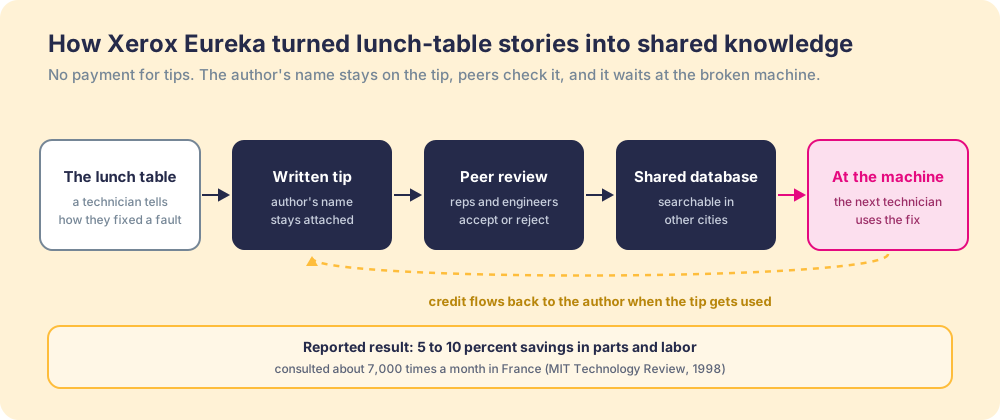
That lunch table is knowledge sharing in its natural state. No manager scheduled it or measured it, and it was carrying the service organization. Xerox later built a system called Eureka to carry those stories past the lunch table to technicians in other cities, and the way they got people to contribute is the most useful lesson in the subject: they did not pay for a single tip. Technicians wrote tips for their name, their peers checked the tips, and the tips showed up where the next technician was stuck. Credit for the sharer, and a landing place for the answer. Get those two right and sharing runs on its own. Get them wrong and no wiki or culture campaign will save it.
What is knowledge sharing?
Knowledge sharing is the everyday habit of people on a team passing what they know to each other, so that one person’s lesson becomes the team’s practice instead of staying in one head. It runs in every direction at once: peer to peer, senior to junior, and the other way when the new hire knows a tool better than the veteran.
It helps to split what gets shared into two kinds, because they travel differently:
- Explicit knowledge. Things that fit in words: a pricing rule, an email template, the steps to set up a renewal quote. This kind travels well in writing, and a good internal knowledge base is built for it.
- Tacit knowledge. Judgment that lives in hands and instinct: when to stop talking on a discovery call, which champion is bluffing. This kind travels by story, example, and watching someone work, which is why the copier technicians traded it over lunch and not in the manual. Much of the tribal knowledge a team depends on is this kind.
Knowledge sharing is a team habit, and it is different from knowledge transfer, which is the targeted move of specific know-how from one person to another, as in a handover or a new hire learning the role. Sharing keeps knowledge circulating among many people. Transfer makes sure one person can do one job. A team needs both, and they fail for different reasons.
What are examples of knowledge sharing at work?
The best examples look ordinary, which is part of why they work. Here are six that show up on healthy sales and service teams, roughly from most informal to most built:
- The win note in the team channel. A rep posts the line that turned a stalled deal: the exact reframe, the question that got the CFO talking. Cheap to share, and read by the people who face the same objection this week.
- The weekly deal review. Reps walk through one stuck opportunity and the room offers what worked for them. Tacit judgment moves here faster than anywhere in writing.
- The call library. Recordings of good discovery and negotiation calls, tagged by situation. A new rep hears what “good” sounds like instead of reading a description of it.
- The lunch-and-learn. One person teaches a short session on what they figured out. Useful for spreading a new approach, though it fades fast if nothing reinforces it afterward.
- Peer review of work. A teammate reads the proposal or the email sequence before it goes out. The knowledge moves inside a real piece of work, which is where it sticks.
- The tip database. Xerox’s Eureka is the famous one: technicians wrote up fixes, peers vetted them, and the tips were there when the next technician hit the same fault.
Why does knowledge sharing matter?
Because the alternative is paying for the same lesson twice. When a team does not share, people interrupt each other, rebuild work that exists somewhere already, or guess. Panopto’s workplace knowledge study put a number on the waste: employees lose about 5.3 hours a week waiting on knowledge a colleague holds or recreating expertise that already existed (Panopto, Valuing Workplace Knowledge). That is most of a working day, gone every week, per person.
The Xerox numbers show the other side of the ledger. Once Eureka was running, MIT Technology Review reported a 5 to 10 percent savings in parts and labor, and the French technicians consulted it about 7,000 times a month, close to six times per technician. A later account in Stewart Brand’s book on maintenance reports return on the program “in the range of tenfold” (Maintenance of Everything). One field report from the same era describes a technician in Brazil who, following a colleague’s tip, replaced a 90-cent connector instead of a $40,000 machine (KMWorld, 1999).
Sales teams pay the same tax in a different currency. The rep who does not know a teammate already beat this competitor on this objection does not lose 90 cents. They lose the deal.
What stops people from sharing what they know?
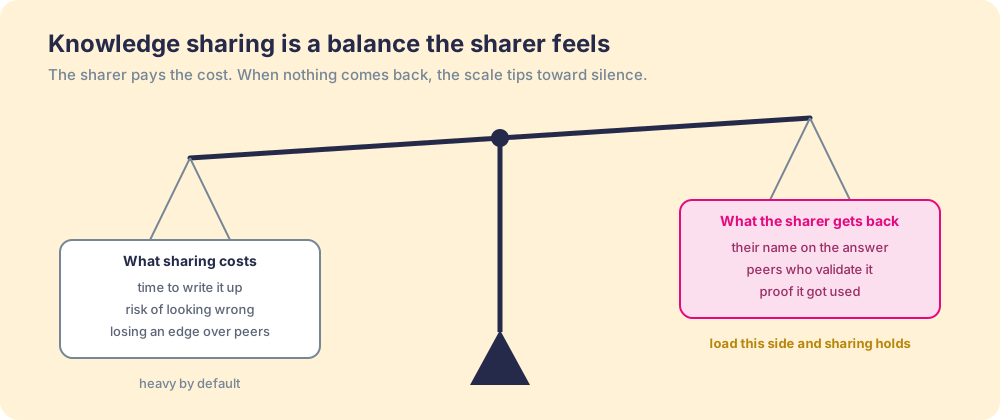
Sharing has a cost and a payoff, and they land on different people. The sharer pays: time to write it up, the risk of being wrong in public, sometimes the loss of being the only one who knows. The receiver collects. Left alone, that arrangement runs at a loss for the sharer, which is why exhortations to “share more” fade by the following week.
Think of it as a balance scale. On one pan sits everything sharing costs the person who knows. On the other sits everything they get back. When the second pan is empty, the scale tips toward silence no matter how good the culture deck looks.
The specific barriers are well studied:
- Time cost with no budget. Writing a good answer takes time that sits on top of a full quota, and no sales plan has a line for it. If sharing has to happen after the work, it mostly does not happen.
- Knowledge hiding. Catherine Connelly and colleagues, studying it in the Journal of Organizational Behavior in 2012, defined knowledge hiding as “the intentional attempt to withhold or conceal knowledge that has been requested by another person” and found three forms: playing dumb, evasive hiding (a partial answer, or a promise to follow up that never comes), and rationalized hiding (“I’m not allowed to say”). Distrust drove it: people hide from colleagues they see as competitors (Connelly et al., 2012). Stack-ranked sales floors build exactly that distrust.
- No credit. If the person who cracked the objection gets nothing for writing it down, while the person who used it gets the commission, the incentive points one way.
- Fear of being wrong in writing. A spoken tip can be revised over lunch. A written one sits there with your name on it. Peer review lowers this risk; a free-for-all wiki raises it.
- Nowhere for the answer to land. A post dropped in a busy channel scrolls away within the hour. The people who needed it were on calls.
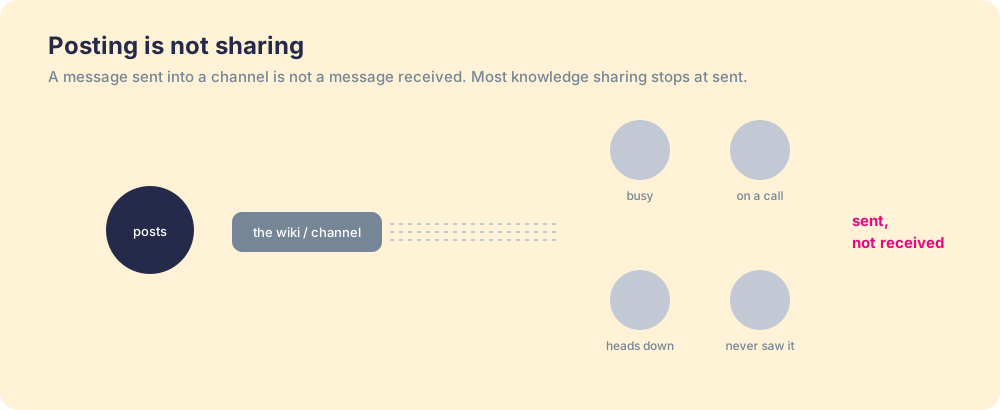
None of these is a character flaw. When people do not share, the arrangement around them made silence the sensible choice. Change the arrangement and the behavior follows.
How do you encourage knowledge sharing on a team?
Load the sharer’s side of the scale and give the answer somewhere to land. Eureka’s design is still the best template, and each of its moves has a sales-team version:
- Credit in place of cash. Xerox did not pay for tips. In Brand’s account, “the reps chose to have their names attached to tips,” building standing the way scientists do through the quality of their work. Paying per post rewards volume; a name on a used answer rewards quality. On a sales team, credit the author when their play wins a deal, in the forecast call where people hear it.
- Peer validation. Eureka tips went through local experts, then a central review where reps and engineers accepted some, rejected others, and removed duplicates. Validation makes the shared answer trustworthy, which is what makes people use it, which is the credit the author wanted.
- Capture inside the work. Lower the cost to near zero by catching the answer while it is fresh: a two-line note on the call recap, a tag on the call recording, a field on the closed-won record. Asking reps to write an article later costs them time they do not have.
- Delivery where the next person works. The tip was useful because a technician could reach it standing at the broken machine. A sales answer should show up inside the CRM or the email draft when that objection or stage comes up, not in a channel from three weeks ago.
- Inspection of use. Track whether shared answers change what the team does: is the new discovery question showing up in calls, is the renewal play being run. Counting posts measures the sharer’s effort. Counting use measures whether sharing worked.
One caution on culture campaigns. Leaders often respond to weak sharing with a values poster and a monthly “knowledge champion” award. The award is fine. On its own it changes nothing about the time cost, the distrust, or the missing landing place, which is why the poster is forgotten by the next kickoff.
What tools help with knowledge sharing?
Different kinds of knowledge need different channels. A useful way to sort them is by two questions: is the knowledge explicit or tacit, and does the person go looking for it (pull) or does it come to them (push)?
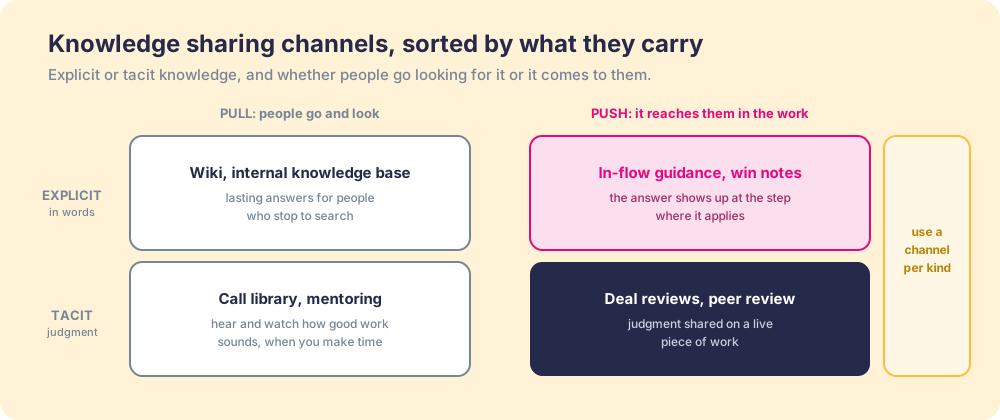
| Channel | Best for | Where it breaks |
|---|---|---|
| Wiki or internal knowledge base | Explicit answers that need to last: policies, pricing rules, setup steps | Answers only reach people who stop work to search |
| Team chat channels | Fast questions, win notes, today’s news | Answers scroll away within hours and are hard to find later |
| Call recordings and libraries | Tacit skill: how good discovery or negotiation sounds | Someone has to set aside time to listen |
| Deal reviews and peer review | Judgment on a live situation, shared in the room | Limited to who attends and what they remember |
| In-flow guidance in the CRM | The shared answer appearing at the step where it applies | Needs someone to keep the guidance current |
For the stores themselves, our breakdown of knowledge management tools compares the main options, and the sales knowledge base covers what a sales team should keep in one.
Supered sits in the bottom row of that table. It is one way to give shared knowledge a landing place, and it does nothing for a team where the sharer still pays every cost and gets no credit, so fix the scale first.
What we recommend
There are three ways teams usually try to fix weak knowledge sharing. They buy a better wiki, which improves the store but not the reasons people stay silent. They run a culture campaign, which asks the sharer to absorb the cost for goodwill. Or they redesign the arrangement the way Xerox did: credit the sharer by name, have peers validate what gets shared, capture answers inside the work so sharing costs minutes, deliver them where the next person is working, and inspect whether they got used.
We recommend the redesign. Panopto’s 5.3 lost hours a week are the price of the current arrangement, and Eureka’s 5 to 10 percent savings came from a program that paid contributors nothing and gave them their names on the work. When a team is not sharing, the scale is tipped against the sharer. Rebalance it and people share because it makes sense to.
Sharing keeps knowledge moving around the team. When one specific person has to pick up what another knows, a departing rep’s accounts or a new hire’s first territory, that is a different job with different methods, covered in knowledge transfer. For the full set of steps a company runs to manage what it knows, from finding it to retiring it, see the knowledge management process. What happens when shared plays exist and still are not run is the subject of the sales execution gap.
Frequently asked questions
What is knowledge sharing?+
What are examples of knowledge sharing at work?+
What are the barriers to knowledge sharing?+
How do you encourage knowledge sharing on a team?+
What is the difference between knowledge sharing and knowledge transfer?+
What tools help with knowledge sharing?+
Your process, running itself.