Cold Outreach: Three Doors, Three Doorkeepers, and the List That Decides Which to Knock On
Cold outreach works when the list is right and the channel fits the buyer.
The published limits on email, phone and LinkedIn, the 2025 Bridge Group numbers, a four-step cold outreach strategy, and how to measure it past the reply.
Cold outreach is contacting a person who has never heard from you, by email, phone, or LinkedIn, to start a sales conversation they did not ask for, and it works when the list is right and the channel fits what you know about the buyer.
The door-to-door salesman of the 1950s learned the street before he learned the pitch. He knew which houses had a car in the drive, which had a dog, and which had a sign on the gate that said no hawkers. The pitch mattered once the door opened. Most doors never did, and the ones that stayed shut were usually the wrong houses.
Cold outreach is contacting a person who has never heard from you, by email, phone, or LinkedIn, to start a sales conversation they did not ask for, and it works when the list is right and the channel fits what you know about the buyer. The pages that rank for the term today are mostly lists of tips about subject lines and templates. Those tips are fine. They describe the pitch. The three things that decide the result sit earlier: who is on the list, which door you knock on, and whether you measure past the reply.
The short version, for a sales leader setting up cold outreach this month:
- The list first. The right people at accounts that fit, with verified contact data, decide more than any message can.
- The channel second. Each channel has a doorkeeper with published limits; mix all three in one sequence and stay inside the rules.
- The measure last. Count replies, then follow each list to worked and closed, so you build more of the lists that close.
What is cold outreach, and why does relevance decide it?
The seller picks the buyer and makes first contact. Those few words put the burden of relevance on the seller from the first word. Buyers have made their side plain. In a Gartner survey of 632 B2B buyers published in June 2025, 61% said they prefer an overall rep-free buying experience and 73% said they actively avoid suppliers who send irrelevant outreach (Gartner). Robert Blaisdell, a VP Analyst in Gartner’s sales practice, put it in one line: “Bad prospecting actively damages relationships with potential customers.”
Read those two numbers together. A buyer who would rather not talk to a rep at all still talks to some, and the ones who get through are the ones whose message fit. Irrelevance does worse than fail. It puts the company on a list the buyer avoids.
So relevance is the first best practice, and the list decides most of it before the rep writes a word. A message about a team’s new Salesforce rollout is relevant to the RevOps lead who is running it and noise to the rest of the building. The work of cold outreach is finding that person, at that company, while the rollout is under way. Inbound starts from the buyer’s hand going up; for the full contrast, see what outbound sales is.
Which cold outreach channel should you use?
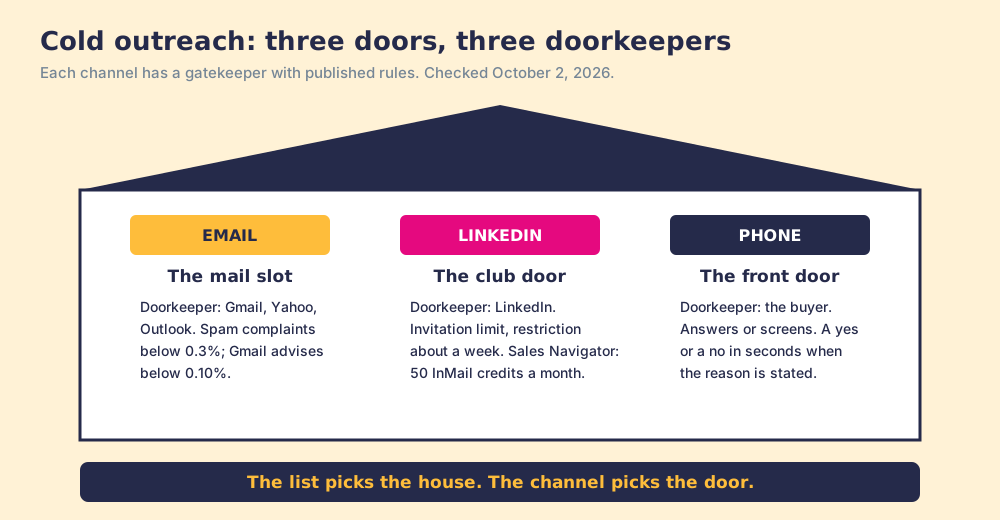
The buyer’s attention is a house with three doors, and a doorkeeper at each one. Email is the mail slot: a cold outreach email is cheap to send, and the postman (Gmail, Yahoo, Outlook) counts how many residents complain about your letters. LinkedIn is the club the buyer belongs to: you arrive under your own name and photo, and the club secretary limits how many introductions you may request. The phone is the front door: the buyer answers or does not, and if they answer you get a yes or a no in seconds. A seller who knocks on one door a hundred times has used one door, whatever the activity log says.
The doorkeepers publish their rules, which makes this the most checkable part of cold outreach. Checked October 2, 2026:
| Channel | Doorkeeper’s published rule | Volume a rep can spend | Best use | What a reply tells you |
|---|---|---|---|---|
| Gmail and Yahoo: spam-complaint rate below 0.3%; Gmail advises below 0.10% | High; the Bridge Group median SDR sends 41 emails a day | Reaching many people with one specific reason | Interest, slowly; silence tells you little | |
| Phone | The buyer screens the call; since March 2024 the FTC bars misrepresentation in B2B calls | The median SDR makes 44 dials a day | The fastest yes or no from a person who fits | Fit and timing, in seconds |
| Invitation limits with a restriction that “typically lasts one week”; Sales Navigator 50 InMail credits a month | Rationed; 50 InMails is about 2.5 a working day | Senior buyers and warm context such as shared connections | That your name and profile earned a look |
Sources: Google email sender guidelines; Yahoo sender best practices; LinkedIn Help, invitation limits; LinkedIn Help, InMail credits; FTC, March 7, 2024; Bridge Group, 2025.
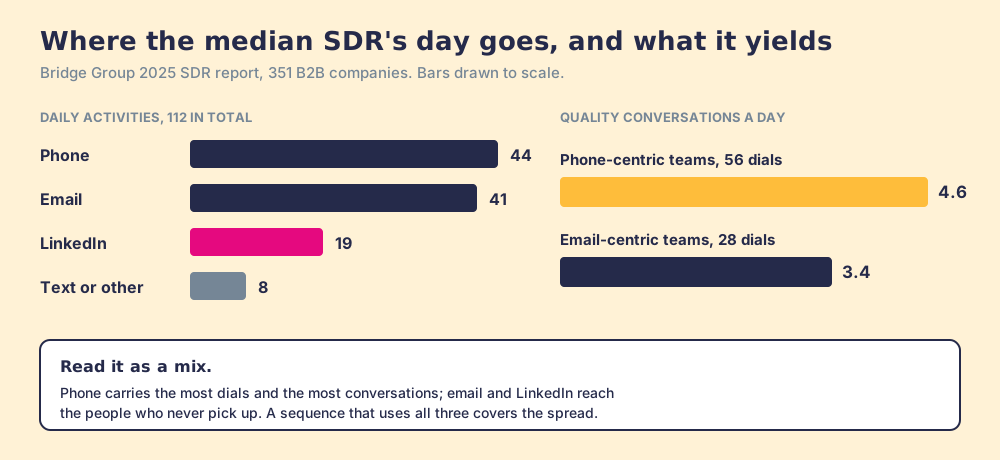
The phone deserves more credit than the tip lists give it. In the Bridge Group’s 2025 report across 351 B2B companies, the median SDR logged 112 activities a day: 44 phone, 41 email, 19 LinkedIn, and 8 text or other. Phone-centric teams made 56 dials a day and held 4.6 quality conversations; email-centric teams made 28 dials and held 3.4. The opener matters too: Gong’s data shows “a 2.1x higher success rate for salespeople who state their reason for calling” (Gong). Our cold calling tips and cold call script cover the first ten seconds.
LinkedIn cold outreach is the rationed door, and the ration is the point. A month of Sales Navigator InMail, 50 credits, covers about a day and a quarter of the median SDR’s email volume (our arithmetic: 41 emails a day against 50 InMails a month). Free members can add a personal note to only five connection requests a month, and a member who hits the invitation limit loses the ability to invite for about a week, which LinkedIn’s support team “cannot remove or shorten.” Spend LinkedIn on the senior buyer and the account where a shared connection or a recent post gives you a reason to be there. Our LinkedIn prospecting guide covers the workflow.
How do you build a cold outreach strategy?
A cold outreach strategy is four decisions in order, and each one constrains the next. Get the first wrong and the other three spend effort on the wrong house.
- Targeting. Write the ideal customer profile from your closed-won deals, then add the trigger that makes an account worth contacting this month: a new leader, a funding round, a hiring spree. Our guide to what an ICP is turns the profile into search filters.
- The list. Two to four people in the buying group at each account, with a verified email and a direct phone, sized to what one rep can touch before the data ages. The lead list guide walks through the build.
- The sequence. Four to seven touches across email, phone, and LinkedIn, spaced three to four days apart, each adding a new reason, with a stopping rule. Instantly’s 2026 benchmark found 58% of email replies come from the first message, so the first touch carries the most weight (Instantly, January 12, 2026). Our sales cadence guide covers the spacing.
- The measure. Replies and conversations by channel, then each list followed to worked and closed.
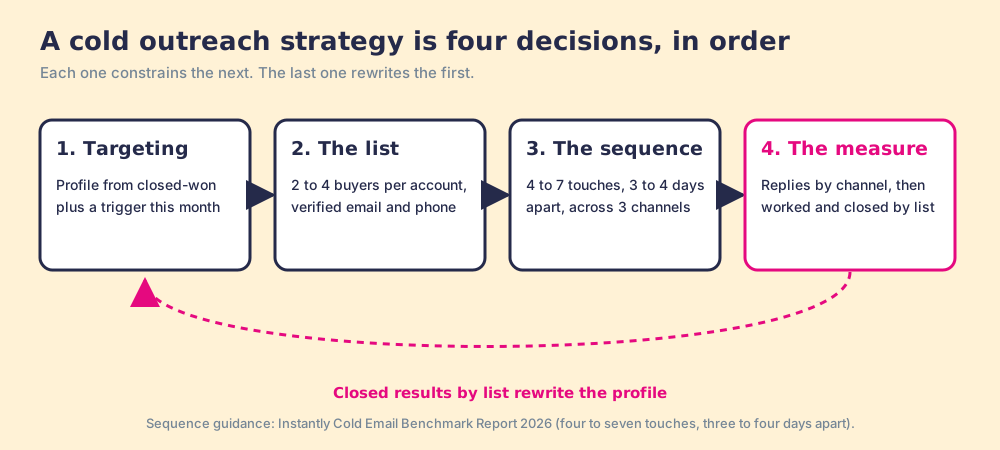
The loop at the end does the teaching. A team that sees which lists closed rewrites its profile from evidence, and the next list is better than the last. A team that sees only meetings booked keeps building the lists that book meetings, which are not always the lists that buy. For the full system from profile to closed, see outbound lead generation.
Why is list quality the first cold outreach best practice?
Because errors at the list multiply through everything after it. A wrong person gets four to seven touches they did not want. A bad address bounces, and bounces count against the sending domain: Instantly’s benchmark puts the line at under 2% (Instantly). And a large share of business email cannot be checked at all. OrbiSearch’s 2026 study of 1.6 million business domains found 31.4% were catch-all, configured to accept mail for any address, so no verifier can confirm a given inbox exists (OrbiSearch, May 2026).
Go back to the salesman with the street map. If a third of the houses on his map have no number on the gate, he can still knock, but he should know which ones those are and knock on them last. A cold outreach list needs the same marking: verified, catch-all, and unknown, in that order of trust.
- Verified addresses. Clay’s waterfall asks provider after provider across 200+ vendors until one returns an email, then validates it with ZeroBounce by default, and a setting excludes catch-all addresses (Clay, checked October 2, 2026; Clay University).
- The buying group. Two to four people per account, so one silent inbox does not end the account. Gartner puts B2B buying groups at six to ten people (Gartner).
- Duplicate checks. Before anyone touches a contact, check the CRM for an owner and a recent touch. Two reps emailing the same VP in one week tells the buyer you are not organized.
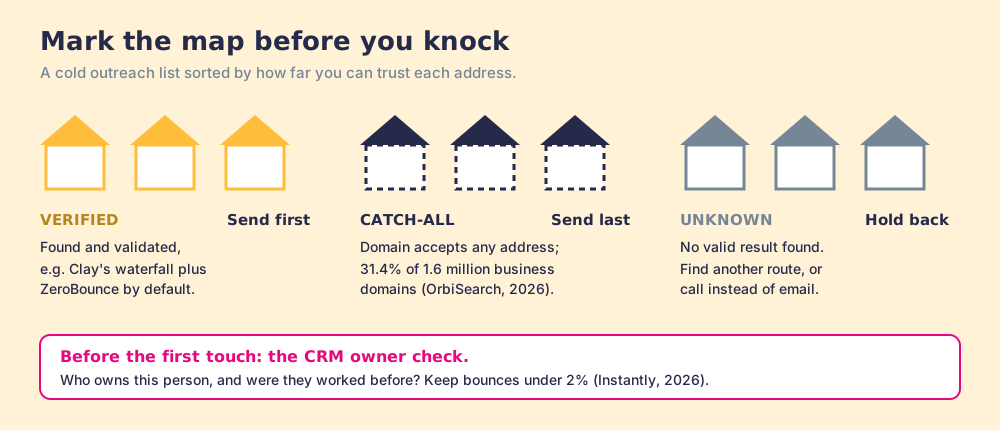
The street map breaks in one place. A house number is permanent; a contact record decays as people change jobs. Build the list close to the day it gets worked, and re-check anything that sat for a month.
How should you measure cold outreach?
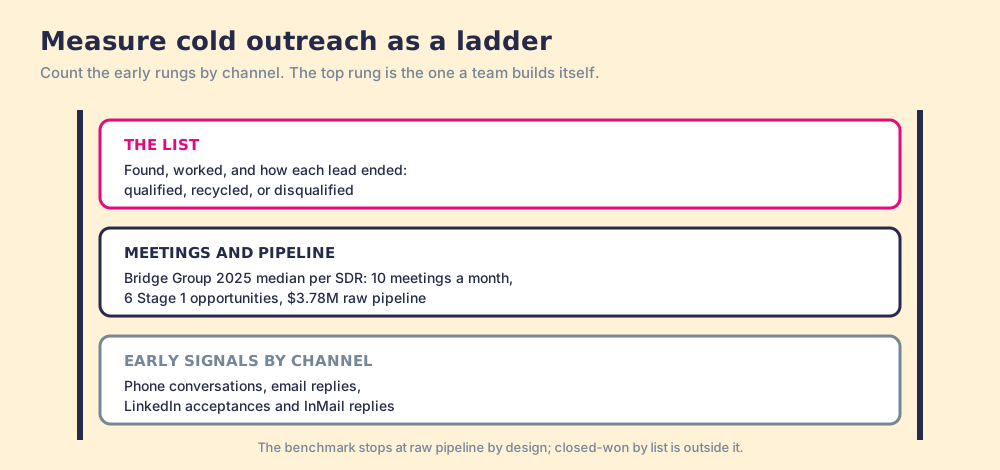
Measure what each door tells you, then follow the list. Each channel gives a different early signal: a conversation on the phone, a reply to email, an accepted invitation or an InMail reply on LinkedIn. Those are worth counting by channel, because they tell you which door this market answers. They are early numbers.
The most-cited benchmark in outbound is careful about the same limit. The Bridge Group reports the median SDR holds 10 meetings a month, converts 6 to Stage 1 opportunities, and sources $3.78M in pipeline, and then states plainly: “Pipeline figures represent raw pipeline generated, not forecast or closed-won revenue.” Only 60% of SDRs in the study hit quota, the lowest in its history. Meetings and pipeline are gauges partway along the pipe.
So the last measure belongs to the list. Tag each contact with the list it came from and count three things per list: how many were found, how many were worked, and how each one ended. A list where every contact ends as qualified, recycled, or disqualified is a list the team learned from. A list where half the contacts were never touched tells you something different, and it is usually a fix to the system, since the rep with 400 contacts and one afternoon picks the easy ones first.
Where does Supered Prospector fit in cold outreach?
The list is where a rep’s afternoon goes. The rep finds a VP in Sales Navigator, copies the name into a data tool, checks the CRM in a third tab for an owner, and pastes the result into the sequencer. Supered Prospector puts that work one click from the person the rep is already looking at, on the team’s own Clay account, with no Clay login for reps. It runs inside the Supered Chrome extension.
- The starting point. A LinkedIn profile, a Sales Navigator list, a company’s website, or a HubSpot, Salesforce, or Pipedrive record.
- Verified contact data. The rep runs the team’s Clay table, and Clay’s waterfall across 200+ providers returns the verified email and phone.
- The owner check. On the profile the rep sees the matching CRM record, who owns it, and whether the person was worked before, so two reps do not knock on the same door.
- One click to the CRM. Ops sets the field mapping once, and the contact lands in HubSpot, Salesforce, or Pipedrive, ready for your sequencer.
- The list after it ships. The team’s process applies to worked prospects, so the leader sees which lists were found, which were worked, and how each lead ended, and coaches from the lists that convert.
Prospector works within LinkedIn’s terms and does not copy search results in bulk; the contact data comes from Clay’s waterfall on the customer’s Clay account. Supered does not bring its own database. It brings Clay’s waterfall, which is every database, routed, and that is why we chose Clay as our only data provider. Prospector does not write or send email; your sequencer does. It costs $45 per rep per month, billed annually, from one rep, on your own Clay plan. The product is on the Prospector page, and the full rep loop on the sourcing use case.
Choose something else if:
- No Clay account. Prospector needs one. A single database such as Apollo is the simpler start.
- Ops builds every list. If reps never build lists, Clay’s own CRM sync on its Growth plan does the job.
- Email drafting. Prospector does not draft or send outreach; pair it with your sequencer.
Why trust this guide?
Before Supered I started RevPartners, a HubSpot partner that did only sales implementations, sold roughly twice as much Sales Hub as any other partner, and reached HubSpot’s Elite tier in 13 months. I have run cold outreach teams and watched them work the easy contacts first. Supered is the #1 sales enablement app on the HubSpot marketplace, rated 5.0 from 122 reviews there and 4.9 out of 5 from 81 reviews on G2 (checked October 1, 2026). The disclosure: we make Prospector, and it appears above as one way to build the list.
What we recommend
Build the list before you write the message, mix the doors, and measure each list to the end. In practice that means rep-built lists: the rep picks the people from the profile and the account they know, a waterfall fills verified data, the owner check prevents double knocks, and each list is followed to worked and closed.
The evidence above points there. 73% of buyers avoid irrelevant outreach, so the person on the list matters more than the message. Phone-centric teams held more conversations, so the list needs a direct phone as well as an email. And the best public benchmark stops at raw pipeline, so the closed count by list is the gauge a team has to build for itself.
Two other setups are common, and each has a narrower place:
- Volume-first sending. A large exported list, one channel, a long sequence, and success read as meetings booked. It spends the complaint budget fast; at Gmail’s 0.3% line, three complaints per thousand emails is the limit. Keep it, if at all, for a one-time test of a new market.
- Ops-built lists. A GTM engineer builds segments in Clay and pushes them to the CRM. Clean data on steady segments, handed to reps who did not choose the people. It suits rules-based segments that need no rep judgment.
From here, the email door gets its own rules in cold email best practices: the 2026 sender requirements, list hygiene, copy, and follow-up timing.
Frequently asked questions
What is cold outreach?+
Which cold outreach channel works best?+
Is cold outreach legal?+
What is a good cold outreach response rate?+
How many touches should a cold outreach sequence have?+
Where does Supered Prospector fit in cold outreach?+
Your Clay waterfall, where reps already work.