B2B Contact Data in 2026: Rent One Database or Run a Waterfall
A buyer's guide to B2B contact data: renting one B2B contact database against running a waterfall on your own Clay account, with coverage, decay and the 2026 Delete Act sourced, and a graded shortlist with live prices.
B2B contact data is the work emails, direct dials, mobile numbers, job titles and company details a sales team uses to reach buyers, bought by renting one B2B contact database or by running a waterfall that asks many providers in turn.
B2B contact data comes two ways in 2026: rent one database, or run a waterfall that asks many. The short answer, graded in full below:
- Supered Prospector. For teams that already have Clay: Clay’s waterfall across 200+ providers, run by reps from LinkedIn, Sales Navigator, a company website, or the CRM record, at $45 per rep per month billed annually.
- Apollo. For a small team without Clay that wants data, sequences and a dialer in one plan, from $49 a seat on annual billing.
- ZoomInfo or Cognism. For enterprise depth in North America (ZoomInfo) or phone-first selling in EMEA (Cognism), quote-only, with Vendr medians of $33,500 and $32,750 a year.
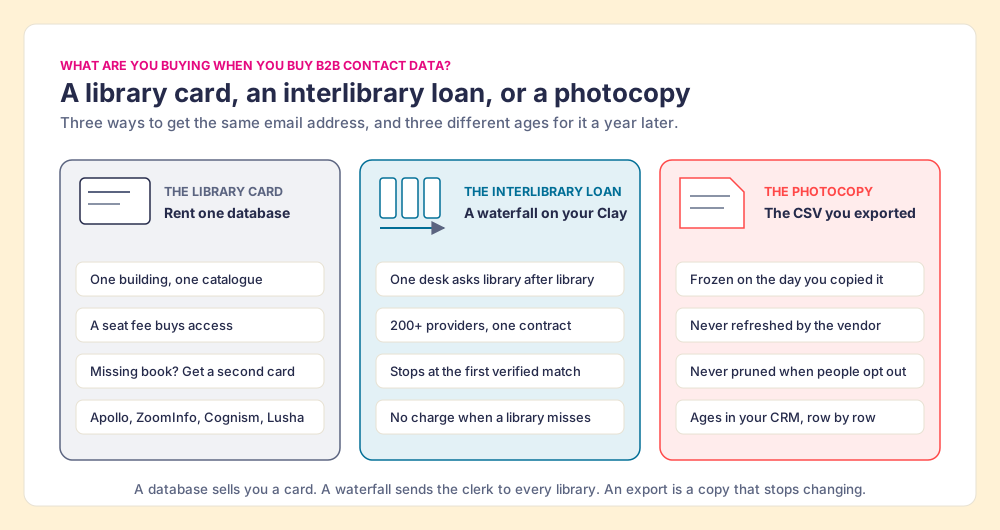
A public library lends you a book for as long as you hold the card. If the book is not on its shelves, the librarian can send for it through interlibrary loan, and the loan desk asks library after library until one has it. And if you photocopy a chapter and take it home, the copy is yours to keep, but it stops changing the day you make it. The library replaces worn pages and pulls books off the shelf. Your photocopy does neither.
B2B contact data is the work emails, direct dials, mobile numbers, job titles and company details a sales team uses to reach buyers, bought by renting one B2B contact database or by running a waterfall that asks many providers in turn. Those are the library card and the interlibrary loan. The photocopy is the CSV your team exported last spring, and in 2026 it picked up a new problem the top-ranking guides have not caught up with. Each major vendor on this page, Clay included, sits on California’s data broker registry, and since August 1, 2026 each one has to prune its copy every 45 days. Your export gets no such pruning.
What is B2B contact data, and how do teams buy it?
The fields are dull and the buying decision is not. A B2B database holds a person’s name, title, employer, work email, and with luck a mobile or direct dial, plus company facts such as headcount and industry. A B2B email database is the same thing with the phones left off. The decision is how you get access.
- The rented database. One vendor collects, verifies and sells access by the seat or the credit. Apollo, ZoomInfo, Cognism, Lusha, Kaspr and RocketReach all work this way. One contract, one standard, one shelf.
- The waterfall. A list of instructions your GTM engineer writes: ask this provider first, then that one, stop when a verified email or phone comes back. “Clay’s signature data waterfalls check multiple providers to return the most verified emails (lower bounce rate) and phone numbers (higher connect rate)” (Clay, rep prospecting), across “200+ providers in one place” (clay.com/pricing, October 2, 2026).
- The export. Whichever route you take, a contact that leaves the tool as a file becomes a photocopy, and no vendor refreshes it.
Our B2B data providers hub lists the vendors. This page is about the choice between the two models, and about the three things that decide it: coverage, decay, and the law.
Why trust this guide?
I started RevPartners, a HubSpot partner that did only sales implementations, sold roughly twice as much Sales Hub as any other partner, and reached Elite tier in 13 months. We ran RevOps as a service for our clients, acting as a fractional sales leader, so the question of where reps get their contacts came up in nearly every engagement. Supered came out of that work and is the #1 sales enablement app on the HubSpot marketplace, rated 5.0 from 122 reviews there and 4.9 out of 5 from 81 reviews on G2 (October 1, 2026). That is also the disclosure: we make Supered Prospector, and it ranks first below for teams that have Clay. The weights are printed so you can change them, and one change puts Apollo first.
Who sells B2B contact data, and how do they grade?
The lens is a mid-market or SMB team of ten to fifty reps that needs contact data reps will use where they already work, and a leader who can see which lists turn into pipeline. Each criterion is scored 1 to 5 and multiplied by its weight, out of 50. The scores match the ones on the Kaspr alternatives page and the Apollo alternatives page, so the pages read together.
| Criterion | Weight | What it rewards |
|---|---|---|
| Coverage of the contact you need | 30% (x3) | Verified emails and mobiles when the first source misses |
| Rep-side delivery | 20% (x2) | Works on the profile, the company site, the CRM record; no new tab or login |
| Price structure for mid-market | 20% (x2) | Published, per-result or per-seat, no platform fee or auto-escalator |
| What the leader sees after the export | 20% (x2) | Which sourced lists were worked and which closed, by your definitions |
| Bundled outreach | 10% (x1) | Sequencing, dialer, drafting in the same plan |
| Rank | Tool | Grade | Score | Best fit | CRM integration | Setup effort | Pricing (checked October 2, 2026) | Reason to pick it |
|---|---|---|---|---|---|---|---|---|
| 1 | Supered Prospector on your Clay | A | 44 | Teams that already have Clay | Native (HubSpot, Salesforce, Pipedrive) | Under a week on an existing Clay account | $45 per rep per month billed annually, plus your Clay plan (Growth $446 a month billed annually) | 200+ providers per lookup, any page the rep is on, lists you can follow to closed |
| 2 | Apollo | A- | 36 | Small teams wanting data plus outreach | Native (HubSpot, Salesforce) | A day | Basic $49, Professional $79 per seat per month billed annually ($65, $99 monthly) | Sequencer and dialer in the plan |
| 3 | Lusha | B+ | 29 | A LinkedIn extension with posted prices | Native (HubSpot, Salesforce) | Minutes | Starter $37.45 a month billed yearly (captured September 25, 2026) | Posted price ladder to five seats |
| 4 | ZoomInfo | B | 28 | North American enterprise depth and intent | Native (HubSpot, Salesforce, Dynamics) | Weeks | Quote only; Vendr median $33,500 a year | US depth, for teams with seats to spread a platform fee |
| 5 | Cognism | B | 26 | EMEA, phone-first, compliance-led | Native | Weeks | Quote only; Vendr median $32,750 a year | Phone-verified mobiles and named DNC screening |
| 6 | Kaspr | B- | 25 | Email-first reps on LinkedIn | Native (HubSpot, Salesforce, Pipedrive) | Minutes | Starter $49, Business $79 per user per month billed annually | Unlimited B2B emails at a low seat price |
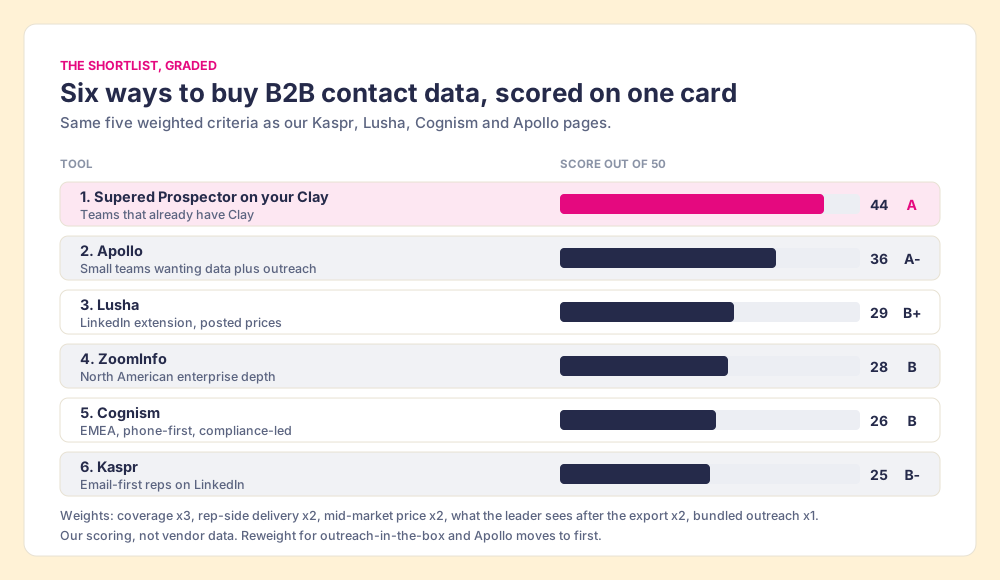
Prices come from each vendor’s page or Vendr on October 2, 2026: Apollo’s plan data (apollo.io/pricing), Kaspr’s pricing page (kaspr.io/pricing), Clay’s plans (clay.com/pricing), and Vendr’s medians for ZoomInfo across 1,574 purchases (Vendr, ZoomInfo) and Cognism across 94 (Vendr, Cognism). Lusha’s dollar prices render in the browser and were last captured September 25, 2026; its credit rates, 1 per email and 5 per phone, were confirmed today (lusha.com/pricing). Corporate status, checked today: ZoomInfo is public (Nasdaq: GTM) and announced its acquisition of DoubleO.ai on September 30, 2026; Kaspr has been part of Cognism since 2022; Apollo, Lusha and Clay are independent.
Is B2B contact data regulated in 2026?
More than the guides ranking for this term let on, and the change landed this summer. California’s Delete Act built a single front door: since January 1, 2026, a Californian can file one deletion request through the Delete Request and Opt-out Platform, DROP, and it reaches “over 600 registered data brokers” (privacy.ca.gov/drop). The second half started on August 1. “Starting on August 1, 2026, data brokers must access DROP at least once every 45 calendar days” and work through the requests they download (CalPrivacy, processing DROP requests).
So who is a data broker? I downloaded the 2026 California Data Broker Registry, last updated July 29, 2026, and it lists 603 companies (CPPA registry). Zenleads, Inc., doing business as Apollo.io, is on it. So are ZoomInfo Technologies, Cognism, Lusha Systems, Seamless Contacts, RocketReach, LeadIQ, UpLead, Lead411, ContactOut, People Data Labs, and Hunter. So is Clay Labs, Inc. A waterfall does not make anyone exempt, and I would distrust a guide that claimed it did.
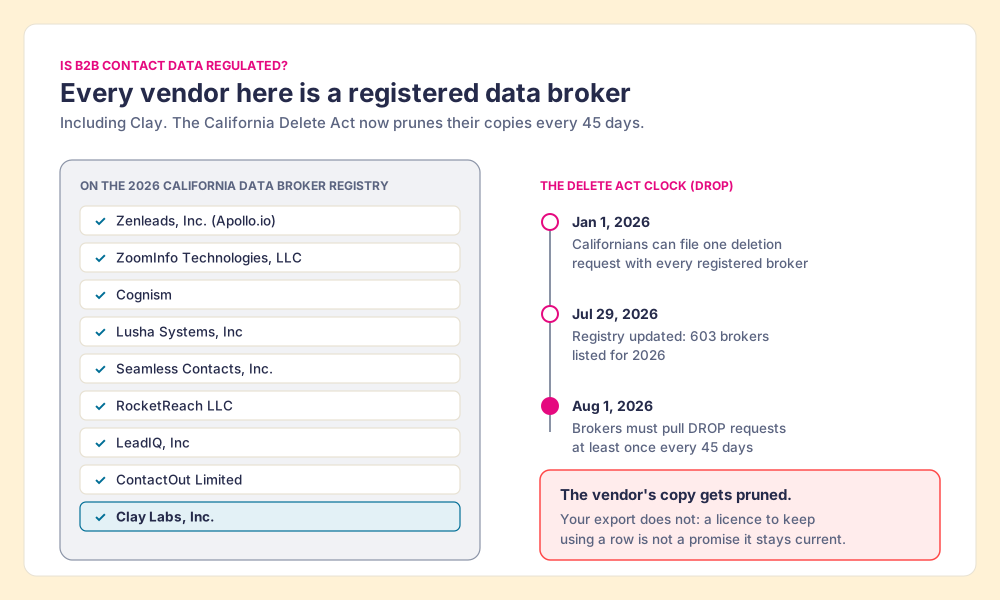
What this does to the library picture is simple. The library now pulls a book every time a Californian asks it to, on a 45-day clock. The photocopy in your CRM is not the library’s to pull. ZoomInfo’s licence terms say that after a contract ends, the “Licensee may continue to use Licensed Materials obtained during the Term subject to the terms of this Agreement” (ZoomInfo License Terms, section 3.3.1, version May 1, 2025). That is a generous licence. It is also a licence to keep a copy the broker has since been required to delete from its own shelves, and whatever obligations you carry under your own privacy program now rest on a file no one at the vendor will ever touch again.
The rest of the rulebook is older and still applies.
- US email. The FTC’s CAN-SPAM guide says “The law makes no exception for business-to-business email,” with penalties of up to $53,088 per violating email (FTC).
- EU notice. GDPR Article 14 requires telling a person “from which source the personal data originate,” at the latest within one month or at the first communication (GDPR Art. 14). Cognism’s own compliance page says it notifies business contacts “within GDPR timeframes” and screens against Do Not Call lists (cognism.com/compliance), which is one reason EMEA teams pay its price.
- Your CRM’s own rules. HubSpot’s Trust and Safety guidelines say “Do not use the HubSpot Service to email purchased, rented, or borrowed lists” (HubSpot policy).
This is not legal advice, and the lead list guide walks the bought-list rules in more depth. The buying lesson is narrower: fetch contact data close to the moment a rep uses it, in the volume they will use, and the vendor’s pruning reaches you. Export ten thousand rows in January and none of it does.
How much B2B contact data does a database cover?
Less of your list than its headline number suggests, and the headline number cannot tell you which part. ZoomInfo reports “more than 100 million companies, 500 million contacts” in its August 2026 earnings release (SEC filing). Apollo’s pricing page says “240M contacts & 30M companies.” Kaspr’s data page leads with “200 million + European B2B contacts” (kaspr.io/our-data). For scale, the Bureau of Labor Statistics counted 162.7 million employed people in the United States in August 2026 (BLS, Table A-1).
Those counts are worldwide records, counted by the seller, and they include people who have moved on. They measure the size of the library. What a buyer needs is the size of their own shelf: how many of the 200 accounts and 1,400 people in the target list come back with a verified email and a phone that connects.
The best evidence on that question is messy, and it points one way.
- A customer quoted by Cognism. “Cognism’s match rate was 98% vs. 72% by ZoomInfo, and we found that Cognism returned a ton more phone numbers” (cognism.com, Cognism vs ZoomInfo). A vendor’s page quoting a happy customer, so read it as one list in one region.
- A Lusha reviewer. “Sometimes, I am not able to find contact details for about 20% of the contacts,” a founder wrote on G2 in May 2026 (G2, Lusha).
- Clay. Waterfall enrichment “routinely triples our customers’ data coverage and quality,” on Clay’s waterfall page (clay.com/waterfall-enrichment). Clay’s claim, with no study behind it on the page.
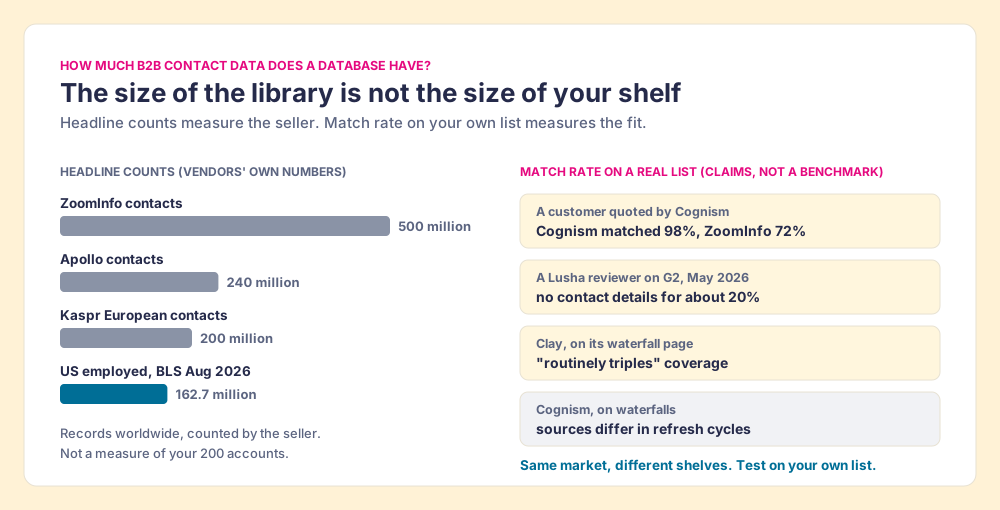
The mechanism is the useful part. Different databases collect differently, so each has its own strong shelves: Vendr describes ZoomInfo as “Global; strong North America coverage” and Cognism as “Strong EMEA coverage” (Vendr, ZoomInfo), and Clay added Lusha to its marketplace in March 2026 “for better EMEA match rates” (Clay changelog). A single database is strong where its sources are strong. A rep whose territory falls between its shelves gets a gap, and the company buys a second card.
Cognism makes the best case against the waterfall, and it deserves to be stated at full strength. On its Clay comparison page, Cognism writes that “Each provider applies different collection methods, refresh cycles and standards, increasing the likelihood of inconsistency, duplication and compliance exposure, particularly in Europe” (cognism.com, Cognism vs Clay). That is true. Two hundred libraries keep two hundred catalogues. A waterfall’s order and validation are set by your team, not left to chance: Clay validates emails through ZeroBounce by default and refunds data credits when a provider returns nothing (Clay University). The same Cognism page also says Clay’s providers do not include ZoomInfo. That line has aged: ZoomInfo has been a Clay integration since January 15, 2025 (Clay, ZoomInfo integration).
Do you have to choose between a database and a waterfall?
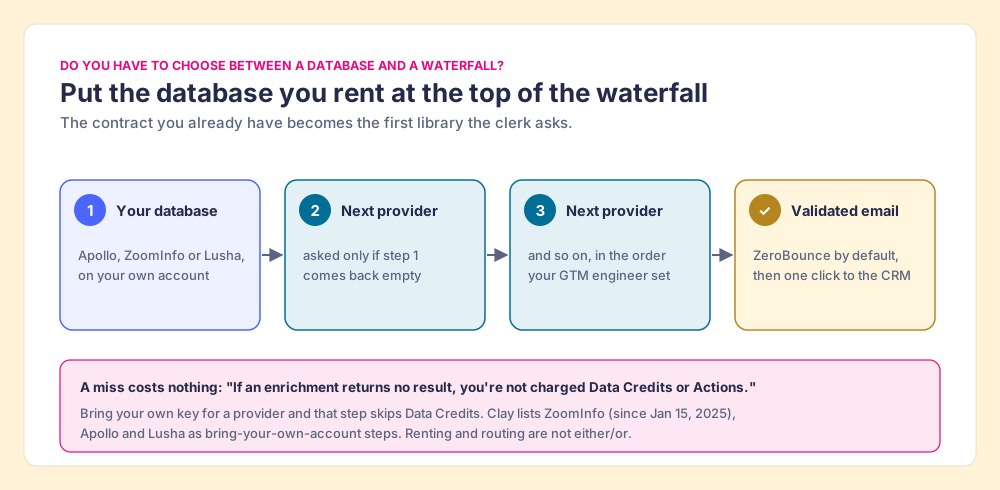
No. The ranking guides frame it as a fork, and it works better as a sequence. Clay lists ZoomInfo, Apollo and Lusha as “Bring Your Own Account Required” steps. A team that already rents a contact database can make that database step one of the waterfall, on its own contract, and send only the misses onward. “If you bring your own API keys for a data provider, you skip Data Credits entirely and only use Actions for the platform work Clay handles behind the scenes,” and “If an enrichment returns no result, you’re not charged Data Credits or Actions” (clay.com/pricing, October 2, 2026).
In the library picture, the card you already hold becomes the first library the loan desk tries. The desk only goes further when your library comes back empty.
How fast does a B2B contact database go stale?
Fast enough that the date of the last check matters more than the size of the file. An Apollo insights page cites a monthly decay rate of 2.1% that “compounds to roughly 22.5% annually” (Apollo), a vendor figure, so treat it as direction rather than measurement. The government numbers point the same way. The Bureau of Labor Statistics counted 5.1 million US job separations in August 2026, 3.2% of jobs in a single month (BLS JOLTS), and median tenure with an employer was 4.1 years in January 2026, 3.0 years for workers aged 25 to 34 (BLS Employee Tenure).
A rented contact database at least tries to keep up, re-verifying and pruning on its own schedule and now on the Delete Act’s. The photocopy cannot. If the 2.1% figure holds, about 77.5% of an exported list is still valid after twelve months, and nothing in the file tells you which three rows in four. The practical rule falls out of the arithmetic: buy contact data in small batches, close to first touch, for the rep who will make the call.
How do you test B2B contact data before you sign?
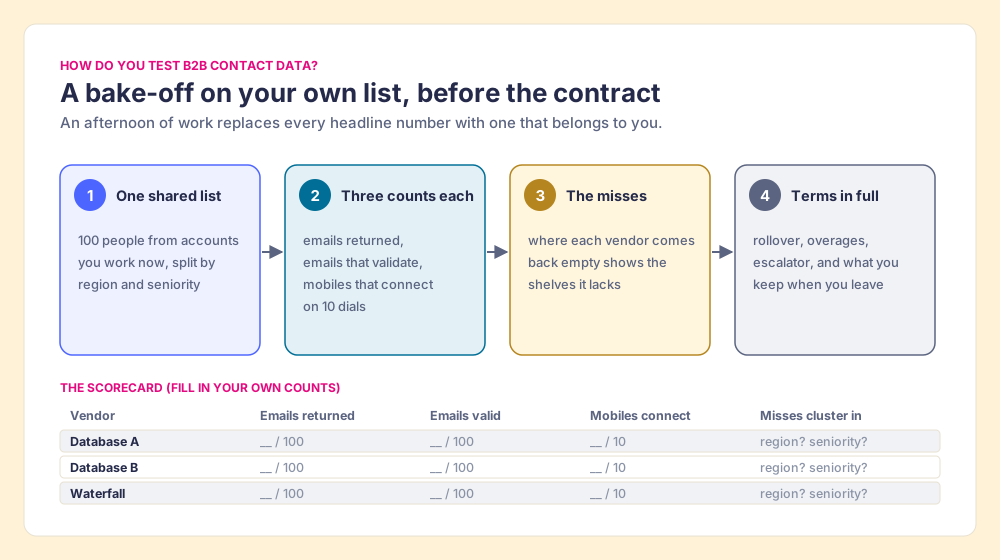
Run a bake-off on your own list, with every vendor’s free trial or demo, before any annual contract. It takes an afternoon and replaces every headline number above with one that belongs to you.
- One shared test list. A hundred people from accounts you are working now, split by region and seniority the way your territories are. Clay’s own course gives the same advice for waterfalls: “always test on small batches” (Clay University).
- Three counts per vendor. Emails returned, emails that pass validation, and mobiles that connect when a rep dials ten of them.
- The misses, by segment. Where each vendor comes back empty tells you which shelves it lacks. If the misses cluster in EMEA or in the C-suite, a second source for that segment is worth more than a bigger seat count.
- The terms, read in full. Credit rollover, overage rates, the renewal escalator, and what the licence lets you keep when you leave. Our ZoomInfo pricing page and our Cognism pricing page walk two of the longer contracts.
Then put the cheapest acceptable source first and route the misses, whether through a waterfall or a second card.
Where does Supered Prospector fit?
Prospector does not bring its own database. It brings Clay’s waterfall, which is every database, routed. We chose Clay as our only data provider for that reason, and it is why Clay is not a row in the grading table. Clay is the row that contains the other rows. Clay governs the data. Supered governs the motion.
Prospector runs inside the Supered Chrome extension, on the team’s own Clay account, and reps never need a Clay login. What a rep gets:
- Lookups from the page they are on. A LinkedIn profile, a Sales Navigator list, a company’s website with company research alongside, or a HubSpot, Salesforce or Pipedrive record.
- A list the rep builds. Clay’s waterfall fills the emails and phones, and a buying-committee lookup returns the titles, departments and seniority the team set.
- Context before the first touch. On a LinkedIn profile, the rep sees the matching CRM record and whether the prospect was already worked in the past.
- One click to the CRM, or into a workflow. Field mapping is set once; a contact syncs to HubSpot, Salesforce or Pipedrive in one click, and a whole list can be pushed into any custom Clay workflow.
- Lists the leader can follow. The team’s process applies to worked prospects, so the manager sees which sourced lists were worked and which closed, and coaches from what is converting.
On LinkedIn, Supered’s position is plain: Prospector works within LinkedIn’s terms and does not copy search results in bulk; the contact data comes from Clay’s waterfall on the customer’s own Clay account. Ask every vendor in this category what it reads from the page, ours included.
Prospector also fits the timing rule above by design. A rep looks up the person they are about to contact, when they are about to contact them, so the record comes from the providers as they stand that day, after whatever re-verification and deletion each has done. The CRM gets one fresh row instead of a stack of photocopies.
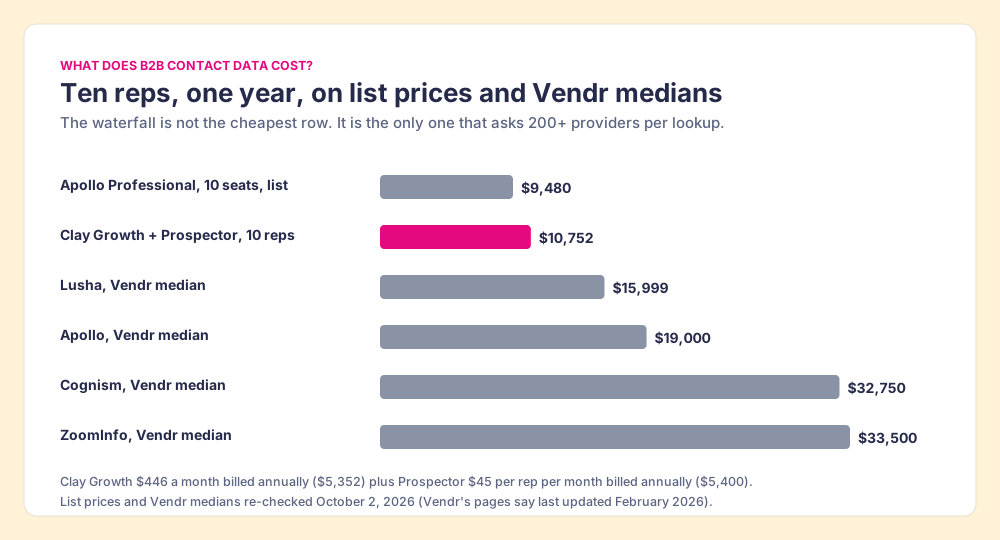
The arithmetic, at list prices on October 2, 2026. Clay’s Growth plan is $446 a month billed annually, $5,352 a year ($495 a month on monthly billing). Prospector is $45 per rep per month billed annually, from one rep (Prospector). Ten reps come to $10,752 a year. Ten Apollo Professional seats at list are $9,480, so Apollo is cheaper on sticker and includes a sequencer. The Vendr medians for the quote-only databases sit far higher: Lusha $15,999 across 147 purchases, Apollo $19,000 across 101, Cognism $32,750, ZoomInfo $33,500.
Choose something else if you do not have Clay. Prospector runs on the customer’s Clay account and does nothing without one, and somebody has to build the waterfall; Clay says plainly that “GTM engineers build on Clay.” Choose something else, too, if the job is outreach in the same box, because Apollo’s sequencer and dialer come in the plan and Prospector has neither. The sourcing use case shows where Prospector sits in a rep’s day.
Which other B2B contact data vendors are worth a look?
- Apollo. The rented database most small teams start with: Basic $49 and Professional $79 per seat per month billed annually, 30,000 and 48,000 credits per seat per year, and a G2 badge of 4.7 from 9,690 reviews on its pricing page. It also sells Waterfall Enrichment, which fills a record “with Apollo data first, then lets 20+ partners fill in the rest,” so its waterfall starts from its own shelf.
- ZoomInfo. The deepest North American library, quote-only, with a Vendr median of $33,500 a year and a range of $7,220 to $155,730. Its licence lets you keep what you exported. Negotiate the escalator and the credits before you sign; Apollo vs ZoomInfo has the head-to-head.
- Cognism. The EMEA phone specialist, quote-only, Vendr median $32,750 across 94 purchases, with named DNC screening and notification practices that matter if your buyers sit in Europe.
- Lusha. A LinkedIn extension with posted prices from $37.45 a month billed yearly, 1 credit per email and 5 per phone, and G2 4.3 from 1,668 reviews (October 1, 2026). It is also an enrichment step inside Clay.
- Kaspr. Cognism-owned, with unlimited B2B emails under a fair-use cap and 100 or 200 phones a month, from $49 a user billed annually. The cheapest library card for an email-first rep.
What we recommend
The choice resolves on two facts about your team: whether you have Clay, and where your list lives. If you do not have Clay and your reps sell mostly in North America, rent one database and test it on a hundred of your own contacts before you sign; Apollo for a small team that wants outreach included, ZoomInfo when depth justifies the fee. If your buyers sit in EMEA and your reps dial for a living, Cognism earns its price. If you already have Clay, do not buy another card for the shelves you lack. Put the database you rent at the top of the waterfall, route the misses, and let reps fetch each contact the day they need it, where they already work.
Whatever you buy, stop treating the export as the asset. The library keeps changing, now by law every 45 days, and the photocopy in your CRM does not. The sales prospecting guide covers what happens once the list is built, and a Prospector demo on your own Clay account shows the fresh-row version of this page in action.
Frequently asked questions
What is B2B contact data?+
Which B2B contact database is best in 2026?+
How fast does B2B contact data go out of date?+
Is buying B2B contact data legal?+
Is a waterfall better than a single B2B database?+
Do I need a Clay account to use Supered Prospector?+
Your process, running itself.