B2B Data Providers, Sorted by the Job: The Map of the Category, and the Row That Contains the Other Rows
Ten b2b data providers graded for a mid-market sales team, sorted into the four kinds of tool they are, with the meter each one charges on, a link to the deeper page on each, and a verdict by team type. Clay is not a row; it is the row that contains the other rows.
B2B data providers are the vendors that sell contact and company data to sales teams, and they sort into four kinds by what the meter counts: single databases per seat, compliance databases per reveal, export-metered tools, and an aggregation layer that charges per result.
A rep on a LinkedIn profile needs a mobile number, opens the one database the company pays for, and gets nothing. She asks the desk beside her, where a teammate keeps a login to a second one. That is how a data budget grows: contract by contract, each one bought to cover the last one’s misses. B2B data providers are the vendors that sell verified business contact and company data to sales teams, and in 2026 they sort into four kinds by what their meter charges on: single databases priced per seat, EU-compliance databases priced per revealed contact, export-metered tools, and an aggregation layer that asks all of them and charges per result. The argument of this page fits in a breath. One database misses, so the org buys a second. A waterfall asks every database in sequence and charges only for the hit. But the waterfall is built by one person in RevOps, the reps never open it, and so the spend is capped by an adoption rate no one measures. The fix is to hand the waterfall to the rep where she already is, and then inspect whether the contact she sourced was ever worked.
What are b2b data providers, and why is one list four lists?
Search for the best b2b data providers and the lists you find stack ZoomInfo beside Clay beside Lusha as if they were the same kind of thing. They are not, and the mistake costs money, because a buyer comparing a single database to an aggregation layer on “number of contacts” is comparing one boat’s catch to the whole fish market. Sort instead by the meter, the thing the invoice counts, and the category falls into four groups plus one thing that is not a database at all.
- Single databases, priced per seat. ZoomInfo, Apollo, Seamless.AI, and LeadIQ each own one dataset and sell a seat that comes with a credit allowance. When the shelf is empty the rep is stuck, and the org buys a second shelf. Vendr’s buyer notes for Cognism include one company “using ZoomInfo in tandem with Cognism” (Vendr), which is the second-contract habit written down.
- EU-compliance databases, priced per revealed contact. Cognism and its subsidiary Kaspr (acquired April 2022) sell a European posture as the product: one credit per revealed contact, mobiles phone-verified on demand, data scrubbed against Do Not Call lists.
- Export-metered tools. RocketReach and Lusha let a rep look for free or nearly so and charge when the record leaves: exports per year on RocketReach, credits per reveal on Lusha (1 for an email, 5 for a phone).
- The aggregation layer. Clay owns no database. It routes one lookup across 200+ data and AI vendors on one contract (clay.com, September 25, 2026) and charges per result, with no charge when a lookup returns nothing. Apollo, ZoomInfo, and Lusha are rows inside it. FullEnrich sells a smaller version of the same idea, and Apollo has bolted a 20-partner waterfall onto its own database.
- The rep-side front end, with a standard. Not a data source. A layer that delivers the waterfall on the profile or CRM record the rep already has open, and then measures whether the sourced contact was worked. Clay describes the category on its own rep-prospecting page; Supered is the one that adds the standard, and it arrives near the end of this page.
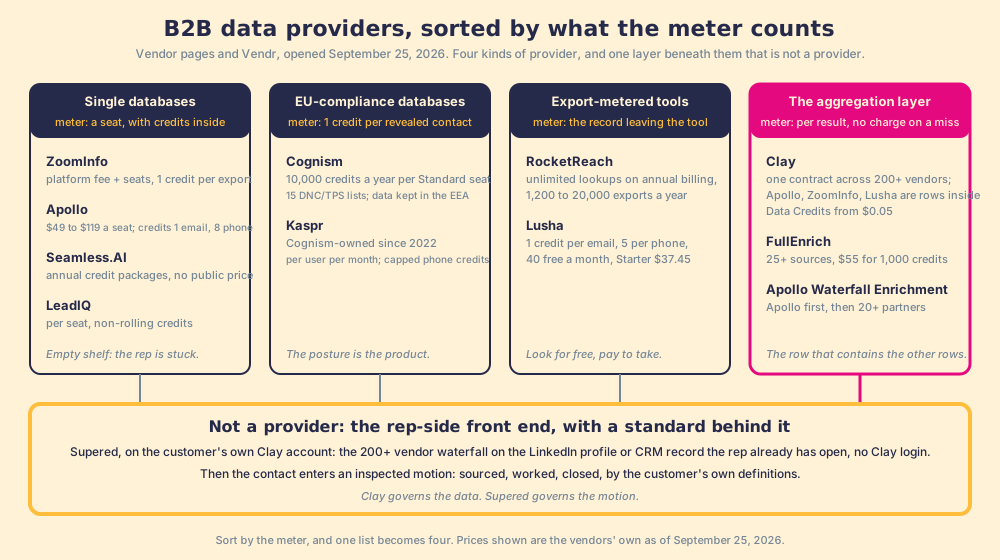
The fish-market picture has an edge, and it should be marked. A single database is not a worse boat. ZoomInfo’s dataset is the largest on the list at “more than 100 million companies, 500 million contacts” (ZoomInfo, Q2 2026 results), and Forrester named it a Leader with the highest current-offering score in its Q1 2026 Wave for B2B marketing and sales data providers (ZoomInfo, Q1 2026). The point is narrower: however large the boat, it is one boat, and the market is every boat.
How we graded the b2b data vendors
A ranking that hides its math is an advertisement. The lens is a mid-market or SMB sales team, ten to fifty reps, that needs prospecting data reps will use and a leader who can tell whether it worked. Weighted that way, per-result pricing and rep-side delivery rise. Weighted for a 200-seat enterprise that wants one vendor’s intent data and a named success manager, ZoomInfo stays the safe answer, and the text says so where it is true. Same criteria and weights as the ZoomInfo competitors page, so the two pages can be read against each other.
| Criterion | Weight | What it rewards |
|---|---|---|
| Coverage of the contact you need | 3 | Verified emails and mobiles when the first source misses |
| Rep-side delivery | 2 | Works on the profile, the company site, the CRM record; no new tab or login |
| Price structure for mid-market | 2 | Published, per-result or per-seat without a platform fee, no auto-escalator |
| The funnel after the export | 2 | Sourced, worked, closed, by your definitions, visible to the manager |
| Bundled outreach | 1 | Sequencing, dialer, drafting in the same plan |
Each criterion is scored 1 to 5 and multiplied by its weight, for a maximum of 50. Sources are the vendors’ own pricing pages and Vendr, opened September 25, 2026, and the per-vendor pages linked in each row carry the citations in full.
| Rank | Provider | Kind | Grade | Score | Best lane | Why it ranks here |
|---|---|---|---|---|---|---|
| 1 | Clay’s waterfall from the rep’s tab (Supered) | Front end + standard | A | 44 | A team that already has Clay and reps who never open it | Coverage is Clay’s 200+ vendors; runs on the LinkedIn profile or CRM record with no Clay login; the sourced contact enters an inspected process. Requires a Clay account. |
| 2 | Apollo | Single database | A- | 36 | Small teams that want data and outreach in one plan | Published seats from $49, credits 1 per email and 8 per phone, G2 4.7 from 9,690 reviews on its own page; the best bundle on the list. |
| 3 | Lusha | Export-metered | B+ | 29 | LinkedIn-first teams with low commitment | 1 credit per email, 5 per phone, a free tier of 40 credits a month, Starter at $37.45 a month billed yearly. |
| 4 | ZoomInfo | Single database | B+ | 28 | Enterprise teams that want one vendor, intent, and a success manager | The largest dataset and a Forrester Leader; quote-only, platform fee plus seats, one credit per export, Vendr median $33,500. |
| 5 | LeadIQ | Single database | B | 27 | SDR teams on Outreach or Salesloft | Capture-to-sequencer workflow and a public MCP server in Claude; narrower data. |
| 5 | FullEnrich | Aggregation, small | B | 27 | Two-to-five-person teams that want a waterfall per result, no platform | 25+ sources, $55 a month for 1,000 credits, work email 1 credit and mobile 10, unlimited users, no charge on a miss. |
| 7 | Cognism | EU-compliance | B | 26 | EMEA, phone-first outbound | Phone-verified mobiles and the most specific GDPR posture on the list; quote-only, Vendr median $32,750. |
| 8 | Kaspr | EU-compliance | B- | 25 | Individuals and small teams prospecting LinkedIn in Europe | Cognism’s data on a per-user monthly plan, Starter €59 a user a month, phone credits capped monthly. |
| 9 | RocketReach | Export-metered | B- | 23 | Individuals and two-person teams | Unlimited lookups on annual billing, exports capped at 1,200 to 20,000 a year, seats from $33 a month billed annually. |
| 10 | Seamless.AI | Single database | C+ | 21 | High-volume real-time search | No published price for any paid tier; a 60-day cancellation window before a 12-month auto-renewal. |
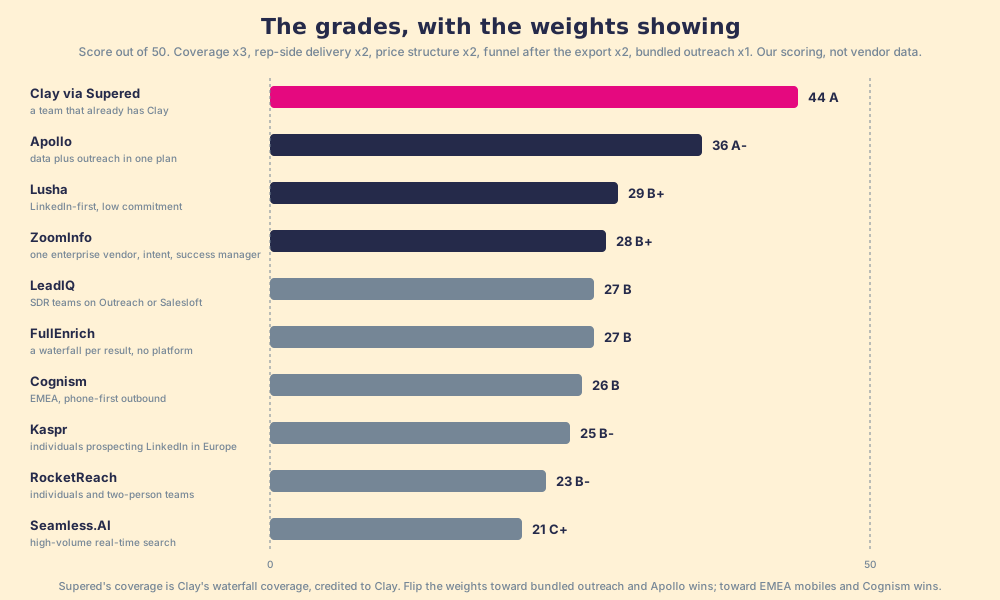
The per-criterion scores, so you can argue with them:
| Provider | Coverage (x3) | Rep-side (x2) | Price (x2) | Funnel (x2) | Outreach (x1) | Total |
|---|---|---|---|---|---|---|
| Clay via Supered | 5 | 5 | 4 | 5 | 1 | 44 |
| Apollo | 3 | 4 | 5 | 2 | 5 | 36 |
| Lusha | 3 | 4 | 4 | 1 | 2 | 29 |
| ZoomInfo | 4 | 4 | 2 | 1 | 2 | 28 |
| LeadIQ | 2 | 4 | 4 | 1 | 3 | 27 |
| FullEnrich | 4 | 2 | 4 | 1 | 1 | 27 |
| Cognism | 4 | 3 | 2 | 1 | 2 | 26 |
| Kaspr | 2 | 4 | 4 | 1 | 1 | 25 |
| RocketReach | 2 | 3 | 4 | 1 | 1 | 23 |
| Seamless.AI | 3 | 3 | 1 | 1 | 2 | 21 |
Two footnotes carry the table. Supered’s coverage score is Clay’s coverage, because Supered brings no database of its own; it brings Clay’s waterfall, which is every database, routed, and that is the reason we chose Clay as our only data provider. And Clay is not a row, because Clay is the row that contains the other rows: three of the ten (Apollo, ZoomInfo, Lusha) are providers inside Clay’s own marketplace, each marked “Bring Your Own Account Required” on its listing (clay.com/integrations).
Which b2b data providers are single databases, and what does each meter count?
Now the rows, one at a time, with the job each is built for, the meter it charges on, and the page that does the arithmetic. Corporate status as of September 25, 2026, because a list that does not say who owns whom is wrong the day a deal closes.
Single databases, priced per seat
The b2b contact data providers in this group share one shape: a dataset they own, a seat they sell, and a credit allowance inside the seat.
- ZoomInfo. The job: one vendor for an upmarket team, with intent data, Chorus call recording, and a success manager on the contract. The meter: a platform fee plus per-seat licences, and “Each export costs one credit” (zoominfo.com/pricing); no list price is published, and Vendr’s median buyer pays $33,500 a year on 1,573 purchases, saving 22% on average (Vendr). Status: public (Nasdaq: GTM), and in May 2026 its board approved a restructuring of about 600 roles, roughly 20% of headcount, with CEO Henry Schuck writing that “the industry is moving toward consumption-based pricing” (SEC 8-K, May 2026). The deeper read is ZoomInfo pricing and Apollo vs ZoomInfo.
- Apollo. The job: data plus sequencing plus a dialer in one plan for a small team. The meter: a seat with a unified credit allowance, 1 credit per email and 8 per phone, on published tiers of $49, $79, and $119 per user per month on annual billing (apollo.io/pricing); Vendr’s median contract is $19,000 on 101 purchases. Its dataset is “240M contacts & 30M companies.” Status: independent, new CEO Matt Curl as of February 2026. The credit arithmetic is on Apollo alternatives and Apollo pricing.
- Seamless.AI. The job: real-time search at volume, where the database is rebuilt at query time. The meter: annual credit packages per user, “Pro plans start off at 10,000 annual credits,” and no dollar price for any paid tier on its own page (seamless.ai/pricing); Vendr shows a median of $8,350. Its Terms require cancellation “no later than 60 days prior to the next annual contract renewal date” or the contract renews for 12 months (Terms of Use). Status: independent, Dublin, Ohio. The exit terms are laid side by side on Seamless.AI alternatives.
- LeadIQ. The job: capture a contact and push it to Outreach or Salesloft in one motion. The meter: per seat with non-rolling credits. Its MCP server puts prospecting inside Claude, “without leaving your AI workflow,” on an existing paid subscription (leadiq.com). Status: independent. It is graded alongside its peers on ZoomInfo competitors.
EU-compliance databases, priced per revealed contact
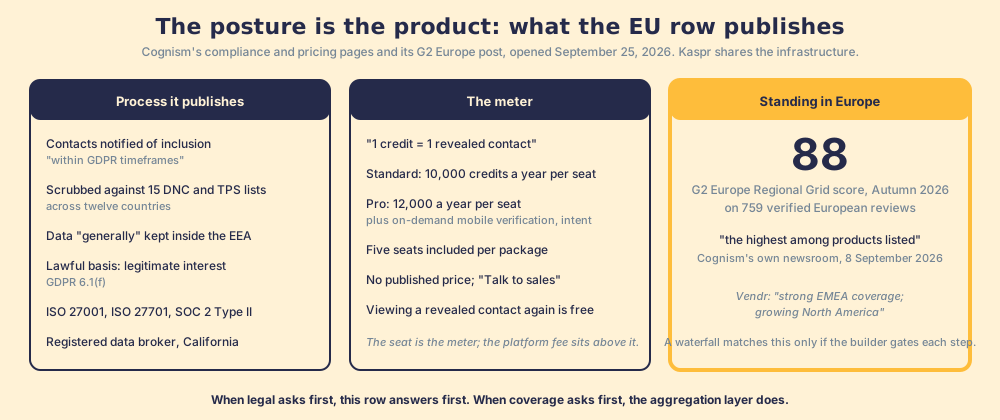
- Cognism. The job: phone-first outbound into EMEA where the compliance question is asked before the coverage question. The meter: “1 credit = 1 revealed contact,” with 10,000 credits a year on a Standard seat and 12,000 on Pro, five seats included per package, no published price (cognism.com/pricing); Vendr’s median is $32,750 on 94 purchases. The posture is the product: contacts notified “within GDPR timeframes,” data scrubbed “against 15 major Do Not Call and TPS lists,” data “generally” kept inside the EEA, ISO 27001, ISO 27701, SOC 2 Type II (cognism.com/compliance). On G2’s Autumn 2026 Europe grid it holds the highest score among products listed at 88 on 759 reviews. Status: private, London, owner of Kaspr. Its competitors are graded on Cognism alternatives.
- Kaspr. The job: the same data on an individual’s monthly card, for reps prospecting LinkedIn in Europe. The meter: per user per month in euros, Starter €59 with 100 phone credits a month and Business €99 with 200, subscriptions renewing monthly (kaspr.io/pricing). Status: Cognism-owned since April 2022.
Export-metered tools
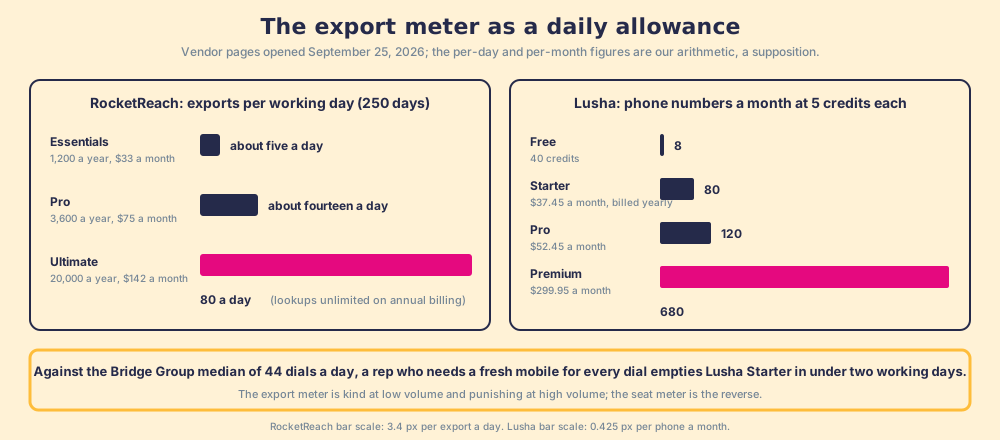
- RocketReach. The job: an individual or a two-person team that wants broad reach and a cheap seat. The meter: lookups are unlimited on annual billing and the invoice counts exports, 1,200 a year on Essentials at $33 a month, 3,600 on Pro at $75, 20,000 on Ultimate at $142, each billed annually; on monthly billing the lookups are capped at the export count (rocketreach.co/pricing). Vendr’s median is $6,750. Status: majority-owned by Brighton Park Capital since 2020. The export arithmetic is on RocketReach alternatives.
- Lusha. The job: LinkedIn-first prospecting with the lowest commitment on the list. The meter: credits per reveal, 1 for an email and 5 for a phone, 40 free a month, then Starter $37.45, Pro $52.45, and Premium $299.95 a month billed yearly (lusha.com/pricing); Vendr’s median is $15,999 on 147 purchases. Since March 2026 Lusha is also a step inside Clay’s waterfall, “for better EMEA match rates” (Clay changelog). Status: independent. The plan-by-plan read is Lusha pricing and Lusha alternatives.
The export meter is easiest to feel as a daily allowance. Over 250 working days, RocketReach’s exports come to about five a day on Essentials, about fourteen on Pro, and 80 on Ultimate. At 5 credits a phone, Lusha buys 8 numbers a month on Free, 80 on Starter, 120 on Pro, and 680 on Premium. Against the Bridge Group’s median of 44 dials a day, a rep who needs a fresh mobile for every dial empties Lusha Starter in under two working days (our arithmetic, a supposition).
Line those meters up and you see the buyer’s real choice, which the vendor names hide.
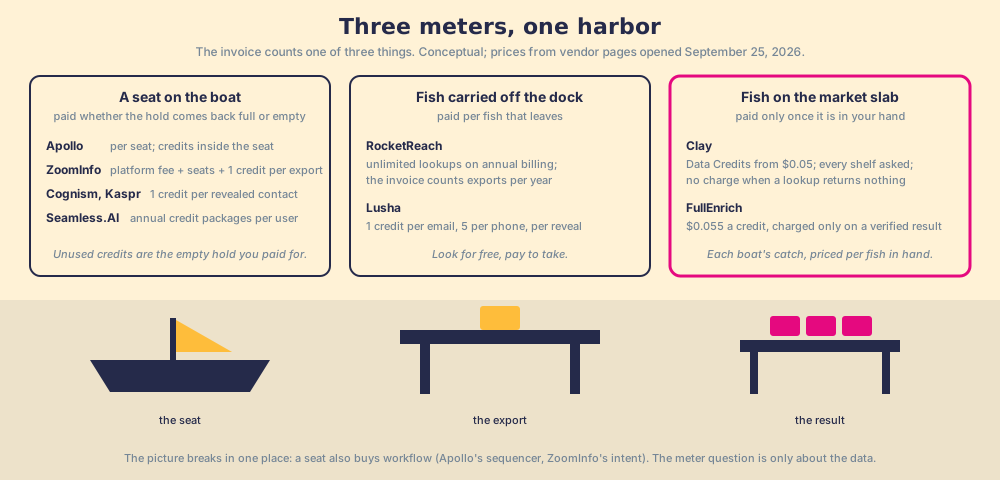
A seat on a boat is paid whether the boat comes back full or empty. Apollo, ZoomInfo, Cognism, and Seamless.AI sell seats; the credits inside the seat are the catch you are allowed to keep, and unused credits are the empty hold you paid for anyway. A fish carried off the dock is paid per fish: RocketReach counts exports, Lusha counts reveals. A fish on the market slab is paid only once it is in your hand, and that is the meter of the aggregation layer: Clay’s Data Credits “start at $0.05 each,” and “If an enrichment returns no result, you’re not charged Data Credits or Actions” (clay.com/pricing). FullEnrich’s headline says the same thing in its own words: “Only Pay For Data You Actually Find,” at $0.055 a credit (fullenrich.com/pricing). The picture breaks in one place, and it should be said: a seat buys workflow as well as catch, and for a team that wants Apollo’s sequencer or ZoomInfo’s intent data, the seat is the right buy. The meter question is only about the data.
Why is the aggregation layer the row that contains the other rows?
Because the coverage you buy a second contract for is what a waterfall already does. Clay’s waterfall page opens with the question at the center of this whole category, “Why use one contact database when you can use them all?”, and then makes the claim we cite as Clay’s, never as measured: “Waterfall enrichment lets you search sequentially across multiple tools until you find a valid match. This routinely triples our customers’ data coverage and quality!” (clay.com/waterfall-enrichment). The mechanism is plain. If one source misses, the next is tried, and the org pays per result rather than per seat per database. Clay’s rep-prospecting page says it in one line: “One click runs Clay’s waterfall enrichment. If one source misses, it tries the next” (clay.com/use-cases/rep-prospecting).
The named providers inside that waterfall are the same names on this page. Clay’s work-email waterfall lists “Prospeo, DropContact, Datagma, Hunter, PeopleDataLabs, Nimbler, Apollo, Lusha, Snov, & more”; its marketplace lists Apollo and ZoomInfo as Clay-built integrations, each requiring the customer’s own account (clay.com/integrations). Cognism’s comparison page pushes back by name, and the objection deserves its full force: it says Clay’s list of providers “doesn’t include industry leaders ZoomInfo or Cognism,” and that stacking providers with different “collection methods, refresh cycles and standards” raises “the likelihood of inconsistency, duplication and compliance exposure, particularly in Europe” (cognism.com/cognism-vs-clay). Half of that is right. Clay’s directory does list ZoomInfo, joined January 15, 2025, but every action is marked “Bring Your Own Account Required,” so ZoomInfo’s data reaches a Clay table only if you also hold a ZoomInfo contract; Cognism is not among the data providers in Clay’s directory on the same day. And the compliance point is the reason Cognism sits in its own group on this page: a waterfall is as compliant as its weakest step unless the builder gates the steps, which Clay’s conditional runs allow (“Only run if” a region matches, per Clay’s docs), and which an EMEA team should insist on.
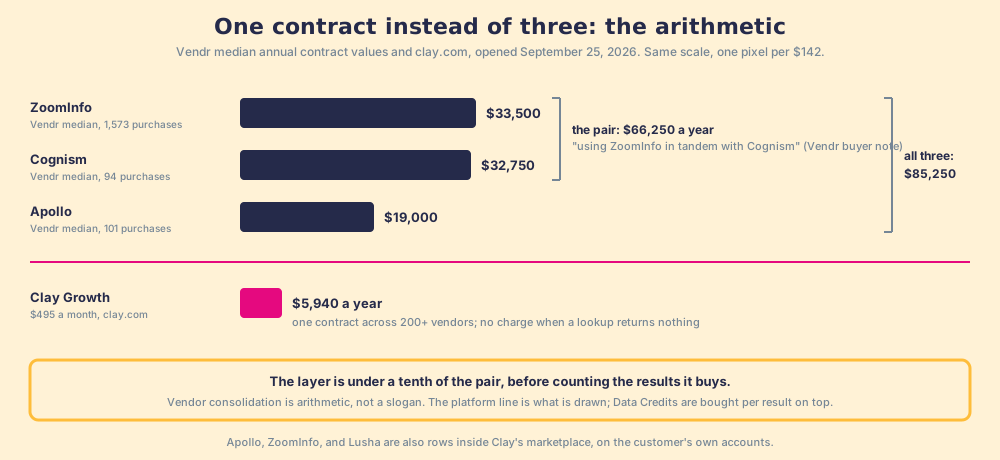
So the arithmetic of one contract instead of three is real arithmetic, and here it is. Vendr’s medians: ZoomInfo $33,500, Cognism $32,750, Apollo $19,000. Two of them, the pair one Vendr buyer runs “in tandem,” come to $66,250 a year; all three come to $85,250. Clay’s Growth plan, the tier with CRM sync, is $495 a month, $5,940 a year, with 6,000 Data Credits a month included (clay.com/pricing; the full ladder is on Clay pricing). The layer is under a tenth of the pair before you count the results it buys. That gap is why the what is Clay post exists, and why the Clay alternatives page says in its first hundred words that for a team that already pays for Clay the better buy is usually a front end on it, not a replacement.
Two smaller versions of the layer belong in the same group, and each is the right buy for a particular team. FullEnrich sells a waterfall across 25+ sources at $55 a month for 1,000 credits, a work email costing 1 credit and a mobile 10, with unlimited users; it is a web app and an API, so the rep goes to it. Apollo’s Waterfall Enrichment fills each record “with Apollo data first, then lets 20+ partners fill in the rest,” currently for emails and phones only, from the seat a rep already has (apollo.io/product/waterfall). Both prove the point from inside the vendor tables: the databases themselves are adding the jig.
Which b2b data provider fits which team?
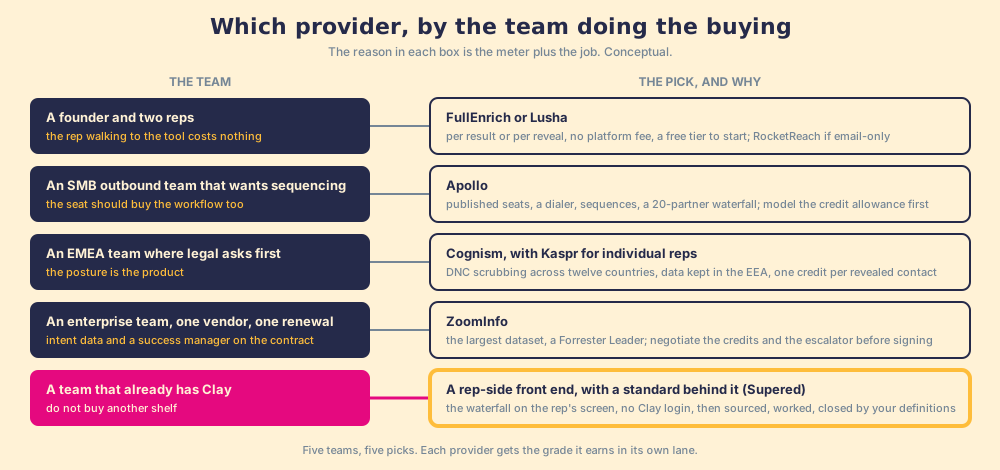
The verdict, by the team doing the buying. Each branch names the pick and the reason, and the reason is always the meter plus the job.
- A founder and two reps. FullEnrich or Lusha. Per-result or per-reveal pricing, no platform fee, a free tier to start (Lusha’s 40 credits a month), and at that size the rep walking to the tool is fine. RocketReach if the team’s motion is email-only and the seat price is the deciding number.
- An SMB outbound team that wants sequencing in the same plan. Apollo, and it is not close. Published seats, a dialer, sequences, and a 20-partner waterfall inside the plan. The credit allowance is the thing to model before signing; the burn-down is on Apollo alternatives.
- An EMEA team where legal asks first. Cognism, with Kaspr for individual reps. The DNC scrubbing across twelve countries and the EEA data residency are the product, and no waterfall matches that posture without a builder gating every step.
- An enterprise team that wants one vendor and one renewal. ZoomInfo. The largest dataset, a Forrester Leader, intent, Chorus, a success manager. Negotiate the credits and the escalator up front: Vendr reports that buyers who negotiate credit terms before signing “often avoid $10,000-$50,000+ in unexpected overage fees” (Vendr).
- A team that already has Clay. A front end on it, with a standard behind it. This is the case the rest of the page has been building toward, and the one where we sit.
What happens after a b2b data provider hands over the contact?
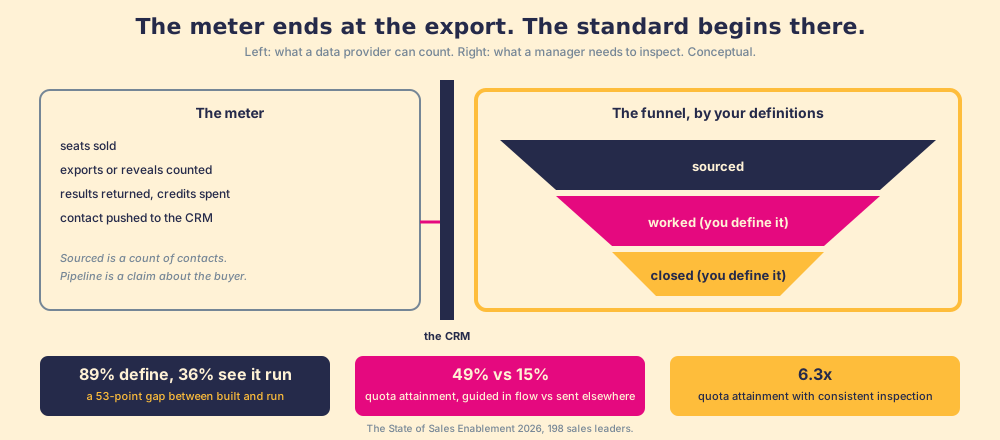
Here is where every vendor on this page stops, and where the second half of the argument begins. Start with where a rep’s day goes. The Bridge Group’s 2025 SDR report, 351 B2B companies, puts the median rep at 112 activities a day: 44 phone, 41 email, 19 LinkedIn, 8 text or other, with a median of 60% of SDRs at quota, “the lowest reported in study history” (Bridge Group, 2025). None of the 112 happens in a data tool’s tab. The same report puts median pipeline sourced per SDR at $3.78M, and then adds the limitation line that decides the purchase: “Pipeline figures represent raw pipeline generated, not forecast or closed-won revenue.” Sourced is a count of contacts. Pipeline is a claim about the buyer. The two are separated by whether the rep worked the contact, and no data provider’s meter can see that.
Our field data measures the same gap for the sales process as a whole. Across 198 sales leaders, 89% have a defined process and 36% see reps run it, a 53-point gap between built and run; reps who get the next step in the flow of their work report 49% quota attainment against 15% for reps who have to go somewhere else for it; and teams that inspect deals against the process consistently hit quota at 6.3x the rate of teams that rarely do (The State of Sales Enablement). A Clay table the reps never open sits in that gap. So does a ZoomInfo seat whose exports never became a call.
Clay says the first half of this itself. Its homepage promises to “build centralized workflows for any rep to run,” and its rep-prospecting page describes a Chrome-extension partner that “lets reps enrich with Clay and sync prospects to your CRM anywhere on the web,” with a case study of a sales team that put 110 reps on Clay prospecting and “No Clay login required” (clay.com/use-cases/rep-prospecting). The category is real and Clay endorses it. What that category lacks is the second half: a front end without a standard is a faster way to fill the CRM with contacts no one works.
The one we built is Supered. It runs on the customer’s own Clay account, so a rep on a LinkedIn profile, a Sales Navigator list, a company website, or a HubSpot or Salesforce record gets Clay’s waterfall across 200+ vendors in one click, with no Clay login, and the contact then enters a motion the Behavior Layer guides and measures: sourced, worked, closed, by the customer’s own definition of worked and closed, deal by deal, with the manager coaching off the signal instead of chasing it. It is for a team that has Clay; if yours does not, one of the four groups above is the right read, and we say so plainly. Clay governs the data. Supered governs the motion.
What we recommend
The options, plainly. Buy a single database when the seat buys a workflow you want (Apollo’s bundle, ZoomInfo’s intent and success manager) or a posture you need (Cognism’s EMEA compliance). Buy an export-metered tool when the team is small enough that the rep walking to the tool costs nothing. Buy the aggregation layer when the coverage problem is the problem, because it asks every shelf and charges only for the fish in your hand, and one Growth plan costs less than a tenth of the ZoomInfo-plus-Cognism pair a second-contract habit builds.
And if the team already has Clay, do not buy another shelf. Put the waterfall on the rep’s screen and set a standard behind it: 49% against 15% is the difference the front end makes, and 6.3x is the difference the standard makes. What that standard looks like step by step, from the first sourced contact to the customer’s definition of closed, is the subject of the sales prospecting guide, and the same map read through the enrichment lens, which fields each tool fills and why a waterfall out-matches a single source, is data enrichment tools.
Frequently asked questions
What are the best b2b data providers for a mid-market sales team?+
What is the difference between a b2b data vendor and a data aggregation layer?+
Which b2b contact data providers are GDPR compliant?+
How much do b2b data providers cost?+
Do I need a data provider contract at all if my team has Clay?+
What should I look at beyond the data provider's match rate?+
Your process, running itself.