AI Upskilling: Lyron on the Kid in the Library
Lyron trains groups from the Pentagon to Major League clubs on AI. How he uses Claude as a thought partner, his three stages of AI maturity, and why he says AI will not fix bad governance.
AI upskilling is training that builds people's ability to do their work well with AI, which in Lyron' view means framing problems well, verifying what the model says, and fixing the governance it runs inside, because AI speeds up whatever a team already does.
Lyron showed up to our recording a few minutes late. He had come straight from a four-hour facilitation on agentic AI for members of the Pentagon, his second session with them. Before that he had run sessions at Yankee Stadium and at the San Francisco Giants’ ballpark, and the Detroit Tigers were next on his calendar.
Lyron runs ProFabula, where he builds leadership academies for clients, and he works close to full time as an author fellow for Pluralsight, speaking and teaching. He came to generative AI already knowing the older kind. He had trained people on expert systems and knowledge management, rule-based systems that return a firm yes or no. ChatGPT put the probabilistic kind in front of the public, and on that side he started from scratch.
He sat down with Ashley Freter on Show Me Your Prompt, and his line on AI upskilling is one he repeats often: “AI will not replace you, but the person who knows AI will.” In the episode he explains what knowing AI means to him. You frame the problem well, you check what comes back, and you fix how the work is governed before AI speeds it up.
How does Lyron use Claude as a thought partner?
Ashley asked for his featured prompt, and he described a problem from that week. A national client had launched its first leadership academy, and participants were sending back anxious feedback about the capstone project. People were putting it off. Lyron suspected the assignment was unclear, and he did not have much time to think it through.
So he wrote the problem up for Claude. His steps, as he described them:
- The problem. The anxiety coming back about the capstone, and his hunch that it came from ambiguity.
- The evidence. The feedback he had collected from participants.
- The ask. Advice on what the academy should do next.
- The handoff. He sent Claude’s responses to the client, framed as ideas the team should explore.
The advice was “clear, clean, good advice that took me a little bit further down the causal issue rather than the symptoms.” Claude looked past the anxiety and the delays and asked whether the capstone itself was designed well, then suggested questions to put to the participants. “It’s more as a thought partner, you know, that’s super smart, um a little bit inexperienced about life, uh but super intelligent.”
Nothing in the prompt was clever. What made it work was what Lyron put in: he knew the academy and the participants, he had the feedback, and he had a hunch worth testing. Anthropic’s own guidance says the same about its model: “Think of Claude as a brilliant but new employee who lacks context on your norms and workflows. The more precisely you explain what you want, the better the result” (Anthropic).
What does a kid locked in a library know?
Lyron describes generative AI today as “a kid who’s locked in a library and has access to everything.” The kid “doesn’t go outside and play, doesn’t know anything about the outside world, doesn’t know know about adulthood.” So you can send it to fetch information, he said, as long as you treat that information as something that “does absolutely need to be verified and checked and validated.”
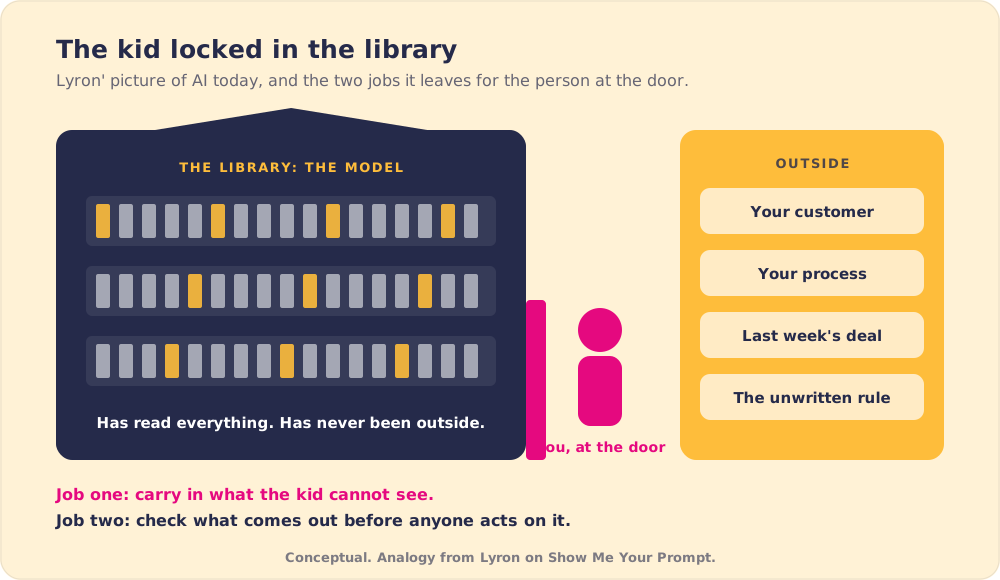
Ashley had run into this the same week. She asked a model something, pushed back with “Are you sure? I think it could be so-and-so,” and it answered, “Oh, you’re right. I didn’t take that into account.” She said it sounded like her daughter when she is sure she is right and missing part of the story.
A study of consultants shows what happens when people do not push back. Harvard and BCG researchers gave more than 700 BCG consultants realistic tasks, some inside AI’s capability and one chosen to sit outside it. On the tasks inside, consultants with GPT-4 improved 38%, and those who also got a prompting overview improved 42.5%. On the task outside, performance dropped 13 percentage points for the GPT-4 group and 24 points for the group with the overview (MIT Sloan, 2023). The consultants who had been taught to prompt leaned on the tool hardest on the task it got wrong.
So Lyron’s habit belongs in the training next to the prompting. AI training for employees that stops at prompting leaves people trusting the kid more. Ashley’s “Are you sure?”, and a check against a source the model did not write, is the part a course tends to leave out.
Where is your company on Lyron’s three stages?
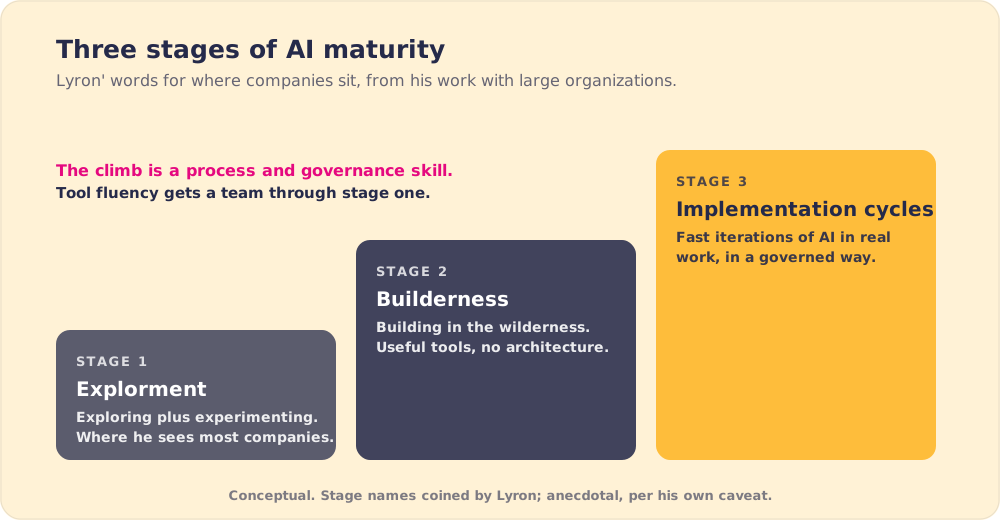
Ashley asked where people’s AI skills sit today. Lyron answered with three words he coined, and a disclaimer: his view is anecdotal, drawn from his work with Fortune 100 companies, and “people look at them like, ‘That’s dumb.’”
- Explorment. A blend of exploring and experimenting. “I think is where most people are.”
- Builderness. “A combination of building in the wilderness.” Teams build useful tools that may still be around in two years, without asking how they fit the enterprise architecture. “It makes me feel like I’m crazy when I hear about it.”
- Implementation cycles. Fast iterations of AI services and products in real work, “and it is in a governed way.” He calls it the most mature stage.
As evidence that the bulk of companies are still exploring, he pointed to analyst research showing “upwards of 70 to 90% of companies have experienced zero ROI.” MIT’s GenAI Divide study came out in the same range: about 5% of AI pilots achieve rapid revenue acceleration. Its lead author, Aditya Challapally, blamed a “learning gap” in both tools and organizations, since generic tools “don’t learn from or adapt to workflows” (Fortune, 2025).
Is AI behind the layoffs?
Ashley pressed him on a contradiction. If so many companies see no return from AI, why are layoffs and hiring freezes happening anyway?
Lyron doubts the official answer. The leading indicators show little link between AI and the current cuts, and researchers agree so far: Yale’s Budget Lab found “the broader labor market has not experienced a discernible disruption since ChatGPT’s release 33 months ago” (Yale Budget Lab, 2025). “I tend to not believe that,” Lyron said. His reason is an old corporate habit more than anything about AI. Companies look at the future they expect, decide “we’re not right-sized for where we’re supposed to be,” and cut ahead of it. He has watched the large cloud providers let people go before any problem arrived. “This has been behavior, I think, that’s always always been out there.”
He expects the next jump to be a release on the scale of Anthropic’s Model Context Protocol, which changed how agents connect to tools. In his view the next one will take on the manual work inside organizations, and he thinks it is months away.
Why won’t AI fix bad governance?
Lyron ended with a warning. He borrowed a term he heard from a religious leader and philosopher, AI effervescence, for an overly rosy belief about what AI will produce. He felt the same hesitation in the early days of the cloud.
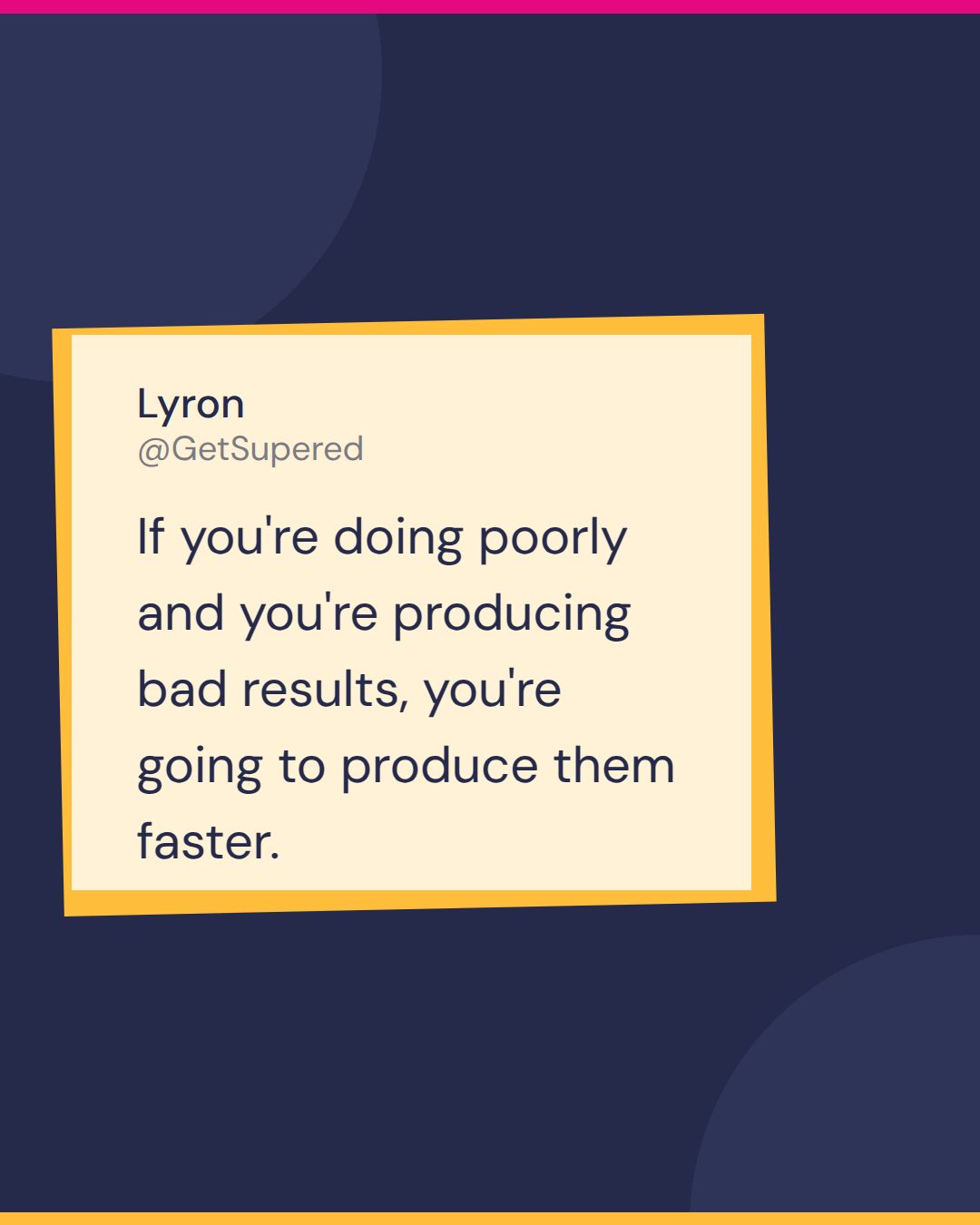
“AI is not going to make bad governance better,” he said. “What AI will do is it will accelerate whatever you’re doing. So, if you’re doing poorly and you’re producing bad results, you’re going to produce them faster.”
Our survey of 198 sales leaders found the same pattern in sales teams. In The State of Sales Enablement 2026, 40% of teams with strong process adherence rated AI’s impact as high, against 21% of teams with weak adherence (The State of Sales Enablement 2026). Both groups had access to the same kinds of tools. The teams that got more from AI were the ones already running their process. We make a related argument in our post on the knowing-doing gap, about why a course can add knowledge without changing how the work gets done.
What does Lyron’s version of AI upskilling include?
Stay educated, he said, and start with what is free. “Anthropic has uh training that is all free, basically.” Anyone interested in where AI is headed who has not taken it, “that’s on them.” A lot of people will need it. The World Economic Forum projects that 59 of every 100 workers will need reskilling or upskilling by 2030, as nearly 40% of the skills required on the job change (World Economic Forum, 2025).
His other lessons turn into AI skills a team can practice:
- Problem framing. Set up the problem the way Lyron did with the capstone: the situation, the evidence, your hunch and the question.
- Verification. Treat each answer as the kid’s first try, and ask “Are you sure?” before anyone acts on it.
- A stage check. Name which of his three stages your company is in, and whether its tools connect to anything.
- Governance first. Fix the process before AI speeds it up, because it will speed up the bad version too.
- Staying human. His parting advice: “stay fabulous as a human.”
Teach the tool and the governance together
If we were spending an AI upskilling budget, we would not stop at prompt courses and completion counts. The consultant study shows where that leads: more use, and more confidence in places the tool is wrong. We also would not wait, because in Lyron’s terms waiting means staying in explorment. We would teach the tools next to the two things Lyron kept coming back to, a well-framed problem and a governed process, and have people check AI’s answers against both.
Lyron’s capstone prompt shows what good framing does. The consultant study shows the cost of trusting the tool outside its range. And our survey found AI’s payoff close to double where the process underneath it is followed.
For sales teams, Supered handles the governance half. It is the Behavior Layer that guides reps through the sales process inside HubSpot and Salesforce, in the flow of work, and shows whether each step ran, so the process AI speeds up is the one you intended.
Next, read our post on AI sales training for why practice alone does not carry into live selling, and our post on whether AI will replace sales jobs for what the data says so far.
Frequently asked questions
What is AI upskilling?+
Will AI replace my job?+
What are the three stages of AI maturity?+
Where can I get free AI training?+
Does AI training improve results?+
Your process, running itself.
Turn the playbook into rep behavior.
More from Show Me Your Prompt

AI Content Workflow: Erin Wriggers' Pipeline and the Human MCP
Erin Wriggers
AI Impact on Entry-Level Jobs: Nate Singer's Forecast and His Own AI Workflow
Nate Singer