AI Prompts for Sales Enablement: Christian Palmer's Daily Workflow
Christian Palmer is the only enabler at Lightricks, the company behind Facetune. How his daily prompt reads Slack, email and Zoom for his sales team, why he speaks his prompts, and how he prompts for the prompt.
AI prompts for sales enablement are instructions that direct an AI model to gather, filter, and translate company information into material reps can use; Christian Palmer's daily prompt reads email, Zoom calls, and Slack and turns the items his reps need into rep material.
Christian Palmer has worked in sales enablement for about eight years. “It’s kind of weird to say because enablement wasn’t a word for those first few years,” he said. Today he is the only enabler at Lightricks, the company behind the Facetune app, and he counts it as the fifth or sixth AI-focused company he has worked for. At one of them he enabled sellers of a workforce tool that used AI to find fractional talent, a contract CFO for instance.
For a long time his own use of AI lagged the products he sold. In the past year that changed, and he now runs AI prompts for sales enablement every day. “Now it’s like a daily part of everything it is that I do,” he said. “It’s hard to think about life before I had this now.”
Ashley Freter asked him to walk through his setup on Show Me Your Prompt, and his setup starts with reading. His main prompt goes through the email, Zoom calls and Slack threads that no single enabler could keep up with, and turns the items his reps need into material they can use. He spends the time it saves with sellers.
What is Christian’s daily prompt?
His problem is volume. Information reaches his company through every channel you would expect: email, recorded Zoom calls, Slack. It comes from different regions. “At all hours of the day, at any point with or without notice, something pertinent might come through the door that my sales team even like either at the very least needs to know about or more so might need a session around.”
So he built “a prompt that kind of automates and aggregates all of that information, displays it in one place, but also creates internal materials that they then can go use.” The materials are the ones a rep reaches for: the best discovery questions, the objections they will have to handle, and an explanation pitched “like they’re a fifth grader.”
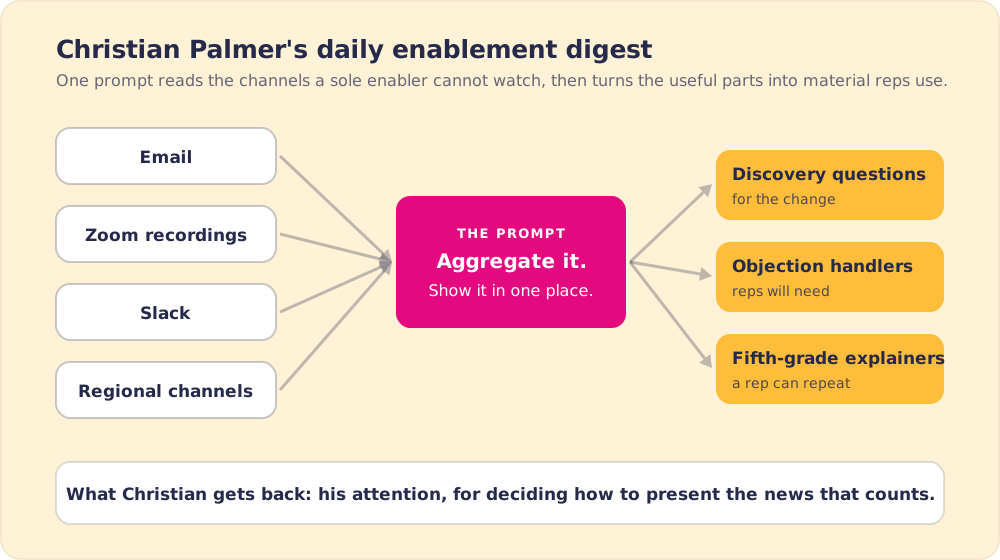
He said the prompt lets him “take my attention off of having to keep track of everything coming in and is it getting to the right people at the right time and more so like kind of crafting the best way to present that information to people.”
The volume is not his imagination. Microsoft’s telemetry on its 365 users found the typical employee interrupted every two minutes during core hours, 275 times a day, receiving 117 emails and 153 Teams messages a day (Microsoft Work Trend Index, 2025). Christian is one enabler reading on behalf of a whole sales team, so he has the prompt read it first and hand him a short list.
Why does Christian speak his prompts instead of typing them?
Because the words come out easier than they type. “I actually speak using the voice uh function more than typing,” he said. “Um because I don’t know what it is that I’m going to type, but I can get it out in words pretty easily.” Ashley, a self-described horrible speller, called it “a dream come true.”
Speaking is the first step of a habit he calls prompting for the prompt. He does not write his automation prompts from scratch anymore:
- Talk it out. He describes the job aloud in a chat window.
- Ask for a bolstered prompt. “Hey, please create like a bolstered prompt around um you know, aggregating all these different channels. um you’re going to need to use these XYZ connectors.”
- Iterate. He tweaks the draft, and when a light-bulb idea hits later, he goes back and adds it.
- Move it to Claude Cowork. The finished prompt goes into the automation tool. “It’ll spit out a couple clarifying questions and I’m off to the races.”
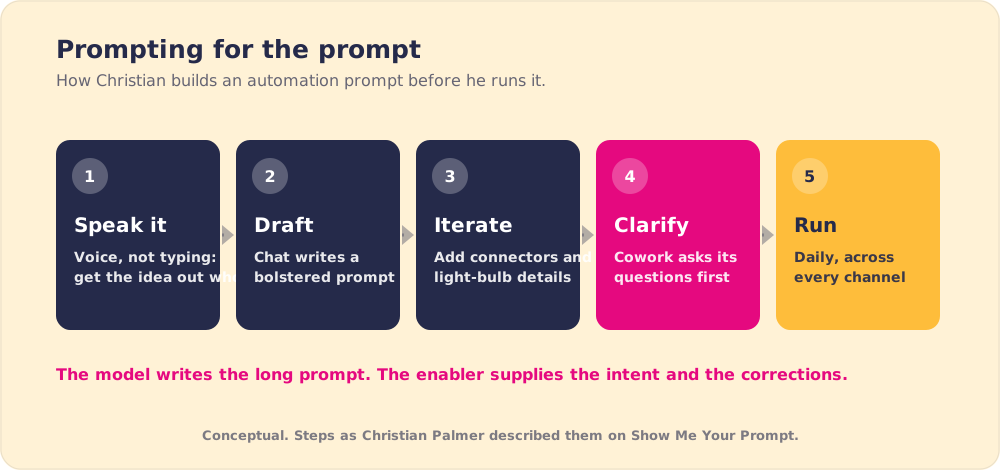
The method fits how the models are built to work. Anthropic’s guidance tells users to “think of Claude as a brilliant but new employee who lacks context on your norms and workflows. The more precisely you explain what you want, the better the result” (Anthropic). Christian’s spoken explanation carries that context, and the chat model tidies it into a precise brief. What he adds is what his sales team needs this week, which the model has no way to know.
How does Christian keep the human edge?
Christian has two habits for keeping the output his own.
The first is examples. “The more you give it opportunities to learn about you, I think the better,” he said. He feeds it samples of how he communicates: emails, video recordings, his comments on his own LinkedIn posts and other people’s. It worked well enough that the model now tells him a draft sounds “just like how you run enablement sessions, Christian.” His reaction: “You know what? It’s right.” Anthropic’s guidance backs the habit: “Examples are one of the most reliable ways to steer Claude’s output format, tone, and structure,” and it recommends three to five.
The second is in his settings. He has rewritten his preferences for how the model should talk to him many times, and the current version asks it to “challenge me with alternative angles.” Now it reframes his requests and flags parts that do not make sense before he builds on them.
He is candid about the trade. Many of his tools hold homegrown content he made over years, and he still wonders what happens to it. That fear has eased over the last 18 to 24 months, “mostly because of what it’s unlocked for me in terms of productivity.”
Will AI replace the enablement role?
“I think about it every day,” Christian said. He calls himself “naturally a somewhat paranoid person about layoffs in general,” and he does not think the tools are “very far away” from matching the brain power people bring. His answer is to make sure the people around him learn the tools too, because the ones who never touch them will be left behind.
He also sees what cheap content does to his own work. He used to “spend weeks or months writing up a deck” for a live session, only for it to “maybe not land.” The reinforcement afterward was often weak. Now that material is easy to produce, he said, “I’m willing to do to throw more at the learners.”
More material only helps if reps think it is worth their time. In The State of Sales Enablement 2026, the top reason enablement tools become shelfware was that reps do not see the value, cited by 55% of respondents, ahead of managers not reinforcing the tool at 51%. Christian’s digest keeps each piece small and tied to something that came in that week, as discovery questions, objection handlers, or a plain explanation a rep could repeat to a buyer.
Ashley asked where he thinks the role is going. He expects AI to let enablers spend more time “on the ground building relationships with their revenue compadres,” hearing what sellers deal with, instead of sitting behind a screen analyzing trends. Some companies will cut the role and call AI the replacement, he said, “but they’re going to find that that isn’t a long-term strategy.”

Christian’s workflow as sales enablement prompts
His setup, written out as three sales enablement prompts you can adapt. The wording below is ours, built from what he described.
- The bolstered-prompt request. “I want to automate a daily enablement digest. It needs to read these Slack channels, this email label, and our Zoom recordings through these connectors. Write a detailed prompt for an agent to run it, and ask me any questions first.”
- The daily digest. “Aggregate everything new across these channels since yesterday and show it in one place. For anything my sales team needs to know, draft the best discovery questions, the objections reps will have to handle, and a plain explanation a fifth grader could follow.”
- The standing preference. Set once in your settings: “Challenge me with alternative angles.”
For prompts aimed at the reps’ own selling work, our post on ChatGPT prompts for sales covers that side of the desk.
Christian’s lessons on AI prompts for sales enablement
- A digest before a deck. His first prompt watches the channels and pulls out what reps need to know; content comes second.
- Spoken intent. He talks the idea out because he can say it more easily than type it, then lets the model tighten it.
- A prompt for the prompt. A chat model writes the long automation prompt, he corrects it, and Claude Cowork asks its questions before it runs.
- Your own examples. Emails, videos, and comments teach the model his voice.
- A model that argues. His standing preference tells it to challenge him.
- Time back for sellers. The hours AI saves go to working with reps on the ground.
Where should an enabler start with AI prompts?
We would copy Christian’s order. Build the digest first, so reps hear about a change the day it happens. Build it by prompting for the prompt: talk the job through, let a chat model write the long version, and correct it. Then spend the saved hours with sellers, and put the few changes they need in front of them where they already work.
That last step is what we build at Supered. It is the Behavior Layer that puts the sales process and the next action in front of reps inside HubSpot and Salesforce, in the flow of work, and shows whether they took it.
The role Christian describes is the one we traced in our post on the sales enablement specialist in 2026. For how to sequence AI behind a process reps follow, read our guide to AI sales enablement.
Frequently asked questions
What AI prompts does a sales enabler use every day?+
What does prompting for the prompt mean?+
How do you make AI output sound like you?+
Can AI replace a sales enablement role?+
Is it safe to put company information into AI tools?+
Your process, running itself.