Risks of AI in Business: Tracy Gratzani on Mediocre at Scale
Tracy Gratzani started using AI tools years before ChatGPT. Her Claude workflow for call transcripts and scopes of work, and her view that the risk of AI in business is good-enough work at scale.
The risks of AI in business are the ways AI can cost a company clients, money or standing, and Tracy Gratzani of Greenfire Strategy puts one at the top: AI makes good-enough work cheap, so firms that were only ever good enough lose the reason clients paid them.
Tracy Gratzani was using AI tools four or five years before ChatGPT launched. She runs Greenfire Strategy, a Cleveland agency, under the title Geek Executive Officer (“everybody gets to pick their job title”), and she got early because of a neighbor. Paul Roetzer, who had built the first HubSpot agency partner, sold that agency and started the Marketing AI Institute in the same city. Tracy respected him, followed him, and tried whatever tools he said he was using.
Tracy sat down with our Ashley Freter on Show Me Your Prompt and walked through how she uses Claude today. It reads her sales calls, finds what she missed, and drafts scopes of work. At the end Ashley asked where all of this is going, and Tracy named the one risk of AI in business she does believe in. AI will make good-enough work cheap.
How did Tracy start using AI?
Carefully, and on the dull work first. Greenfire’s first paid tool was copy.ai. Tools like Jasper could already write content from scratch, and Tracy did not want that. “I didn’t really want to use it to create content directly,” she said. The tedious part of marketing was repurposing, so her team took blog posts written by people, fed them into copy.ai, and had it iterate on email subject lines and LinkedIn copy.
The results were modest. “It only did like okay first drafts even back then,” she said, “but it still was saving us some time and kind of working as a brainstorming partner.”
She still works that way. In the workflow she showed Ashley, people do the selling and the thinking, and Claude does the reading and the first draft.
What is Tracy’s favorite Claude prompt?
Her favorite job for AI right now is “bringing structure to unstructured data” and “catching the things that I miss.” Call transcripts are the unstructured data. Until recently she copied and uploaded them by hand; now a Fathom plugin feeds them to Claude.
The day she recorded the episode, a prospect told her on a call that her price was way more than he expected. He was sure she had said something else. She was sure she had been clear. After the call she loaded their three previous conversations into Claude and asked it straight: he swears he never knew this was the price, I swear it was obvious, “Where did this break down?”
Claude found it. “Here’s why you’re both confused because you in conversation one posed a hypothetical dollar amount.” In the first call she had said, “Well, I think that would be about $5,000 a month.” She had her own assumptions about what that covered. So did he. Neither of them ever pinned it down, and both anchored to the number from then on.
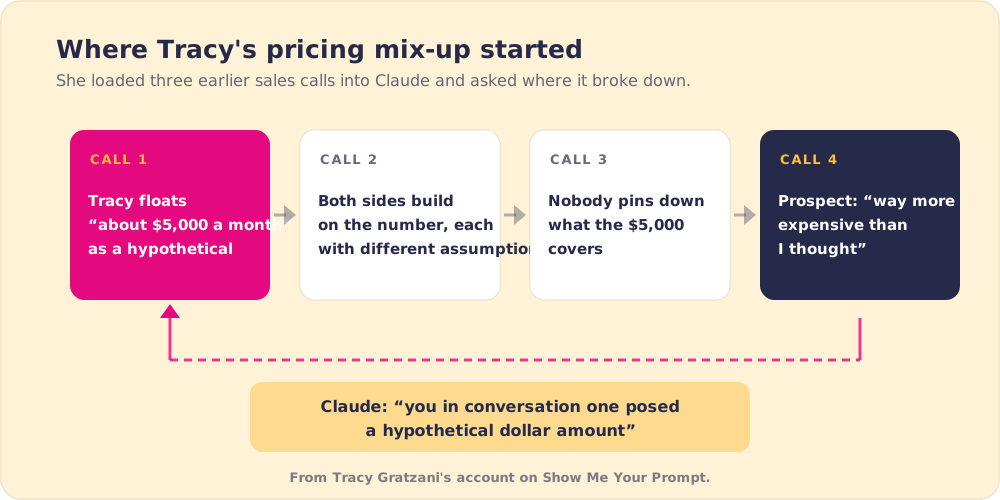
She went back to the prospect with the answer. “I can see why we’re both confused. I went back, I looked at the call recordings.” She told him she did not think either of them was being deceptive. It was a misunderstanding, and they could move past it.
Tracy’s point was that this used to be impossible. “We never had the ability to go back and figure those things out,” she said.
The psychology backs her up. In Amos Tversky and Daniel Kahneman’s classic 1974 study, people spun a wheel that landed on 10 or 65 and then guessed the share of African countries in the United Nations. The median guess was 25% for the group that saw 10 and 45% for the group that saw 65 (Tversky and Kahneman, Science, 1974). Tracy’s $5,000 was a guess too, and both she and the prospect carried it through three more calls.
Reading transcripts is also where sales teams already lean on AI most. In The State of Sales Enablement 2026, 73% of respondents said they actively use AI for call analysis and summaries, the top use in the survey. Tracy’s twist is the question she asks: she uses the summary to find her own mistake.
How does Tracy turn sales calls into a scope of work?
She calls this use more helpful than the first. Greenfire keeps a Claude project that holds its process for building a scope of work, a budget and a timeline. Tracy uploads the sales calls with a prospect, runs them through that project, and gives an instruction along the lines of: “based on the conversations this is the combination of products and services I want to sell them. Help me create a scope of work, timeline, and budget.”
“Because I already have all that data in there,” she said, “it puts out something that needs very little editing.”
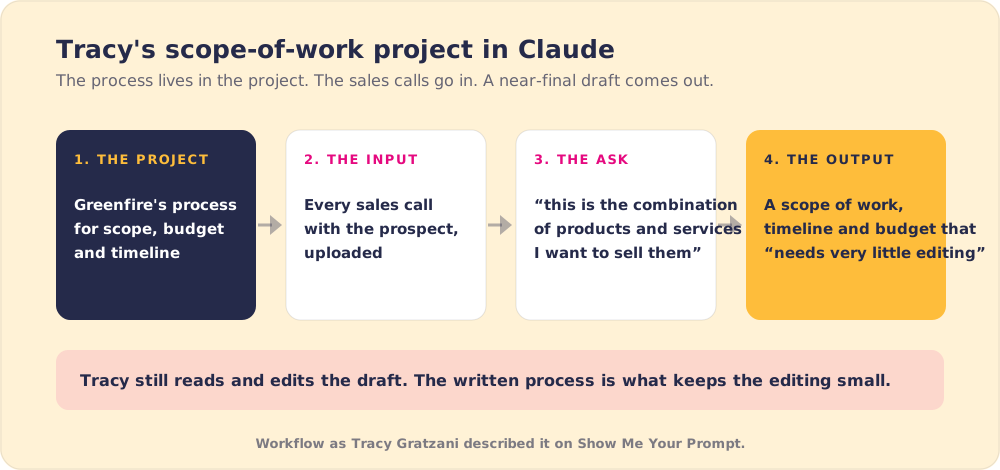
Tracy built the project before she ever uploaded a call. It already holds Greenfire’s process for scopes, budgets and timelines, so Claude drafts the scope the way her team would.
Larger companies find the same thing at scale. BCG surveyed 1,000 executives in 59 countries in 2024 and found 74% of companies had yet to show tangible value from AI. The leaders followed a split of 10% of their AI effort on algorithms, 20% on technology and data, and 70% on people and processes (BCG, 2024). Tracy’s Claude project is a small version of that 70%: Greenfire wrote its method down, and Claude follows it.
Why does Tracy keep a human in the loop?
Because Claude knows some things about Greenfire and not others, and Tracy has seen it argue from half the facts. She prefers Claude, partly because Anthropic built it on a constitution. “They actually have like moral parameters on which they built the company,” she said, “that does trickle through.” She uses AI agents to QA Greenfire’s website as a neutral third party (“go to this website as our persona… Do all the buttons work? … Is the messaging clear?”), in addition to people.
Claude also keeps Greenfire’s company values in memory, and that produced her favorite story. She was posting a job on Indeed, got stuck on a form, and asked Claude what to pick. The question was whether Greenfire wanted to be a second-chance employer, open to candidates with a criminal record. For this role, she said no.
Claude pushed back. “I want to push back on you here,” it said, pointing to Greenfire’s “very humanist, like, pro-people values and culture” and asking why she would exclude a possibly good candidate for something in their past.
Tracy supplied what the model did not know: “this person would have access to our client’s sensitive data.” Claude accepted the point. Tracy took the challenge seriously too. For a role without access to client CRMs, she said, “maybe I should consider a a second chance employer… Why not, right?” Her verdict on the exchange: “Man, like you’re trying to help me be a better person, Claude. All right, we’ll take it.”
Claude asked a fair question, based on the values Greenfire had given it. Tracy knew who would see the client data, so she made the decision.
What does Tracy think the real risk of AI is?
Ashley asked where all this is headed. Tracy started with agents, and she is skeptical. “I think people are over indexing on agents,” she said, because “cost of running an agent isn’t actually significantly cheaper than a human doing a lot of that work,” and it “requires a whole lot of that human in the loop.” She expects a swing back to a middle ground, and pointed out that some companies that laid people off to replace them with AI have already started hiring back.
Then she named the one item on her own list of AI risks that she does believe in. In professional services, “like the work that we do, uh but also lawyers, accountants,” she said, “these tools are going to get good at doing things that people have been doing. And it won’t be great, but it’ll be good. And good is good enough.”
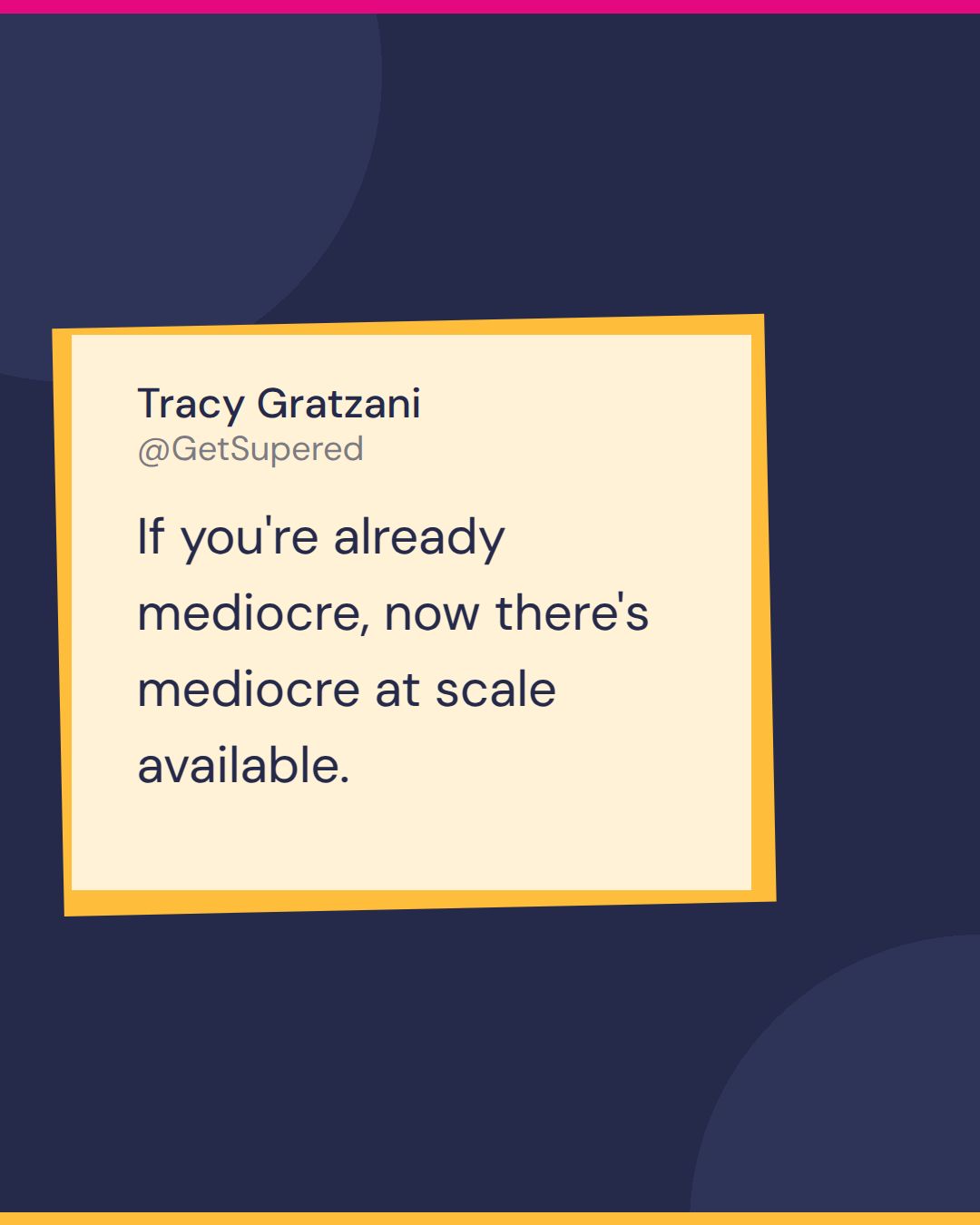
Her conclusion: “probably the bottom 20% of of companies in any given space aren’t going to be able… If you’re already mediocre, now there’s mediocre at scale available.”
The strongest field evidence fits her forecast closely. Researchers from Harvard Business School and BCG gave 758 BCG consultants realistic consulting tasks, with and without GPT-4. Inside what they called the frontier of AI’s abilities, below-average consultants improved by 43% and above-average consultants by 17%. On a task chosen to sit outside that frontier, consultants using AI were 19 percentage points less likely to get the right answer (Dell’Acqua et al., Harvard Business School, 2023).
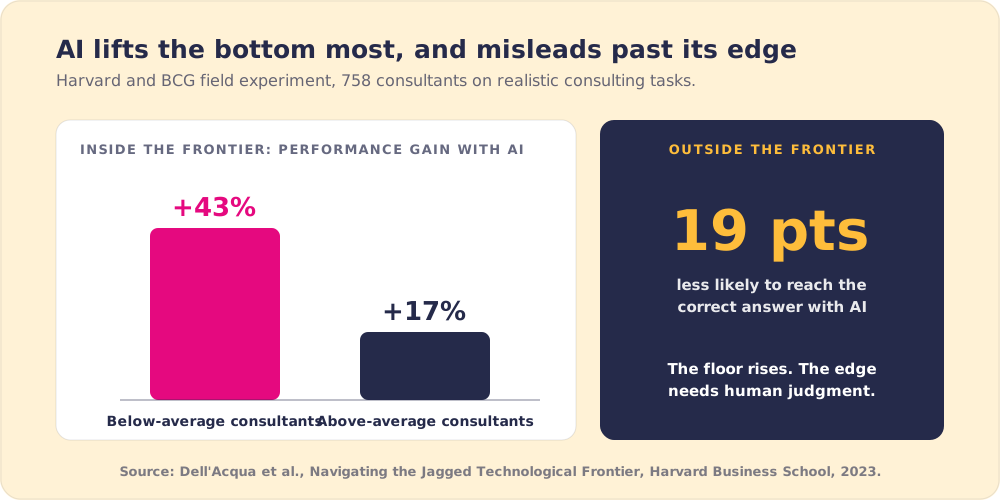
The study backs both parts of what Tracy said. The biggest gains went to the weaker consultants, which is her “good is good enough” in numbers. And on the task outside what the AI could do, people who leaned on it got more answers wrong, which is why she keeps a person on the hiring form and the pricing call.
Why does Tracy reject “AI won’t take your job, someone using AI will”?
She has heard it too many times. “If I see one more stupid like AI bro say on LinkedIn again, I might just my head might explode,” she said. “It’s not that direct,” she told Ashley. The change will come from somewhere else. The pressure comes from the economics of the business, which “has always… optimized for efficiencies and profit.” Her rule is simple: “where it makes sense for a business, they will use AI. Where it doesn’t, they won’t.”
So Tracy looks at the firm, and at the quality of its work. “I think that a lot of people are in a safe place, really, if they if they do good work,” she said. The firms that have done “just enough to get by” are the ones she expects to have a hard time.
Tracy’s lessons on the risks of AI in business
- Humans on the original. From her first copy.ai experiment on, people wrote the work and AI reshaped it.
- AI as a reader of your own record. Three call transcripts and one question found a $5,000 anchor she would never have spotted by memory.
- The process in the project first. Her scope-of-work drafts need little editing because Greenfire’s method was written down before any call went in.
- A person where context lives. Claude questioned her answer on the hiring form, and Tracy settled it with a fact Claude didn’t have: the role could see client data.
- Skepticism on agents. She sees them costing close to what a person costs and needing a person to run them.
- Good work as the defense. Her forecast is hardest on the bottom 20%, the firms whose work AI can now match.
What to do with Tracy’s warning
Take Tracy’s warning the way Greenfire did. Write the method down, point AI at it and at your own records, and keep people on the calls where context decides the answer. Waiting assumes good-enough AI never reaches your kind of work, and automating everything today copies your process at whatever quality it has now. The Harvard and BCG study shows AI closing the gap between average and good work, and BCG’s 2024 survey found the companies getting value from AI spent 70% of the effort on people and process. Tracy did that on a small scale when she wrote Greenfire’s method into a Claude project.
A sales team can make the same move Greenfire made. Write the sales process down, then get it in front of reps while they sell. Supered does the second part inside HubSpot and Salesforce and reports which steps got done. Our guide to AI sales enablement covers how to sequence AI behind a process people already follow.
The natural next read is on the gap between having a process and running it. Start with why reps drift from the sales process, then the knowing-doing gap.
Frequently asked questions
What are the biggest risks of AI in business?+
What does mediocre at scale mean?+
How does Tracy Gratzani use Claude with sales calls?+
Will AI agents replace employees?+
How do you reduce the risks of AI in business?+
Your process, running itself.
Turn the playbook into rep behavior.
More from Show Me Your Prompt

AI Prompts for Sales Enablement: Christian Palmer's Daily Workflow
Christian Palmer
AI Impact on Entry-Level Jobs: Nate Singer's Forecast and His Own AI Workflow
Nate Singer