Sales Enablement Specialist: The Job Description Is Depreciating
Most job posts cast the sales enablement specialist as an asset-maker: build the decks, run the LMS, keep the library tidy.
That job description is depreciating. Here is the role that survives, and what good looks like.
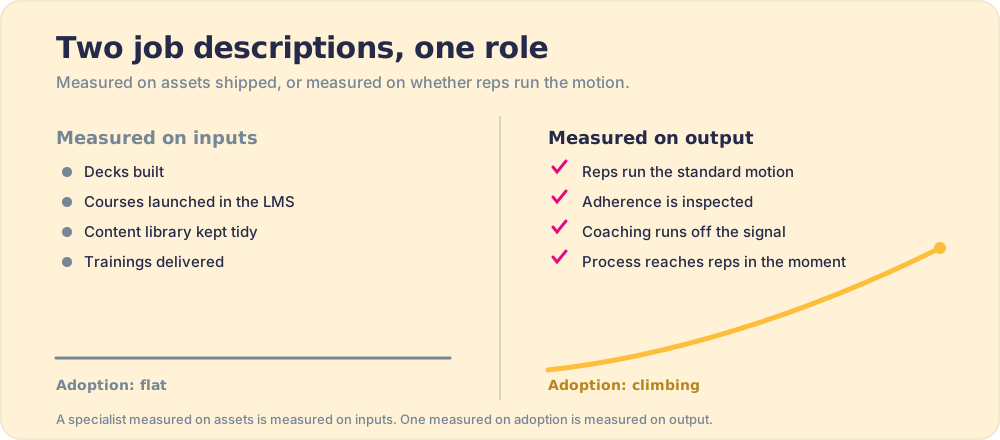
A sales enablement specialist is the person who equips reps to sell well; the durable version of the role makes the standard reach the rep in the moment of the work and inspects whether they follow it, rather than producing decks and courses.
A new sales enablement specialist gets a job description in week one, and it reads like a production schedule. Build the onboarding deck. Stand up the certification path in the LMS. Keep the content library current, tag the assets, retire the stale ones. Run the monthly product training. Each line is a thing to make. By the end of the quarter the specialist has shipped forty assets, and the slow truth arrives at the same time the numbers do: the portal shows a handful opened twice, and the reps who hit quota would have hit it anyway.
That job description is a depreciating one. The asset-maker version (build the decks, run the LMS, keep the library tidy) treats enablement as a content problem. It is not. Knowledge is solved. Any rep can find the doc, and an AI can summarize it in seconds, which means the part of the job that produces documents is the part a machine now does faster and cheaper every year. The work that decides whether the role matters is the other half: making the standard reach the rep in the moment of the work, and inspecting whether they follow it, then coaching off that signal. A specialist measured on assets shipped is measured on inputs. One measured on whether reps adopt the motion is measured on output. Defined for 2026, a sales enablement specialist is the person who equips reps to sell well, and the durable version of the role makes the standard reach the rep in the moment of the work and inspects whether they follow it, rather than producing decks and courses that go stale the day the process changes.
What is a sales enablement specialist, exactly?
Strip the title to its plain meaning and a sales enablement specialist is the person whose job is to make reps better at selling. They sit between the sales team and the rest of the company: they take what marketing, product, and leadership know, and they turn it into something a rep can use on a real deal. Useful, ordinary, and plain enough to agree on before we argue about it.
The trouble starts with how the job gets scoped. Most sales enablement specialist job description templates list the deliverables, because deliverables are easy to write down and easy to count: number of trainings run, assets created, courses launched. A hiring manager can put those on a scorecard and feel like they have defined the role. They have defined the inputs. Whether any of it changes what a rep does in the flow of a real deal is a separate question, and it is the one that decides the number.
Consider two specialists. The first builds a beautiful discovery-call playbook, uploads it to the enablement portal, and announces it in the team channel. Done. The second builds the same playbook, then makes the three questions from it appear next to the deal the moment a rep opens a new opportunity, watches which reps ask them and which skip straight to the demo, and tells the manager which reps to coach this week. Same artifact. The first specialist produced a document. The second produced a behavior. Only one of them is doing the durable job.
The two specialists differ the way knowing better differs from doing better, the oldest problem in the field. Pfeffer and Sutton wrote a whole book on it in 1999, The Knowing-Doing Gap, about companies that knew far more than they did. The execution gap, the space between what a team knows it should do and what it does on real deals, is where sales numbers are won and lost, and no amount of content closes it. A document is an input. The behavior the rep runs in the flow of the work is the output. A specialist who cannot tell the two apart will spend a career improving the wrong one.
What does a sales enablement specialist do day to day?
The sales enablement specialist role splits cleanly in two when you watch it across a week. The legacy day looks like a content calendar: build, schedule, publish, repeat. The durable day looks like a loop run against real deals. Naming both cleanly matters, because a specialist drifts toward the first by default. The first is what the job description asked for.
- Define the standard. Decide what good looks like for one motion at a time, stated as something you could watch happen on a deal: the discovery questions that must get asked, the fields that must be filled before stage two, the proof point that has to land before the demo. A standard with no visible edges cannot be adopted, and it cannot be inspected.
- Deliver it in the flow of work. Put the next right step in front of the rep where they already are, the instant it is relevant, so following the process is the path of least resistance instead of a memory test. This work replaces “build a deck and hope they read it.”
- Inspect adherence on real deals. Watch whether the motion is being run, deal by deal, while there is still time to fix it rather than at quarter close. Inspection is the keystone, and the asset-maker version of the role skips it entirely.
- Feed coaching. Hand managers the coachable moments: the rep who keeps skipping discovery, the stage reps game to hit a pipeline target, the step that has stopped earning its place and should be retired. The specialist does not replace the manager’s coaching; they make it possible by surfacing where it is needed.
Most of the content production is missing from that list. Content still matters. In 2026 it is the cheap part. A specialist who spends the day making decks is spending it on the input a language model now generates in a minute. The scarce, valuable work is the part a machine cannot do: deciding what the standard should be, getting it to land in the moment, and reading whether reps followed it.
What skills does a sales enablement specialist need?
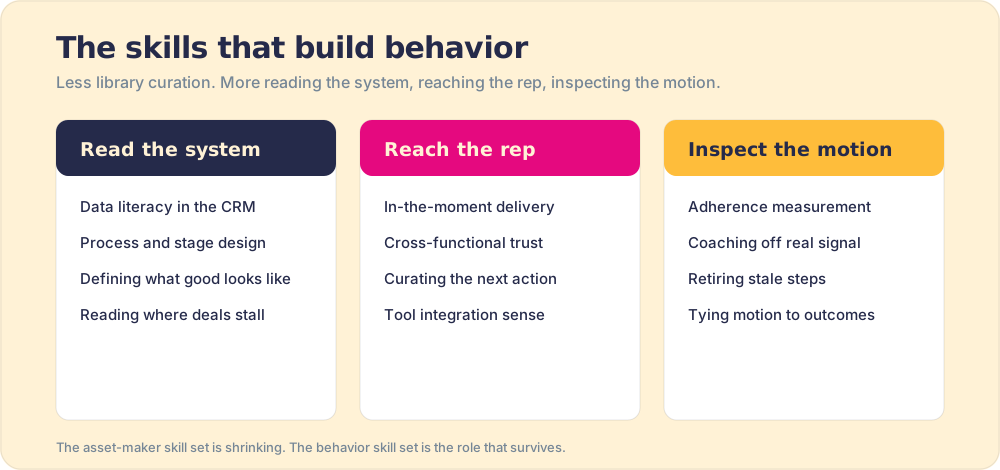
The conventional skills list reads like a content producer’s resume: instructional design, copywriting, LMS administration, project management. Those are real, and a specialist needs enough of each to function. But the sales enablement specialist skills that decide whether the role moves the number cluster into three groups, and only one of them overlaps with the old list.
- Read the system. Data literacy in the CRM, process and stage design, and the judgment to define what good looks like for a given segment. A specialist who cannot read where deals stall cannot decide what standard to set, and will end up building content for problems the data says are not the bottleneck.
- Reach the rep. In-the-moment delivery, the cross-functional trust to get sales managers to adopt a motion, and the discipline to curate one next action instead of adding surface area. Reps get more effective with a short, curated set of steps tied to a clear expectation, not with another tab to check.
- Inspect the motion. Adherence measurement, coaching off real signal, and the honesty to retire a step that has stopped earning its place. You can only expect what you inspect, and a specialist who cannot measure adherence is running on intuition, which is to say running blind.
The skill the market still over-weights is content production, and it is the one losing value fastest. CSO Insights, the research arm now inside Korn Ferry, found that the firms which formalize enablement (a charter, dedicated headcount, integrated technology, measured coaching) capture roughly 20 to 30 percent advantages on win rate, quota attainment, and ramp time (Korn Ferry / CSO Insights). The lift comes from the measured, integrated parts of the function. It does not come from the size of the content library.
Why the asset-maker job description is depreciating
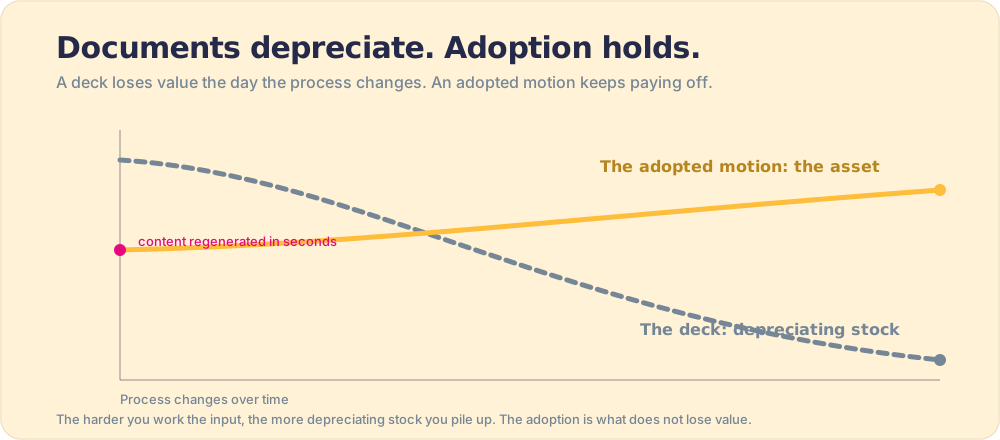
The deeper reason goes beyond “AI writes decks now.” A document is a depreciating asset the moment the process it describes changes, and the process always changes. The deck built for last quarter’s pitch is wrong by the next pricing update; the certification path drifts out of date the week the messaging shifts; the library that was tidy in January is a graveyard of stale assets by June. A specialist whose output is documents is, in accounting terms, producing inventory that loses value on a schedule. The harder they work, the more depreciating stock they pile up.
This is not a hypothetical. The same research that ties formalized enablement to better outcomes also shows what happens when the function is measured on the wrong thing: scope expands, responsibilities pile on, and yet the value is not felt where it should be. The Sales Enablement Collective’s 2025 Salary and Landscape report found average enablement compensation fell, from $137,032 to $131,413 year over year, even as teams took on more strategic scope (SEC, 2025 Salary and Landscape report). Only 23 percent of practitioners feel enablement salaries reflect the value the function delivers. A function busy producing inputs reps do not adopt has a hard time proving its worth, and the comp data is what that looks like from the outside.
Working harder at the inputs will not fix it. Changing what the role is measured on will. The behavioral version of the job produces something that does not depreciate: an adopted motion, inspected and coached, that keeps paying off because it keeps getting run. The content inside it can be regenerated in seconds when the process changes. The adoption is the asset.
Teams whose guidance is embedded in the flow of work hit quota at 49 percent. Teams whose guidance lives in docs, wikis, and a separate tool hit quota at 15 percent. Same content. The moment of delivery is the lever.
That contrast, from the State of Sales Enablement 2026, puts the case in two numbers. The same guidance, embedded in the flow of work versus parked in a portal, more than triples the share of reps hitting quota, 49 percent against 15 percent. A specialist who spends the quarter filling the portal is working on the 15 percent side of that gap. The job that survives is the one that moves guidance to the 49 percent side, where the work already happens.
How does adoption move the number?
Through a mechanism that is easy to state and hard to fake: a process exists only to the degree that adherence to it is inspected, and the firms with high adoption post the better numbers because the motion is getting run, not because the playbook is prettier. The CSO Insights study is unusually clean on this. Track quota attainment against how widely the sales process is adopted, and the line climbs steadily: at under 25 percent process adoption, quota attainment sits at 49.4 percent; at 76 to 90 percent adoption it reaches 64.0 percent; above 90 percent adoption it hits 72.4 percent (Korn Ferry / CSO Insights, via Highspot).
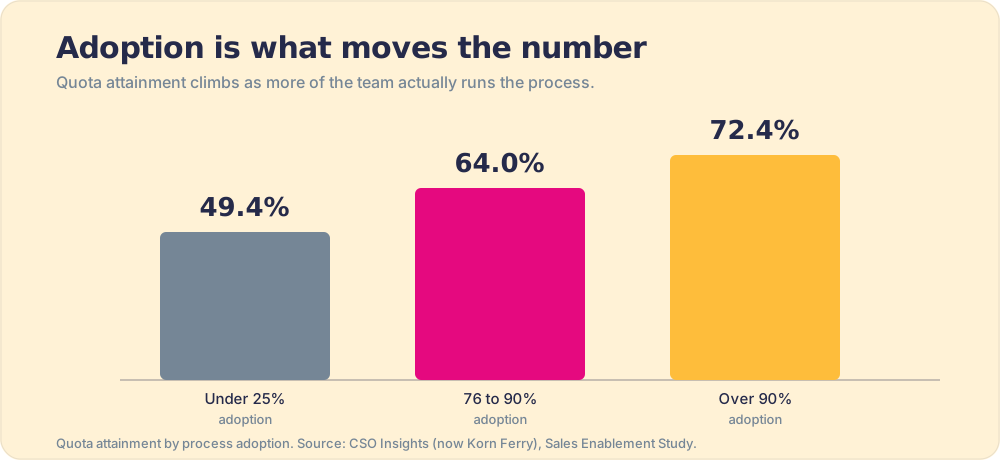
Read that curve as a job description and it tells the specialist exactly where to spend time. The distance from 49.4 percent to 72.4 percent quota attainment is not a content gap; it is an adoption gap. You cannot close it by building a better deck, because the teams at the bottom of the curve are not failing for lack of material. They are failing because the material is not getting run on real deals. The specialist’s edge is in the climb between those bars, and the only tool that climbs it is inspection plus coaching, not production.
Inspection is also what turns the role from a cost center into a function you can steer. In our own survey, teams that consistently inspect deals against a defined process hit quota at 6.3 times the rate of teams that rarely do, the single largest effect we measured (State of Sales Enablement 2026). The catch every specialist hits is that inspecting by hand eats the time that should go to coaching, which is exactly why it gets dropped and the work falls back to producing content the team can at least count. The durable version of the role lifts that burden: automate the inspection, spend the human time on the coaching. A tool belongs exactly there.
Sales enablement specialist versus sales enablement manager: what is the difference?
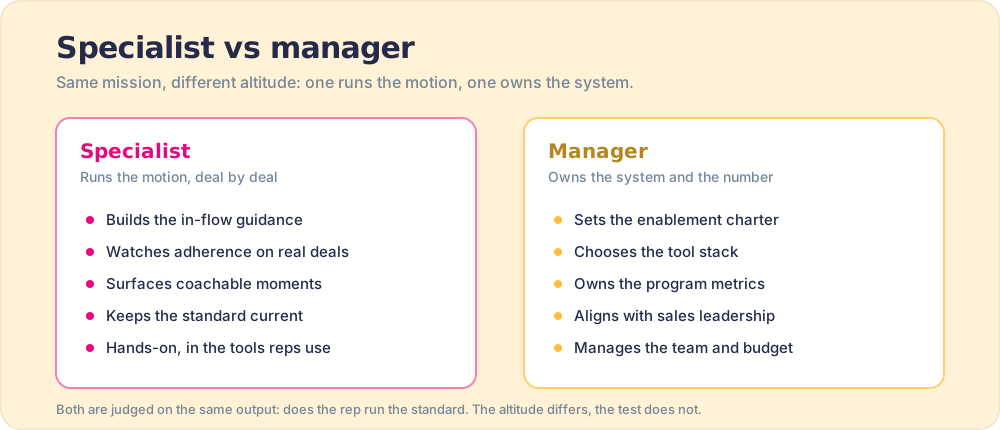
The two roles get blurred in job posts, and the blur costs money, because a team that hires a specialist to do a manager’s job, or pays manager rates for specialist work, has mis-scoped its biggest lever. The clean cut is altitude.
A sales enablement specialist runs the motion deal by deal. They build the in-flow guidance, watch adherence on real deals, surface coachable moments, and keep the standard current. The work is hands-on and lives in the tools reps use. A sales enablement manager owns the system. They set the charter, choose the tool stack, own the program metrics, align with sales leadership, and manage the team and budget. One is closer to the deal; the other is closer to the strategy.
The pay reflects the altitude more than the work itself. The SEC’s 2025 report puts entry-level enablement professionals at an average of $75,517 and sales enablement managers at $116,800, with heads of enablement at $147,000 and directors at $190,000 (SEC salary guide). For the specialist title specifically, US salary sources land between roughly $77,650 (Salary.com, 2025) and an average near $103,851 on Glassdoor as of 2026 (Glassdoor). The same SEC data shows the “sales enablement” title averaging $112,879 against $163,870 for “revenue enablement,” a gap of more than $50,000 for largely similar day-to-day work. Scope and title move the number, a pattern that holds across every level in our sales enablement salary breakdown. What does not move it, on either rung, is how many assets you produced.
For the fuller picture of what the function is and where it is heading, what sales enablement is maps the field, and the sales enablement framework lays out the operating model a specialist runs inside.
What good looks like
A good sales enablement specialist is not the one with the fullest content library or the most trainings on the calendar. They are the one whose reps run the standard on a deal no manager is watching. That single test cuts cleanly through every input metric on a typical scorecard.
Concretely, a strong specialist can answer three questions about any motion they own, and a weak one can answer none of them. What is the standard, stated so plainly you could watch it happen on a deal? What share of reps run it, measured on real opportunities and not self-reported? And which reps need coaching this week, named, with the specific step they are missing? A specialist who can answer all three is running the durable version of the role. One who can only tell you how many assets they shipped is running the depreciating one. The comp data, the adoption curve, and the quota numbers each say which of the two to hire.
The right sales enablement KPIs for the role follow directly: adoption and adherence over content volume, coaching coverage over courses launched, and the motion’s effect on win rate over the size of the library. Measure the specialist on those, and you have hired for the job that survives. Measure them on assets, and you have hired for the job a machine is busy taking over.
So if you are writing the job description, or living inside one, change what it counts. The asset list is the easy half and the disappearing half. The hard half, the one worth a career, is making the standard reach the rep and inspecting whether they run it. If you want the system that makes that practical at a team’s scale, the sales enablement software guide is the place to start; if you want to know what the function is before you specialize inside it, begin with what sales enablement is.
Frequently asked questions
What is a sales enablement specialist?+
What does a sales enablement specialist do day to day?+
What is the difference between a sales enablement specialist and a sales enablement manager?+
What skills does a sales enablement specialist need?+
How much does a sales enablement specialist make?+
Your process, running itself.