BDR Meaning: the Prospector Is Only as Good as the Assay
BDR means business development representative.
What a BDR does all day, the quota and pay benchmarks, the career path, and the two places a BDR team breaks: the definition of qualified and the handoff to the AE.
BDR means business development representative: an early-funnel sales rep who reaches out to prospects who have not asked to hear from you, qualifies the ones worth an account executive's time, and books that first meeting.
In 1849, a man with a pan could stand in a California creek all day, swirling gravel, and go home rich or broke on one question: was the yellow flake in the bottom of the pan gold, or pyrite? The two look alike in the water. They do not look alike on the assayer’s scale. The prospector’s skill was half the business. The other half was the test that decided what counted as gold before anybody paid for it.
The BDR meaning fits in that one picture. A business development representative works the creek: cold accounts, most of them gravel, a few worth an account executive’s hour. BDR sales is a volume job and a judgment job at once, and the standard definitions list the volume (the calls, the emails, the sequences) and say little about the judgment. The judgment is what the company pays for. A BDR who books forty meetings of pyrite has produced nothing, and the account executive who drives across town to each one knows it by the third.
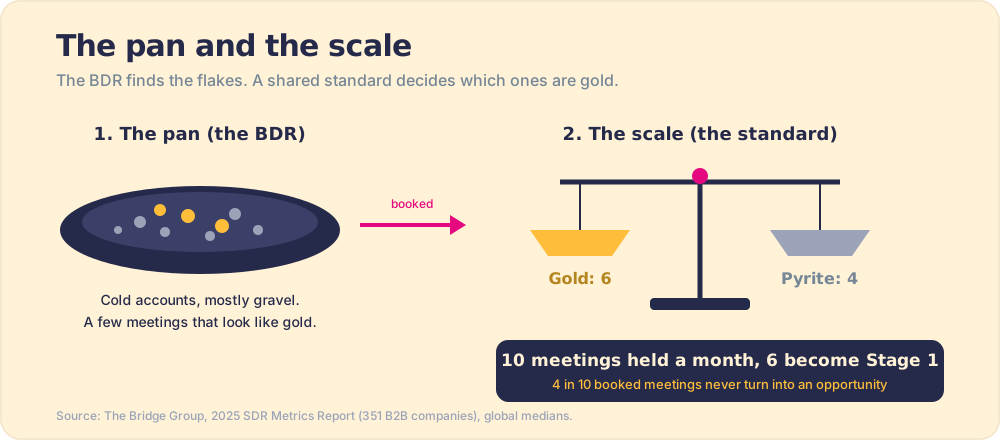
The pan is the rep’s skill. The scale is the company’s standard. The Bridge Group’s 2025 medians: 10 meetings held a month, 6 converted to Stage 1, so 4 in 10 weigh in as pyrite.
BDR meaning: what is a BDR, in plain terms?
A BDR is the person whose job is the first conversation. They pick an account that has never raised its hand, find the likely buyers inside it, and reach them by phone, email, LinkedIn, and sometimes text. When a buyer engages, the BDR runs a short discovery: is there a problem we solve, is the timing plausible, is this person anywhere near the decision? If the answers clear the bar, the BDR books a meeting and hands it to an account executive (AE), who owns the deal from there to close.
At Salesforce in the early 2000s, Aaron Ross split prospecting away from closing and put dedicated reps on it. In his account to David Skok, outbound reps “do NOT close deals, but create & qualify new sales opportunities and then pass them to Account Executives to close,” and his team’s qualified opportunities rose by 500 percent. The logic was specialization. Closers were too busy to prospect, and, in Ross’s blunt words, “Experienced sales people hate to prospect, and are usually terrible at it.”
So a BDR owns a narrow slice of the funnel on purpose:
- The source. Outbound, cold demand: accounts with no prior interest in you. The line between a BDR and an SDR usually falls here.
- The output. A qualified meeting that an AE accepts, measured against a written definition of qualified.
- The quota. Meetings held and pipeline created, never closed revenue, which belongs to the AE.
Is a BDR the same as an SDR?
Mostly, and the titles are not standardized. The common convention is that a BDR works outbound and an SDR (sales development representative) qualifies inbound leads that marketing generated, and both book meetings for an AE. Plenty of companies flip the labels or use one title for both. We cover the full comparison, comp table and all, in BDR vs SDR, and the inbound side of the job in what is an SDR. For the BDR meaning, one point carries over: the two roles share the same output and the same weak spot, which is the moment the meeting changes hands.
What does a BDR do all day?
A BDR’s day is mostly attempts, and a few conversations. The Bridge Group’s 2025 SDR Metrics Report, drawn from 351 B2B companies and published in February 2025, puts the median at 112 activities a day: 44 phone, 41 email, 19 LinkedIn, and 8 text or other. Out of that, the median rep gets 4.1 quality conversations a day.
More than a hundred knocks on doors for four conversations. The day runs roughly like this:
- Account research. Picking target accounts, finding the buying roles, and noting a reason to reach out now.
- Sequenced outreach. Calls, emails, and LinkedIn touches in a set cadence. The sales prospecting process covers how to build one, and cold calling tips covers the phone half.
- Short discovery. A few minutes on the phone to test fit, pain, and timing against the team’s qualification standard.
- The booking and the notes. Scheduling the AE meeting and writing down what the buyer said, which is the part the AE inherits.
- CRM logging. Recording the activity and the buyer’s answers, so the manager can see both the effort and where the buyer stands.
Which accounts get a phone call and which get a sequence is a team decision, made before the day starts, not one each rep makes alone.
From the field
We’re gonna create tier one, tier two, and tier three based on your ICP, and prioritize it, and it’s gonna be sent to your CRM. Your reps are not gonna be able to prospect into the tier three. So we’re gonna use email, we’re gonna do cold emails, and it is no way ever gonna book a meeting. It is straight-up marketing spend, and you need to see it that way. And then on tier twos, we’re gonna use a prospecting agent inside HubSpot, and tier ones, we’re gonna operationalize and distribute to your AEs or your SDRs.
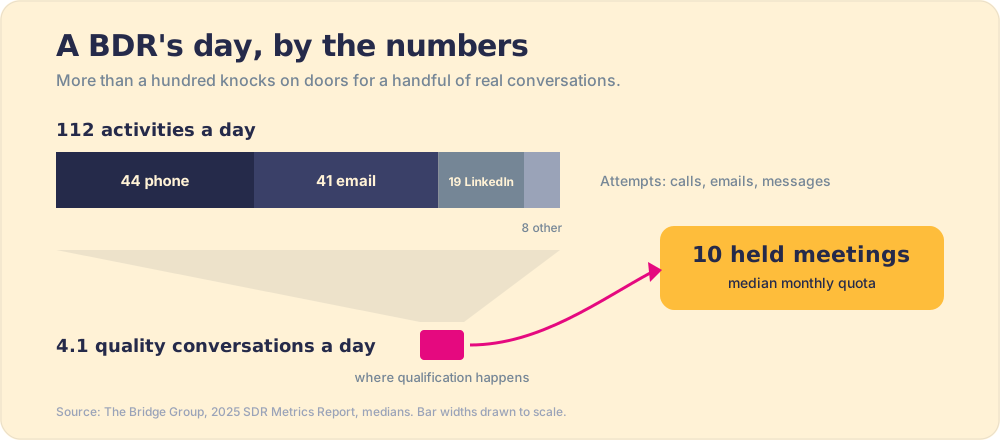
The funnel inside one BDR’s day: 112 activities (44 phone, 41 email, 19 LinkedIn, 8 other) become 4.1 quality conversations, feeding a quota of 10 held meetings a month.
How is a BDR measured, and what is a typical quota?
A BDR quota counts meetings, and the better teams count what the meeting turned into. The Bridge Group’s 2025 medians give you the benchmark set:
| BDR metric (2025 median) | Value | Trend noted in the report |
|---|---|---|
| Meetings held per month (quota) | 10 | Down 40% since 2018 |
| Meetings converted to Stage 1 per month | 6 | Down 43% since 2018 |
| Raw pipeline sourced per rep per year | $3.78M | Up from $2.83M in 2022 |
| Reps at quota | 60% | Lowest on record |
| Ramp to full productivity | 3.0 months | Lowest since 2010 |
| Reps per AE | 1 BDR : 2.4 AEs | Consistent since 2018 |
Ten meetings held, six converted: four in ten meetings a BDR books never become an opportunity. Some of that is ordinary attrition (buyers change their minds), and some of it is pyrite that passed for gold because the BDR and the AE were weighing it on different scales. Activity counts matter here, and you should keep them: they are how a manager sees whether the work happened. They cannot tell you whether the buyer moved, so a strong BDR scorecard pairs activity with the buyer’s position, and it adds one number that activity reports leave out: the share of booked meetings the AE accepts as qualified.
From the field
You have outcomes that you want done every single day. You set that expectation and you measure people against it. We’re not doing activity necessarily. It’s just, are the leads you’ve sourced being worked to your standard? Is your prospecting engine working?
How much does a BDR make?
The Bridge Group puts median OTE (on-target earnings, base plus variable at 100 percent of quota) at $80K, split $55K base and $25K variable, in its February 2025 data. Glassdoor’s self-reported US figures for the business development representative title, checked in September 2026, show base pay between $62K and $82K at the 25th to 75th percentile, and much higher reported total pay. Treat the Glassdoor total as a view of the upper end: the title spans enterprise and senior seats, and the data is self-reported.
Pay climbs with deal size and enterprise territories, and it shifts with how the variable plan is built. Pay a BDR for a booked meeting and you have paid for the flake in the pan. Pay for the meeting the AE accepts and you have paid for the assay.
What is the BDR career path?
The BDR seat is a door, and people walk through it fast. The Bridge Group reports a median tenure of 1.9 years and 40 percent annual attrition, which breaks into three streams: 13 percent involuntary, 11 percent voluntary, and 16 percent promotions. Promotions have halved since the post-2020 boom, when they ran at 34 percent.
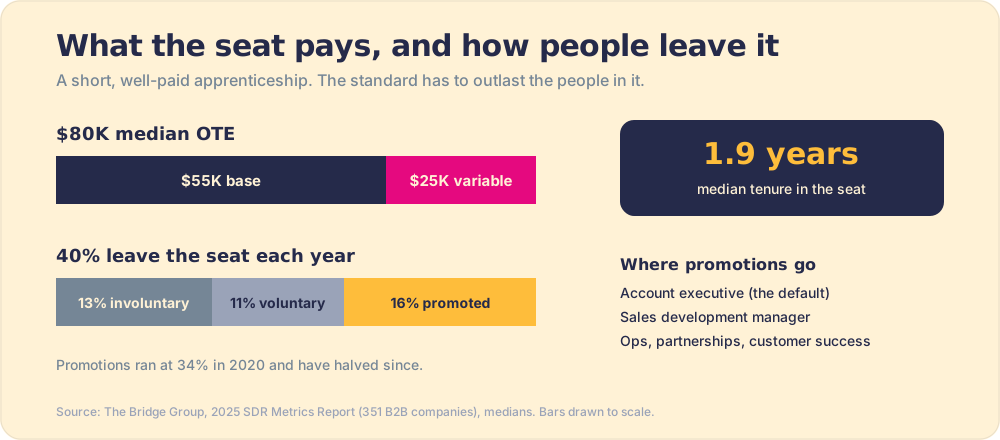
$80K OTE ($55K base, $25K variable) and a seat that turns over: 40% leave each year, 16% of them by promotion, 13% involuntary, 11% voluntary. Median tenure is 1.9 years.
The common exits:
- Account executive. The default next step, usually after 12 to 24 months. The AE seat trades a meetings quota for a revenue quota.
- Sales development leadership. Team lead, then sales development manager, where median OTE reaches $146K in the same report.
- Adjacent go-to-market roles. Sales operations, partnerships, and customer success.
The skills that predict the jump are the ones the job drills: resilience on a day of 112 attempts, crisp written outreach, fast research, the discipline to log what the buyer said, and, above all, qualification judgment. A new BDR learns the first four in weeks. The judgment is the slow one, and sales ramp time is largely a measure of how long it takes to learn the local definition of gold.
Why do BDR teams struggle?
Two failure points show up again and again, and neither is a people problem. Both are problems in the system the people work inside. A RevOps lead at a PE-backed B2B training SaaS company told us on a call, “We are shuttering our BDR team. Just weren’t getting the ROI that we were putting into it.” In the next breath came the cause: “There are inefficiencies within the process that our BDR manager was creating workarounds for.”
The first is the scale. When “qualified” lives in each rep’s head, a team of eight BDRs runs eight slightly different tests. One books any director who agreed to fifteen minutes. Another waits for a named project and a budget holder. Both hit their meeting numbers, and the AEs learn to distrust half the calendar. With 40 percent of the seat turning over each year, a standard carried in heads is rebuilt from scratch by every new hire, who learns it from whoever sits nearby.
The second is the handoff. The BDR’s discovery notes carry most of the value of the meeting, and at the handoff they either survive or they do not. Medicine studied this exact moment. At a hospital shift change, the outgoing doctor passes the patient to the incoming one, and what gets said in those two minutes decides what the next twelve hours look like. In 2014, Amy Starmer and colleagues introduced a structured handoff called I-PASS across nine hospitals and 10,740 patient admissions. Medical errors fell 23 percent and preventable adverse events fell 30 percent, and the study reported that the new handoff added no time. The hospitals hired no new doctors. They gave the same doctors the same short list of things to pass on, every time.
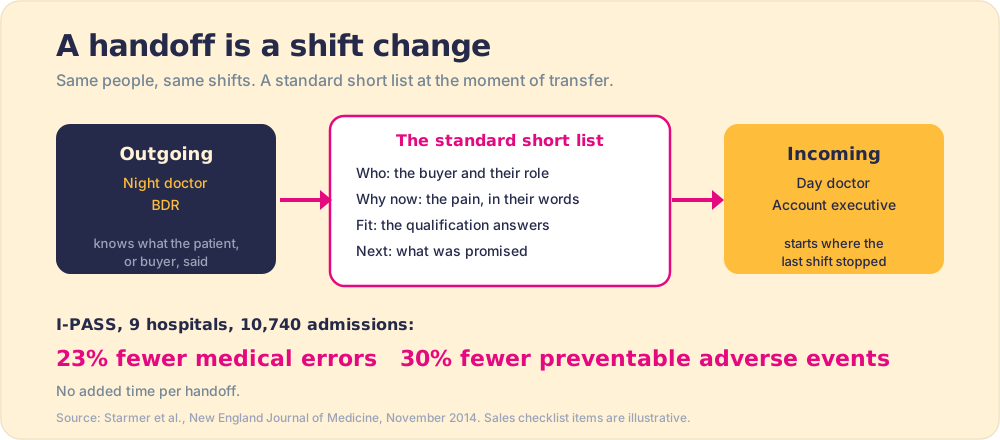
Same doctors, same shifts, a standard handoff: across 9 hospitals and 10,740 admissions, medical errors fell 23% and preventable adverse events fell 30%.
A BDR handoff is a shift change with a buyer on the gurney. When the notes are thin, the AE re-runs discovery, and the buyer tells the whole story twice to a company that has already heard it once. A stalled deal is no medical emergency, but the mechanism carries: a standard short list, required at the moment of transfer, beats a talented person trying to remember which details the AE needs.
How does putting the process in the CRM fix it?
Both failures share a cause: the standard sits somewhere other than the work. The qualification bar lives in an onboarding deck, the handoff template lives in a wiki, and the BDR is in HubSpot or Salesforce with a buyer on the phone. Our State of Sales Enablement 2026 survey of 198 sales leaders found that 89 percent have a defined process and 36 percent see it followed, a 53-point gap. The same research found teams whose process runs inside the CRM workflow hit quota at 49 percent, against 15 percent for teams whose process lives in a doc, a wiki, or an LMS. Teams that inspect adherence most hit quota at 6.3 times the rate of the least-inspected.
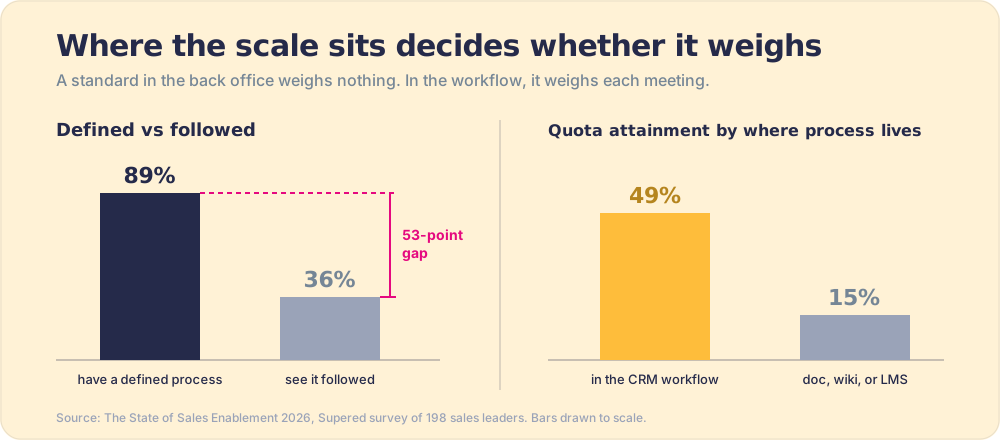
A standard in a wiki is a scale locked in the back office. In the workflow it weighs each meeting as it is booked: 49% quota attainment versus 15%.
For a BDR team, that turns into four concrete moves:
- One written definition of qualified. Short, specific, and agreed with the AEs, often built on a framework like BANT or the ideas in lead qualification.
- Required handoff fields. The I-PASS move: the three to five facts the AE must receive, captured in the CRM before the meeting can be marked qualified.
- Guidance at the moment of booking. The standard shows up in the record while the BDR is on the call, when it can still change what they ask.
- Weekly inspection of acceptance. The share of booked meetings the AE accepts, reviewed by rep, so coaching starts from a number.
Supered does this work inside HubSpot and Salesforce: it puts the qualification standard and handoff steps in front of the BDR in the moment of work and inspects whether they were met, so managers spend their time coaching instead of auditing calendars.
Where should a BDR team start?
Start with the definition of qualified: write it once, agree it with the AEs, and check it inside the CRM at the moment the BDR books the meeting. Hiring for talent will not settle it, because 40 percent of the seat turns over each year and the standard walks out with every rep who carried it in their head. A better playbook will not settle it either, because a defined process and a followed one sit 53 points apart. The four meetings in ten that never reach Stage 1 are where the cost shows up first, in AE hours spent on pyrite. Make the handoff fields required, review AE acceptance by rep every week, and hire BDRs with grit knowing the scale will hold them to one standard.
If the next problem on your list is the AE side of that meeting, the stages it enters are laid out in sales pipeline stages, and the case for automating the prospecting itself sits in the AI SDR field guide.
Frequently asked questions
What does BDR stand for in sales?+
What is a BDR's main job?+
Is a BDR the same as an SDR?+
How much does a BDR make?+
Is BDR an entry-level job?+
What is the career path after BDR?+
What metrics is a BDR measured on?+
Your process, running itself.