What Is a Playbook? The Book, the Call and the Film
A playbook is a set of plays: situations your team will meet and the response you agreed on.
Football ships it as three objects, the book, the call and the film. The meaning, the business types, runbook vs playbook, and how to write one people run.
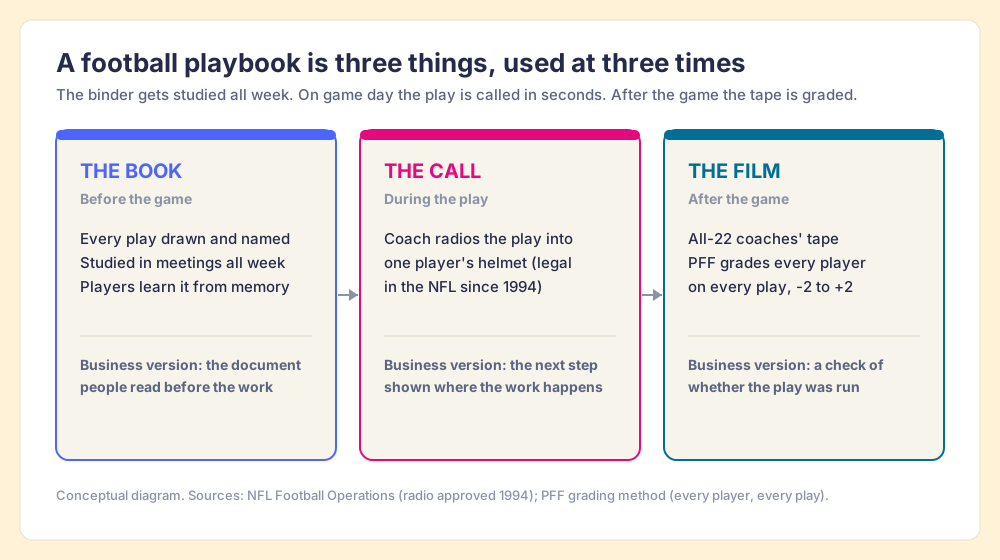
A playbook is a written set of plays, each one a situation your team will meet and the response you have agreed on in advance, delivered to people when the situation arrives and checked afterward to see whether the play was run.
On an NFL sideline, no coach hands the quarterback a binder. The binder exists. It runs to hundreds of pages, and the players spent the week in meetings learning it. But when the offense breaks the huddle, the play arrives as a coach’s voice inside one player’s helmet, a radio the league made legal for all teams in 1994 (NFL Football Operations). After the game, the coaches watch the tape, and the tape decides who plays next week.
So what is a playbook? A playbook is a written set of plays, each one a situation your team will meet and the response you have agreed on in advance, delivered to people when the situation arrives and checked afterward to see whether the play was run. The pages that rank for the question stop at the first clause. Indeed calls a business playbook “a manual that describes a company’s policies, workflows and procedures” (Indeed). Mark Dalgarno’s widely read guide calls it “a manual for how (some) things get done” (Medium). Both are right about the book. Football teams ship three objects: the book, the call and the film. A business playbook that ships only the book is a binder on a shelf.
What does playbook mean?
The playbook meaning has drifted twice in five hundred years. Merriam-Webster gives three senses: “one or more plays in book form,” “a notebook containing diagrammed football plays,” and “a stock of usual tactics or methods” (Merriam-Webster). It dates the first known use to 1511, when a play meant something performed on a stage.
The football sense is the one business borrowed, and it brought a useful idea with it. A football play has a name, a diagram and a trigger. The coach does not ask the offense to “move the ball.” He calls a play by name, and eleven people know where to stand. The third sense, “a stock of usual tactics,” is how most people use the word at work: the CFO’s playbook for a down year, the playbook a competitor ran last spring. That sense describes a habit. It does not tell anyone what to do next.
For this post, a playbook is the football sense applied to work. A set of named plays, each one tied to a situation, written before the situation arrives.
How does a playbook work in football?
Football is a good teacher here because the sport worked on the delivery problem for most of a century, and the history is written down.
- The book. Plays get drawn, named and taught. Players study them before the game, in meetings and walk-throughs, until the names mean something without the drawings.
- The call. During the game, someone sends the right play at the right moment. Before radios, Paul Brown ran a “messenger guard” system, alternating linemen who carried the play in from the sideline (Pro Football Hall of Fame). Two Ohio inventors brought him a helmet radio in 1956. The league approved a version for all teams in 1994, and Kansas City coach Marty Schottenheimer estimated it saved “eight to 15 seconds on play calls” (NFL Football Operations). The NFL spent nearly four decades shaving seconds off the trip from the book to the player.
- The film. After the game, the play gets graded. Pro Football Focus “evaluates every player on every play,” from -2 to +2, and reviews each grade “using every camera angle available, including All-22 coaches’ tape” (PFF). Teams run their own version. The film is how a coach knows whether the play failed or the play was never run.
Take away the call and players run the play they half-remember. Take away the film and the coaches cannot tell a bad play from a play that was skipped. The book alone does neither job.
What is a playbook in business?
A business playbook is the same idea moved to an office: the situations a team meets again and again, and the agreed response to each. Indeed lists four common types, and incident response teams add a fifth.
- Company playbook. History, mission, values and how the place runs. Closest to a handbook.
- Operations playbook. The steps for delivering the service to a customer.
- Sales playbook. How the team finds, qualifies, works and closes deals. Our sales playbook guide goes deep on this one.
- Channel playbook. What partners need to sell or deliver your product.
- Incident playbook. What on-call engineers do when a system breaks.
The type matters less than the unit inside it. A play is the unit. A company playbook that reads like an essay has no plays in it, so there is nothing to run. Below, one play from a sales playbook, taken apart.
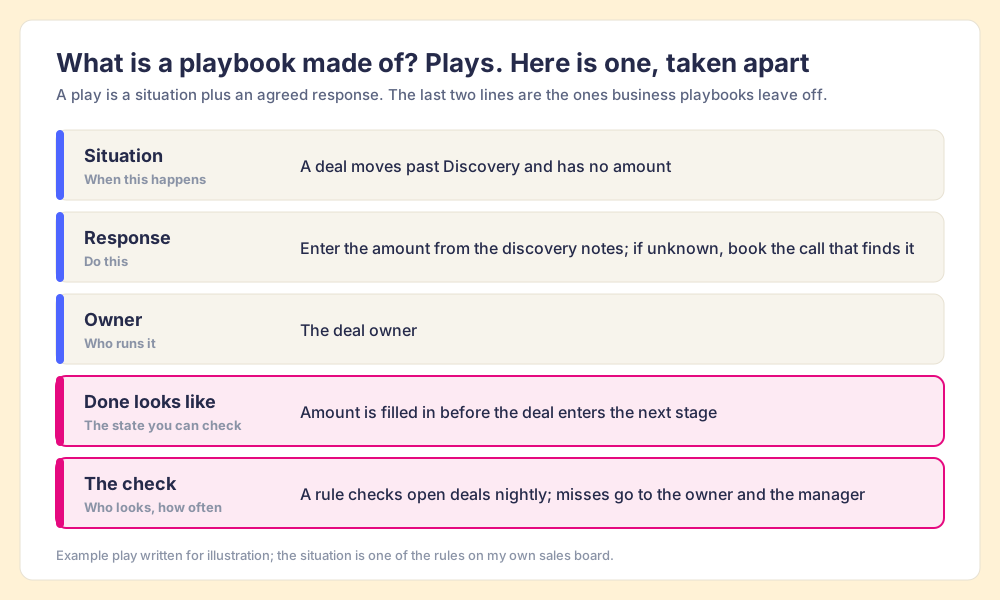
The first three lines are the book. The fourth line, what done looks like, is the hinge. If done is “qualify the budget,” a manager cannot check it. If done is “the amount field is filled in before the deal moves to the next stage,” a person or a machine can check it in a second, across every open deal. The fifth line is the film. Without it, the play is a suggestion.
Runbook vs playbook: what is the difference?
Engineers use both words, and runbook vs playbook gets about 400 US searches a month against 900 for the definition itself (Ahrefs, checked 2026-10-02). incident.io draws the line cleanly: a runbook gives “step-by-step procedures for resolving specific incidents,” while a playbook is “a broader strategic document that outlines an organization’s overall approach to handling various situations” (incident.io, 2023).
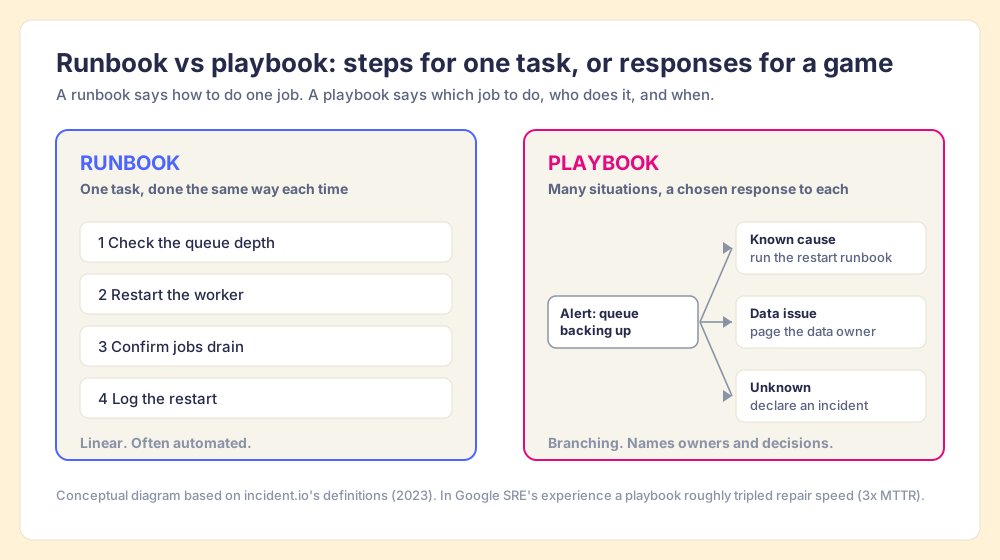
| Runbook | Playbook | |
|---|---|---|
| Scope | One task | Many situations |
| Shape | Linear steps | Branching: situation, choice, owner |
| Typical author | The engineer who owns the system | The team lead or ops function |
| Often automated? | Often | Rarely, the choices need judgment |
| Example | Restart a stuck worker | What to do when the queue backs up |
The engineering world also produced the cleanest number on whether playbooks work at all. Google’s Site Reliability Engineering book reports that “thinking through and recording the best practices ahead of time in a ‘playbook’ produces roughly a 3x improvement in MTTR as compared to the strategy of ‘winging it’” (Google SRE book, Introduction). The next line matters as much: “The hero jack-of-all-trades on-call engineer does work, but the practiced on-call engineer armed with a playbook works much better.”
Look at how an on-call playbook gets used. The engineer does not open a wiki at random. The alert fires, and the alert is the call: it names the situation, and the playbook entry for that alert is one click away. The SRE playbook has a call built into it by design.
Why do most business playbooks fail?
A business playbook usually ships as a document. It gets written at an offsite, presented at kickoff, and stored in a wiki. Then the situation arrives in the middle of a working day, and the play has to travel from the wiki to the person through memory. Memory is a poor courier. Without a call, the playbook depends on someone stopping work, finding the page and reading it, which is the step people skip when they are busy.
Surgery offers the cleanest test of what happens when you add the call. The WHO Surgical Safety Checklist is a 19-item playbook read aloud at three points in an operation where “the entire team stop all other activity” (WHO). The items were not new to anyone in the room. Surgeons knew to confirm the patient and the site. What changed was the call: a fixed moment when the play gets spoken.
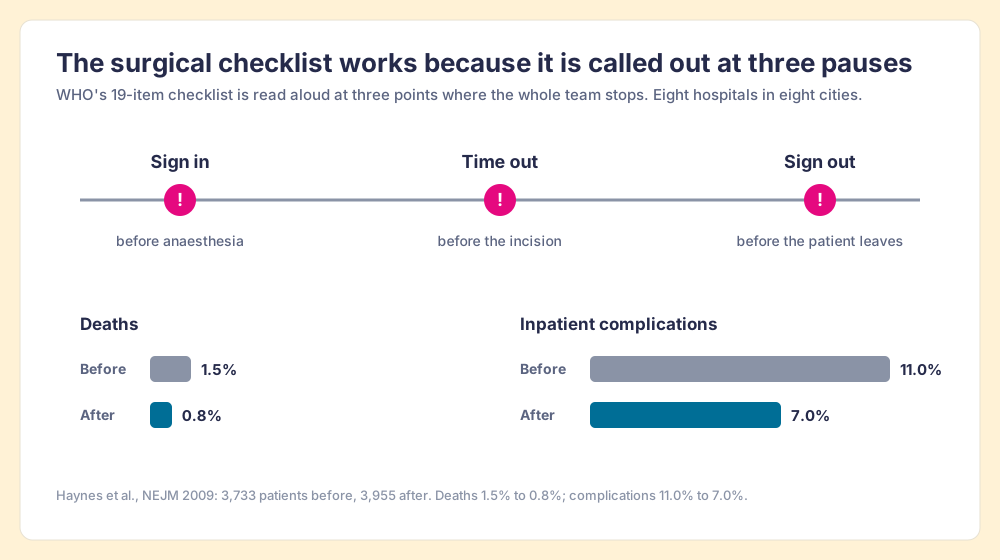
In the eight-hospital study, deaths fell from 1.5% to 0.8% and inpatient complications from 11.0% to 7.0% after the checklist arrived (Haynes et al., NEJM 2009). The surgeons did not get smarter. The play got called.
Sales software has noticed the delivery problem. HubSpot sells a feature named playbooks that appears in the right panel of contact, company, deal and ticket records, so the play sits next to the work (HubSpot knowledge base, opened 2026-10-01). Sales Hub Professional allows up to 5 playbooks and Enterprise up to 5,000 (HubSpot pricing, 2026-10-01). Moving the book into the record is real progress on the call.
The film is where it thins out. HubSpot’s playbook analytics count views and logs by user. In a HubSpot Community thread opened in 2021, a customer asked for reporting on “which Playbooks are used for each Company” so the team could “track the adoption of Playbooks” (HubSpot Community). A view tells you someone opened the page. It does not tell you whether the deal now has an amount. Film grades the play, and opens grade the reading.
Sales teams have film data of their own. In The State of Sales Enablement 2026, teams that inspect deals against a defined process at the highest frequency hit quota at 6.3x the rate of the lowest band (The State of Sales Enablement).
How do you write a playbook people run?
Start from the situations, write each play so it can be checked, and decide the call and the film before you publish. The order matters, because a play you cannot check is a play you cannot coach.
- Situations first. List the moments your team meets weekly: a new inbound lead, a deal stuck in one stage for twenty days, a renewal ninety days out, a champion who changed jobs. One situation, one play. If a page covers no situation, it belongs in the handbook.
- Best reps as the source. The plays that work already live in the habits of your best people. Sit with two of them and write down what they do when each situation arrives. A play imported from a consultant’s template has no believer on the team.
- A checkable done-state. Write done as a field, a date or an artifact: amount entered, next meeting booked, recap email sent within a day. If a machine cannot check it, rewrite it until one can.
- A call at the moment of work. Put the next step where the person is working when the situation arrives: inside the CRM record, in the sequence, in the tool their AI assistant reads. A link in a kickoff deck does not count.
- Film on every open record. Check every live case against the done-state, nightly if you can, and send misses to the owner while there is still time to fix them. Sampling five deals in a pipeline review is a highlight reel.
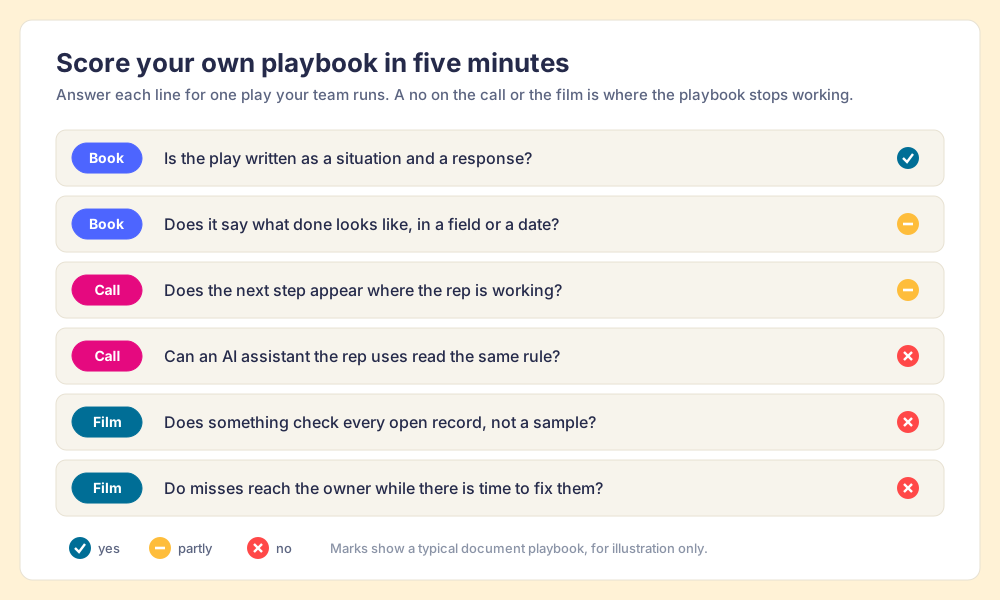
The AI line in that audit is newer than the rest. Reps now ask Claude or ChatGPT what to do next, and the assistant answers from whatever it can read. If your plays live in a slide deck, the assistant improvises. If they live as rules it can read, it runs your play. A playbook in 2026 has two readers, and one of them reads every word.
Where does Supered fit, and where does it not?
Supered is the call and the film for a sales playbook. It started inside RevPartners, the HubSpot partner I founded, which ran RevOps as a service for its clients, and the book was never the part clients needed help with.
In Supered, each play’s done-state becomes a Process Rule that describes the miss, such as a deal past Discovery with no amount (Supered help center, Process Rules logic). Rules group into a Process Ruleset and run against your records in HubSpot, Salesforce or Pipedrive. Deals that break a rule land on a Process Board the rep opens inside the CRM, and managers get a summary without reading records one by one. The board is the film. Cards and guides appear inside the CRM page where the rep is working, which is the call. If a rep works in Claude, the same rules are readable there, so the assistant fixes the misses against your play instead of its own guess.
Choose something else if your playbook is a company handbook, an engineering runbook or a partner manual. A wiki or a documentation tool fits those better, and Supered’s rules are built for CRM records, not servers or HR policies. Supered fits when the playbook is about deals and the question you cannot answer is whether reps are running it.
Process Compliance, which includes the rules, boards, cards and guides, is $40 per user per month paid yearly ($45 monthly) with a five-user minimum (Supered pricing). The sales process adoption use case shows a board running, and the sales expectations page shows the same rules worked from Claude. You can book a demo to see one of your own plays checked against your pipeline.
What we recommend
Write fewer plays and check all of them. Five plays, each with a done-state a machine can check, called inside the tool where the work happens and graded against every open record, will do more than a forty-page document with a beautiful cover. A better document improves the book, and a tool that moves the document into the record improves the call. Neither one grades the film, and the film is where a manager learns whether a play failed or was never run.
The mechanism is the same in the operating room and on the on-call rotation. The surgeons already knew the checklist items, and the engineers already knew their systems. What changed the results was a fixed moment when the play reached them, and a record afterward of whether they ran it. Sales teams get the same deal from the same two additions.
Start this month with one situation your team meets every week, and write its five lines. Then take how to create a sales playbook for the full build, or borrow situations already written from our list of sales plays.
Frequently asked questions
What is a playbook?+
What is a playbook in business?+
What is the difference between a runbook and a playbook?+
What should a playbook include?+
Why do business playbooks fail?+
Your process, running itself.