Sales Enablement Success: How Intuit's Alex Davis Measures It Without Overclaiming
Alex Davis leads the High Performance pillar of Intuit's Sales Excellence team. He measures sales enablement success by how many sellers climb the performance quartiles, and he thinks claiming revenue wins without the chain behind them is a risk to the profession.
Sales enablement success is a measurable change in how sellers sell, traced link by link from the program to the behavior, the output and the business result, instead of a revenue number claimed straight from a training event.
Alex Davis started selling in the 2000s, in small-business sales, and worked up to enterprise before moving into enablement in 2019. At Intuit he now leads the High Performance pillar of the Sales Excellence team, which works on moving sellers from quartiles two and three into quartile one.
Caleb King asked him on Enablement for Real what sales enablement success looks like in that role. Alex answered with the scorecard his team uses, and then spent much of the episode warning his own profession about the numbers it reports. In his view, claiming revenue wins for training costs enablement its credibility.
Intuit’s enablement team has about 80 people. Alongside the usual go-to-market enablement, the Sales Excellence group owns coaching standards, an in-house selling methodology, and Alex’s pillar. “I don’t see that kind of function in too many enablement organizations,” he said. He put his brief as a question. “How do we codify the behavior mindset and disciplines of those top performers to scale that and then create even more top performers within the organization.”
What does sales enablement success look like at Intuit?
Alex’s team tracks what it calls employee lifetime value: how much a seller grows over a whole career at Intuit. The path runs from onboarding, where new sellers ramp, to everboarding, where they reach a proficient level, to an elite cohort that moves up the quartiles.
He measures it on the Kirkpatrick model, the standard four-level scale for training: reaction, learning, behavior and results (Kirkpatrick Partners). Alex called levels 1 and 2 the typical engagement metrics and said “level three and level four are way more interesting for my program.” Level 3 asks whether sellers now perform the critical behaviors on the job. For Alex that means quartile two and three sellers reaching the expected standard, then moving up.
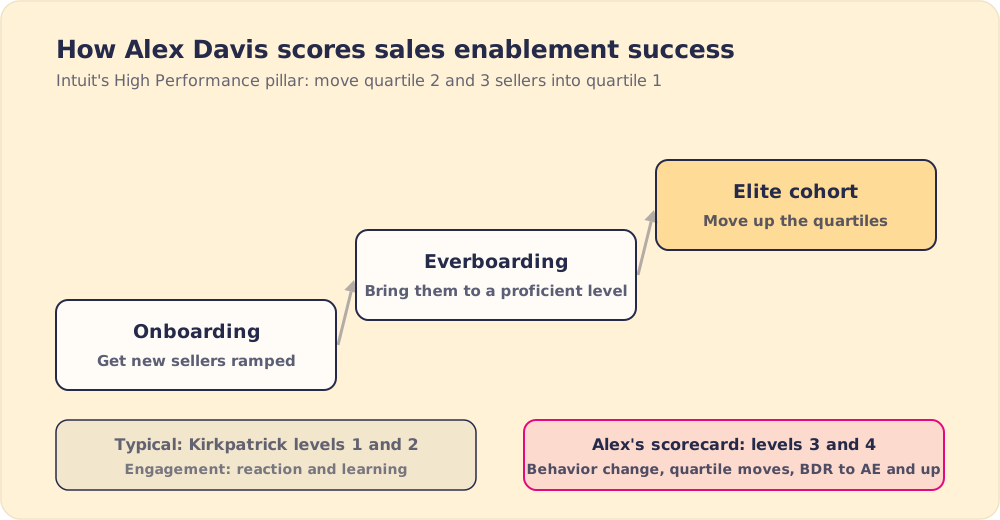
He also watches career moves. “Are we seeing people move from BDR to AE,” and from AE into senior roles or leadership for those who want it. He does not expect to change the whole floor. “We know there’s going to be those lone wolves,” he said, top performers with their own hunger who do not want to multiply their habits across a team. His program is for the sellers in the middle who show the will to grow.
In The State of Sales Enablement 2026, teams in the top quota band averaged 3.83 out of 5 on deal-execution consistency and the bottom band averaged 3.00, while training volume did not differ much between them (The State of Sales Enablement 2026).
Why does Alex think overclaiming business impact is a risk?
Alex warned that his pick for a fad was “slightly controversial.” It is enablement’s obsession with Kirkpatrick level 4, and with claiming that a program caused a revenue number.
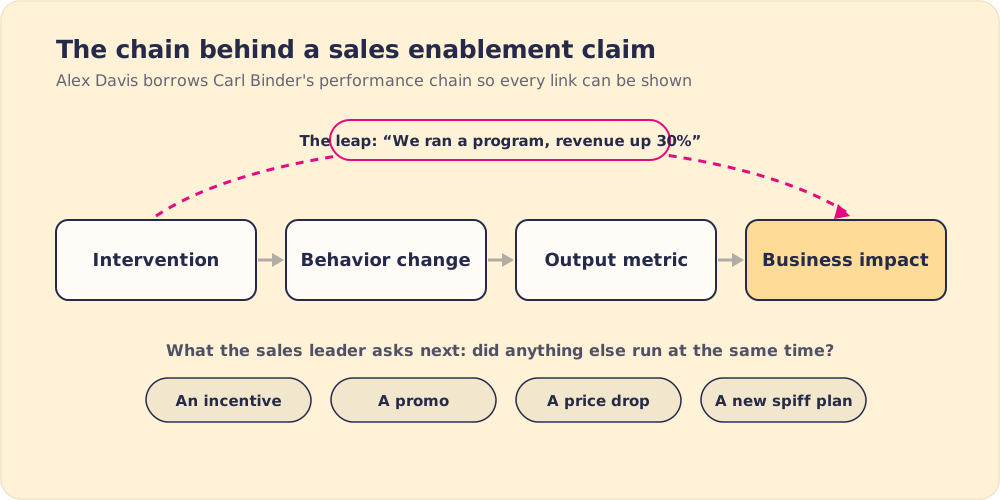
He described the meeting. An enablement team presents to senior leaders: “we ran this amazing enablement activity it’s led to a 30% increase in revenue aren’t we brilliant.” A sales leader looks closer and asks what else ran during that time, and it turns up an incentive, a promotion, a price drop or a new spiff plan. In Alex’s words, “immediately you’re kind of stepping back.”
Alex does connect his work to results. He does it through Carl Binder’s performance chain, which links behavior to work outputs to organizational results (Six Boxes). Alex put the chain in one sentence: “this intervention led to this behavior change, this behavior change led to this output metric, this output metric led to this business impact.”
“I don’t think it’s a fad,” he said. “I just think it’s a risk to us as a profession.”
Caleb pushed back from the selling side, where buyers ask him for ROI as a headline. “You want to hear it will 2x in five months or whatever it is,” he said. “I don’t think it’s a problem unique to enablement proving internal value. I think it’s just a problem with ROI and the human attention span period.”
Alex agreed and kept his point. Lead with the headline if you must, he said, but have the story ready when a stakeholder asks how the pieces link together. “Just be really really careful with the claims that you are making because you will lose the credibility.” In his view the profession has “made this massive step forward and forgotten that there’s a little kind of stepping stones” behind it.
How do you measure sales enablement success without overclaiming?
Lists of enablement KPIs are easy to find. Alex’s approach gives them an order, starting with the measures a skeptical sales leader will accept first:
- Behavior on the job. Kirkpatrick level 3. Are sellers doing the specific things the program taught, on real deals? For Intuit’s pillar, that is quartile two and three sellers selling to the expected standard.
- Output metrics. The work products the behavior should change, such as conversion at a stage, measured before any revenue claim.
- Movement between quartiles. How many sellers moved up a band, which is Alex’s headline number for his program.
- Career mobility. BDR to AE, AE to senior roles and into leadership, the employee lifetime value view.
- Business results, with the chain shown. Level 4 only after the links above are visible, and with the other causes named: incentives, promotions, pricing and comp changes.
Our guides to sales enablement KPIs and sales enablement ROI go deeper on which behaviors to track and how to present the result.
Why does Alex call AI a threat to the sales profession?
Caleb asked what a good salesperson looks like in 2026. Alex started with a statistic he called embarrassing. Citing Gartner, he said “75% of buyers would prefer to buy a product without any interaction with a sales agent,” and added, “I think that’s alarming.” Gartner’s June 2025 release puts that preference at 61% of 632 B2B buyers, and in August 2025 Gartner predicted that by 2030, 75% of B2B buyers will prefer sales experiences that prioritize human interaction over AI (Gartner, June 2025; Gartner, August 2025).
His definition of selling came from a podcast guest years ago: “earning the right to make a recommendation.” Then he said the part he expected pushback on: “I think AI is possibly our biggest threat to us as a profession.”
His worry is about what managers count. “I’ve seen so many poor proposals being sent out to buyers because it’s been generated by Claude or whatever,” he said. When a buyer asks about the content, the seller cannot explain it. “Well, you created it. It’s yours.” Meanwhile managers say, “We’re going to measure you on the amount of proposals you’re sending out.” They are “not actually measuring them on the authenticity and connection around that conversation because that’s difficult to measure.”
Caleb called that one of his worst nightmares: a buyer asks what a line means, and “I didn’t write it.” Alex admitted he has done it himself. His boss called him and said, “You need a human eye on this.” He looked and thought, “Geez, that’s embarrassing. That’s gone out in my name, and there’s, you know, hallucinations all over the place.” Our post asking will AI replace sales jobs covers which parts of the work AI can take.
What does Alex say is real in enablement?
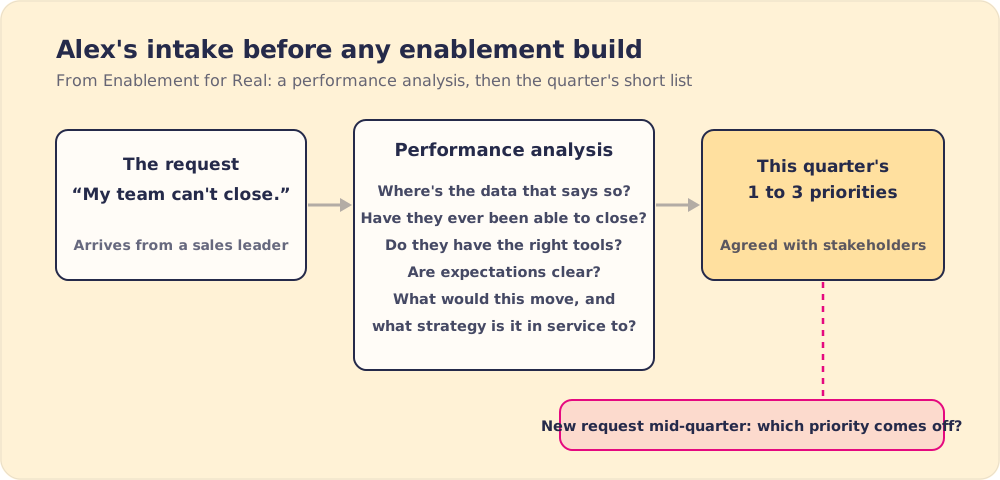
His answer to what is real was advice for anyone new to enablement. First, “have a very very formal intake process.” When a sales leader says the team cannot close, he runs a performance analysis before building anything: “Where’s the data that’s suggesting that they can’t close? Have they ever been able to close?” and “Do they have the right tools in place?” Binder’s Six Boxes model was built for this kind of question. It sorts the factors that help or block a behavior into six boxes, drawn from over 60 years of behavior science, so a request for training gets checked against the other causes too (Six Boxes).
Second, agree the quarter’s priorities up front, one to three of them. When a new request arrives mid-quarter, the question is “What one of our three things are we going to knock off?” He also asks, “What is this going to move if we get this right? What is it in service to? Show me on the strategy where that request has come from.” He learned this the hard way, more than once, he said. Caleb said it sounded a lot like a good sales process.
What is Alex betting on next?
Alex calls himself near the twilight of his enablement career, and his bet is personal. He wants sellers to win in a way they are proud of later, what he calls “winning deeply.” He has had the other kind of quarter more than once, when the number is hit and a seller is “still left hollow.” He tests a deal with three questions. “Yes, you’re going to win deals, but is it the right deal? Is it a high quality deal? And has the buyer had a great experience as a result of it?”
He leans on Brent Adamson and Karl Schmidt’s The Framemaking Sale, and quoted Adamson’s figure that 60% of sales end in no decision. In an interview about the book, the authors put it at 40 to 60% of complex B2B deals, and say buyers with high decision confidence are 10 times more likely to make a high-quality, low-regret purchase (Badger Maps interview). Caleb pointed out that a public company can praise winning deeply and still need the deal signed by June 30. Alex agreed that “lots of enablers out there” are “in the middle of the whirlwind” and will say, “I don’t have time for that.” He still said, “It’s our role as enablers.”

What Alex Davis measures, and why
- Employee lifetime value. Growth across a seller’s career at Intuit, from onboarding to everboarding to the elite cohort.
- Levels 3 and 4. Behavior change and quartile movement, with levels 1 and 2 treated as the start.
- The performance chain. Program to behavior to output to business impact, each link shown, and the other causes named.
- A formal intake. A performance analysis before any build: where the data is, whether the team ever could, whether the tools are there.
- One to three quarterly priorities. A new request means an old one comes off the list.
- Proposals sellers can defend. AI for research and preparation, and a human eye on anything that goes out in a seller’s name.
What would Alex’s scorecard look like on your team?
Pick the two or three behaviors your best sellers run on real deals, measure how many of your middle-quartile sellers run them today, and report that number next to anything you say about revenue. When the revenue claim comes, bring the chain with it, and name the promotion or comp change that ran alongside. It is a smaller claim than a 30% revenue jump, and you can defend it when the sales leader asks what else was running.
For the metrics that sit under that scorecard, read our guide to quota attainment next.
Frequently asked questions
How do you measure sales enablement success?+
What are the Kirkpatrick levels in sales enablement?+
Can sales enablement prove ROI?+
What does a sales enablement intake process look like?+
How many priorities should a sales enablement team take on?+
Your process, running itself.
Turn the playbook into rep behavior.
More from Enablement for Real

AI Sales Role Play: Peter Roccaforte on Rehearsal, Lazy Bots and Two Enablement Fads
Peter Roccaforte
Sales Training Plan: Justin Swapp on the Discovery Step Enablement Skips
Justin Swapp