A Sales Enablement Framework Is Only Real If It Tells You What to Inspect
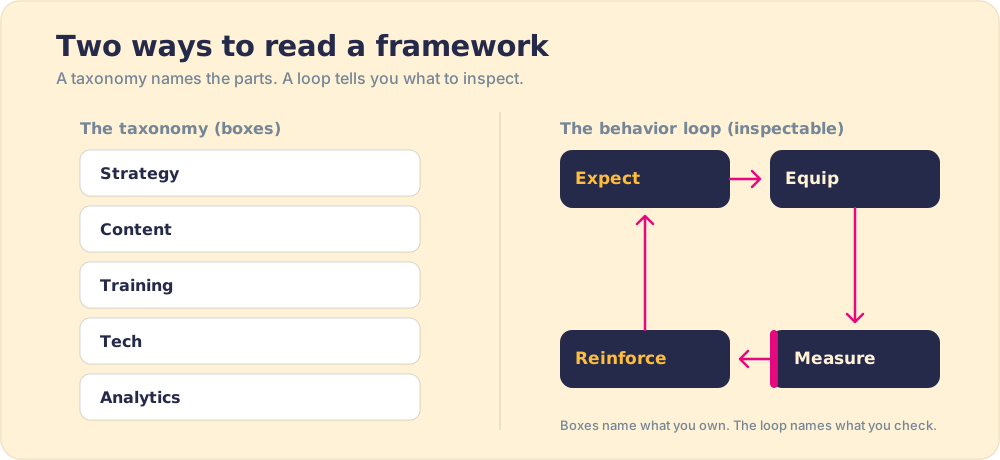
Most sales enablement frameworks are content or competency taxonomies: tidy boxes for strategy, content, training, tech, and analytics.
A framework you can actually run answers a harder question, and here is what it is.
A sales enablement framework is the repeatable system a revenue team uses to set an expectation for reps, deliver the next action in the flow of work, measure whether reps follow it, and coach off what the measurement shows.
A new sales leader inherits a team, asks to see the enablement framework, and is handed a slide. On it sit five neat boxes: strategy, content, training, technology, analytics. Each box has a logo and an owner. It is the picture of a function that has its act together. Then she sits with a rep on a call, watches a buyer ask about a competitor, and watches the rep freeze, alt-tab to a folder, and promise to circle back. The framework named five domains. It said nothing about the one second that just decided the deal.
Most sales enablement frameworks are taxonomies. They sort the work into content, competency, or capability buckets, draw the boxes, and stop. A taxonomy is a fine way to inventory what you own. It is a poor way to run anything, because it never tells you the only thing a working system has to tell you: what to go and check. A framework you can operate has a test built in. It says, here is the standard, here is how the rep gets it in the moment, and here is how you confirm they followed it. If a framework does not tell you what to inspect, it is a filing cabinet with a strategy deck taped to the front.
A sales enablement framework is the repeatable system a revenue team uses to set an expectation for reps, deliver the next action in the flow of work, measure whether reps follow it, and coach off what the measurement shows. It is a loop, not a list. Set the expectation (Expect), deliver the action (Equip), measure adherence (Measure), coach off the signal (Reinforce). Each part has a named mechanism behind it.
What is a sales enablement framework, exactly?
Strip the slide back. A sales enablement framework is the system a revenue team uses to make good selling repeatable: to decide the right way to run a deal, get that way in front of every rep, and confirm it is happening. Ordinary, useful, and worth defining before we argue about it.
The two readings matter because they send you to different work. Read the framework as a category list and every gap looks like a hire or a purchase: no readiness program, build one; no analytics dashboard, buy it. Read it as a loop and the question changes to whether reps do the thing the categories were built for. A content library reps skip mid-deal is not a content capability. It is a shelf. The box is filled and the behavior is missing, and only one of those shows up in a board review.
We hold this one as a tenet. You can only expect what you inspect. Documentation is not running a process; a process exists only to the degree adherence to it is checked. A framework that names domains but never closes the inspection loop has skipped the part that holds the weight. It looks complete and steers nothing.
What are the well-known sales enablement frameworks?
They deserve their due, because they got real things right. The dominant model in the field is the pillar or domain framework, the one Forrester, the Sales Enablement Collective, and most analyst write-ups share in some form: enablement rests on a few pillars, usually strategy, content, training, technology, and analytics, holding up rep performance. It is a useful map. It gives a new leader vocabulary, it assigns ownership, and it keeps a team from forgetting that content without measurement, or training without tech, leaves a hole.
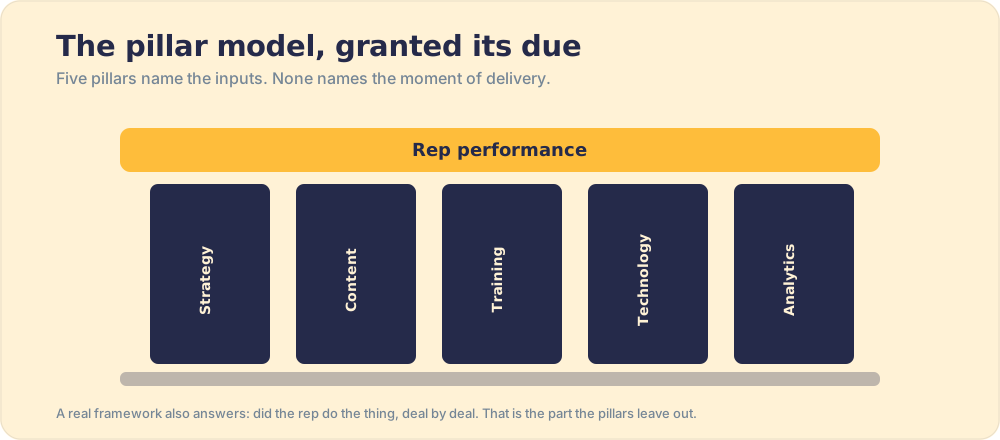
Grant the pillar model its strength. As a checklist of what a function must cover, it is hard to beat, and any team without those domains in place has bigger problems than its framework. The trouble is structural, not careless. A pillar names an input. Strategy is an input. Content is an input. Training is an input. Even analytics, as most models draw it, reports lagging outputs, revenue and attainment, after the deals are already won or lost. What the pillars do not name is the hinge between input and output: whether the rep, on a particular deal, did the thing the strategy intended.
That hinge is behavior, and behavior is the unsolved problem. Knowledge is solved. Any rep can find the doc, and an AI can summarize it in seconds. The hard part was never assembling the pillars. It is getting what lives in them to reach the rep in the second that decides the call, and then knowing whether it did. A sales enablement model built only from pillars answers “what do we have?” and leaves “are reps using it?” to intuition. The second question is the one that moves the number, and it needs its own structure.
The behavior-first framework: a loop with a mechanism per step
Put the loop on top of the pillars. The categories still hold the inputs; the loop turns them into checked behavior. Four steps, and each rests on a named mechanism, so this is a framework you can defend, not a tidy acronym.
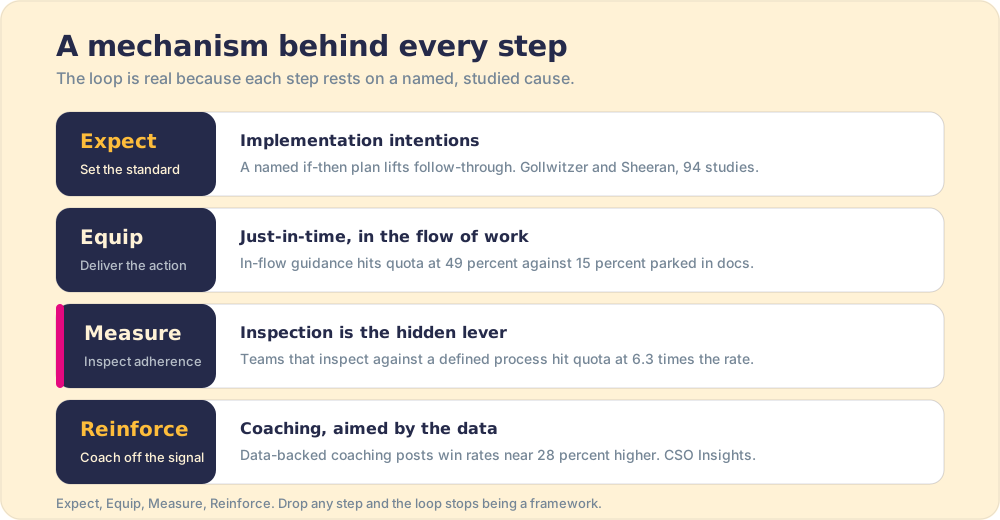
- Expect. Set one clear standard for what good looks like on this kind of deal, stated as a concrete action, not a value. The mechanism is older than sales. Peter Gollwitzer and Paschal Sheeran’s review of 94 studies found that turning a goal into a specific if-then plan, an implementation intention, produced a medium-to-large lift in follow-through (Gollwitzer and Sheeran, Advances in Experimental Social Psychology). “Do better discovery” changes nothing. “When the buyer names a competitor, ask these two questions” changes behavior, because the brain now has a trigger and a move wired together. An expectation is an if-then plan written down.
- Equip. Deliver that next action where the rep already works, the instant the trigger fires, so following the standard is the path of least resistance instead of a memory test. Delivery is the variable the pillar frameworks leave unnamed, and it is decisive. In the State of Sales Enablement 2026, teams whose guidance is embedded in the flow of work hit quota at 49 percent; teams whose guidance lives in docs, wikis, and a separate tool hit quota at 15 percent (State of Sales Enablement 2026). Same content. The moment of delivery more than triples attainment. A pillar can hold the best playbook in the world and still lose if it arrives after the call.
- Measure. Check whether the rep did the thing, deal by deal. The taxonomies skip this step, and it is the one that makes the loop a loop. In our survey, teams that consistently inspect deals against a defined process hit quota at 6.3 times the rate of teams that rarely do, the single largest effect we measured (State of Sales Enablement 2026). Adherence is the hidden lever and the prerequisite to every other answer. You cannot ask “what should we change?” until you can answer “is the process being followed?” A team that never measures adherence is not running a process; it is hoping one is happening.
- Reinforce. Take the adherence signal and coach off it, aimed at the rep and the moment that went off-standard. The mechanism is targeting. CSO Insights, the research arm now inside Korn Ferry, found that teams running adaptive, data-backed coaching posted win rates roughly 28 percent higher than teams without it (cited via SEC). The lift comes from the coaching landing on the right gap, not from owning a coaching tool. Measurement is what aims it.
Each step does something a pillar does not: it names a behavior and a way to verify it. Expect is a checkable standard. Equip is a delivery you can confirm happened in the flow of work. Measure is the verification itself. Reinforce is the correction. The loop closes, and closing it separates a system from a slide.
Why does a framework without a measure step stall?
Because a framework with no measurement is a thermostat with no thermometer. You set the dial to sixty-eight, the furnace runs on its own schedule, and the room can be freezing while the dial insists everything is fine. Nothing reads the room, so nothing corrects. Most enablement frameworks are built exactly this way: a strategy sets the target, content and training feed the furnace, and not one component reads back whether reps are running the motion on real deals.
The heat is on. Whether it reached the room is anybody’s guess.
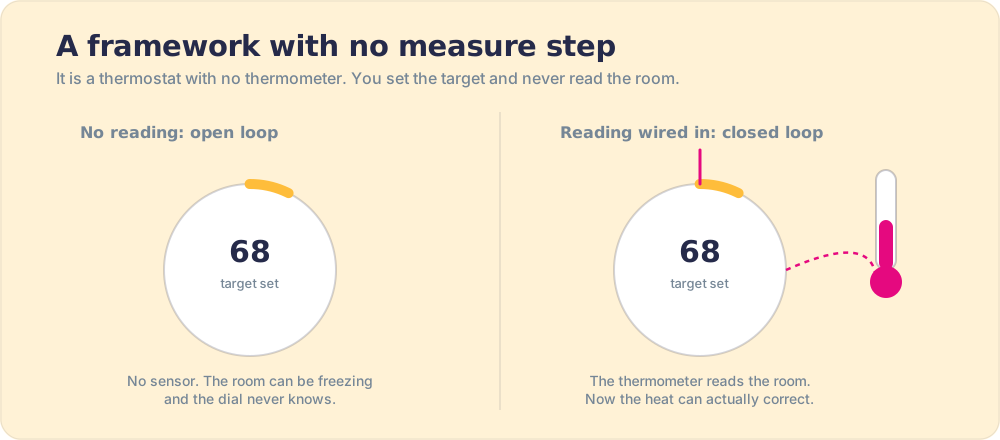
The analogy has limits. A thermostat reads one number; a deal has many, and a rep is not a furnace. But the core of the analogy holds: an open loop cannot correct itself, no matter how good the target or the heat source. And the cost of the open loop is not abstract. The Sales Enablement Collective’s 2025 Impact of Enablement report found that 79.7 percent of enablement leaders say their reps leave at least 40 percent of a stand-alone tool’s features untouched (SEC). Four in five enablement leaders are paying for capability their reps leave untouched, and many cannot see it, because their framework has pillars but no thermometer. When reps drift from the standard, the cause is almost never laziness. It is friction, late delivery, and missing inspection, a system that never made the right action easy or ever checked whether it happened. Fix the system, not the rep.
One more caution about the artifact itself. A sales enablement framework template is a fine way to align a team on language and name the domains. The risk is mistaking the filled-in template for the running process. A framework exists only to the degree adherence to it is inspected, so the template pays off the moment it drives a loop you run, and not before. Documentation is a depreciating liability; the asset is the behavior, in the flow of work, measured and adopted.
At this point the model stops being a diagram and becomes a tool. Supered is the Behavior Layer: it surfaces the expected next action in the flow of the work, inside HubSpot, Salesforce, Salesloft, Gong, and Gmail, the instant the trigger fires, then measures whether reps follow it, deal by deal, and hands managers the signal to coach off. It does not replace a pillar. It closes the loop the pillars leave open, which is the part that decides whether any of the inputs ever reach the buyer.
What should you do with all this?
You have two real paths. Keep the pillar framework as your inventory, the map of what the function owns, which it is good at. Then decide whether to leave it open-loop or close it. Leaving it open means continuing to run enablement on the dial alone, setting strategy, buying content, booking training, and reading attainment after the fact, hoping the heat reached the room. Closing it means adding the loop: a checkable expectation, in-flow delivery, adherence measurement deal by deal, and coaching aimed by the signal.
We recommend closing the loop, and the data is not close. The largest effects in our survey both live in the steps the taxonomies omit: in-flow delivery (49 percent against 15 percent) and inspection (6.3 times the quota rate). Those are not the pillars. They are the verbs the pillars sit still beside. A framework that names five domains and checks none of them will keep producing tidy slides and soft numbers, because it has no way to tell whether the strategy ever became behavior. Build the loop on top of the boxes, and the boxes finally do something.
If you want the pillar view in full before you start, what sales enablement is lays out the domains; to see where your team sits on the path from documentation to a closed loop, the sales enablement maturity model maps the stages; and if the gap between what reps know and what they do is the part that stings, the knowing-doing gap is the mechanism underneath this entire argument. Read that one next.
Frequently asked questions
What is a sales enablement framework?+
What are the parts of a sales enablement model?+
How is a sales enablement framework different from a strategy?+
Do I need a sales enablement framework template?+
How do you measure if a sales enablement framework is working?+
Your process, running itself.