The Sales Enablement Maturity Model Measures the Wrong Axis
Most sales enablement maturity models grade you on artifacts: a charter, a team, an integrated stack, a dashboard.
Here is the axis that actually predicts results, and the four stages reread around it.
A sales enablement maturity model is a staged framework that scores how developed a team's enablement is, from ad hoc to strategic; the more useful version scores one thing, whether the process is actually being followed and inspected, deal by deal.
A new head of enablement walks into a quarterly business review with a slide she is proud of. The team has a charter, signed by the CRO. There is a dedicated headcount now, three people where last year there was a fraction of one. The tech stack is integrated, the dashboard is live, and the onboarding program has a real curriculum. By every published sales enablement maturity model, she has climbed two stages in a year. Then a regional director asks a plain question. “On the deals we lost last quarter, did the reps run discovery the way the playbook says?” No one in the room can answer it. The artifacts are all there. The one thing they were built to produce cannot be seen.
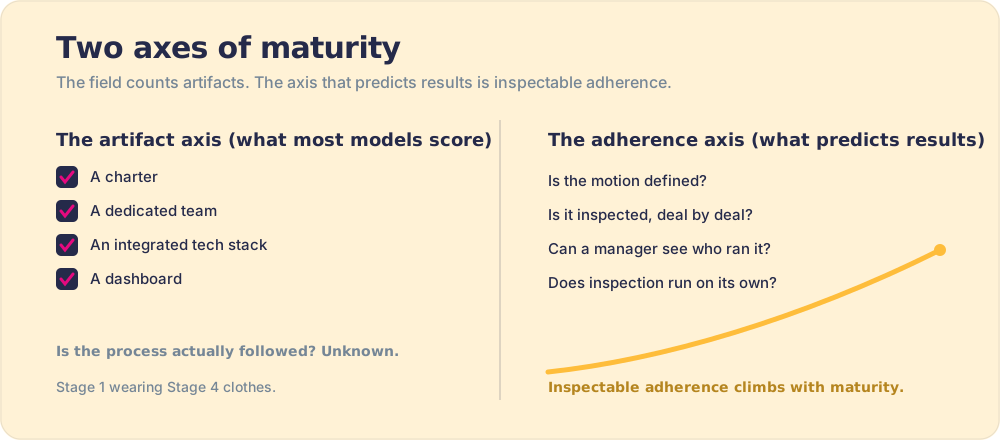
That gap sits underneath almost every maturity model on the market. The field measures maturity by inputs and artifacts: do you have a strategy document, a dedicated team, an integrated tech stack, an analytics dashboard. Our claim is simpler and more uncomfortable. A maturity model built on artifacts measures the wrong axis. The axis that matters is adherence you can inspect, whether the process is being followed, deal by deal. You can only expect what you inspect. A team with a charter, a CRO line, and a full stack that still cannot answer “is the process being followed?” is Stage 1 wearing Stage 4 clothes.
Clothes are cheap.
Defined plainly, a sales enablement maturity model is a staged framework that scores how developed a team’s enablement is, from ad hoc to strategic. The more useful version scores one thing: whether the process is being followed and inspected, deal by deal, rather than which artifacts the team owns. Grade the behavior and leave the bookshelf out of it.
What is a sales enablement maturity model?
Strip away the jargon and a maturity model is a ruler with named notches. It takes a messy capability, enablement, and sorts it into ordered stages so a team can see where it stands and what the next rung looks like. Most models grade several dimensions at once: strategy and leadership alignment, training and onboarding, content, the tech stack, data and analytics, and cross-functional collaboration. You score each, average it, and land somewhere on a line from undefined to advanced.
The serious versions are worth naming, because they own this topic and a reader has probably seen them. Forrester’s Sales Enablement Maturity Model grades five disciplines, strategy, content, training, technology, and analytics, and moves a team from “undefined” to “dynamic,” tying the climb to revenue impact. Gartner frames maturity as how well enablement integrates with the revenue tech stack and aligns to the buyer journey. CSO Insights, the research arm now inside Korn Ferry, tied maturity to outcomes directly: teams that reached a dynamic coaching stage posted win rates roughly 28% higher than their peers (cited via the Sales Enablement Collective). These are not strawmen. They are careful frameworks, and the 28% finding is real evidence that the top of the curve is worth reaching.
Grant them their due, then look at what they share. Almost all of them score what a team has assembled. A documented strategy. A dedicated function. An integrated set of tools. A dashboard with the right charts. Those are good things to own. The trouble is that owning them is not the same as the reps running the motion, and a maturity model that cannot tell the difference will keep promoting teams that look mature and lose like teams that are not.
Why does the artifact axis mislead?
Because artifacts are easy to acquire and behavior is hard to produce, the two come apart almost immediately. You can buy a content platform on Tuesday and have nine hundred assets loaded by Friday. Getting a rep to pull the right one into a live deal, under pressure, when a buyer asks a question they have not seen before, is a different kind of problem entirely, and no purchase order solves it.
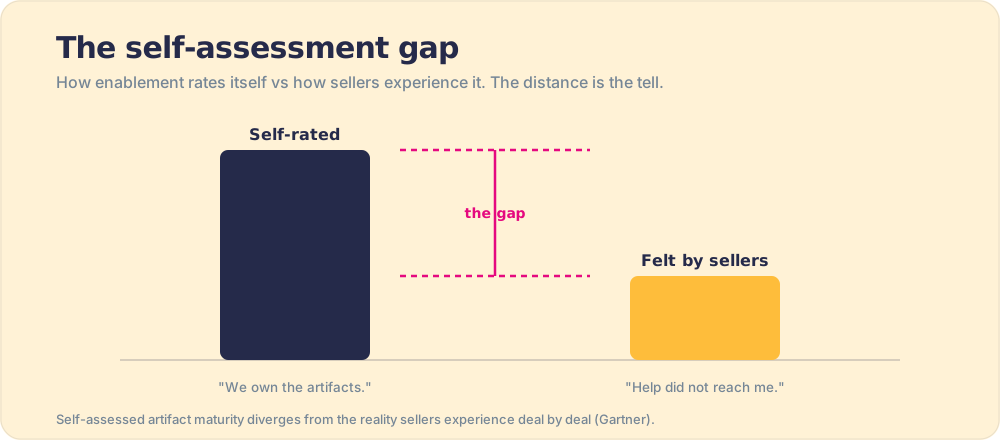
The field has its own evidence for this divergence, and it comes from one of the frameworks we credited a paragraph ago. Gartner has found a consistent gap between how mature enablement teams rate their own maturity and how their sales stakeholders experience it. Read the right way, that finding makes our argument with someone else’s data. The enablement team scores itself high because it can see the artifacts it built. The sellers score it lower because they live in the only place that counts, the moment of the work, where the help either arrives or it does not. Self-assessed artifact maturity and felt, inspected reality are two different numbers.
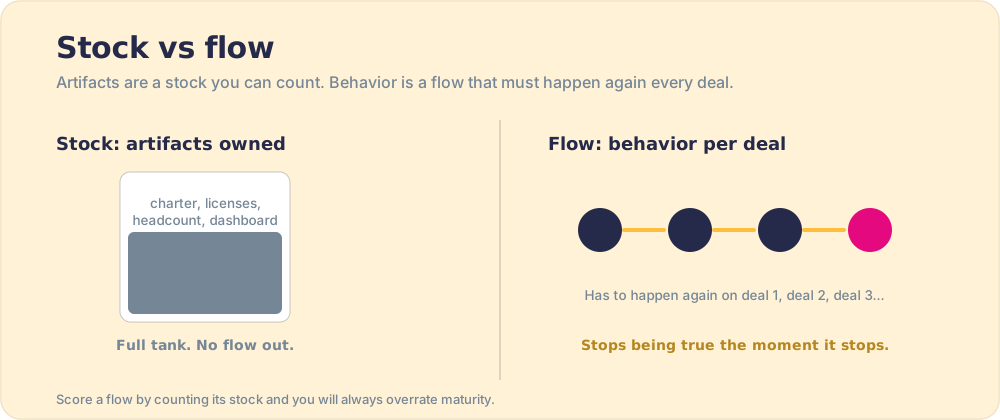
A deeper reason explains the pattern. Artifacts are stocks; behavior is a flow. A stock is a thing you possess and can count on a given day: documents, licenses, headcount. A flow is something that has to happen again every time, on every deal, or it stops being true. A charter does not refresh itself when the process changes; a dashboard does not run discovery; a content library does not open under pressure. Score a flow by counting its stocks and you will always overrate it, because the stock can sit full while the flow has stopped. The maturity illusion works exactly this way.
It also explains why the money keeps flowing into the artifacts. Enablement is not a starved function: 85% of companies kept or grew their enablement budgets this year and 42% increased them, per the Sales Enablement Collective’s 2025 Salary and Landscape Report (SEC). The same report found roughly 39% of teams added headcount in the past year, and 36% of practitioners have been in their role three years or less. A young, growing, well-funded function buys artifacts fast, because artifacts are what budget visibly produces. The behavior lags the spend, and an artifact maturity model rewards the spend.
What are the stages of sales enablement maturity?
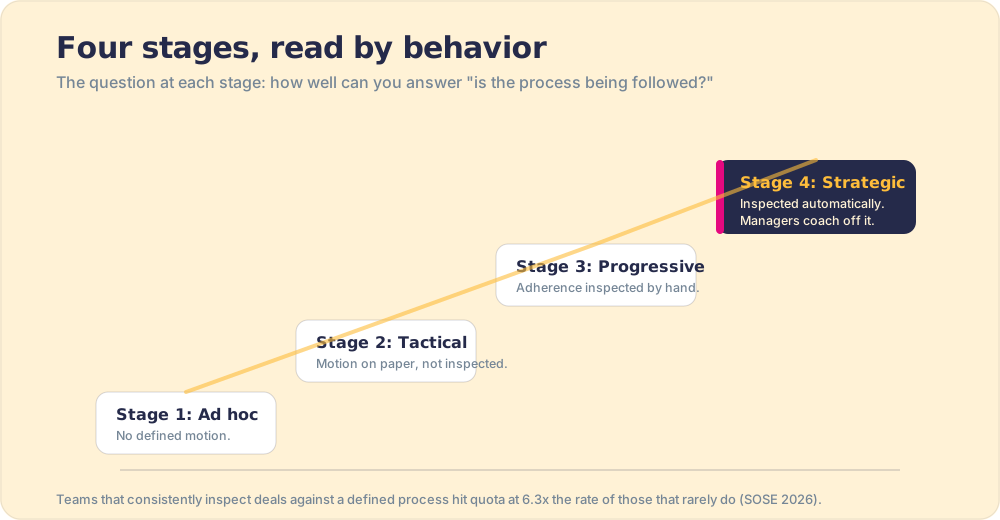
Most models land on four stages, and the four are sound. The rungs are fine. The error is in what describes each one. Read the conventional stages and you get a list of what a team owns. Read them by behavior and each stage answers a single question with rising confidence: how well can you tell whether the process is being followed?
The four sales enablement maturity stages, reread around that question:
- Stage 1, ad hoc. Enablement is reactive and personality-driven. There is no defined motion, so the question “is the process being followed?” has no meaning yet. There is no process to follow. A team that calls itself “early” is usually here, and that is fine; it is the right place to start.
- Stage 2, tactical. A motion now exists. Someone wrote the playbook, built the onboarding, loaded the content. But adherence is not inspected, so the question gets a shrug. The process exists on paper and dies in practice, because a process you do not inspect is a suggestion. A team that looks mature on the artifact checklist often stops here, artifacts complete, behavior unverified.
- Stage 3, progressive. Adherence is inspected, and that is real progress. A manager can tell you which reps ran discovery, because the manager spent an afternoon reading call notes to find out. The answer exists, but it costs the manager the exact hours that should have gone to coaching. Inspection is happening; it is expensive and human.
- Stage 4, strategic. Adherence is inspected automatically. The answer to “is the process being followed?” surfaces on its own, so the manager’s time goes to coaching the gap rather than hunting for it. Only at this stage do inspection and coaching both happen at full strength, because the burden of the first has been lifted off the human who does the second.
The reread closes a loophole. On the artifact axis, a team can leap from Stage 2 to Stage 4 with a purchase, because the artifacts arrive the moment the contract is signed. On the adherence axis, you cannot buy your way up, because the rung is defined by a behavior that has to keep happening. The ladder is harder to climb, and it tells you the truth about where you stand.
How do you assess your sales enablement maturity?
Put the checklist down and run one test instead. Pick five deals you closed or lost last quarter. Without asking the reps, try to see which steps of your defined process each one followed. The answer places you faster than any scorecard.
The test sorts cleanly into the four stages:
- Stage 1, no process. If you have no defined motion to check the deals against, you are here, whatever your tooling.
- Stage 2, process unseen. If you have the process but cannot tell who ran it, the tools you own are decoration over a blind spot.
- Stage 3, process seen by hand. If you can tell who ran it, but only because someone spent hours reconstructing it from call recordings and CRM notes, you are paying for the answer in your managers’ coaching time.
- Stage 4, process seen on its own. If the deal history shows it unprompted, surfaced as the work happened, and your managers spend their hours coaching the gaps it reveals, you are at the top of the model.
This same logic applies whether you grade enablement or grade the broader sales motion. A sales maturity model that scores pipeline discipline and forecast accuracy fails the moment it counts what a team owns instead of whether reps run the standard, and the deal test corrects both. It is a more demanding assessment than the usual survey, and that is deliberate. The standard maturity questionnaire asks “do you have X?” and a team answers from inventory. The deal test asks “can you see the behavior?” and a team has to answer from reality. The first is a flattering mirror. The second is the truth, and the truth is what moves a number.
There is a behavioral reason the inspection test predicts results when the artifact survey does not. The gap between knowing a process and running it is the well-documented distance between intention and action. Psychologist Peter Gollwitzer’s work on implementation intentions showed that people who merely intend to do a thing follow through far less often than people whose intention is tied to a specific cue in the moment, and a meta-analysis of 94 studies found the effect of that in-the-moment trigger sizable and consistent (Gollwitzer and Sheeran, 2006). A playbook in a wiki is an intention. Inspection is what converts intention into a behavior you can see, because what gets inspected gets done. A maturity model that never inspects is measuring intentions and calling them outcomes.
What actually moves a team up a stage?
Another artifact will not do it. The move from Stage 2 to Stage 3 is a decision to inspect adherence at all, and no platform makes that decision for you. The move from Stage 3 to Stage 4 comes from lifting the inspection burden off managers so the inspection happens on its own, rather than asking them for more discipline. Both moves concern where the help and the measurement reach the rep. Neither concerns what the team owns.
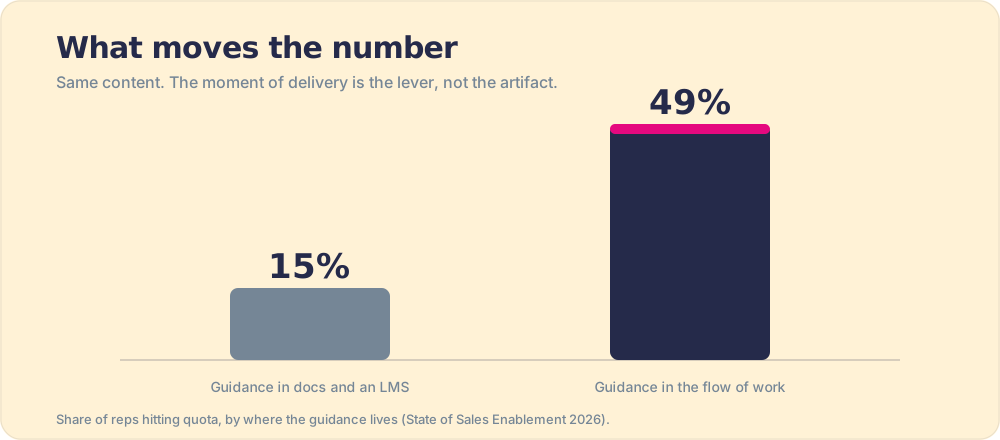
Our own data makes the lever concrete, and it is the sharpest number we have. In the State of Sales Enablement 2026, teams that consistently inspect deals against a defined process hit quota at 6.3 times the rate of teams that rarely do. That was the largest single effect in the study. And the mechanism behind it is the moment of delivery: teams whose guidance reaches reps in the flow of work hit quota at 49%, while teams whose guidance lives in docs and an LMS hit quota at 15%. Same content. The difference is whether the next step arrives where the work is happening or waits in a folder the rep does not open under pressure.
Here the named frameworks and our worldview meet rather than collide. CSO Insights tied the top of the curve to dynamic coaching and measured a 28% win-rate lift. The SEC found teams delivering the right coaching grow revenue 16.7% faster year over year (SEC). We agree completely that coaching is the prize at the top of the model. We add the part the artifact models skip: coaching at scale is impossible until inspection stops eating the manager’s day. You cannot coach the gap until you can see the gap without spending your coaching time finding it. So Stage 4 is defined by automatic inspection rather than by a coaching program. The program is the goal; automatic inspection makes it affordable.
Teams whose guidance is embedded in the flow of work hit quota at 49 percent. Teams whose guidance lives in docs, wikis, and a separate tool hit quota at 15 percent. Same content. The moment of delivery is the lever.
It also explains a fact about cross-functional maturity. The SEC reports that 64% of firms now build collateral through joint enablement, marketing, and product-marketing efforts (SEC). That collaboration is genuine maturity, but only if the jointly-built content reaches the rep in the moment. Three teams co-authoring a battlecard that still sits in a library a rep does not open is more artifact, not more behavior. The collaboration counts when it changes what the rep does, and not a moment before.
Where this leaves the maturity model
You have two ways to grade your own maturity, and they will give you different answers. The artifact model is comfortable: count what you own, average the dimensions, and report the stage. It is the one a busy team will keep using, because it flatters the spend and the slide looks good in a board review. The adherence model is harder: run the five-deal test, accept the stage the behavior places you at, and climb by making the process visible rather than by buying the next tool.
We recommend the harder one, and the recommendation is not a matter of taste. It rests on the data the post has laid out. The 6.3x quota gap, the 49% against 15% on delivery, Gartner’s documented divergence between self-rating and seller experience, and Gollwitzer’s intention-action research each show that artifacts predict little about results while inspectable adherence predicts a lot. Grade yourself on what moves the number. Use the named frameworks for their dimensions and their history, then overlay the one question they underweight, can you see whether the process is being followed?
A maturity model is supposed to tell you the truth about where you stand so you know what to fix next. An artifact model tells you what you bought. Run the deal test on Monday, find your real stage, and you will know exactly which rung to climb. If you want the system that makes that climb concrete, start with sales enablement strategy for the operating plan, read what the sales execution gap is for the mechanism that separates knowing from doing, see CRM adoption for why behavior dies when help lives in a separate tool, and use the sales enablement software guide to choose tooling by the behavior it produces rather than the categories it fills.
Frequently asked questions
What is a sales enablement maturity model?+
What are the stages of sales enablement maturity?+
How do you assess your sales enablement maturity?+
What is the difference between a sales maturity model and a sales enablement maturity model?+
Why do most teams overrate their own maturity?+
Your process, running itself.