Sales Enablement Charter: A Document You Inspect Against, Not a Mission Statement
Most sales enablement charters are a paragraph of aspiration that goes in a deck and is never read again.
Here is what makes one real: a named motion, a cadence you inspect on, and the one metric that proves it.
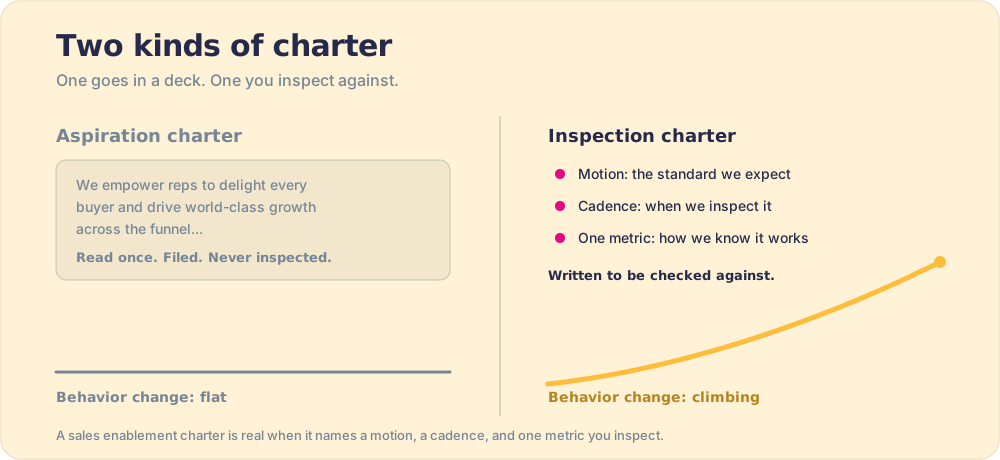
A sales enablement charter is a written, agreed set of expectations for the enablement function that names the motion you expect reps to run, the cadence you will inspect it on, and the one metric that proves it is working.
A new head of enablement, ninety days in, is asked by the CRO to write a charter. She does what almost everyone does. She opens a slide, writes a paragraph that says enablement exists to empower reps and accelerate revenue across the funnel, lists four pillars, picks a calm blue, and presents it. Everyone nods. The deck gets approved, dropped into a shared drive, and that is the last time anyone opens it. A quarter later, the same CRO asks why reps still skip discovery, and the charter on the drive has no answer, because it was never written to have one.
That document was a sales enablement mission statement wearing a charter’s name, and it is the most common mistake in the discipline. The market treats a charter as a vision artifact, a paragraph of aspiration you compose, approve, and file. The trouble is that an aspiration gives you nothing to check, and a thing you cannot check is a thing that does not happen. A real charter is the opposite of a mission line. It is a written set of expectations you inspect against, and what makes it real is not the vision at the top. It is the three things underneath: the motion you expect reps to run, the cadence you will inspect it on, and the one metric that proves it is working.
So here is the definition worth keeping. A sales enablement charter is a written, agreed set of expectations for the enablement function that names the motion you expect reps to run, the cadence you will inspect it on, and the one metric that proves it is working. The mission line can sit at the top. It is not the point. The point is whether you can walk into a deal review and check the document against reality.
What is a sales enablement charter, exactly?
Strip the formatting away and a charter is the answer to one question: what is this function on the hook for, and how will we know. Most of the artifacts that carry the name answer only the first half. They state a purpose, list some responsibilities, and stop, which is why they read well and change nothing.
The reason the inspection definition matters is that the two readings lead to different documents. Read a charter as a vision statement and you polish the prose: the verbs get stronger, the pillars get rounder, the aspiration gets bigger. Read it as an operating agreement and the question changes to whether the thing it describes is happening on a real deal. A charter that says reps will run a consistent discovery motion is worth exactly as much as your ability to check whether they did. If you cannot check it, you have written a wish.
This is the same principle that governs whether any process is real, an enablement one included. A process exists only to the degree adherence to it is inspected. A documented motion nobody inspects is not a process; it is a suggestion with a flowchart. A charter is that idea applied one level up: it is the agreement that says which motion will be inspected, and by whom, and how often. Without that, you have a document that describes intentions, and intentions are the cheapest thing in any sales organization.
It matters more every year because charters are becoming standard practice. More than half of enablement functions now have a charter or are actively drafting one, per the Sales Enablement Collective’s research on the function (SEC). And the ones that do show it in the numbers: Korn Ferry’s CSO Insights study found organizations with a sales enablement charter win at 55.1 percent, 15.9 points higher than organizations running a random approach, even though only 15.8 percent of teams had written one (Korn Ferry, CSO Insights). The risk is no longer that teams skip the charter. The risk is that they write the aspirational kind, approve it, and mistake having one for having a function that can be steered. A bad charter is worse than none, because it manufactures the feeling of clarity without any of the accountability.
Why do most sales enablement charters become shelfware?
Not because they are badly written. Because they are written to be approved, not inspected. The incentive in the room when a charter gets drafted is to produce something everyone can nod at, and the fastest way to universal agreement is to stay abstract. Specifics create disagreement. Aspirations do not. So the document drifts toward language nobody can object to and nobody can check, and a thing nobody can check is a thing nobody returns to.
Think of the difference between a thermometer and a thermostat. A thermometer reads the room and reports a number. It is honest, it is useful for a second, and it changes nothing, because reading the temperature is not the same as acting on it. A thermostat names a target, measures the gap between the target and the room, and acts until the two match. The aspiration charter is a thermometer. It describes a desired state and stops. The inspection charter is a thermostat. It names the motion it wants, measures whether reps are running it, and drives the gap toward zero. One observes. The other governs.
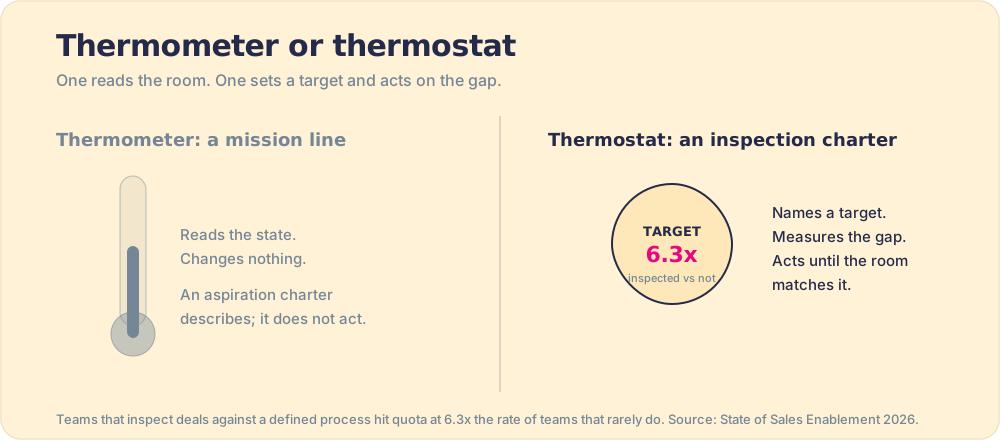
The evidence that inspection is the lever, and not the prose, is blunt. In the State of Sales Enablement 2026, teams that consistently inspect deals against a defined process hit quota at 6.3 times the rate of teams that rarely do, the single largest effect we measured. A charter that names a motion but never says when or how that motion gets inspected is leaving the largest available lever on the floor. It has the steering wheel and no road. The aspiration is the part everyone writes; the inspection cadence is the part that decides whether any of it happens, and it is the part that gets cut for being uncomfortable.
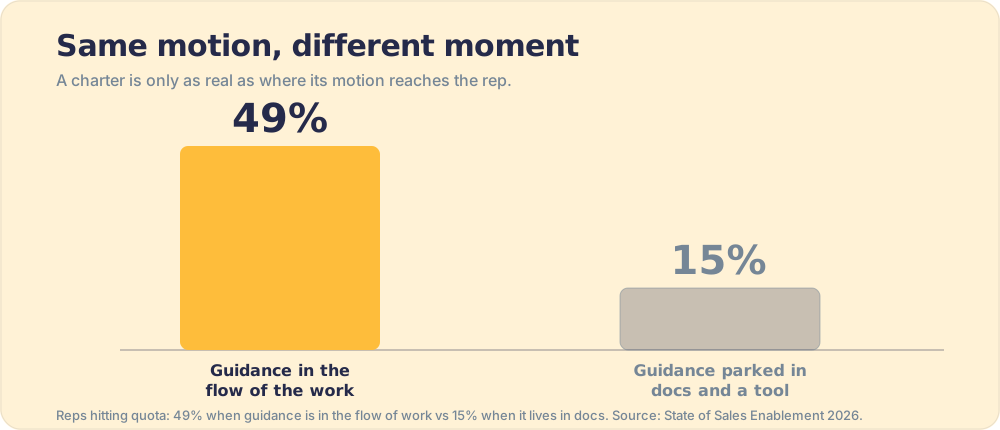
There is a second reason charters die, and it is structural rather than political. The motion a charter describes usually lives in one place (a slide, a wiki, an enablement portal) while the work happens somewhere else entirely (the CRM, the inbox, the call). The State of Sales Enablement 2026 found that teams whose guidance is embedded in the flow of the work hit quota at 49%, against 15% for teams whose guidance sits in docs and a separate tool. Same guidance. Different moment of delivery. A charter that describes a beautiful motion the rep has to leave the deal to go read is, in practice, a charter that does not reach the work, and a motion that does not reach the work is one most reps will not run.
What should a sales enablement charter include?
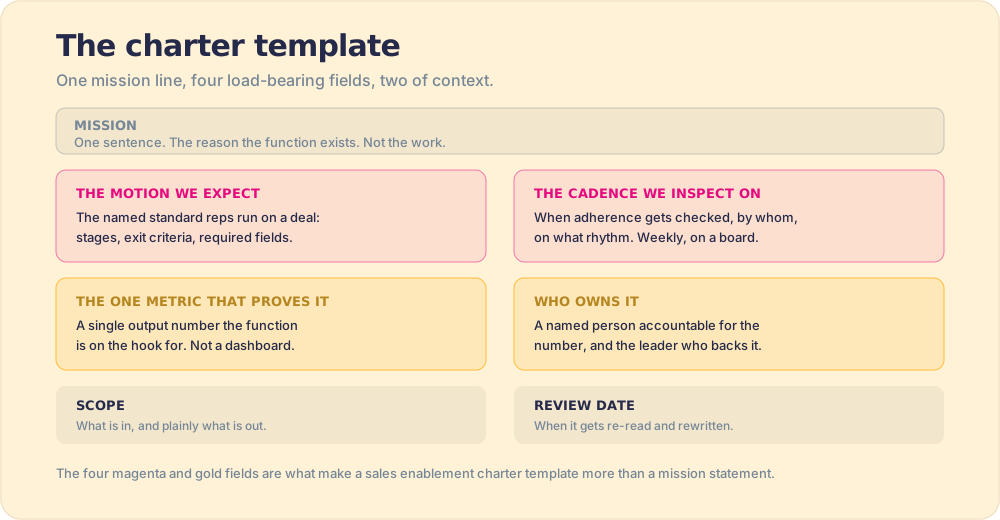
Start with the mission line, then spend almost all your effort on the four fields the mission line cannot carry. The conventional template inverts this. It gives three paragraphs to vision and values and one bullet to scope, when the value is entirely in the operating fields. Here is a sales enablement charter template structured the other way around, with the load-bearing fields where the work goes.
- Mission, one line. Why the function exists, stated plainly enough that a new hire understands it in a sentence. This is the only aspirational field, and it earns one line, not a paragraph. “We make our best reps’ motion the standard every rep runs” is a mission. A list of adjectives is not.
- The motion we expect. The named standard a rep runs on a deal: the stages, the exit criteria, the required fields, the qualification questions you decided matter. This is the heart of the charter, because it is the thing you will inspect. State it concretely enough that two managers reading it would check the same things on the same deal.
- The cadence we inspect it on. When adherence gets checked, by whom, on what rhythm. Weekly deal reviews against the motion. A monthly adherence read by segment. Without this field, the motion above is an aspiration with better formatting. The cadence is what converts the document from a description into a contract.
- The one metric that proves it. A single output number the function is accountable for, not a dashboard of twelve. Adherence to the defined motion is the strongest candidate, because it is the leading indicator the 6.3x finding points at. Pick one. A charter that claims responsibility for everything is accountable for nothing.
- Who owns it. A named person on the hook for that metric, and the executive who backs the cadence when a manager would rather skip a deal review. Accountability without a name evaporates.
Two context fields sit underneath: scope (what enablement does, and plainly what it does not, so the function is not the place every orphan task goes to die) and a review date (when the charter gets re-read and rewritten, because a motion that never changes is a motion nobody is testing). Keep both short.
The test for whether your charter is the real kind is mechanical. Take any field and ask: could a manager check this against a live deal next week? “We empower reps to win” fails the test. “Every stage-two deal has a confirmed economic buyer and a documented next step” passes it. If a field cannot be checked, it is mission-statement language, and it belongs in the one line at the top or nowhere. A useful way to pressure-test the draft is to read it next to your broader sales enablement strategy: the charter is the part of the strategy you can stand behind in a deal review, not the part you present to the board.
How does a charter actually change what reps do?
By being the thing managers inspect against, the charter stops being a document about enablement and becomes the operating standard for the team. This is the mechanism, and it is worth being precise about, because “alignment” is the hand-wave most charter advice stops at.
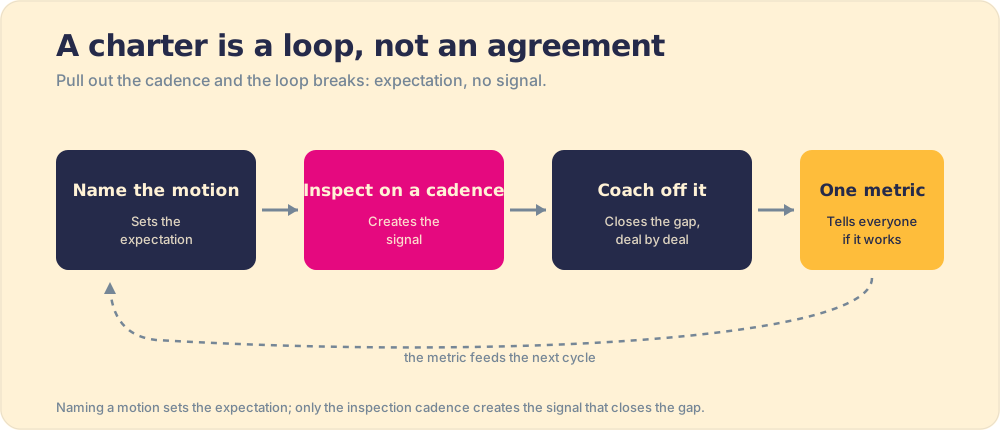
A charter changes behavior through a loop, not through agreement. Naming the motion sets the expectation. Inspecting on a cadence creates the signal that tells you whether the expectation is met. Coaching off that signal closes the gap, deal by deal, before a bad habit sets. The metric tells everyone, the rep, the manager, the CRO, whether the loop is working. Pull out the cadence and the loop breaks: you have an expectation and no signal, which is exactly the state every shelfware charter leaves you in. The behavioral science is old and settled here. Knowing the standard is not the same as running it. The intention-action gap is the most replicated finding in behavior research, and it is why the charter that only states intentions never moves the number. Peter Gollwitzer’s work on implementation intentions showed across more than ninety studies that people close the gap between knowing and doing only when the intention is tied to a specific cue and a specific check, not when it is merely stated (Gollwitzer, meta-analysis). A charter with a cadence is that cue and that check, written down.
This is also why the charter belongs at the level of behavior, not content. The reflex when enablement underperforms is to produce more: more decks, more certifications, more knowledge. But knowledge is solved. Any rep can find the doc and an AI can summarize it in seconds. What a rep does on a slipping deal, under pressure, is the thing revenue turns on, and it is the thing a charter governs only if the charter inspects behavior rather than cataloging content. A charter that measures how much enablement produced (assets created, sessions run, courses completed) is measuring input, which is the 2022 way to grade the function. A charter that measures whether reps run the motion is measuring output, which is the only grade that predicts the number.
There is a maturity arc underneath all of this. The aspiration charter is what a function writes at the start, before it can measure anything; the inspection charter is what it writes once it can. If you want the full picture of how a function moves from one to the other, the sales enablement maturity model lays out the stages, and the charter is the artifact that should evolve at each one rather than sitting frozen in a drive.
Teams that consistently inspect deals against a defined process hit quota at 6.3 times the rate of teams that rarely do. It was the single largest effect we measured. The lever is not how good the standard reads. It is whether anyone checks it.
What does the field get wrong about charters?
The dominant advice, from the analysts and the enablement community alike, treats the charter as an alignment document: get leadership to agree on enablement’s purpose, scope, and stakeholders, write it down, and you have a charter. The Sales Enablement Collective, which owns more of this conversation than anyone, frames the charter primarily as the tool that secures executive buy-in and clarifies the function’s remit (SEC on building the function). And that is genuinely valuable. Buy-in is real, scope creep is real, and a function with no agreed remit gets handed every orphan task in the building. On that, the field is right, and we agree without reservation.
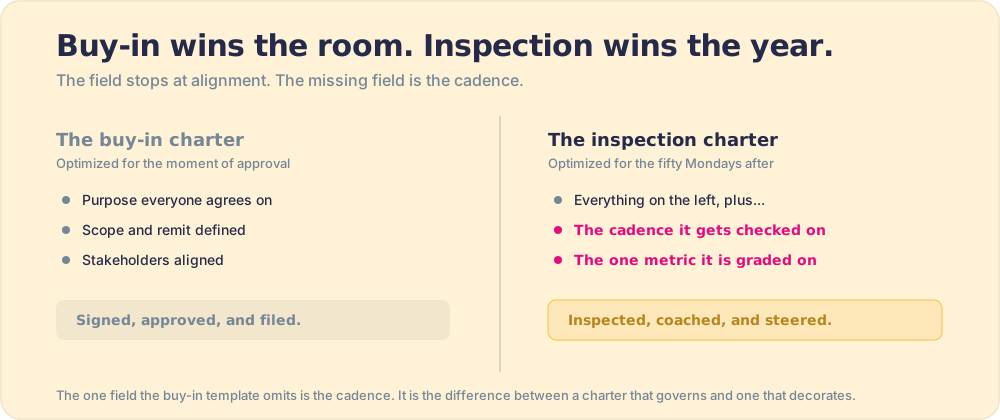
Where we go further is on what makes the document survive contact with the quarter. Alignment gets you a charter everyone signed. It does not get you a charter anyone inspects against, and an unsigned-but-inspected charter beats a signed-but-filed one every time. The buy-in framing optimizes for the moment of approval. The inspection framing optimizes for the fifty Mondays after it, when the only question that matters is whether reps are running the motion the charter named. Buy-in is necessary. It is not sufficient, and treating it as the finish line is exactly how the aspiration charter wins the room and loses the year.
So the disagreement is narrow and specific. Build the alignment, absolutely. Then add the field the alignment template omits: the cadence on which the agreed motion gets checked. That single field is the difference between a charter that governs and one that decorates, and it is the field that gets cut because it is the one that creates obligation. The buy-in fields cost a meeting. The inspection field costs a recurring commitment, which is why it is the first thing to go and the last thing you can afford to lose.
How do you write a charter that drives behavior?
Write the four operating fields first, and the mission line last. Most teams do it backwards, opening with the vision and running out of energy before the fields that matter, which is how the document ends up all aspiration and no inspection. Reverse the order and the charter comes out the right shape.
- Name one motion, drawn from your best reps. Do not invent a process from a template. The motion that works already lives in the reps who are hitting; capture what they actually do and make it the standard, so the charter describes a thing that wins rather than a thing a consultant drew. A motion your top reps recognize as their own is one the team will run.
- Set the cadence before you set the metric. Decide when and how adherence gets checked, and who runs the review, before you pick the number. The cadence is the engine; the metric is the readout. Teams that pick a metric with no cadence to feed it end up with a number nobody updates.
- Pick one output metric, and make it adherence. Resist the dashboard. The function is accountable for whether reps run the motion, because that is the leading indicator the 6.3x finding points to. Revenue is the lagging result; adherence is the thing you can move this quarter and the thing the charter should be graded on.
- Put the motion where the work is. A charter whose motion lives in a portal the rep has to leave the deal to reach will lose to the 15% column. Deliver the next step in the flow of the work, the instant the question arises, so following the charter is the path of least resistance instead of a memory test. The 49% column is built this way.
- Date the review, and actually hold it. A charter with no expiry is a charter nobody revisits. Put a review date on it, and when it arrives, check the motion against what your best reps are now doing and rewrite the parts that have drifted.
Keep the charter to a page. A charter that runs to ten pages is a charter that gets read once, and the length is usually a tell that the document is hiding a thin core under a thick coat of aspiration. The shorter the charter, the more likely every line in it is something you can check, and checkable is the only quality that matters.
What we recommend
Two paths sit under this topic, and the choice between them decides whether the function can be steered. You can write the charter the field defaults to: a sales enablement mission statement, aligned, approved, aspirational, and filed, which wins the room and changes nothing. Or you can write the charter as an operating agreement: one mission line, then the motion you expect, the cadence you inspect it on, the one metric that proves it, and a name on the hook for that metric.
We recommend the second, without hedging, and the evidence is why. The 6.3x inspection finding says the lever is whether anyone checks the motion, not how well the charter reads. The 49% against 15% split says a motion only counts where it reaches the rep, in the flow of the work. Gollwitzer’s ninety-study record on the intention-action gap says a stated intention closes nothing without a specific cue and a specific check. Those three point the same way: the aspiration is the cheap part, and the cadence is the part that earns the function its budget. So write the mission line in one sentence, then spend the document on the four fields you can inspect, and put a review date on it so it cannot drift back into a deck nobody opens.
The deeper move, once the charter exists, is making its motion reach the rep at the moment of the work rather than living in a document they have to go find. That is a tooling problem, and it is the one the sales enablement software guide takes apart in full. If you are still defining what the function is for before you charter it, start with what sales enablement is; and if you want the survey the 6.3x and 49% numbers come from, read the State of Sales Enablement. The charter is where the function stops being a content shop and becomes something you can steer, but only if it is the kind you inspect.
Frequently asked questions
What is a sales enablement charter?+
What should a sales enablement charter include?+
What is the difference between a sales enablement charter and a mission statement?+
Why do most sales enablement charters fail?+
Do I really need a sales enablement charter?+
Your process, running itself.