Sales Content Adoption: Matt Bolian and Crispy Barnett on Who Owns the Content Sales Won't Use
On Pardon the POV, Matt Bolian and Crispy Barnett argued over sales content adoption: whose fault unused collateral is, whether reps still inform buyers, and whether positioning should be delivered word for word.
Sales content adoption is whether reps use the collateral marketing and enablement build, such as case studies, one-pagers and positioning, with real buyers; it rises when the makers build each piece into the rep's daily work, managers reinforce it, and reps can adapt the words.
Our host opened with a dinner bill. Two departments take a customer to dinner. One orders the appetizers, the other orders the entrees, and when the check arrives they spend 40 minutes working out who owes what, “line by line with real conviction on both sides.” The restaurant closed an hour and a half ago. The customer paid for their own meal and left.
The two departments were marketing and sales, and the argument that followed was mine and Crispy Barnett’s, four rounds of it on Pardon the POV, about sales content adoption and the old fight underneath it. Marketing says sales won’t use the content. Sales says the content isn’t usable. Crispy worked at Supered and has been a partner of ours for a long time. Our host held us to agree or disagree on a count of three, and by the end we had argued out who owns a piece of content after it ships, and what a rep should do with it in front of a buyer.
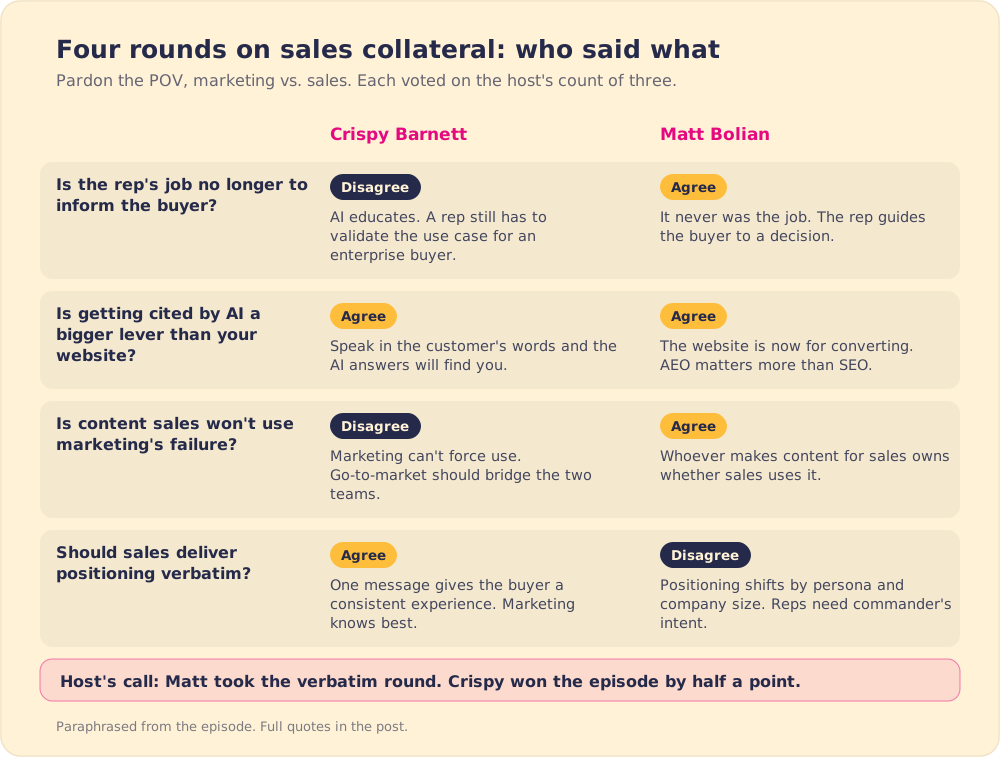
Is it still the rep’s job to inform the buyer?
The host started with two Gartner numbers that seem to contradict each other. In his telling, 67% of buyers would rather not talk to a rep, and 69% call one before they sign anyway. His reading: the buyer wants to do the research alone, then wants a human being “to confirm they are not about to make a career-ending mistake.” Gartner’s 2026 survey of 646 B2B buyers found 67% prefer a rep-free experience and 45% used AI during a recent purchase (Gartner, 2026).
Crispy voted disagree. “Although AI has given more access to information in the buying process, it still needs to be validated by a sales rep whenever you’re going, you know, the enterprise route of buying software or some specialized service.” In his view, “AI will help educate, but will not ultimately validate the use case.” And: “People still want to buy from people, not be completely rep-free.”
I voted agree, tangled myself up for a full minute, and the host made me start over. Informing, in the sense of telling someone what a thing is, has never been the rep’s job. “It’s always been, where do you provide value in the sales transaction? And that is helping someone make a decision and being customer facing and being a guide, not a vending machine.”
We agreed more than the vote showed, and I said so on air: “I think we agree. We’re just saying different words.” Both of us think a human helps the buyer decide. For collateral, that changes what a piece is for. Marketing collateral that explains what the product does now competes with whatever the buyer can get from ChatGPT. The pieces a rep still needs are the ones that help the buyer decide, and help them explain that decision to the people above them.
Does AI citation matter more than the website?
Round two was the calmer one. The host described a buyer who opens ChatGPT, describes the problem in their own words, and gets three vendors back, with no ad, no keyword and no rep involved. Is getting cited by AI assistants now a bigger revenue lever than your website?
We both agreed. I said the website’s job has changed. It still has to tell a story so visitors convert, “but as a conversion tool, not a how I find you tool,”. Crispy said the two cannot be pulled apart, because AI search scrapes your website to decide what to say about you, and the companies that show up first “speak in the language of your customer and understand their pain points.” The host split the point between us.
Who owns sales content adoption?
Round three was the real fight. The host read out the statistic both departments have quoted for years, that sales ignores 90% of marketing content, and noted it “appears to have been made up on a slide.” He is right about its history. In 2010 Andrew Rudin went looking for the source of the 90% claim and found it repeated by the American Marketing Association, an e-book and an agency video, none of them a study (CustomerThink, 2010). Then the question: content that sales doesn’t use is marketing’s failure. Agree or disagree?
I agreed, and I put the weight on whoever makes the content. Reps “are the people on the ground and you must influence them and get into their daily work patterns. And if you don’t, you can’t blame them. You can only blame yourself. Have some accountability. Get good at talking to sales and stop making excuses.”
Crispy disagreed, and his case was about how companies are organized. “Marketing cannot force sales reps to use things that they create. Uh enablement does not fall under the job of marketing.” He sees a go-to-market function taking over positioning, messaging, demand gen and nurture, and ending the blame game: “Marketing and sales have always been opposing forces in a business that are finger pointing to see who you know, made the mistakes, slipped on the banana peel.” His answer to the finger-pointing: “you challenge your go-to-market strategy and build the right one that helps you scale.”
So I asked him the same question with his new team’s name on it. Whose fault is it if go-to-market makes content and sales doesn’t use it? Crispy answered with a question of his own: are the reps choosing not to use it “cuz it’s not valuable or because they’re just lazy?”
“There it is,” I said. “My point is that’s the same thing marketing says.” Then I finished the thought: “if you’re making it for a reason and the people that you’re supposed to be making it for don’t like it, it’s always your fault.” Crispy pushed back that disliking a piece is different from choosing not to use it. I said that if they are not using it, they have chosen.
The host never scored that round on its own. He rolled its points into the next question.
Our State of Sales Enablement 2026 asked why sales tools and content become shelfware. The top three answers were reps not seeing the value (55%), managers not reinforcing (51%) and the tool not being embedded in the workflow (48%). Two of the three describe what happens to content after marketing hands it over.
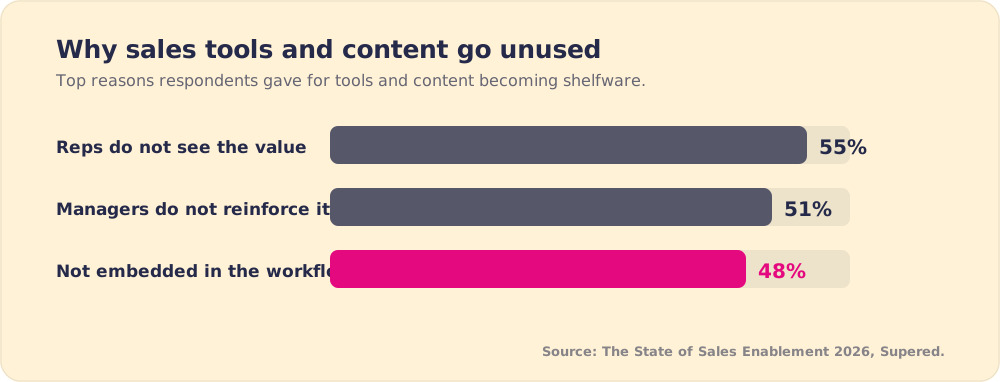
Those answers back my side of round three: when reps skip a piece of sales enablement content, the usual reasons are where it lives and how it reaches them, and the people who make it control both. They back Crispy’s side too, because getting content into a rep’s day takes managers and systems as well as marketers.
Should reps deliver positioning word for word?
He called it the first ever double or nothing and set up the last round with another Gartner finding: a confident buyer is twice as likely to report a high-quality deal. Marketing writes the value prop, then “sales rewrites it live on the call because the original one did not survive contact with a real person.” The question: positioning is a marketing deliverable, and sales should be required to deliver it verbatim.
Crispy agreed, and he made the strongest case of the night. “Sales reps are wild west cowboys.” Marketing sits between revenue and post-sale, hears the feedback from both, and understands the messaging “much more than what sales can uh do right now.” Delivering it as written “creates consistency in the process and consistency in experience. Marketing knows best.”
The host told me I had better eviscerate him or he would win the episode. I started with who is actually in the room. “There’s only one person in the room that is uh that’s actually in the room and it’s not marketing.” A rep who reads the script exactly as written “will lose the deal.” Then I used Crispy’s own point about replicating behavior, because the buyer judges more than the words: “How fast a follow-up is done. How fast a recap is done. How a meeting is held.” And positioning moves: “Positioning changes by persona you’re talking to, by size of company you’re talking to, and you need fluidity to be able to navigate.”
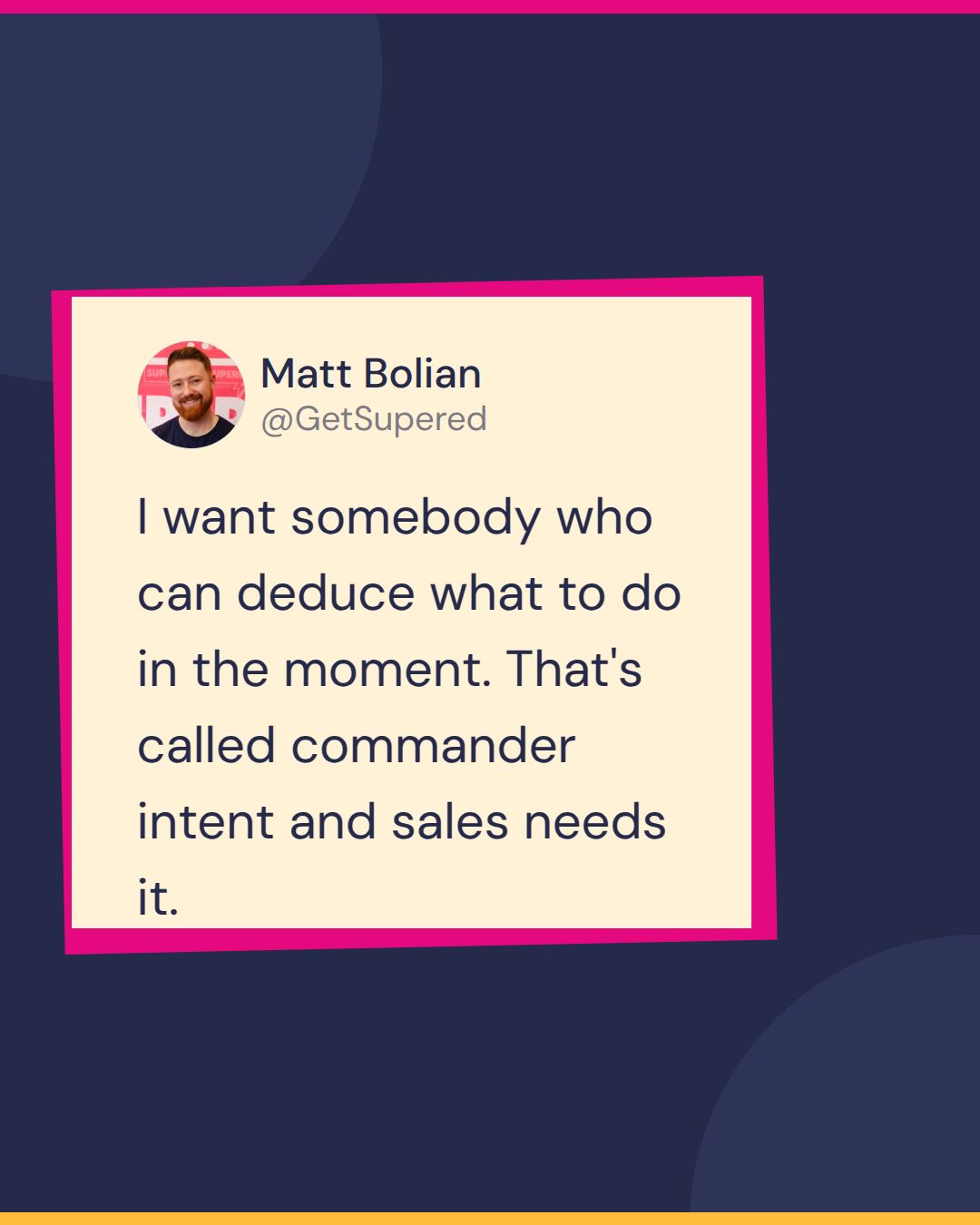
I closed with a captain: “I don’t want a captain that goes straight through a storm because that’s what the best best because that’s what a map said.” Commander’s intent is a real military idea. The US Army describes it as a clear, concise statement of what the force must do and the conditions it must establish, so that people can act when the plan meets reality (Intent (military)). For positioning, marketing writes the purpose, the end state and the boundaries, and the rep chooses the words for the CFO or the IT lead in front of them.
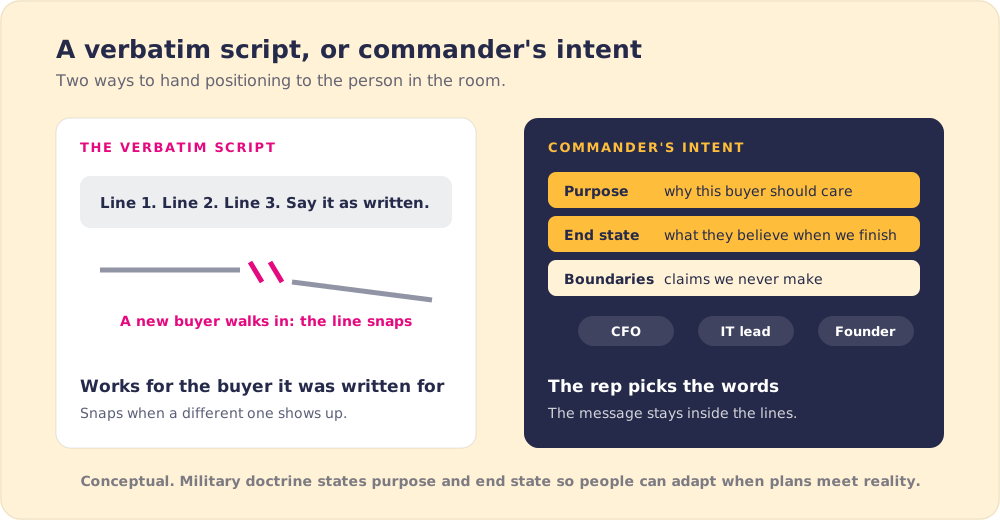
The host gave me the round “to the word verbatim,” because Crispy had read it loosely. Crispy still won the episode by half a point. Asked if I had anything to say to him, I said I had nothing verbatim scripted, so I was “lost at sea forever.”
How do you improve sales content adoption?
Crispy and I disagreed on who owns the fix more than on the fix itself. Pulled from the four rounds and our survey, it runs in this order:
- Talk to reps before building. “Get good at talking to sales,” I said in round three. A piece built without them starts behind.
- Build for the decision. After round one, the rep’s job is helping the buyer decide, not explaining the product.
- Put it in the daily work. Not being embedded in the workflow was a top reason content went unused (48%).
- Have managers reinforce it. Managers not reinforcing came in at 51%, the part of Crispy’s bridge marketing cannot build alone.
- Write intent, not scripts. Fix the claims, numbers and promises, and let reps choose the words for the buyer.
- Treat non-use as an answer. If reps are not using a piece, they have chosen, and the choice tells the maker what to change.
What the sales collateral debate taught
- Maker ownership. Whoever builds sales collateral for a purpose owns whether reps use it. Renaming marketing to go-to-market does not change who owns it.
- A shared bridge. Crispy’s go-to-market idea puts positioning, messaging and the rep’s daily work under one owner who answers for all of it.
- Consistency of experience. Crispy’s case for verbatim holds for the parts a buyer should hear the same way every time: the claims, the numbers and the promises.
- Commander’s intent. The words can change by persona and company size as long as the purpose, end state and boundaries stay fixed.
The verdict
On round three I would vote the same way again.
Unused sales collateral is its maker’s problem, and blaming lazy reps is what both departments do when they are losing the argument. On round four, the host was right to give me the word and Crispy the episode. Consistency matters to the buyer, and “wild west cowboys” is a fair description of a sales floor with no shared message. Where we both ended up: fix the boundaries, give reps the intent, and put the piece inside the work where the rep will reach for it.
We built Supered around the same idea. It puts the right piece and the guidance behind it in front of reps inside HubSpot and Salesforce while they work. For the other side of this argument, read our guide to sales and marketing alignment, and then our post on sales battlecards, a piece of collateral built for one moment in a deal.
Frequently asked questions
Whose fault is it when sales doesn't use marketing's content?+
What is sales content adoption?+
Do sales reps ignore 90% of marketing content?+
Should sales reps deliver positioning word for word?+
Is it still a sales rep's job to inform the buyer?+
How do you improve sales content adoption?+
Your process, running itself.
Turn the playbook into rep behavior.
More from Pardon the POV

How to Set Sales Quotas When Everyone Has AI: Matt Bolian and Crispy Barnett Debate
Matt Bolian & Crispy Barnett
Referral Selling Beat Claude, HubSpot and the Phone: Matt Bolian and Crispy Barnett Debate
Matt Bolian & Crispy Barnett