How to Set Sales Quotas When Everyone Has AI: Matt Bolian and Crispy Barnett Debate
On Pardon the POV, Matt Bolian and Crispy Barnett debated how to set sales quotas now that reps have AI: grow or shrink the team, raise quota on unmeasured gains, and where the AI budget should go.
Knowing how to set sales quotas means turning what the market will buy into a target each rep can reach, and on Pardon the POV both Matt Bolian and Crispy Barnett argued that AI gains belong in that target only after someone has measured them.
The week I posted about quotas on LinkedIn, Robert built a whole Pardon the POV episode around it and called it “the math ain’t mathin’.” My post said that past tech waves shrank sales teams and paid the survivors more, and that AI was breaking the pattern: same rep, same pay, double the number. Robert put the problem in one line. “The AI writes call summaries. The quota assumes it closes enterprise deals. It’s charging your teenager rent because the dishwasher exists.”
Crispy Barnett and I spent five rounds on how to set sales quotas now that reps have AI. We split on the first round, voted together on the second, and landed in the same place by the end: a sales quota should rise on gains someone has measured, and on nothing else.
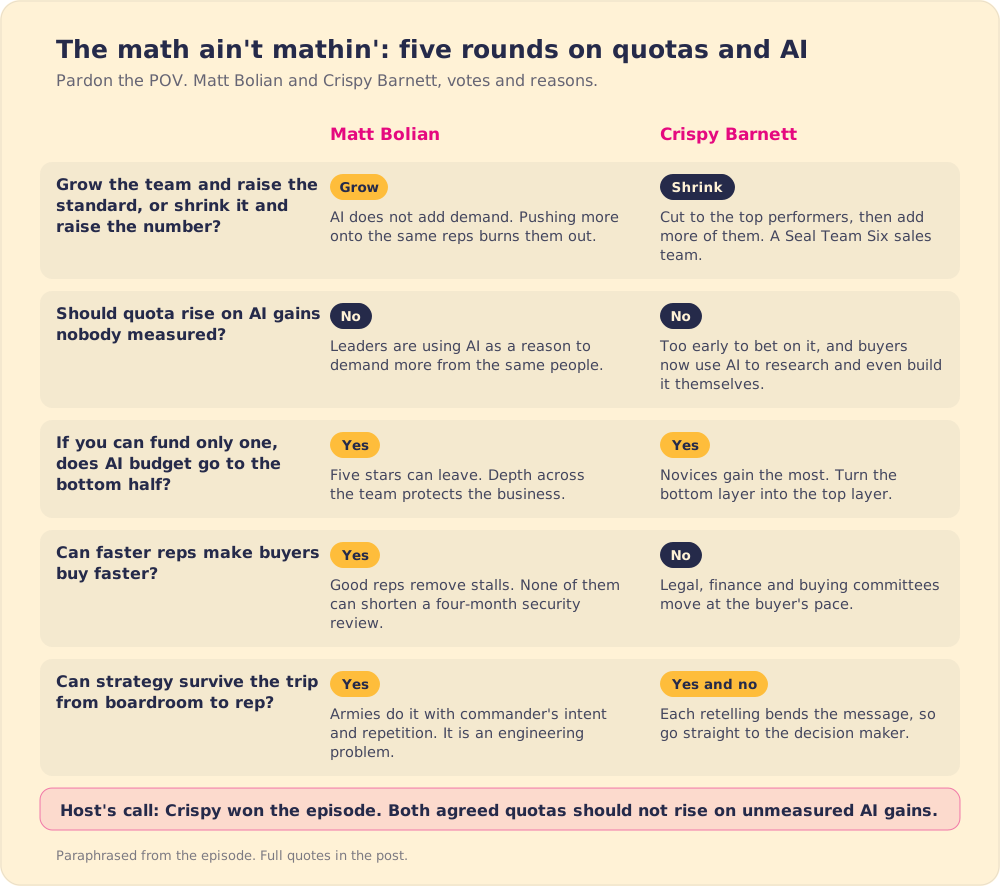
Should you grow the team or shrink it and raise the number?
Robert opened with The Bridge Group’s 2026 numbers: 48% of reps hit annual quota, down from 51% in 2024, across 158 B2B companies (The Bridge Group, 2026). Then he asked whether “grow the team, raise the standard” beats “shrink the team, raise the number.”
I said yes, and started with pharma. Drug companies once ran huge field forces. When buying moved online they shifted to smaller inside sales teams and key-account reps, and paid those reps a lot more. “Less humans. Some of the humans got a lot more pay.” AI is different, I argued, because “AI does not change the demand of things.” Only so many companies will ever buy from you. When leaders say AI will make their best people better, I hear “straight-up jargon for I can pay people less money or the same amount and get more from them margin-wise.” The early result is burnout. “I do not think you’re going to get 3x output from people paying them the same amount of money.”
Crispy said no, and his case was about what systems reveal. “Systems will expose who your top performers are and systems will expose who your bottom are.” AI makes that easier, because data you could never see before is now a Claude or ChatGPT prompt away. His plan: “shrink the team down to the highest performers and add more high performers.” Then the line Robert teased him about: “Build a seal team six sales team and that will grow the number.”
I pointed out that cutting the bottom and adding more top performers sounds a lot like growing the team and raising the standard. Then I made the claim I would still make today: “we will not be able to say hey rep your 750k quota is now 2 million. Deal with it. I gave you AI. It’s not going to work that way.” Crispy saw the overlap too. You shrink, then add high performers, then raise the standard, “which the outcome is raise the number. So portions of both are accurate.”

How to set sales quotas before the AI gain is measured
Round two was the phantom raise. Robert cited CaptivateIQ’s 2026 survey of 200 incentive compensation professionals: 43% of companies have already priced AI productivity into sales quotas, while 28% report using AI extensively (CaptivateIQ, 2026). More companies have raised the number on AI than use it in depth. We both said no.
Crispy’s reason was risk. “I think it is foolish to make a bet on increased productivity or increased revenue with AI because it’s still so new in its current infancy.” And “you’re also competing against more AI slop from all other competitors.”
Mine was demand again. AI has put “this insidious idea in our head that we’re more capable and I should just demand more and through me demanding more from a person they will do more.” I expect a lot of burnout at companies that act on that idea.
Then Crispy turned the question toward the buyer, and it was the best point of the episode. The AI gains that affect quota attainment, he said, come more from the buyer than the seller. “Now end users are enabled to do more research about whatever they’re buying than ever before.” In software there is a new default option: “I can just build this myself with AI.” His conclusion: “I would argue it makes it harder.” Gartner’s 2026 survey of 646 B2B buyers supports him: 67% prefer a rep-free experience, and 45% used AI during a recent purchase (Gartner, 2026).
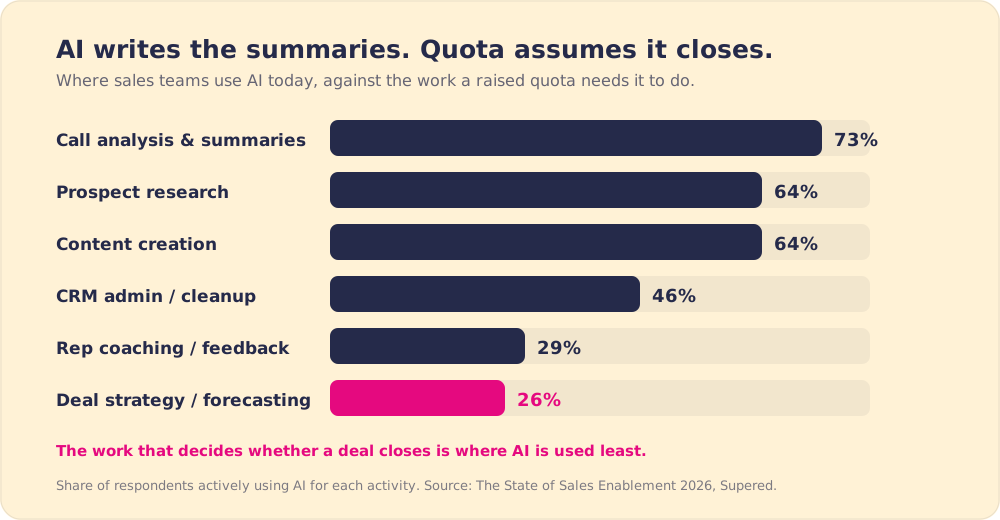
Our own survey shows Robert’s dishwasher line is close to literal. In The State of Sales Enablement 2026, the most common AI uses were call analysis and summaries (73%), prospect research (64%) and content creation (64%). Deal strategy and forecasting came last, at 26%.
Taken together, our answers give an order for quota setting. Start from demand: the accounts that fit and your real conversion rates. Check it against what a ramped rep can carry. Set the number at the lower of the two. Add an AI uplift only when it shows up in deal behavior, such as more qualified meetings or faster stage movement, and write that assumption down next to the number.
Should the AI budget go to your rookies or your veterans?
Round three came from a field study of AI at work. Erik Brynjolfsson, Danielle Li and Lindsey Raymond followed 5,179 customer support agents given an AI assistant. Productivity rose 14% on average and 34% for novice and low-skilled workers, with minimal impact on the most experienced (NBER, 2023). For the veterans, Robert said, the AI was “their own habits sold back to them at a subscription price.” If you can fund only one group, does the budget go to the rookies? We both said yes.
I argued from risk. “If you have five high performers and you put all the hopes, they can leave and go somewhere and what are you going to replace them with?” Betting everything on a few stars, I said, is “literally taking a gun, shooting ourselves in the knees, and then telling ourselves to run.”
Crispy argued from the data. “Novices are the ones that will see the most amount of gains initially.” A sales leader’s job “is create more high-performers,” which means “focus on on the bottom layer and making them the top layer.” Put everything into the top layer and “you create key man syndrome.”
I brought up soccer. When Mauricio Pochettino took over the US men’s team, he told comfortable starters they were replaceable. “It’s really important for the top key people to know there’s a rookie behind them ready to take your place.” Crispy came back to it in his closing words: top teams add great players to an already great team “to make others uncomfortable and improve the level.”
Our survey adds a condition. Among teams with strong process adherence, 40% rated AI’s impact as high. Among weak-adherence teams, 21% did. A rookie with AI and a process to follow gets more from both.
Can faster reps make buyers buy faster?
Robert’s fourth round quoted my post: market demand sets the quota, and rep capacity does not. “You can strap a jetpack to your rep,” he said, and the buying committee will still take four months to schedule the security review.
Crispy said the committees win. “There are decision-making committees internally in businesses that will likely never go away such as legal, finance.” A rep can follow up all day. “You can be super organized but ultimately you’re at the mercy of the buyer.”
I said yes, up to a point. “The best reps uh, make it easier to purchase and thus faster.” Take away the follow-ups and the information and the deal stalls. But “a best rep can’t actually change a four-month security review or an annual planning cycle for enterprise customers.” So I want every rep working the way the best ones do: “your best reps all must be executing at the same standard.” Robert compared it to personal trainers, and I agreed: “good trainers actually work at a certain speed. They actually don’t go too fast. This is what makes great sales.”
Can a strategy survive the trip from the boardroom to the rep?
The last round was about the message itself. Robert cited Frederick Bartlett’s 1932 experiment, where a story retold through seven people shrank from 330 words to about 180. Crispy said yes and no. Buyers describe their pain their own way and then explain the solution internally their own way, so he goes straight to the decision maker whenever he can. I said yes, and pointed to the Army, which trains officers to pass orders down through several ranks with the commander’s intent intact. It works through repetition, in the same language, on the same rhythm.
What the quota debate taught
- Demand as the ceiling. AI can raise a rep’s capacity. It has not raised the number of buyers, so a quota built on capacity alone assumes demand that is not there.
- Measured gains only. Neither of us would raise quota on unmeasured AI gains. Hours saved count once they show up as meetings held, stages moved or deals won.
- Buyer-side AI. Crispy’s point: buyers use AI too, including to build instead of buy, which can make the number harder to hit.
- Rookie-first AI budget. Novices gained 34% in the Brynjolfsson study, and veterans gained little. Crispy and I both put the budget there, and both warned about key man risk.
- One standard. A good rep can speed a deal up to the buyer’s pace. Beyond that, the gain comes from the whole team working the same way.
The verdict
Robert gave Crispy the win, and his round-two point about buyers building instead of buying earned it. I would still vote the same way on round one. If you double the number and keep the same headcount, I expect burnout and turnover before I expect double the revenue. Crispy and I agree on what to do instead: hold the number, measure the change in deal behavior, and raise it when the evidence is there.
Measuring that change deal by deal is what Supered’s Behavior Layer does inside HubSpot and Salesforce, and our page on sales process adoption shows how. For what to do once the number is set and half the team is below it, read our guide to quota attainment, then our look at sales forecasting, which keeps the conversion rates under your quota trustworthy.
Frequently asked questions
Should sales quotas go up because reps now use AI?+
How do you set sales quotas?+
What percentage of reps hit quota?+
Should AI budget go to new reps or top performers?+
Can faster sales reps shorten the sales cycle?+
Your process, running itself.
Turn the playbook into rep behavior.
More from Pardon the POV

Sales Content Adoption: Matt Bolian and Crispy Barnett on Who Owns the Content Sales Won't Use
Matt Bolian & Crispy Barnett
Referral Selling Beat Claude, HubSpot and the Phone: Matt Bolian and Crispy Barnett Debate
Matt Bolian & Crispy Barnett